Need 200 Custom Pins Fast? A Small-MOQ Buyer Plan
Why 200 custom pins require a different sourcing strategy
A 200-piece custom pin order sits in the most expensive part of the unit-cost curve. Tooling, die setup, plating bath changeover, enamel filling, curing, post soldering, inspection, and export packing are spread across too few units to be efficient, yet the order is large enough that one approval error can consume the whole budget. That is why a buying process built for 2,000-piece promo runs usually underperforms at 200 pieces.
For a standard 28 to 32 mm pin ordered FOB China in 2026, typical factory pricing at 200 pieces is usually: stamped iron soft enamel at USD 0.88 to 1.30 each, die-cast zinc alloy soft enamel at USD 1.18 to 1.82 each, imitation hard enamel at USD 1.35 to 2.05 each, and offset-printed pins with epoxy dome at USD 0.92 to 1.50 each. Separate mold charges are common: about USD 45 to 85 for a simple stamped design, USD 70 to 140 for zinc alloy with cutouts or irregular outlines, and USD 25 to 60 for a printed epoxy style using a simpler die profile.
At this volume, the main risk is rarely missing the best quote by USD 0.07 per piece. The bigger risks are approving artwork that cannot plate or fill cleanly, discovering legibility problems after tooling is cut, or receiving a shipment with weak posts, wrong plating tone, inconsistent enamel fill, or mixed pack-out. A good 200-piece plan prioritizes manufacturable artwork, realistic lead times, and written acceptance criteria before it negotiates cents.
Choose the construction that fits the artwork and timeline
Soft enamel is usually the safest default for a 200-piece order because it tolerates bolder metal outlines, slightly larger fill areas, and shorter production windows than imitation hard enamel. If the brand requires a smooth, jewelry-like face, imitation hard enamel can work well, but the artwork must be cleaner, polishing time is longer, and the defect risk on tiny cells is higher.
Stamped iron is normally the best value when the pin has a regular perimeter, flat 2D face, and limited internal cutouts. Common base thickness is 1.2 to 1.5 mm, with raised metal lines and recessed enamel fields. Die-cast zinc alloy is a better fit for open centers, organic silhouettes, sculpted relief, or a thicker premium edge; it is commonly produced at 2.0 to 2.5 mm thickness and holds irregular shapes more cleanly than stamped iron, but with higher tooling and unit cost.
Decorative plating also needs to be specified realistically. Bright nickel, bright gold, rose gold, and black nickel on promo pins are appearance finishes, not heavy protective coatings. Typical decorative plating thickness is about 0.03 to 0.05 microns. That is acceptable for events, gifting, and short-term retail display, but it is not enough to guarantee long storage in humid conditions. If pins may sit in inventory for 90 to 180 days, request anti-tarnish bagging, desiccant in master cartons, and where suitable, a clear lacquer topcoat on exposed metal areas.
| Build option | Best use at 200 pcs | Typical FOB unit price | Typical mold charge | Normal production lead time | Avoid when |
|---|---|---|---|---|---|
| Stamped iron soft enamel | Simple 25-35 mm logos, shields, mascots | USD 0.88-1.30 | USD 45-85 | 10-14 days | Artwork needs multiple cutouts, floating sections, or thick sculpted relief |
| Die-cast zinc alloy soft enamel | Irregular outlines, open centers, thicker premium profile | USD 1.18-1.82 | USD 70-140 | 12-16 days | Budget is tight and artwork is a simple flat badge |
| Imitation hard enamel | Premium brand badges with smooth polished face | USD 1.35-2.05 | USD 55-110 | 14-18 days | Timeline is tight or enamel cells are very small |
| Offset print with epoxy dome | Gradients, maps, small labels, photo detail | USD 0.92-1.50 | USD 25-60 | 8-12 days | You need strong metal outlines or better scratch resistance |
A practical rule: if the design can be drawn as one clean perimeter with stable color cells, get the first quote in stamped iron soft enamel. If the design depends on curved negative space, internal voids, or a thicker edge profile that would feel too light at 1.2 to 1.5 mm, quote zinc alloy immediately instead of forcing the artwork into the wrong process.
Adjust the artwork to real production limits before tooling
Most avoidable small-run cost overruns start with artwork that was approved as a brand mockup rather than as a manufactured part. Once a die is cut, changes to line width, text size, or hole geometry mean delay, sample revision, and sometimes a new tool charge. The cheapest improvement on a 200-piece order is almost always pre-production simplification.
For a low-risk enamel pin at 28 to 32 mm, use these practical limits: 4 to 5 enamel colors, minimum raised metal line width of 0.25 mm, minimum recessed color width of 0.35 mm, minimum isolated metal island of 0.30 mm, minimum pierced hole diameter of 1.2 mm, and minimum capital letter height of 2.0 mm for readable text. If using black nickel, antique silver, or antique bronze, increase practical text height to 2.2 to 2.5 mm because darker plating reduces contrast and makes fine text disappear.
Size discipline matters as much as artwork detail. A 30 mm pin is usually the best commercial center because it balances visibility, fill stability, metal weight, and wearability. Moving from 30 mm to 40 mm commonly increases the 200-piece FOB unit price by 15 to 30 percent, depending on thickness and process. For example, a 30 mm stamped soft enamel pin quoted at USD 1.05 each may move to USD 1.24 to 1.36 at 40 mm, and a second post may become mandatory to control rotation.
Concrete example: a startup badge with a 0.18 mm ring, six fill colors, and 1.5 mm circular border text will likely fail in standard 30 mm soft enamel. A production-ready revision would reduce the palette to four Pantone references, increase the ring to at least 0.25 mm, enlarge the border text to 2.0 mm or more, and remove isolated micro-details that trap enamel or plate inconsistently. If the gradients are essential, shift the design to offset print with epoxy instead of forcing it into enamel.
- Keep one size, one plating finish, and one attachment across all 200 pieces
- Limit enamel to 4 or 5 Pantone references to reduce color drift and rework
- Remove metal lines under 0.25 mm and color cells under 0.35 mm
- Use printed epoxy construction if the design requires gradients, maps, or photo detail
- Convert all fonts to outlines before RFQ and proof approval
- Standardize one backing card and one SKU instead of splitting a small order
Use MOQ tiers and price ladders to make the quantity decision
Suppliers may advertise minimums of 50 or 100 pieces, but the real commercial breakpoints are normally 100, 200, 300, 500, and 1,000 units. At 200 pieces, you are past the worst pricing tier, but setup cost is still doing heavy damage to the per-unit number. That makes ladder pricing more important than bargaining over a few cents on the 200-piece line.
A realistic 2026 ladder for a 30 mm stamped iron soft enamel pin with 1.5 mm thickness, one post, butterfly clutch, bright nickel plating, and individual polybag is: 100 pieces at USD 1.18 to 1.60 each, 200 pieces at USD 0.88 to 1.30 each, 300 pieces at USD 0.76 to 1.12 each, 500 pieces at USD 0.63 to 0.95 each, and 1,000 pieces at USD 0.48 to 0.75 each, plus a mold charge of roughly USD 45 to 85. Adding a second post usually adds USD 0.05 to 0.10 each. Upgrading from butterfly clutch to rubber clutch typically adds USD 0.03 to 0.06 each. A printed backing card with insertion often adds USD 0.08 to 0.18 each on a 250 to 350 gsm card stock.
The right comparison is total project value, not isolated unit cost. If 200 pieces cost USD 1.08 each plus a USD 65 mold, total FOB is USD 281. If 300 pieces cost USD 0.92 each with the same mold, total FOB is USD 341. The extra 100 pins cost only USD 60 more. If there is any chance of trade-show overage, employee distribution, influencer seeding, or a second event within six months, 300 pieces often outperforms 200 pieces financially because it avoids a second tooling setup, second freight bill, and higher reorder tier.
Also confirm mold retention and repeat-order terms. Many factories say tooling is reusable for one to three years, but that does not always mean free repeat setup or stable finish matching. Ask whether the tool stays in-house, whether there is a mold maintenance or die refresh fee on repeat orders, and whether repeat plating can be matched to the approved sample. On decorative metal goods, repeatability is often more valuable than the first quote spread.
Control quality with samples, AQL, and measurable tolerances
At 200 pieces, a pre-production sample is usually justified for a new design, a new supplier, or any order with a fixed event date. Typical sample charges are about USD 35 to 75 after tooling, plus courier cost. A photo sample often takes 4 to 6 days. A physical sample usually requires 5 to 7 production days plus 3 to 5 transit days by express courier.
Use a physical sample if the design includes text under 2.0 mm, custom cutouts, black nickel or antique finishes, large brand-critical Pantone fills, two-post alignment, or nonstandard hardware such as magnetic backs or deluxe clutches. If the design is a repeat run on proven tooling, a dimensioned proof, post-location drawing, and clear in-line production photos may be enough, but only if the previous run was acceptable.
Put inspection terms into the PO before mass production starts. For promotional pins, a workable baseline is ANSI/ASQ Z1.4, General Inspection Level II, with AQL 2.5 for major defects and AQL 4.0 for minor defects. Major defects should include wrong plating finish, missing or loose clutch, detached or weak post solder, unreadable text, missing enamel, exposed base metal on the front face, incorrect attachment, or severe color mismatch. Minor defects should include light back scratches, small polishing marks not visible from about 50 cm, or slight color variation within the approved visual standard.
Dimensional tolerances should also be explicit. A realistic decorative-metal baseline is overall size tolerance of plus or minus 0.20 mm, thickness tolerance of plus or minus 0.15 mm, and post placement tolerance of plus or minus 0.8 mm from the approved centerline. For color, avoid vague language like exact Pantone match. A more enforceable requirement is visual Pantone match under D65 or normal daylight viewing with no obvious shipment-wide shift. If you need tighter color control across multiple reorders, expect an added sample loop, tighter process control, and a higher price.
Specify hardware, packaging, and pack-out as part of the product
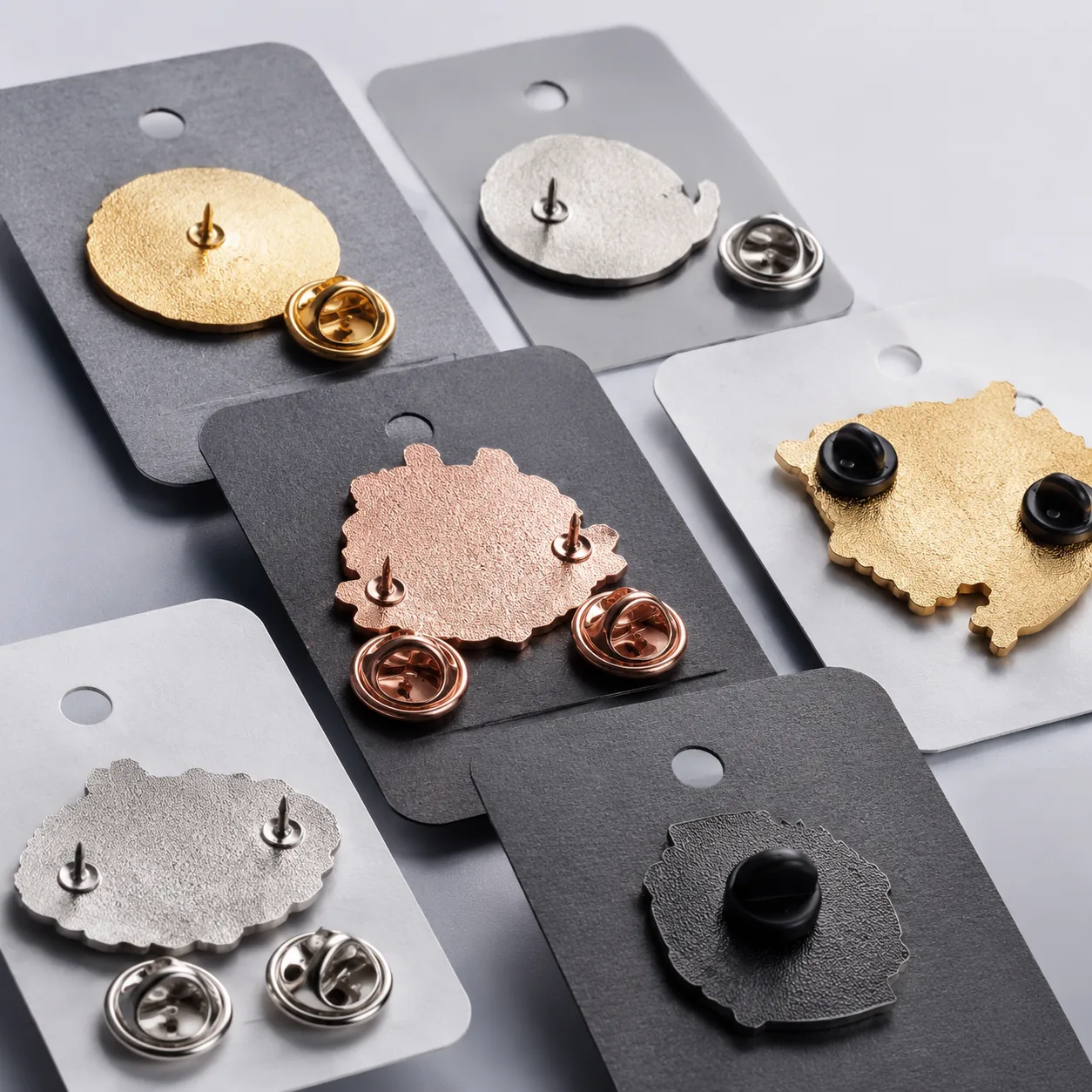
A large share of complaints on pin orders starts on the back side, not the front. Bent posts, weak solder joints, loose clutches, and face abrasion inside packaging can turn acceptable artwork into an event failure. Hardware needs to match the weight and geometry of the part, not simply the factory default.
For a light 25 to 30 mm round or square pin, one post with a butterfly clutch is usually acceptable. For wide horizontal shapes, asymmetrical designs, or pins over roughly 35 mm, two posts are safer because they reduce rotation and cut the chance of bending in transit. For pins above about 45 mm wide or above roughly 10 to 12 grams, two posts should be treated as the default unless a special backing system is specified.
Magnetic backs are useful only when garments cannot be punctured, such as on some uniforms or delicate fabrics. They add material cost, bulk, and handling complexity, and they may create safety restrictions for some end users. On a 200-piece launch run, they are usually the wrong default unless the application clearly requires no-puncture wear.
Packaging should be tied to the end use. Individual polybags usually add USD 0.03 to 0.06 each and help limit rubbing during export transit. Printed backing cards usually add USD 0.08 to 0.18 each in small runs, depending on size, print coverage, paper weight, and insertion labor. For trade-show handouts, polybagging is often enough. For ecommerce, fundraising, or influencer kits, card mounting is usually worth the extra cost because presentation affects perceived value at first touch.
Build the schedule backward from the in-hands date
A 200-piece pin order is not automatically fast. The calendar still has to absorb artwork revision, proof approval, die making, plating queue, enamel filling, curing, polishing, post welding, inspection, and final pack-out. For a straightforward order, a realistic timeline is 1 to 3 days for quotation and DFM artwork adjustment, 1 to 2 days for proof approval, 3 to 5 days for tooling, 5 to 7 days for a pre-production sample if required, 10 to 14 days for mass production, and 1 to 3 days for final packing and dispatch.
Shipping runs on a separate clock. Express courier from China is often 3 to 5 business days door to door under normal conditions. Air freight with customs handoff is more often 5 to 8 business days. During peak shipping periods or around Lunar New Year, Golden Week, or year-end retail congestion, either route can slip. A practical buyer rule is to keep at least 7 calendar days of arrival buffer before the event date, and 10 days is safer for fixed, high-visibility launches.
Rush production exists, but it rarely stays cheap or low-risk. A simple bright nickel soft enamel order may be compressed to 7 to 9 production days, but antique finishes, imitation hard enamel, and complex zinc-alloy shapes are much harder to accelerate cleanly. Rush surcharges of 10 to 25 percent are common, and expedited schedules leave less time for sample review or final inspection. In most cases, the cheapest rush strategy is earlier artwork lock, not paying a formal rush fee.
Compare quotes with one approval brief and one buyer checklist
The cheapest quote on a 200-piece order is often the least complete quote. One supplier may exclude the mold, sample fee, second post, card insertion, upgraded clutch, or polybagging. Another may quote higher but include realistic lead time, usable tolerance language, and clear inspection terms. At small volumes, these hidden differences matter more than a narrow unit-price spread.
Request quotations in the same structure every time: material, size in mm, thickness, plating finish, number of colors, attachment type, packaging method, FOB unit price, mold charge, sample charge, production lead time in days, AQL standard, carton quantity, carton size, gross weight, and reorder pricing at 300, 500, and 1,000 pieces. If one quote is dramatically lower, check whether thickness was reduced from 1.5 mm to 1.0 or 1.2 mm, whether zinc alloy was downgraded to iron, whether two posts became one, or whether carded units were switched to bulk pack.
Before issuing the PO, create a one-page approval brief that includes final vector artwork, Pantone references, size, thickness, plating, post count, clutch type, packaging method, required ship date, AQL standard, dimensional tolerances, and the approved proof image. That single document usually prevents more cost and delay than another round of bargaining because it closes interpretation gaps before the tool is cut.
- Lock material, size, thickness, plating, and post count before final pricing
- Request unit price, mold charge, sample fee, and packaging as separate line items
- Use a pre-production sample for text-heavy, color-critical, cutout, antique, or black-nickel designs
- State AQL, dimensional tolerances, and pack-out requirements directly on the PO
- Hold at least 7 calendar days of in-hands buffer before the event date
- Ask for reorder pricing at 300, 500, and 1,000 pieces before placing the first order
Have a project? Send your artwork and target quantity and we’ll reply with a detailed quotation within 12 working hours.
Ready to get this made?
Send your sketch, target quantity and ship-date. Detailed quotation in 12 hours.



