Moving Parts on Custom Pins and Keychains: Buyer Specs
Why moving pins fail after the first event
A spinner pin or hinged keychain is not just a decorative badge with extra parts. It is a small mechanical assembly built from stamped or cast metal, plating, enamel fill, rivets, washers, jump rings and hand assembly. The most common failure is not artwork mismatch; it is functional failure in week one: a disc that scrapes, a slider that binds, a charm that flips backward, or a hinge that loosens after repeated handling. Those defects are expensive because they are often discovered only after a visual sample has already been approved.
Movement compresses the tolerance budget. A 0.05 to 0.12 mm plating build on two contact surfaces, a 0.10 to 0.20 mm enamel overfill, and a slightly bent washer can turn a design that looks perfect in a mockup into one that jams in production. Treat these products as assemblies, not flat pins. The drawing must define moving interfaces, not only colors and outside dimensions.
This guide covers spinner pins, slider badges, hinged keychains, dangling charms and short chain assemblies. If the campaign only needs a low-cost giveaway under about USD 0.80 FOB, a flat enamel pin or standard keychain usually makes more sense. Add motion only when interaction is part of the message and the buyer can support extra tooling, sampling, inspection and packing control.
Choose the mechanism before finalizing artwork
Do not lock the artwork before you decide how the part moves. A spinner needs a centered pivot and a clearance ring around the rotating disc. A slider needs a straight track, end stops and enough surrounding metal to resist bending. A hinge needs aligned knuckles and enough body thickness to hold the pin without crushing the joint. If the movement is forced into the art later, the factory will usually solve it by enlarging the part or loosening the fit, which can change the design intent.
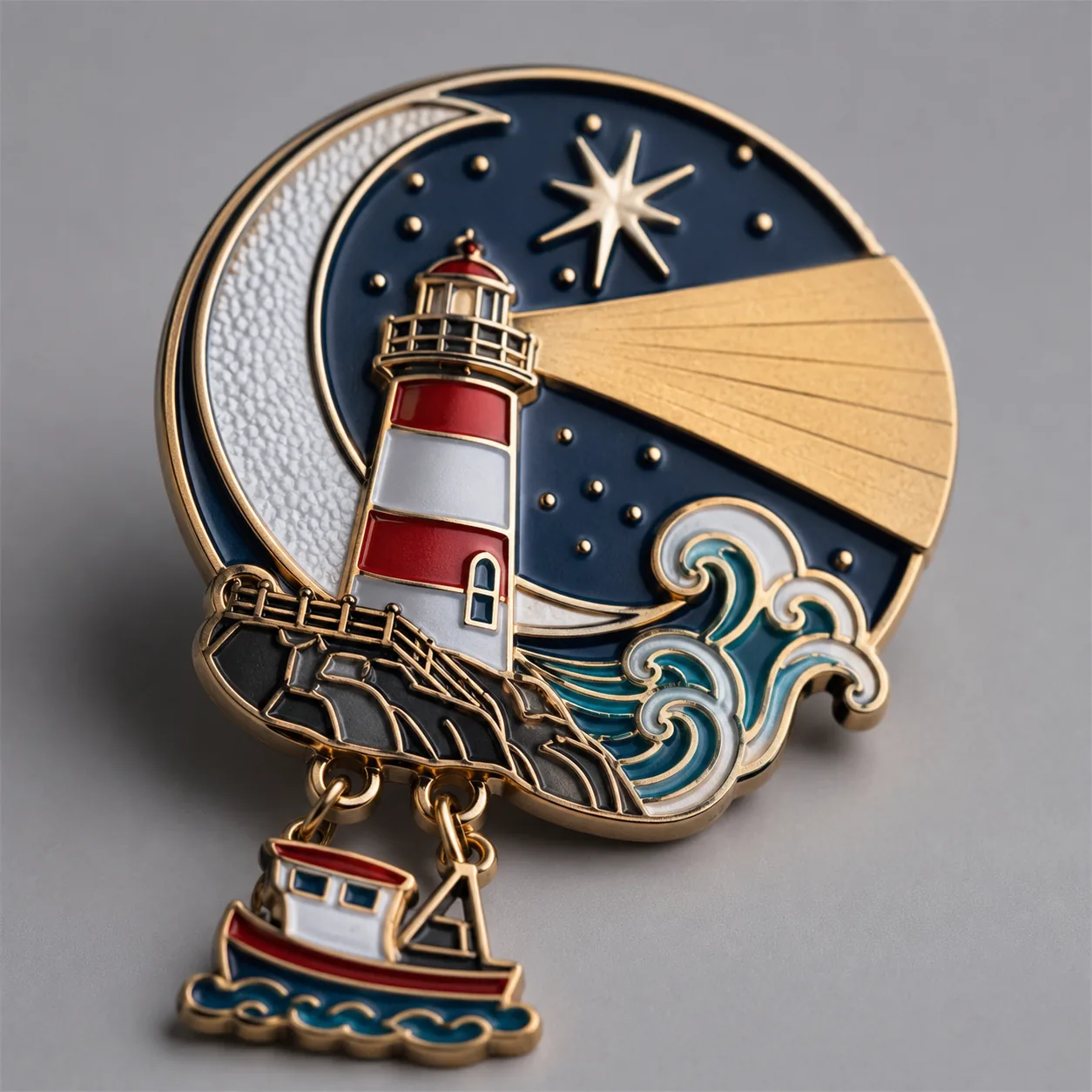
For enamel pins, the easiest and most reliable moving formats are two-layer spinners and small dangling charms. Sliders are possible, but the track has to stay clean after plating and fill. For keychains, hinged shapes and charm clusters are more forgiving because the body is thicker and not constantly rubbing against fabric, but the attachment hardware must be stronger because users pull on it more aggressively.
| Movement type | Typical size range | Best use | Main risk | Typical FOB add-on |
|---|---|---|---|---|
| Spinner pin | 35 to 60 mm overall; 12 to 35 mm moving disc | Campaign badge, sports theme, countdown graphic | Disc scrape or rivet too tight | USD 0.25 to 0.75 per piece |
| Slider badge | 45 to 75 mm length; 12 to 25 mm travel | Reveal, progress, before/after effect | Track plating buildup and jamming | USD 0.35 to 0.95 per piece |
| Hinged keychain | 40 to 80 mm body; 2.0 to 3.0 mm hinge barrel | Openable logo, novelty object, retail souvenir | Loose hinge or misaligned halves | USD 0.45 to 1.30 per piece |
| Dangling charm | 20 to 50 mm main piece plus 8 to 25 mm charm | Mascot accessory, number tag, badge add-on | Jump ring opening or awkward swing | USD 0.12 to 0.50 per charm |
| Short chain assembly | 30 to 80 mm total spread; 2 to 5 links | Multi-logo set, route map, membership token | Chain wear and tangling in packout | USD 0.20 to 0.70 per piece |
Dimensions and tolerances to write into the RFQ
Separate the visible artwork size from the mechanical clearance size. For spinner pins, define the base diameter, spinner diameter, pivot hole diameter, washer diameter and finished clearance between layers. After plating and assembly, a practical running gap is 0.20 to 0.35 mm. Below 0.15 mm, rejection rates usually rise. Above 0.50 mm, the movement often feels loose and cheap.
For slider badges, specify the track width, slider tab width, travel distance and stop tolerance. A common slot width is 2.2 to 3.0 mm for small promotional pieces, with a slider peg around 1.6 to 2.2 mm. Side clearance of 0.20 to 0.30 mm per side is usually workable. If you ask for plus or minus 0.10 mm on a stamped enamel slider, expect cost to rise and yield to fall; plus or minus 0.25 to 0.30 mm is more realistic for mass production.
For hinges and charms, write down wire diameter, ring outer diameter, barrel outer diameter and allowable axial play. Small charm rings are commonly 0.8 to 1.2 mm wire with 5 to 8 mm outside diameter. Keychain rings are usually 1.2 to 1.6 mm wire. Hinge pins are often 0.8 to 1.5 mm diameter, with axial play held around 0.15 to 0.40 mm so the joint opens smoothly without rattling excessively.
- State total size in millimeters, not only in inches or artwork scale.
- Define moving part diameter, hole size, washer size and post-plating clearance.
- Specify the desired feel: free spin, controlled spin, firm slider, or friction hinge.
- Call out no-scratch zones around pivots, tracks and hinge edges.
- Ask for a proof that marks mechanical dimensions, not only Pantone colors.
- Confirm whether dimensions are measured before epoxy, after epoxy or after final assembly.
Materials, thickness and plating choices
Material choice changes how well a moving product survives wear. Iron is cost-effective for stamped soft enamel pins at about 1.2 to 1.8 mm thickness, but it wears faster at rubbing points. Brass is the safest choice for clean hinge knuckles, precise slots and smoother pivot feel, especially on retail-grade pieces. Zinc alloy works well for thicker cast keychains at roughly 2.5 to 4.0 mm, but it is less forgiving on thin slider walls and fine mechanical edges.
For most moving pins, brass at 1.5 to 2.0 mm gives better edge quality than iron and reduces burr risk at the pivot. Stainless steel is useful for rings and some chains because it resists corrosion and deformation, but it is harder to color-match with plated bodies. If the design uses a lot of mechanical contact, spend more on the hardware that moves and less on decorative complexity that does not affect function.
Plating thickness needs to be balanced against friction. Decorative flash plating is often around 0.05 to 0.10 microns on the visible surface, while a more durable finish on contact-heavy assemblies may be specified at 0.15 to 0.30 microns over the base layer. Too much buildup on a track or hinge can block motion. The problem is not only wear; it is also dimensional growth. A plated slider slot can close by 0.03 to 0.08 mm per side, which is enough to cause binding in a tight design.
| Component | Recommended material | Practical thickness | When not to use |
|---|---|---|---|
| Spinner top disc | Brass or iron | 1.0 to 1.5 mm | Avoid very thin 0.8 mm discs if the enamel area is large; they bend during riveting |
| Main enamel base | Iron or brass | 1.2 to 2.0 mm | Avoid iron for premium retail pieces needing a very smooth pivot feel |
| Slider peg | Brass, iron or stainless pin | 1.6 to 2.2 mm diameter | Avoid soft zinc pegs in narrow tracks with high pull force |
| Hinge barrel | Brass or zinc alloy | 2.0 to 3.0 mm OD | Avoid tiny hinge barrels on items under 30 mm wide |
| Jump ring | Iron, brass or stainless steel | 0.8 to 1.6 mm wire | Avoid 0.6 mm rings for charms likely to be pulled repeatedly |
MOQ, tooling, samples and lead time
Moving products usually need more than one tool and more manual setup than flat pins. A simple spinner may need a base die, a disc die and a rivet fixture. A slider may need a punching operation or machined slot plus a checking jig. A hinged keychain may need casting tools plus a barrel alignment fixture. That extra setup is why the MOQ is usually higher than for a standard soft enamel badge.
For simple dangling pieces and basic spinner pins, a realistic MOQ is often 300 pieces. For sliders and hinges, 500 pieces is the more common production threshold because setup cost and hand fitting are higher. At 100 pieces, many factories can still quote, but pricing behaves like a sample run rather than a production run. By 1,000 to 3,000 pieces, the unit cost becomes more stable and the factory can keep tighter process control because the setup cost is spread over more units.
Lead times also stretch. Expect 10 to 18 days for sample development after artwork approval, compared with about 7 to 12 days for a simpler flat pin. Mass production is commonly 18 to 30 days after sample approval for a 500 to 3,000 piece order. Add 3 to 7 days for epoxy, glitter, antique finishing or multi-part assembly. If the buyer needs pre-shipment photos, function video and an English packing list, allow another 1 to 3 days for documentation and recheck.
| Order type | Typical MOQ | Tooling range | Sample lead time | Mass lead time | Typical FOB unit range |
|---|---|---|---|---|---|
| Dangling pin | 300 to 500 pcs | USD 70 to 160 | 9 to 14 days | 15 to 24 days | USD 0.85 to 1.80 |
| Spinner pin | 500 to 1,000 pcs | USD 110 to 260 | 10 to 16 days | 18 to 28 days | USD 1.10 to 2.40 |
| Slider badge | 500 to 1,000 pcs | USD 150 to 320 | 12 to 18 days | 22 to 32 days | USD 1.35 to 2.90 |
| Hinged keychain | 500 to 1,000 pcs | USD 180 to 450 | 14 to 22 days | 24 to 35 days | USD 1.80 to 4.20 |
Prototype checks that catch mechanical problems early
A photo is not enough for moving parts. Ask for a short video that shows the spinner rotating, the slider traveling end to end, the hinge opening and closing, or the charm hanging naturally from different angles. The test should include normal finger pressure, not only a slow staged motion. If the factory cannot show motion in a real-time clip, the mechanism is not ready to approve.
On the physical sample, check appearance, movement feel and strength separately. The part should move without scraping visible enamel or leaving metal dust, but it should not rattle so much that it feels loose. If the first sample is too tight, ask which dimension will change: washer height, pivot compression, slot width or pin diameter. Do not accept vague promises to “make it smoother” without a measurable adjustment.
For an engineering-safe process, approve a marked drawing before tooling, then approve one physical pre-production sample before bulk work begins. Keep one golden sample as the reference for movement feel. That sample should be labeled with the date, finish, material and the approved tolerance band so the factory can compare production pieces against a fixed standard instead of memory.
- Rotate or slide the sample at least 30 times before approving it.
- Check for plating dust, black marks or enamel scratches near contact points.
- Measure overall thickness, because moving layers can make the piece sit away from fabric or packaging.
- Test the attachment while the moving part is in its worst position, not only centered.
- Confirm the back side has no sharp rivet head, burr or raised washer edge.
- Reject samples where motion only works when the part is held at one exact angle.
Bulk inspection, AQL and functional tests
For standard promotional orders, buyers often use AQL 2.5 for major defects and AQL 4.0 for minor defects. With moving parts, functional failure belongs in the major-defect bucket: a jammed slider, non-rotating spinner, open jump ring, hinge pin that walks out, sharp burr at a contact point or attachment failure. Small plating shade variation can stay minor if it does not change brand appearance or function.
Use both visual sampling and functional sampling. On a 1,000 piece order, inspect the appearance under AQL Level II and function-test a separate sample of at least 80 to 125 pieces, depending on risk. For retail, collectible or child-facing products, tighten the plan. A factory-side 100 percent movement check before packing is often worth the labor cost because it catches failures before the cartons are sealed.
Write the test method into the PO. A spinner should complete at least one free rotation when flicked lightly if free spin is required, or move smoothly through 360 degrees if controlled spin is the target. A slider should complete 20 full cycles without binding or shedding plating flakes. A dangling charm on a ring connection should pass a 2 kg static pull for 10 seconds for adult promotional use. If the product needs a higher pull requirement, that should be engineered into the hardware from the start.
| Defect | Classification | Suggested acceptance rule |
|---|---|---|
| Spinner cannot rotate or scrapes through plating | Major | Reject under AQL 2.5 or tighter |
| Slider jams before full travel | Major | Reject under AQL 2.5 or tighter |
| Jump ring gap over 0.30 mm on a small charm | Major if the charm can detach | Rework or reject affected pieces |
| Light rattle but function remains normal | Minor | Accept only if it matches the approved sample |
| Small contact mark hidden behind the moving disc | Minor | Accept if not visible from the normal front view |
| Sharp burr near rivet or hinge | Critical or major | Reject; do not ship without rework |
Packing rules that prevent transit damage
Moving parts scratch each other more easily than flat pins. A spinner disc can rub against its base during vibration, and loose charms can chip enamel if they are packed together in bulk. For enamel moving pins, individual OPP bags are the minimum. For retail pieces, add a backing card or a thin foam sheet so front-to-front contact does not polish the plating or mark the enamel.
Use smaller inner packs for chain or charm assemblies because loose links tangle quickly. A practical export carton target is around 10 to 14 kg gross weight, with inner boxes of 100 to 250 pieces depending on size. If the assembly has multiple dangling parts, pack in inner bags of 25 to 50 pieces to reduce tangling during customs inspection and repacking. That extra step usually adds only USD 0.03 to 0.12 per piece, which is cheaper than sorting damaged stock after arrival.
For event giveaways, label cartons by design, colorway and quantity so staff do not open every box to find the right version. Avoid the cheapest bulk packing for sliders, hinges or antique plating unless scratches are acceptable. If the product will ship to a retailer, state whether the supplier must use master cartons, insert cards, polybags or barcoded stickers, because those details affect both lead time and packing labor.
What to confirm before you place the order
Start by deciding whether movement is actually needed. If the product is a one-day giveaway and the target FOB must stay under about USD 0.80, a flat enamel pin or standard keychain will usually deliver better value. If motion supports the campaign story, brief the supplier with mechanical details before asking for a final price. A quote based only on artwork will almost always miss the true cost of assembly and testing.
Send artwork at actual size and include one instruction for every moving part: rotate, slide, hinge, swing or fixed. Ask the supplier to return a proof that shows hole sizes, slot widths, washer dimensions, hinge barrel diameters and clearance between layers. If the factory cannot explain those numbers, the risk is not only price. It is that the defect may be discovered only after tooling and plating are already committed.
For a safe first order, choose at least 500 pieces if the design includes a slider or hinge, approve a physical sample, and require a short function video before bulk production starts. Use AQL 2.5 for major functional defects, define cycle and pull tests in writing, and keep one golden sample for comparison. ZheCraft can help convert flat artwork into an assembly drawing for spinner, slider, hinge or dangling constructions when the buyer provides target size, budget range, use case and delivery deadline.
Have a project? Send your artwork and target quantity and we’ll reply with a detailed quotation within 12 working hours.
Ready to get this made?
Send your sketch, target quantity and ship-date. Detailed quotation in 12 hours.



