Mixed-Design Pin Orders: MOQ, Tooling and QC Questions to Ask
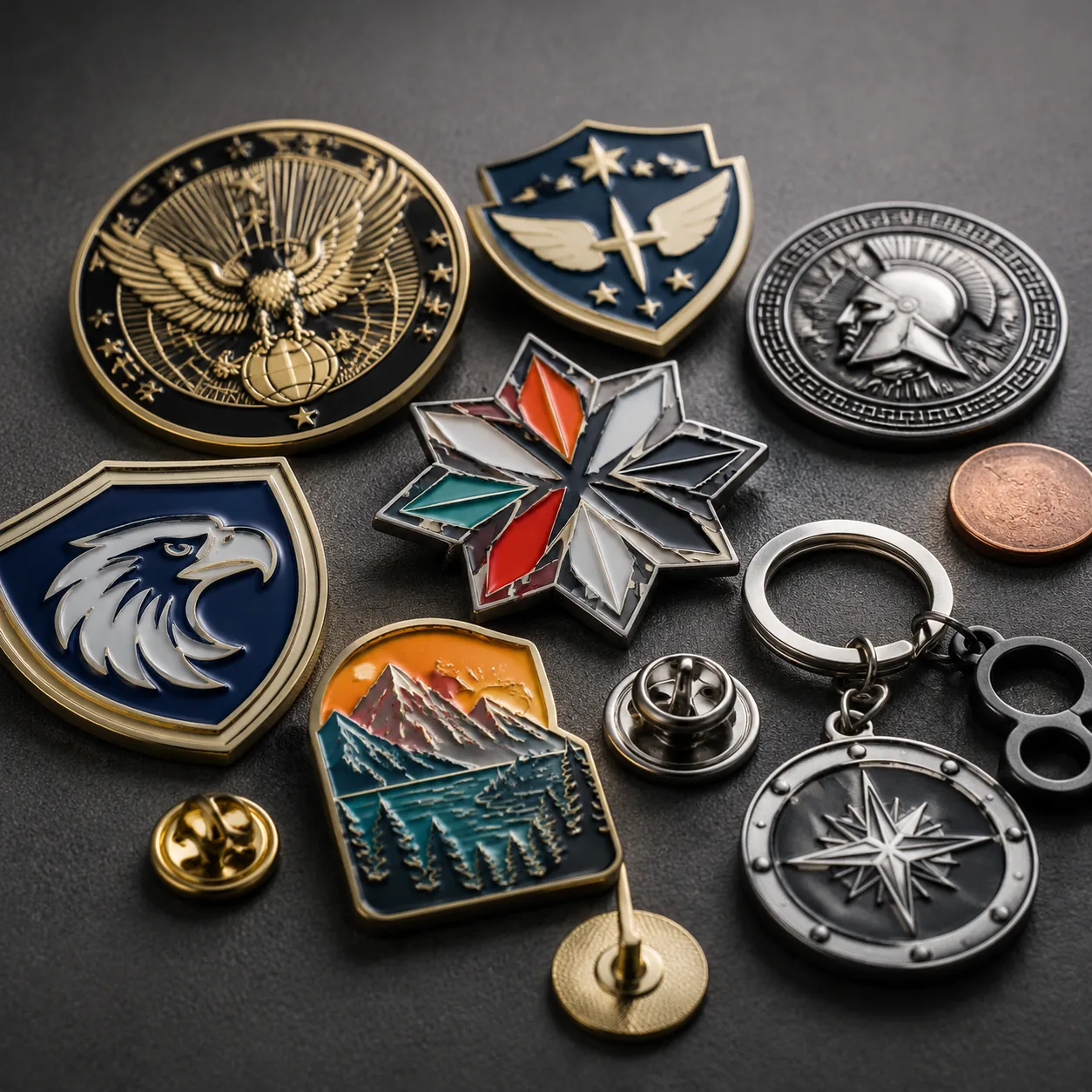
Can multiple pin designs share one factory MOQ?
Usually yes for order acceptance, but not automatically for unit price. A buyer may send 10 designs at 100 pieces each and call it a 1,000-piece order, while the factory still has 10 molds, 10 enamel-fill setups, 10 inspection identities and often 10 packing count sheets. For custom metal pins, the useful question is not “Can I combine the quantity?” but “Which production steps can actually be consolidated?”
For stamped soft enamel or hard enamel pins, a practical mixed-order floor is 50 to 100 pieces per design, with the total PO preferably above 500 pieces. Below 50 pieces per artwork, mold cost, engineering review and reject replacement dominate the price. On a 50-piece SKU, one scrapped pin equals 2 percent of the line. If exact retail quantities are required, the factory may need to produce 3 to 5 percent extra blanks to cover QC losses.
Etched pins, printed acrylic charms and PVC patches may allow lower per-design minimums because they use different tooling economics. Metal enamel pins need more control over die cutting, plating racks, enamel walls and polishing. Treat each artwork as its own manufacturing lot unless the metal outline and raised line structure are identical.
The safest RFQ format is a SKU table, not a note saying “1,000 assorted pins.” List each design with size, base metal, thickness, plating, enamel type, attachment, packaging and quantity. If a supplier quotes one blended price without showing mold charges, per-design MOQ and variant rules, ask for a breakdown before approving the PO.
Which specifications should be standardized?
The strongest savings come from standardizing base metal, thickness, plating, attachment and packaging. If 12 designs all use 1.5 mm iron, nickel plating, soft enamel, one butterfly clutch and one 55 x 85 mm backing card, the factory can buy material, schedule plating and pack SKUs in a controlled flow. If every design has a different finish, card size, attachment or barcode rule, the order behaves like 12 small orders under one PO.
For stamped iron pins, common thicknesses are 1.2 mm for small pins under 20 mm, 1.5 mm for most 20 to 35 mm retail pins, and 1.8 to 2.0 mm for larger or premium pieces. Zinc alloy is useful for complex silhouettes, cutouts and 3D relief, but it often has a higher mold charge and slightly heavier feel. Brass gives crisp detail and premium weight, but it is rarely the lowest-cost choice for mixed entry-level ranges.
Plating should be specified by finish and target thickness, not by color name alone. Nickel or black nickel at 3 to 5 microns is common for promotional pins. Imitation gold is often 2 to 4 microns, while antique finishes may need 3 to 6 microns to cover recesses consistently. If the pin will be handled heavily, sold as merchandise or exposed to humidity during ocean freight, ask whether a clear protective coating or higher plating thickness is appropriate.
| Spec area | Best practice for mixed orders | Cost or quality risk |
|---|---|---|
| Base metal | Use one metal and thickness, such as 1.5 mm iron across 20 to 35 mm SKUs | Mixing iron, brass and zinc alloy forces separate tooling and finishing assumptions |
| Plating | Use one finish with a written target, such as nickel at 3 to 5 microns | Gold, rose gold, black nickel and antique silver create separate plating batches |
| Attachment | Standardize one butterfly clutch, rubber clutch, safety pin or magnet grade | Different backings increase packing errors and require separate pull checks |
| Packaging | Use one OPP bag and backing card size, such as 60 x 90 mm bag with 55 x 85 mm card | Unique cards, barcodes and warnings per SKU slow final packing |
| Color system | Provide Pantone Coated references and approved color tolerance | RGB files, gradients and vague color names cause sample revisions |
| Artwork rules | Keep raised metal walls at 0.25 mm or wider where possible | Thin walls can break, underfill or polish unevenly on hard enamel |
What MOQ and FOB price tiers are realistic?
For international B2B sourcing, 100 pieces per design is the cleanest starting point for mixed enamel pins. Fifty pieces per design can work when the total order is large enough, the artwork is simple and the buyer accepts higher unit cost. For example, 20 designs at 50 pieces each is usually easier to schedule than 3 designs at 50 pieces each because the total order supports plating, packing labor and export handling.
As a rough FOB Yiwu or FOB Shenzhen range for 25 to 30 mm soft enamel pins with one clutch and individual polybag, 50 pieces per design often falls around USD 1.20 to 2.40 per piece plus mold. At 100 pieces per design, expect about USD 0.75 to 1.55. At 300 pieces per design, USD 0.45 to 0.95 is common. At 1,000 pieces of one design, standard soft enamel can reach USD 0.28 to 0.68 depending on finish, size and factory workload.
Hard enamel typically adds USD 0.08 to 0.30 per piece because the factory must overfill, cure and polish the surface flush. Screen printing may add USD 0.03 to 0.12 per color per piece. Glitter, glow enamel, translucent enamel, epoxy domes, dual posts, magnets and custom backing cards also add cost. A 45 mm pin with two posts and glitter cannot be compared with a 25 mm nickel soft enamel pin using one clutch.
Mold charges are normally per metal design, not per PO. For standard 20 to 35 mm stamped pins, tooling commonly runs USD 25 to 80 per design. Larger zinc alloy molds, deep 3D relief or oversized coins may reach USD 90 to 180. If tooling is advertised as free on a small mixed order, confirm whether the unit price has absorbed it and whether reorder pricing will drop when the same mold is reused.
| Quantity per design | Typical use case | Approx. FOB unit range, excluding mold |
|---|---|---|
| 50 pcs | Artist drops, market tests, event city variants | USD 1.20 to 2.40 |
| 100 pcs | Small retail SKU launch with controlled cost | USD 0.75 to 1.55 |
| 300 pcs | Wholesale reorder or proven design | USD 0.45 to 0.95 |
| 1,000 pcs | Single high-volume design or hero SKU | USD 0.28 to 0.68 |
Are color variants cheaper than new designs?
Yes, if the raised metal line art, outer silhouette, cutouts, backstamp and post location are identical. In that case, one stamping mold can produce all blanks, and the factory splits the order into separate enamel-fill batches. This is common for team badges, regional editions, campaign ribbons, character sets and membership tiers.
The saving is real but not unlimited. A 1,000-piece metal run split into five colorways of 200 pieces may price closer to one 1,000-piece blank run plus five enamel setups, not five fully separate 200-piece molds. The factory still needs separate Pantone checks, count control, rejection tracking and packing labels for each colorway.
Do not call a pin a same-mold variant if any metal line moves. A 0.2 mm shift can change enamel flow or wall strength. A new outer silhouette requires a new cutting profile, and a changed post location requires a separate backing setup. For hard enamel, raised walls below about 0.25 mm can polish down unevenly, so variant sets should be reviewed before promising many colorways to retailers.
- Use one master SKU for the shared metal design and suffixes for colorways, such as PIN-042-A, PIN-042-B and PIN-042-C.
- Provide Pantone Coated numbers for every enamel color; avoid descriptions such as navy, cream or warm red.
- Confirm whether the factory will stamp the full blank quantity first, then split enamel filling by colorway.
- Request one pre-production sample per critical color family when brand color matching matters.
- Keep attachment, card size and barcode placement identical unless a retail customer requires separation.
- State whether overruns can be moved between colorways or must remain exact by SKU.
How should QC work when each SKU is small?
Mixed orders create a common inspection error: checking the total shipment as one lot and missing a defect limited to one design. If a 2,000-piece PO contains 20 SKUs, a random sample of 125 pieces across the whole order may barely touch some designs. Identity risks such as wrong enamel color, missing metal line, wrong backstamp, reversed logo or incorrect card artwork must be checked per SKU.
For general workmanship, many buyers use ANSI/ASQ Z1.4, General Inspection Level II, with AQL 2.5 for major defects and AQL 4.0 for minor defects. Critical defects should be AQL 0, meaning no acceptance. Critical issues include sharp burrs, exposed copper or base metal on the front face, loose posts that fail a normal pull test, incorrect child-safety warnings, trademark errors and mixed retail labels.
For 50 to 100 pieces per SKU, sampled inspection alone is weak. A practical approach is 100 percent visual identity and count verification for every SKU, plus sampled checks for plating, enamel surface, attachment strength and packing. Measure at least 5 pieces per SKU for size and thickness when the design is new. For repeat orders, compare against the approved retained sample and current PO spec.
| Check point | Per-SKU requirement | Typical tolerance or rejection rule |
|---|---|---|
| Size | Measure outer width and height on at least 5 pieces per new SKU | ±0.2 mm for most stamped pins; ±0.3 mm for complex silhouettes |
| Thickness | Measure metal body before attachment or at exposed edge | ±0.1 mm for 1.2 to 2.0 mm pins |
| Enamel color | Compare to approved sample or Pantone chip under D65 light | Visual match required; brand colors may need buyer signoff |
| Raised metal walls | Check thin lines and separated enamel cells | Avoid walls below 0.25 mm unless approved for the process |
| Attachment | Pull and twist test posts, magnets or safety pins | No looseness under normal hand force; dual posts for many pins over 35 mm |
| Plating | Inspect front, edge, recesses and back | No blistering, peeling, heavy stains or exposed base metal |
| Packing | Verify SKU label, count and carton mark | Zero tolerance for SKU mixing in retail cartons |
What packing data prevents warehouse errors?
For mixed-design orders, packing is a production specification, not an administrative detail. A factory can make acceptable pins and still fail the order if SKUs are mixed inside one inner bag, card barcodes are swapped or carton marks do not match the buyer’s receiving system. This is especially costly for distributors shipping to multiple event cities or ecommerce brands fulfilling individual designs.
Define unit pack, inner pack and export carton before production starts. A common retail setup is one pin mounted on a 55 x 85 mm backing card, one 60 x 90 mm OPP bag, 50 pieces per inner bag or inner box, and 500 to 1,000 pieces per export carton depending on weight and card thickness. Keep gross carton weight below 15 kg for pins to reduce crushed cards, torn bags and warehouse handling complaints.
If barcodes are required, provide print-ready files and exact placement. Leave at least 3 mm safe margin from the card edge and about 5 mm clearance around pin holes so the pin back does not damage the barcode or legal text. Carton labels should show PO number, buyer SKU, design name, quantity, carton number, gross weight, net weight, carton dimensions and country-of-origin wording if your importer requires it.
- Pack one design per inner bag or inner box; do not mix SKUs to save carton space.
- Use buyer SKU codes on artwork proofs, production sheets, inner labels and carton marks.
- Confirm overrun and underrun tolerance, commonly ±3 percent for larger SKUs and ±5 percent for small SKUs unless exact count is required.
- For exact retail quantities, approve paid spare production so QC rejects do not create shortages.
- Require photos of each packed SKU, inner label and export carton before shipment release.
- Separate replacement parts, spare clutches and loose cards from finished retail units.
How much lead time should a mixed order need?
A single standard enamel pin can often finish in 12 to 18 production days after artwork approval, excluding freight. A mixed order with 10 to 30 designs usually needs 18 to 30 production days because artwork checking, mold cutting, enamel filling, plating control and SKU packing all multiply. If pre-production samples are required for every design, add 7 to 12 days before mass production approval.
The bottleneck is rarely stamping alone. Delays usually come from unclear vector artwork, Pantone corrections, shared plating queues, custom card printing, barcode approval or final carton sorting. If all designs use the same plating and packaging, the factory can consolidate more steps. If the order mixes hard enamel, soft enamel, glitter, epoxy and multiple card sizes, plan separate finishing and packing queues.
For event deadlines, work backward from the in-hand date. Allow 2 to 4 days for engineering artwork, 5 to 7 days for mold cutting and blank trial, 7 to 12 days for sample production if needed, 12 to 25 days for mass production depending on SKU count, 2 to 4 days for final inspection and packing, and 3 to 10 days for express or air freight. Sea freight is economical for heavy coin or keychain orders, but it is rarely suitable for urgent mixed pin launches unless the delivery window is flexible.
Add at least one buffer week for orders above 15 designs, custom retail packaging, brand-critical colors or approvals involving multiple stakeholders. A tight schedule can still work, but only if the buyer freezes artwork, approves samples quickly and avoids late changes to plating, card layout or SKU quantities.
RFQ checklist for mixed-design pin orders
Before asking for pricing, decide whether the priority is lowest landed cost, exact retail SKU control or fastest launch date. Most mixed pin programs can optimize two of those, not all three. A 30-design artist collection at 50 pieces each is feasible, but it should be managed like a small SKU program, not like one bulk giveaway item.
Send the supplier a spreadsheet and artwork folder using identical SKU names. Include vector artwork, Pantone colors, size in millimeters, enamel type, plating finish and micron target, attachment, packaging, barcode requirements, quantity per SKU, inspection expectations and required delivery date. If you compare multiple factories, force them to quote the same specification. The cheapest offer is often the one missing mold fees, packing labor, thicker plating or exact-count replacement allowance.
A useful engineering review should flag mold-sharing opportunities, risky enamel walls under 0.25 mm, pins over 35 mm that may need dual posts, colors that require sampling, and SKUs that should not share a plating run. That review is most valuable before internal artwork is locked, because small changes at that stage can save tooling charges and prevent sample delays.
- List every design as its own SKU with quantity; use “assorted” only when the mix is truly random.
- State whether mold charges must be shown separately and whether reorders will use the same tooling.
- Standardize plating, attachment, thickness and backing card size wherever the retail plan allows.
- Set inspection terms: Critical 0, Major 2.5 and Minor 4.0 is a common starting point for promotional pins.
- Require packed-SKU photos before shipment, including inner labels and carton marks.
- Confirm shortage rules; if exact quantities are mandatory, order 3 to 5 percent extra production for QC replacement.
- Build one extra week into schedules with more than 15 designs, custom cards or sample approvals.
Have a project? Send your artwork and target quantity and we’ll reply with a detailed quotation within 12 working hours.
Ready to get this made?
Send your sketch, target quantity and ship-date. Detailed quotation in 12 hours.



