Metal vs Soft Goods for Promo Giveaways: Pick the Right Format
Start With the Job, Not the Product
The most expensive mistake in promo procurement is comparing items by unit price alone. A custom enamel pin, woven patch, lanyard, and keychain can all sit in the same campaign budget, but they behave very differently once you factor in attachment, wear, pack-out, and reorder risk. If the item will be handed out at a two-day event, worn for months, mailed to members, or bundled into retail packaging, the right format changes quickly. The decision should start with what the item must do after it leaves the factory.
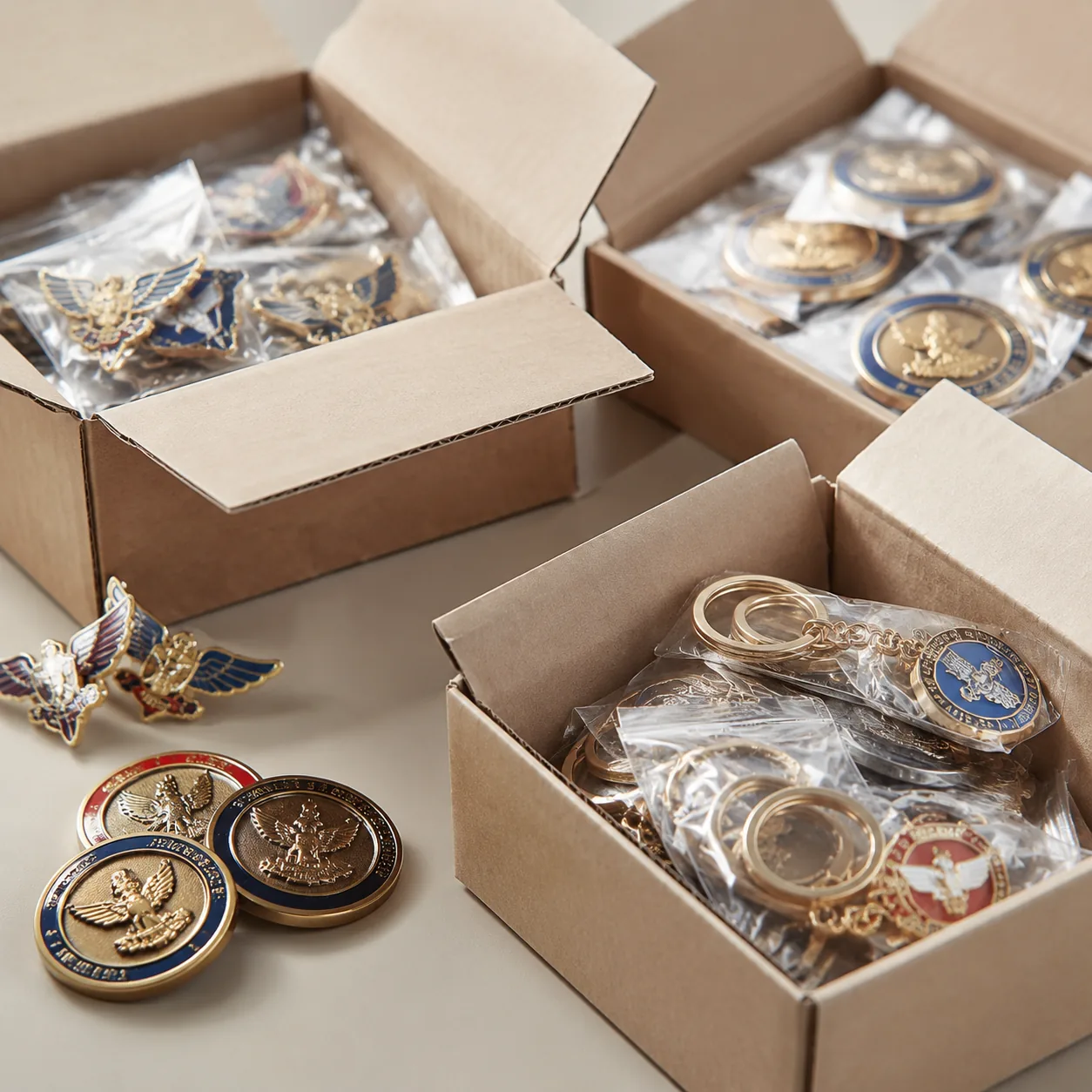
For buyer teams, the real question is whether you need a rigid branded object or a flexible wearable/packable item. Rigid products such as pins, coins, magnets, and metal keychains usually deliver stronger perceived value, cleaner color control, and more consistent repeat orders. Soft goods such as patches and lanyards usually win on comfort, broader print area, and lower damage risk in transit. ZheCraft sees the best results when buyers define the use case first, then select the format that fits that job instead of forcing one product type into every campaign.
In practice, the format choice is often determined by the recipient’s first interaction. A 30 mm hard enamel pin feels collectible in hand; a 20 mm embroidered patch usually feels more like apparel branding; a 900 mm lanyard functions as utility; and a metal coin signals recognition. That first impression matters because promo items are judged in seconds but retained for weeks or months.
Decide by Use Case, Not by Department Preference
Different stakeholders often optimize for different outcomes. Marketing wants visibility, sales wants a premium feel, procurement wants fewer defects, and event teams want something easy to distribute. Those goals are not always compatible. A product that looks excellent in a deck may be awkward at the booth if it needs special backing, individual bagging, or careful size sorting.
A practical framework is to ask four questions: How long should the item survive? How much artwork detail must it hold? How will it attach or be worn? And how many pieces must be ordered to make the cost acceptable? Once those answers are clear, the product family usually narrows quickly. If you want a premium collectible, metal often wins. If you need large logo coverage, text readability, or comfort on clothing, soft goods usually win.
Use these rules of thumb early in sourcing:
- Choose rigid metal when the item is meant to feel collectible, durable, and premium.
- Choose soft goods when comfort, flexibility, or large print areas matter most.
- Choose magnets only when the recipient will place the item on a metal surface.
- Choose lanyards or patches when the brand needs daily visibility, not just display value.
- Choose coins for recognition and awards, not high-volume handouts.
The fastest way to save time is to separate “impression” from “utility.” A hard enamel pin may be the right choice for a membership launch because it signals status, while a polyester lanyard is the right choice for conference badges because it solves a functional problem. The format should match the campaign’s primary job, not the stakeholder who happened to approve it first.
The Trade-Offs Buyers Actually Feel
Metal products usually offer sharper edges, better relief, and stronger perceived value, but they also introduce more manufacturing variables: plating, polishing, fill level, attachment choice, and edge safety. They are a poor choice if your design depends on large areas of tiny text, gradients, or frequent size changes at the last minute. They are also less forgiving when the distribution channel is rough, because scratches and plating variation are easier for end users to notice.
Soft goods have a different set of constraints. Patches and lanyards are more tolerant of larger artwork areas and are often friendlier for broader branding campaigns, but they can lose detail in small line work and depend heavily on thread count, weave quality, or print method. They are also more likely to be judged by softness, drape, and finishing than by raw “value.” If the campaign needs a gift that feels substantial in hand, soft goods may underperform even if the print is technically clean.
The right choice usually comes down to what failure looks like. If failure means the item scratches, bends, or tarnishes, choose soft goods or a more flexible substrate. If failure means the logo becomes unreadable or the brand feels cheap, choose metal. If failure means the user never wears it because it is uncomfortable, choose a different attachment format entirely.
A useful buyer test is to define the acceptable defect. For a premium pin, a 0.3 mm plating nick may be unacceptable; for a woven patch, a slightly softer edge may be normal; for a lanyard, a one-shade print shift may be tolerable if the logo remains legible. That defect threshold should be written into the RFQ before sampling starts.
Compare the Formats Before You Quote
This comparison table is a fast way to screen options before requesting factory quotes. It is not a design rulebook; it is a buyer filter. Use it to decide which direction deserves artwork development and sample time.
| Format | Best For | Typical MOQ | FOB Range (USD) | Main Risk |
|---|---|---|---|---|
| Hard enamel pins | Collectibles, uniform branding, premium gifts | 100-300 pcs | 0.45-1.95 per pc | Tiny text, plating defects, and color fill overflow |
| Soft enamel pins | Lower-cost badge programs | 100-300 pcs | 0.28-1.20 per pc | Recess dirt, less crisp detail, visible scratches |
| Metal keychains | Retail-style gifts, membership items | 100-300 pcs | 0.65-3.20 per pc | Attachment wear, ring fatigue, scratch marks |
| Woven or embroidered patches | Apparel branding, larger logos | 100-500 pcs | 0.22-1.35 per pc | Detail loss on small artwork and edge fray |
| Polyester lanyards | Events, ID use, high-volume giveaways | 100-500 pcs | 0.18-1.10 per pc | Print color drift, edge fray, weak hardware |
| Fridge magnets | Postal gifts, home and office visibility | 100-300 pcs | 0.30-1.80 per pc | Weak magnet force, curling, or warping |
| Challenge coins | Recognition, awards, collector appeal | 100-200 pcs | 1.10-5.50 per pc | Weight, cost, and tooling depth |
These ranges assume common factory setups and normal artwork complexity. Hard enamel pins commonly use 1.2-1.5 mm zinc alloy or iron bases, 0.8-1.2 mm recessed line widths, and 0.6-0.8 mm minimum text height for reliable readability. Patches usually hold up best with 75D to 150D thread counts, a stitched border tolerance around ±1.0 mm, and edge cutting that stays within AQL 2.5 for visible defects. Polyester lanyards are typically quoted at 900 x 20 mm or 900 x 25 mm, with a ±2 mm length tolerance and print alignment held within about 1.5 mm on acceptable bulk runs.
Lead times are usually 12-18 days for simple metal items, 15-25 days for mixed finishing or soft goods, and 20-30 days if you need custom packaging, multiple approvals, or a new mold. Expedited samples can often ship in 4-7 days, but pre-production sampling still adds calendar time. For freight, FOB price is only part of the landed picture; a low FOB item with a bulky gift box or a weak attachment can become the expensive option after rework or returns.
Budget for Failure, Not Just Production
A cheap item that gets rejected after delivery is not cheap. Buyers should price in three cost layers: unit price, rework probability, and distribution damage. For example, a soft patch may have a lower FOB price than a hard enamel pin, but if the campaign expects a premium executive gift, the patch may deliver the wrong perceived value and force a second purchase. Likewise, a metal item that requires strict plating control may be a better fit if the order is small but high-visibility.
When comparing quotes, ask whether the factory is pricing to a stable spec or to an assumed interpretation. The biggest gaps usually come from finish thickness, attachment grade, and packaging. A magnetic badge back, a stronger split ring, or a better carton insert can add only cents per piece but materially change breakage rates. ZheCraft generally recommends locking the spec first, then comparing FOB on the same exact bill of materials rather than comparing “similar-looking” samples.
A practical budget model for promo buyers is simple: if the item is under $0.50 FOB, a 10 percent defect or damage rate can erase the savings fast; if the item is above $2.00 FOB, a one-time rework cycle may cost more than the original premium. That is why premium-looking items deserve tighter incoming QC and clearer acceptance criteria than commodity giveaways.
The most common hidden costs are attachment swaps, packaging upgrades, and artwork revisions. A lanyard clip upgrade from basic J-hook to lobster clasp may add $0.08-$0.18 per piece. A gift box can add $0.25-$0.90 depending on board grade and insert style. On metal products, switching from nickel to black nickel or antique brass usually changes both visual tone and cost, sometimes by 5 percent to 15 percent depending on plating runs and minimums.
Use a Spec Checklist Before You Request Samples
A good RFQ does not ask a factory to guess intent. It tells the supplier what must stay fixed and what can be flexible. For mixed promo programs, the lowest-risk path is to define product family, size band, attachment method, finish level, and packing format before asking for a quote. Without that, different suppliers will quote different assumptions and the comparison becomes meaningless.
Use this checklist before sampling:
- Fix the intended use: collectible, wearable, mailed gift, award, or event handout.
- State the target size band and allow a tolerance, such as ±1 mm for small metal items or ±2 mm for lanyard length.
- Lock the attachment type and minimum durability expectation.
- Specify whether the finish should be premium, standard, or cost-driven.
- State the packing method: bulk, individual polybag, backing card, or gift box.
- Ask for a sample based on the final spec, not a conceptual mockup.
- Define the acceptable defect level, such as AQL 2.5 for major visual defects and AQL 4.0 for minor packaging scuffs.
If the campaign includes multiple item types, make sure the visual system can survive across formats. A logo that works on a 30 mm pin may fail on a 15 mm keychain tag or a narrow lanyard repeat. Buyers often get better results by simplifying the artwork before production rather than asking the factory to “make it fit.”
Concrete examples help. A 4-color logo with thin serif text may work on a 25 mm coin only if the text is dropped or converted to a plain sans-serif ring. A stitched patch should usually keep lines above 0.3 mm and leave enough negative space so the border does not swallow the mark. A printed lanyard repeat should be checked at full scale, because artwork that looks balanced on screen can crowd badly once it wraps around the neck.
Where Each Format Wins, and Where It Does Not
Metal is strongest when the item needs to communicate permanence, authority, or collectability. Soft goods win when the item will be worn, handled, or carried every day. Magnets are best when you need easy display on a metal surface and do not want clothing wear. Challenge coins are usually for recognition or premium gifting, not mass distribution, because the weight and cost make them inefficient for broad handouts.
Material and construction matter as much as category. A 1.2 mm zinc alloy pin with hard enamel fill will read differently from a thin stamped iron badge with soft enamel. A 100% polyester woven patch with merrowed edge will outperform a lightweight cut-edge print when abrasion is high. On lanyards, flat polyester is usually the lowest-cost option; satin feels softer but may show wear faster if the campaign is heavy-use. Those differences are often more important than the headline product name.
A good rule is to avoid forcing a premium metal look onto a use case that is physically better served by textiles or print. Conversely, do not use a soft-format product when the campaign depends on a strong keepsake impression. If the item is likely to be stored, displayed, or traded, metal often justifies the higher cost. If the item must be worn comfortably for hours, softer options usually create fewer complaints.
When in doubt, ask what the recipient is most likely to do with it in the first 10 seconds and in the next 10 months. That simple test usually separates the right format from the merely familiar one. The 10-second action tells you whether the piece must impress, attach, or function; the 10-month outcome tells you whether durability or comfort will control satisfaction.
What to Do Next
Shortlist two product families, not ten. Then compare them against the same use case, same artwork constraints, and same packaging plan. If the item must feel premium and survive long-term handling, move toward metal. If the item must cover a large logo area, stay comfortable, or ship economically at scale, move toward soft goods.
Next, request quotes on the exact same basis: same size, same decoration method, same attachment, same packing, and same delivery target. For ZheCraft, the fastest way to avoid rework is to send one clear buyer brief and ask for a spec-driven recommendation instead of asking which product is “best” in general. The right answer depends on the job, and the job should always be written first.
If you want to move quickly, keep the RFQ to one page: product type, artwork file, size with tolerance, material, finish, quantity tier, packing, target lead time, and destination port. That is usually enough for a factory to quote accurately and for procurement to compare options on equal terms.
Have a project? Send your artwork and target quantity and we’ll reply with a detailed quotation within 12 working hours.
Ready to get this made?
Send your sketch, target quantity and ship-date. Detailed quotation in 12 hours.



