Magnet Strength Specs for Custom Magnets and Badges
Weak Magnets Usually Start With a Weak RFQ
A fridge magnet that slides down a powder-coated refrigerator, or a magnetic badge that drops from a suit jacket, is usually not caused by one defective magnet. It is normally a specification gap. RFQs that say only "magnetic backing" or "strong magnet" leave the factory to choose the cheapest workable option, often without knowing the product weight, contact surface, coating thickness, fabric type, or required hold test.
For B2B orders, those missing details create predictable costs: remake charges, air freight for replacement backs, complaints from event staff, scratched appliances, or inconsistent performance between production lots. A 12 mm neodymium disc can feel strong on bare 10 mm steel in a supplier's office but perform poorly through a 1.5 mm PVC layer, a 0.5 mm epoxy dome, a painted refrigerator panel, or a wool blazer.
Magnet performance depends on the full assembly: magnet material, grade, diameter, thickness, contact area, plating, adhesive, pocket design, product weight, and the gap between the magnet and the holding surface. This guide focuses on practical purchasing specs for custom fridge magnets, enamel magnets, zinc alloy badges, bottle openers, keychains, brooches, and magnetic lapel backs. The goal is not maximum strength. Over-specified magnets can scratch surfaces, pinch fingers, increase freight weight, chip in transit, and make retail packaging harder.
Select Magnet Material by Load and Format
Most promotional products use flexible ferrite sheet, hard ferrite, or neodymium iron boron. Flexible ferrite is the standard for flat printed fridge magnets because it is inexpensive, die-cuts cleanly, and is normally supplied at 0.4 to 1.0 mm thickness. It works well when the magnet only needs to hold itself flat. It is not the right choice for heavy zinc alloy souvenirs, thick PVC pieces, or products expected to hold several sheets of paper.
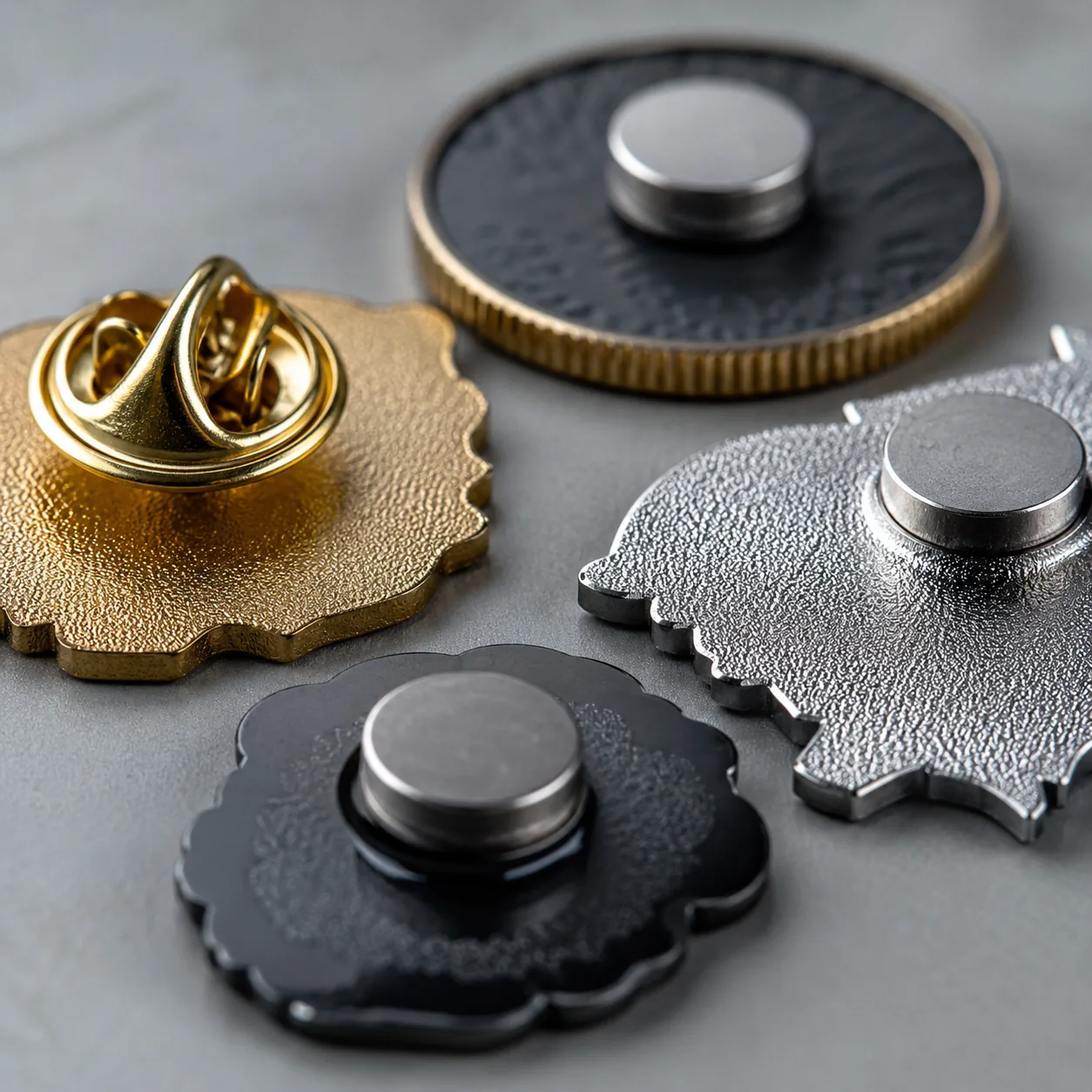
Neodymium is much stronger for its size and is common for magnetic lapel backs, heavy metal fridge magnets, bottle opener magnets, premium badges, and compact designs where there is no space for a large ferrite area. Common commercial grades are N35, N38, N42, and N52. The grade number indicates maximum energy product, but higher is not automatically better. N52 costs more, is more brittle, and can be excessive if a larger N35 or N38 disc fits safely in the design.
Hard ferrite blocks and discs sit between these options. They are cheaper than neodymium, more temperature stable, and suitable for thicker souvenir products. They are also bulky and weaker than neodymium for the same footprint. Use them when thickness is acceptable and the buyer wants a lower-cost magnetic bottle opener or molded souvenir magnet.
| Magnet type | Typical purchasing spec | Best use | Avoid when | Approx. FOB impact |
|---|---|---|---|---|
| Flexible ferrite sheet | 0.4-1.0 mm thick, anisotropic preferred, matte or laminated face | Flat printed fridge magnets, light PVC magnets, calendars | Finished product exceeds 25-30 g or has a curved back | +$0.03-$0.12 per pc |
| Hard ferrite | 10-25 mm disc or block, 3-6 mm thick | Bottle openers, thick molded souvenirs, low-cost heavy formats | Thin badges, premium retail items, designs needing small pockets | +$0.06-$0.18 per pc |
| Neodymium N35-N42 | 8-20 mm disc, 1.5-3.0 mm thick, Ni-Cu-Ni plated | Magnetic pin backs, zinc alloy fridge magnets, compact badges | Children's items, scratch-sensitive surfaces, very thin edges | +$0.08-$0.35 per pc |
| Neodymium N52 | 6-12 mm disc where space is limited | Small premium badges or backs needing high force in a small area | Large flat magnets where N35/N38 can be sized up | +$0.15-$0.55 per pc |
Define Pull Force With the Test Surface
Pull force is only useful when the test condition is stated. A supplier may quote 1.2 kgf for a neodymium disc tested in direct contact with a polished 10 mm steel plate. The same magnet may hold only 250 to 500 g on a painted refrigerator panel after allowing for coating thickness, surface texture, glue layer, product curvature, and imperfect contact.
For fridge magnets, sliding resistance is usually more relevant than theoretical pull force. A flat magnet under 30 g should not slide on a vertical painted steel panel for 24 hours at 20-25°C and 40-60% RH. A zinc alloy souvenir magnet weighing 40 to 80 g normally needs either two 10-12 mm N35/N38 discs at 2 mm thick or one 18-20 mm disc, depending on product shape and contact balance.
For magnetic badge backs, test through the target fabric. A common two-piece lapel back uses dual 10 mm N35 magnets on a 45-46 mm steel plate and works for shirts, polos, and light jackets. Thick wool, fleece, padded uniforms, or laminated event vests may require 12 mm magnets or a longer backing plate. Avoid strong magnetic backs for hospital, aviation, school, or pacemaker-sensitive environments unless the client has approved the risk in writing.
- State finished product weight in grams, including epoxy, plating, backing, inserts, and any attached card if it affects display.
- Define the exact test surface: painted refrigerator steel, 0.8 mm iron plate, stainless appliance door, cotton shirt, blazer fabric, or client-supplied material.
- Specify the pass condition: no sliding for 24 hours, no drop after 20 shake cycles, or minimum pull force in newtons or kgf.
- State magnet placement tolerance: ±0.5 mm for glued neodymium discs and ±1.0 mm for flexible ferrite sheets.
- Require pre-production samples using final magnet size, adhesive, plating, product weight, and packaging method.
Size the Magnet System Before Artwork Approval
A frequent sourcing mistake is treating the magnet as a standard accessory after the artwork is approved. Magnet size should be set during engineering because the artwork, relief depth, enamel fill, bottle opener cutout, PVC thickness, or back stamp can limit bonding area. If the magnet is too close to the edge, the product can rock, lose contact area, or show a visible bulge under soft PVC.
For flat printed fridge magnets, 0.5 mm flexible ferrite is acceptable for small pieces below 70 x 70 mm and below 15 g. For calendars, photo frames, or vehicle-shaped magnets over 100 mm wide, specify 0.7 to 0.8 mm ferrite to improve flatness and reduce corner lift. Narrow photo-frame borders need special attention: an 8 mm border may require wider ferrite strips, corner pads, or a full-back ferrite layer to avoid sagging.
For die-cast zinc alloy or stamped iron magnets, calculate magnet need after confirming metal thickness. A 45 mm zinc alloy piece at 2.0 mm thickness may weigh 28 to 40 g before plating, enamel, and epoxy. A clear epoxy dome of 0.3 to 0.6 mm adds both weight and standoff, reducing holding force. For this reason, one small 8 mm disc that worked on a bare metal prototype may fail on the final domed version.
| Finished product | Typical weight | Suggested magnet system | Target performance | Engineering note |
|---|---|---|---|---|
| Flat printed fridge magnet, 60 mm | 8-15 g | 0.5 mm flexible ferrite full back | No sliding on painted steel for 24 hours | Lowest-cost giveaway option |
| Large printed fridge magnet, 100 mm | 18-35 g | 0.7-0.8 mm flexible ferrite full back | Corners remain flat after 24 hours | Avoid 0.4 mm ferrite on wide shapes |
| Zinc alloy souvenir magnet | 35-60 g | Two 10-12 mm N35 discs, 2 mm thick | No slide on vertical fridge panel | Use recessed pockets for repeatable alignment |
| Magnetic bottle opener | 60-110 g | One 18-25 mm ferrite or neodymium disc | Holds own weight plus light handling | Check opener leverage does not loosen glue |
| Magnetic lapel badge | 8-25 g | Dual 10-12 mm N35 discs on 45-46 mm plate | No drop through approved fabric | Not suitable for very heavy brooches |
Control Plating, Adhesive, and Pockets
Neodymium magnets corrode quickly if their coating is thin, cracked, or damaged during assembly. A normal promotional-grade disc uses nickel-copper-nickel plating with total coating thickness around 10 to 20 microns. For humid markets, ocean freight storage, or longer retail shelf life, specify at least 12 microns total plating and reject pinholes, rust spots, swelling, chipped edges, or exposed dark base material before assembly.
Adhesive choice must match the substrate and pull direction. Pressure-sensitive adhesive is fast and clean for light ferrite-backed fridge magnets but can creep above 45°C, especially in containers, warehouses, or vehicles. For zinc alloy, iron, or hard PVC magnets, two-part epoxy or high-strength acrylic adhesive is safer. A practical cured glue line is 0.05 to 0.15 mm; too much adhesive increases standoff and weakens the magnetic hold.
A recessed magnet pocket is better than surface gluing when product thickness allows it. For zinc alloy or iron, specify pocket depth 0.05 to 0.10 mm shallower than magnet thickness so the magnet sits nearly flush after glue and remains close to the contact surface. Pocket diameter should be magnet diameter plus 0.10 to 0.20 mm. If the pocket is too tight, assembly workers may press-fit the disc and crack the plating; if too loose, placement variation increases and pull force becomes inconsistent.
- Use polarity marks or assembly jigs when magnets must align with a separate backing plate.
- Specify pocket diameter tolerance as +0.20/-0.00 mm for glued round discs.
- Keep neodymium discs at least 1.5 mm from thin product edges to reduce cracking and glue overflow.
- Avoid cyanoacrylate for heavy magnets because impact and peel resistance are weaker than epoxy or acrylic adhesive.
- Require a 24-hour curing period before pull testing when liquid adhesive is used.
Plan MOQ, Lead Time, and FOB Cost
Magnet choices affect material MOQ, sample timing, tooling, and assembly speed. Flexible ferrite sheet is generally easy to source, so the practical MOQ is usually driven by printing, lamination, die-cutting, or packaging rather than the magnet material itself. For custom-shaped fridge magnets, 300 to 500 pieces is a common starting MOQ, with better FOB pricing at 1,000 and 3,000 pieces.
Neodymium costs vary by diameter, thickness, grade, coating, and magnetization direction. Standard sizes such as 10 x 2 mm, 12 x 2 mm, 15 x 2 mm, and 20 x 2 mm are easier to buy quickly. A nonstandard N52 disc, black epoxy coating, countersunk shape, or unusual polarity pattern can add 5 to 10 days and may require 3,000 to 5,000 magnet pieces even when the finished product order is smaller.
For Yiwu production, realistic lead time after artwork approval is 10 to 16 days for flat printed fridge magnets, 14 to 22 days for zinc alloy or iron enamel magnets, and 18 to 28 days for complex magnetic badges or bottle openers with custom back plates. Add 3 to 5 days when the buyer requires a formal pull-force report, salt spray check, custom fabric test, or revised pre-production sample before mass production.
| Order type | Practical MOQ | Sample time | Mass production lead time | Typical USD FOB range |
|---|---|---|---|---|
| Printed flexible fridge magnet | 300-500 pcs | 5-7 days | 10-16 days | $0.18-$0.65 per pc |
| Soft PVC fridge magnet | 500 pcs | 7-10 days | 14-20 days | $0.35-$1.20 per pc |
| Zinc alloy enamel magnet | 100-300 pcs | 8-12 days | 14-22 days | $0.75-$2.80 per pc |
| Magnetic lapel badge | 100-300 pcs | 7-12 days | 15-24 days | $0.85-$3.50 per pc |
| Magnetic bottle opener | 300-500 pcs | 8-12 days | 18-28 days | $1.10-$4.20 per pc |
Set Inspection Criteria Before Production
Magnetic products need more than a visual inspection. A badge can look correct but fail because the magnet is reversed, undersized, cracked, off-center, contaminated with glue, or bonded before the adhesive fully cures. Inspection requirements should be written into the purchase order before production, not negotiated from final QC photos.
For general promotional orders, ANSI/ASQ Z1.4 General Inspection Level II with AQL 2.5 major and 4.0 minor is a practical baseline. Classify missing magnets, reversed polarity, sliding failure, detached magnets, sharp chipped magnets, rust, and unsafe magnetic pull as major defects. Small cosmetic marks on the hidden magnet surface can be minor if they do not expose base material or affect bonding.
Dimensional checks should include finished product size, magnet size, magnet position, pocket depth, and total thickness. Practical tolerances are ±0.3 mm for metal badge diameter, ±0.2 mm for custom magnet diameter, ±0.5 mm for glued magnet placement, and ±0.2 mm for total thickness on simple flat pieces. For flexible magnets, also check warpage by placing 10 samples on a flat plate for 30 minutes and then on the agreed vertical test panel.
- Pull-test 20 pieces per lot, or at least 5 pieces per carton for small orders.
- Run a 24-hour vertical hold test on the approved painted steel, iron plate, or fabric surface.
- Check polarity on every magnetic badge back before packing.
- Perform a manual pry test or tape-pull test after adhesive has cured for 24 hours.
- Inspect nickel-plated magnets for rust, chips, swelling, pinholes, and exposed base material.
- Pack strong neodymium magnets with dividers or spacing so they do not snap together and chip during transit.
Send a Complete Magnet RFQ
Before sending the next RFQ, define what the magnet must hold, where it will be used, and what failure means. A fridge souvenir may only need to hold itself flat on a painted appliance. A magnetic badge must hold through fabric without tearing clothing, rotating, or feeling uncomfortable. These are different engineering problems and need different specifications.
A complete RFQ should include finished weight target, artwork size, base material, coating or epoxy thickness, intended surface, required hold test, magnet restrictions, and packaging method. If the client prohibits neodymium, requires child-safe magnetic strength, or needs no scratching on stainless appliances, state that before sampling. If there is a failed sample from another supplier, include its magnet diameter, thickness, location, weight, and photos of the test surface.
For a low-risk production order, approve one pre-production sample made with the final magnet material, final adhesive, final plating, final pocket depth, and final packaging. Test it on the real surface for at least 24 hours before approving mass production. When cost or safety is uncertain, ask the factory to quote two magnet systems side by side, such as 0.8 mm flexible ferrite versus dual 12 mm N35 discs, so procurement can compare FOB price, lead time, weight, and performance before locking the specification.
Have a project? Send your artwork and target quantity and we’ll reply with a detailed quotation within 12 working hours.
Ready to get this made?
Send your sketch, target quantity and ship-date. Detailed quotation in 12 hours.



