Magnet Backing vs Clutch Backing for Pins: Buyer Specs
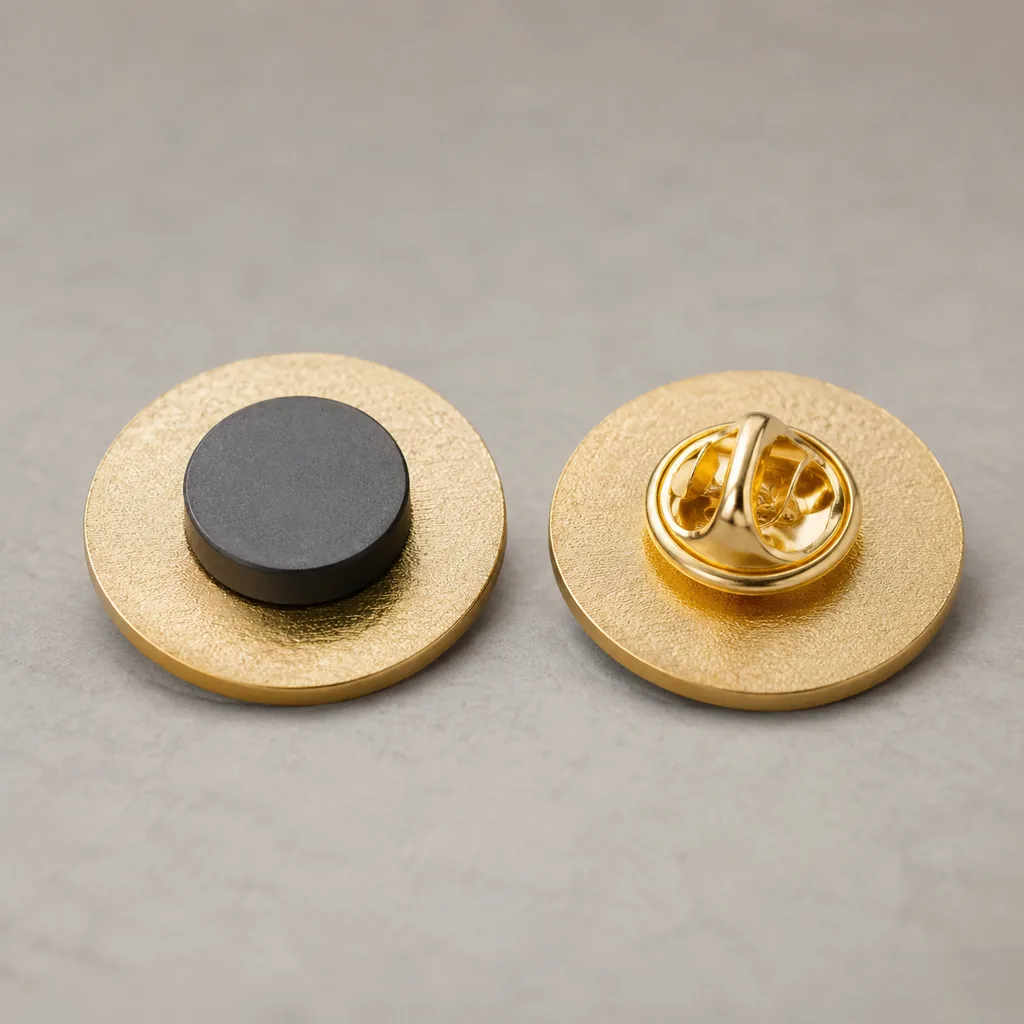
Why this comparison matters
Attachment choice is not a cosmetic detail; it changes who can wear the item, how it behaves on fabric, and how many returns you will eat after delivery. A clutch backing works on most lapels and thicker textiles, while a magnet backing solves holes in delicate garments but introduces slip risk on thicker layers and higher unit cost. If you are buying for retail, VIP gifting, or uniforms, the wrong backing can turn a good pin into a complaint.
The fastest way to avoid rework is to treat the backing as a defined spec, not a sample-room afterthought. For Chinese factory sourcing, that means stating magnet grade, plating, pin length, clutch material, pull force, garment thickness, and any no-damage requirement in the RFQ. ZheCraft often sees buyers compare only the front artwork and then discover too late that the attachment is the real constraint.
Spec table: magnet vs clutch at a glance
| Spec item | Magnet backing | Clutch backing |
|---|---|---|
| Typical use | Delicate fabric, uniforms, premium gift items | General-purpose lapels, jackets, hats, badges |
| Garment damage | No puncture; good for fine knits and silk blends | Creates holes; not suitable for fragile fabrics |
| Holding strength | Depends on magnet grade and steel keeper; 0.7-1.8 kgf common | Depends on post length and clutch friction; usually stronger against twisting |
| Bulk thickness | Usually thicker; adds 2.5-4.5 mm behind garment | Usually slimmer; adds about 1.5-3.0 mm behind garment |
| Unit cost impact | Higher; add about USD 0.05-0.25 per set | Lower; standard brass or iron clutch often included |
| Lead-time impact | Often 1-3 days extra if magnet assembly is custom | Usually no extra lead time unless specialty clutch is required |
| Failure mode | Slides off heavy fabric or when magnet faces misalign | Can loosen, snag, or pierce through thin fabric |
| Best for | Premium presentation, repeated wear on delicate clothing | Promotion, staff uniforms, retail pins, lower-cost programs |
Where magnets win and where they fail
Magnet backings make sense when the wearer must preserve the garment. That includes silk blouses, knitwear, rental uniforms, and formal wear where even a small hole is unacceptable. They also work well for temporary event wear, because they are easy to position and remove without touching the front finish with fingers too much.
The trade-off is physics. A magnet only performs well when the rear steel plate is large enough, the magnet grade is strong enough, and the total fabric stack is thin enough to let the magnet close cleanly. Once you move into thick wool coats, layered lanyard fabrics, or padded garments, slip risk rises fast and the pin can rotate or drop under motion.
- Specify magnet grade and target pull force, not just 'magnetic backing'.
- Use a larger steel keeper for wider or heavier pin bodies.
- Avoid magnets for thick outerwear unless you have tested the actual garment stack.
- Ask for anti-rotation features if the design has a long vertical body.
- Confirm the magnet will not interfere with cards, watches, or devices in the wear area.
Where clutches win and where they fail
Clutch backings remain the default because they are simple, slim, and predictable. For most brass or iron pins in the 20-30 mm range, a metal clutch or rubber clutch is enough to keep the item oriented correctly on woven fabric. They also simplify packing because the assembly is lighter and less bulky than a magnetic set.
But clutches create holes, and they can be a poor fit for thin, expensive, or damage-sensitive textiles. On very light fabrics, a stiff post can sag the pin forward, and on soft materials the clutch may work loose if the post length and barbed grip are not matched to fabric thickness. For frequent wear, you should also think about comfort: a long post can press into the skin if the item is worn directly on thin clothing.
If the brief calls for a low-cost, high-volume promotion pin, clutches usually remain the best answer. If the brief calls for a premium commemorative piece worn on formal clothing, the decision often shifts toward magnet even at a higher landed cost. The right choice is less about preference and more about how the item will be worn in the real world.
Spec details buyers should lock before sampling
The most common mistake is approving a front-side sample and leaving the attachment vague. For magnets, ask for magnet type, diameter or footprint, target pull force, and whether the assembly uses a single magnet or paired magnet-and-steel keeper. For clutches, specify post length, post diameter, clutch type, and whether you want butterfly, rubber, or deluxe locking versions.
Do not stop at wording like 'strong enough' or 'secure backing'. A factory needs measurable targets to avoid back-and-forth later, especially when plating, weight, and body size all change the effective balance of the pin. If the item has an unusually heavy top section or a long dangling element, attachment specs should be tied to the final assembled weight, not the artwork file alone.
| Item to specify | Magnet backing target | Clutch backing target |
|---|---|---|
| Pull or retention | 0.7-1.8 kgf typical; confirm on actual garment | Retention should hold through expected fabric thickness |
| Backing footprint | Match body size; larger for heavy tops | Post centered; clutch size matched to finish |
| Total rear thickness | Keep within wearer comfort limits | Minimize protrusion without weakening hold |
| Plating | Match front finish or use hidden steel keeper | Match front finish or use standard clutch finish |
| Testing condition | Actual garment stack, not paper or board | Actual garment stack, not paper or board |
Cost and lead-time trade-offs
In factory pricing, the backing choice affects more than the attachment line item. Magnet sets typically add material cost, assembly time, and sometimes packing complexity, especially if the rear keeper must be paired and aligned. In bulk orders, the difference is usually modest on a per-piece basis but meaningful across 5,000 to 20,000 units.
As a working range, standard clutch backings often add roughly USD 0.00-0.08 per set when the factory already stocks the component, while magnetic backings often add about USD 0.05-0.25 per set depending on size and magnet grade. Lead time for clutches is usually neutral; magnets can add 1-3 production days if the factory needs to source a specific size or test pull strength. If you are on a tight launch window, that extra buffer matters more than the per-piece delta.
One hidden cost is the sample loop. Magnet samples may need garment testing because a lab card test can look fine while a real blazer still slips. Clutch samples are easier to validate visually, but they still need wear testing if the item will be used on delicate or thin fabrics.
Failure modes that drive complaints
Magnet complaints usually come from slipping, misalignment, or a front-heavy pin that slowly rotates during wear. This gets worse with layered clothing, movement, and heavier metal bodies. If the item will be worn during events, performance testing should include walking, sitting, and leaning, not just static attachment on a table.
Clutch complaints usually come from puncture damage, loss of grip, and discomfort. A clutch that is too loose can fall off in transit or during wear, while a post that is too sharp or too long can irritate the wearer. For retail and employee programs, these issues are not theoretical; they show up as returns, replacement requests, and negative feedback about quality even when the front design is perfect.
The best way to manage risk is to define the actual use case. If the item is for formalwear or reuse across many outfits, magnets usually reduce damage risk. If it is for durable jackets, backpacks, or one-time promotions, clutches are simpler and more stable.
What to do next
Start by sorting your order into one of three buckets: delicate garment, general garment, or heavy outerwear. Then ask the factory for two backing samples on the same pin body, because side-by-side comparison on the real garment is the quickest way to see whether retention, comfort, and appearance all hold up. If you need a supplier-ready spec, lock the following before PO placement.
- Garment type and thickness range
- Target attachment type and acceptable alternatives
- Magnet grade or clutch type
- Rear thickness limit for wearer comfort
- Target pull force or retention expectation
- Any no-damage or no-puncture requirement
- Sample-test method using the actual garment
- Packing requirement for attachment separation or pairing
If you want the safest default, choose clutches for standard promotional pins and magnets for delicate apparel or premium gift programs. If you want the lowest rework risk, test both on the actual garment stack and write the chosen attachment into the final artwork approval sheet, not just the PO. That one step prevents most backing-related disputes later.
Have a project? Send your artwork and target quantity and we’ll reply with a detailed quotation within 12 working hours.
Ready to get this made?
Send your sketch, target quantity and ship-date. Detailed quotation in 12 hours.



