Low-MOQ Spec Sheet for Custom Pin Orders in 2026
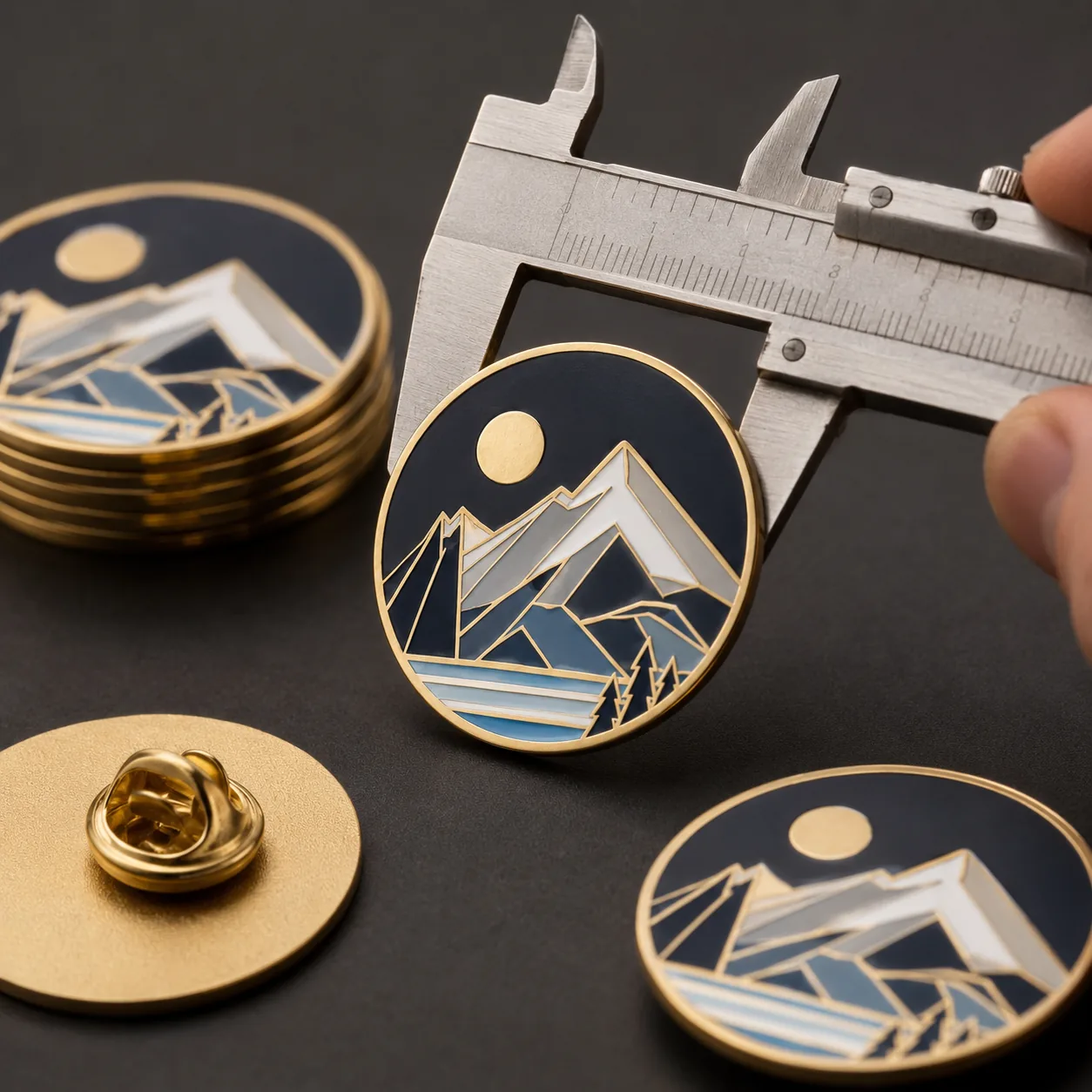
The spec line that breaks most 50-300 piece pin orders
On low-MOQ custom pins, artwork is rarely the root problem. The failures usually start in the RFQ: a buyer writes a specification suited to 5,000 pieces, while the factory is actually trying to make 50, 100, or 200 pieces where tooling amortization, plating drift, manual enamel fill access, and sorting labor have a much larger effect on unit cost and yield. That mismatch creates the familiar sequence: proof approved, engineering review re-quotes, then production shows flooded cutouts, weak lettering, underfilled enamel cells, off-center posts, or visible finish variation across the lot.
For 2026 sourcing, the goal is not to load every premium option into the spec. It is to define a small-batch-capable build: process, finished size, metal thickness, line-width minimums, color count, attachment geometry, finish, packaging, and QC language that a factory can actually hold at 50-300 pieces. When those lines are explicit, a 100-piece custom run behaves like a controlled pilot lot instead of an expensive experiment.
1) Choose the process by MOQ, artwork density, and finish expectation
The practical low-MOQ tiers for custom pins are usually 50, 100, 200, and 300 pieces per design. Below 50 pieces, many suppliers will still accept the job, but often by steering the buyer toward UV-printed construction or simplified artwork because die/tooling recovery is being spread over too few units. At 200-300 pieces, process choice broadens, first-pass yield improves, and price becomes more stable because setup loss and hand-sorting are a smaller share of total cost.
For most corporate, school, event, nonprofit, and promo pins at 50-150 pieces, stamped iron soft enamel remains the safest cost-performance default. A 25 mm stamped iron soft enamel pin, 1.5 mm thick, 1-4 colors, bright nickel, with one butterfly clutch, is commonly around USD 0.78-1.35 FOB China at 100 pieces, excluding expedited freight. The same size in imitation hard enamel is more commonly USD 1.15-1.95 FOB, while true hard enamel on brass typically lands around USD 1.70-2.80 FOB because firing, polishing, and reject risk on fine details all rise at low volume.
Use printed pins with epoxy dome when the design includes gradients, halftones, QR codes, photo elements, lines below 0.20-0.25 mm, or text below about 1.0-1.2 mm cap height. Use die-struck metal with no color for emblems, seals, service marks, and anniversary pins where relief alone carries the design. Use cast zinc alloy only when the shape needs deeper relief, sculptural form, thicker bridges, larger cutouts, or a non-planar outline that stamped sheet metal handles poorly.
| Process | Best MOQ tier | Typical FOB at 100 pcs | Lead time after proof approval | Best use case | Main engineering limit |
|---|---|---|---|---|---|
| Stamped soft enamel, iron | 50-300 pcs | USD 0.78-1.35 | 10-15 working days | Most logo, event, school, and promo pins | Avoid ultra-fine lines and many micro color cells |
| Imitation hard enamel | 100-300 pcs | USD 1.15-1.95 | 12-18 working days | Flatter premium face without kiln-fired true hard enamel | Narrow cells and micro text increase reject rate |
| True hard enamel, brass | 100-300 pcs | USD 1.70-2.80 | 15-22 working days | Premium jewelry-like finish and better wear resistance | Most expensive; still not suitable for extreme micro detail |
| Printed with epoxy dome | 30-200 pcs | USD 0.68-1.20 | 7-12 working days | Gradients, many colors, small text, photo detail | Epoxy can scratch, amber, or dome unevenly |
| Die-struck no color | 50-300 pcs | USD 0.62-1.10 | 10-14 working days | Seals, crests, antique finishes, text-forward emblems | Design must remain legible without enamel contrast |
| Cast zinc alloy | 100-300 pcs | USD 1.10-1.95 | 12-18 working days | 3D relief, thick profiles, large cutouts, irregular silhouettes | Often overspecified for standard flat lapel pins |
2) Set realistic dimensions, thickness, and minimum feature sizes
For apparel and lapel use, 20-30 mm is the most forgiving range. A 25 mm pin is the safest default: large enough to keep most logos legible, light enough for one-post wear, and efficient to plate, pack, and ship. Once size moves to 32-40 mm, the design usually needs two posts, edge contact damage becomes more likely, and low-cost loose polybag packing becomes less acceptable.
For stamped soft enamel, 1.5 mm finished thickness is the best general-purpose specification for low MOQ. At 1.2 mm, larger open shapes can feel light and may flex slightly. At 1.8 mm, hand feel improves on simple shapes, but cost, weight, and edge finishing time increase with limited functional gain unless the pin is deliberately positioned as premium merch. For cast zinc alloy, 2.0-3.0 mm is more typical because the process and form are different.
Most low-volume defects are avoidable if the RFQ includes conservative engineering limits. For stamped enamel pins at 50-200 pieces, use these practical minimums: raised metal line width 0.25-0.30 mm; recessed color cell width 0.50-0.60 mm; bridge width between cutouts 0.70-0.80 mm; free-standing projection width 1.0 mm minimum; and recessed or raised text at least 1.2 mm high, with 1.5 mm preferred for all-cap wording. If the artwork pushes below those thresholds, expect simplification, process change, or higher sorting losses.
Dimensional tolerances should also match the process. A reasonable small-batch standard is ±0.30 mm on overall width and height, ±0.15 mm on finished thickness, ±1.0 mm on post placement, and ±0.10-0.15 mm only for functional holes or slots. Decorative cutouts do not need precision-machined tolerances. Asking for tighter dimensions without a functional reason is one of the fastest ways to trigger re-quotation or delayed approval.
3) Specify metal and plating as manufacturing instructions
Iron is still the default base metal for low-MOQ stamped pins because die cost and unit economics are favorable. Brass strikes more cleanly, takes true hard enamel better, and is a stronger choice for fine die-struck detail, but for mainstream promo or event pins it often raises cost more than perceived value. Zinc alloy should be reserved for cast forms, not used as a generic premium substitute for a flat logo badge.
Plating should be called out by exact finish, not by vague color. Decorative pin plating is usually a thin cosmetic deposit, often around 0.03-0.10 micron depending on finish and supplier practice, not a heavy functional corrosion coating. In low-MOQ runs, bright nickel, black nickel, and antique silver are generally easier to keep visually consistent than imitation gold, which can shift from pale yellow to warmer tone depending on bath condition, clear topcoat, and base metal exposure at edges.
If an antique finish is specified, require clear protective lacquer. If the order may sit in storage for 90-365 days before distribution, ask for sealed polybags and carton-level desiccant to reduce tarnish and moisture spotting. For repeat programs, request that the supplier retain one approved plated control sample or finish swatch; decorative plating drift is common even when the supplier says the recipe is unchanged.
- Base metal: specify iron by default; use brass for true hard enamel or fine die-struck detail; use zinc alloy only for cast geometry
- Plating: call out the exact finish name, such as bright nickel, black nickel, imitation gold, antique bronze, or antique silver
- Lacquer: require clear lacquer on antique finishes and on orders expected to sit in storage for months
- Finish control: ask the supplier to keep one approved plated sample for reorder comparison
- Expectation: decorative plating is cosmetic; do not specify it like industrial corrosion-resistant plating
4) Control color count, Pantone expectation, and fill quality before approving the quote
At 50-200 pieces, color count directly affects setup time, touch labor, and reject exposure. One to four enamel colors is the most efficient range. Five to eight colors is still feasible, but often adds about USD 0.05-0.18 per piece at 100 pieces depending on size and process, and increases the risk of underfill, color contamination, trapped dust, and shade drift. If two brand shades are visually close on a 25 mm pin, consolidating them will usually improve both manufacturability and consistency.
Specify the front-face expectation according to process. Soft enamel should have raised metal lines standing above the color; it should not be described as flush or mirror-flat. Imitation hard enamel should have a smooth, polished front face with color leveled close to the metal height. True hard enamel should be specified as kiln-fired and polished, but still with allowance for minor edge pullback in narrow cells. Any compartment below about 0.50 mm width should be flagged for engineering review and is often better converted to print.
Pantone language also needs to be realistic. A practical note is: 'Pantone references are visual targets to coated standard; minor variation is acceptable due to enamel pigment, plating reflectivity, curing, and lighting conditions.' That avoids the common mistake of treating enamel like offset print. If brand perception is important, request one physical pre-production sample and approve it under 5000-6500K neutral light rather than debating on-screen mockups.
| Color spec item | Recommended low-MOQ standard |
|---|---|
| Enamel colors | 1-4 preferred; 5-8 only when artwork requires it |
| Smallest color cell | 0.50-0.60 mm minimum |
| Raised metal line width | 0.25-0.30 mm minimum |
| Text size | 1.2 mm minimum cap height; 1.5 mm preferred |
| Pantone note | Approximate visual match to coated standard, not exact print match |
| Color-critical orders | Approve 1 physical pre-production sample before mass run |
| Typical sample delay | Add 3-5 working days after tooling or print setup |
5) Engineer the back side: post layout, clutch type, and retention
A large share of low-MOQ complaints comes from the back side, not the face. Buyers approve the front art and then accept default post placement. That is how pins end up spinning, tilting, or sagging on fabric. For a 20-25 mm pin, one post with butterfly clutch is usually acceptable. Above 28-30 mm width, or on tall, narrow, top-heavy, or asymmetrical shapes, two posts should be the starting assumption.
Typical post diameter is 0.9-1.0 mm, with usable post length of 8-10 mm for standard apparel. Keep the post center at least 4-5 mm from the nearest edge unless the part is extremely small. For a two-post layout on a 30-40 mm pin, center-to-center spacing of 12-18 mm is usually workable. On asymmetrical designs, placement should follow center of mass rather than geometric symmetry; that one decision often reduces wear complaints more than upgrading the plating or adding thicker metal.
Butterfly clutch remains the base attachment for giveaways and events. Rubber clutch usually adds only USD 0.01-0.03 FOB per piece at 100 pieces and is often better for retail packaging because it is easier to handle and less likely to scratch adjacent items. Deluxe locking clutches generally add USD 0.12-0.25 and fit uniforms or repeated wear. Magnetic backings add about USD 0.25-0.60, increase thickness, and should be avoided for active wear, child-oriented products, and users with pacemakers or similar implanted medical devices.
| Attachment | Typical application | FOB adder at 100 pcs | When to specify it | When to avoid it |
|---|---|---|---|---|
| Single butterfly clutch | Pins up to 25 mm | Base option | Small standard lapel pin with balanced shape | Wide, tall, or top-heavy designs |
| Double butterfly clutch | Pins 28-40 mm | USD 0.03-0.08 | Larger pins or anti-rotation requirement | Very small pins where spacing is impossible |
| Rubber clutch | Retail and fashion use | USD 0.01-0.03 | Consumer-friendly handling and reduced scratching | Heavy pins needing maximum retention |
| Deluxe locking clutch | Uniforms and repeated wear | USD 0.12-0.25 | Higher retention and premium feel | Low-value event giveaways |
| Magnetic backing | No fabric piercing | USD 0.25-0.60 | Office wear or delicate fabrics | Active wear, children’s items, safety-sensitive users |
| Brooch bar with safety catch | Large badges and brooches | USD 0.10-0.25 | Wide decorative formats above typical lapel size | Small standard pins |
6) Watch the hidden cost drivers: backstamp, packaging, and export packing
On a 100-piece order, extras that look minor in email can move landed cost more than changing from iron to brass. A custom backstamp usually requires a separate die insert or extra tooling work and makes sense mainly for brand protection, licensing, or resale. Sequential numbering is rarely efficient below 300 pieces unless the pins support authentication, membership control, or limited-edition retail. For one-time events, internal recognition, and campaign giveaways, both are usually safe to remove.
Packaging should match the sales channel. Individual polybagging generally adds USD 0.02-0.05 per piece FOB. A printed backing card often adds USD 0.08-0.20 depending on size, coating, and print coverage; 300-400 gsm card stock is typical for retail. A velvet pouch commonly adds USD 0.20-0.45. A rigid gift box often adds USD 0.50-1.20, which is difficult to justify when the pin itself costs USD 0.80-1.20 FOB. If multiple SKUs are involved, standardizing one card size and one barcode position reduces both unit cost and packing error risk.
For export packing, ask for inner bags of 25 or 50 pieces, carton gross weight under 15 kg, and carton labels showing PO, SKU, quantity, country of origin, gross weight, and net weight. If ocean transit or humid storage is likely, require sealed inner bags plus 5-10 g desiccant sachets at carton level. On a low-MOQ order, a mispack of 10 pieces is material, so count control matters more than many buyers assume.
7) Use measurable QC language: AQL, cosmetic standard, and traceability
AQL is still useful on 100-300 piece orders, but defect definitions matter more than the abstract number. A practical default is AQL 2.5 major and 4.0 minor, with critical defects at zero acceptance. For custom pins, critical defects usually mean unsafe sharp points, detached or missing posts, plating burrs capable of cutting skin, wrong magnetic assembly where a magnet is specified, or loose parts that create a safety issue. Major defects include wrong plating, wrong color, unreadable text, missing attachment, severe enamel underfill, obvious front dent, wrong size outside tolerance, or incorrect packaging configuration. Minor defects include light backside polish marks, slight antique tone variation, or tiny front imperfections not visible at normal viewing distance.
The cosmetic inspection condition should be written in one line: front face viewed at approximately 30 cm under 5000-6500K neutral white light for 3-5 seconds, without magnification. That single sentence prevents many avoidable disputes. Back-side weld marks, swirl lines, and minor plating turbulence near posts are normal if they do not affect wear or function. If you demand jewelry-grade perfection on a promotional pin below roughly USD 1.50 FOB, the factory will either re-quote sharply higher or miss schedule while over-sorting.
For first orders, light process visibility is usually more cost-effective than third-party inspection. Require a photo of raw stamped or cast parts before plating, a photo of the first plated pieces, one image showing approved post layout against a ruler, and final packed-carton photos with count labels. Add one simple functional test in the spec: clutch fit verified on 5 pieces per 100, and post pull test to supplier standard, commonly enough to confirm the weld or adhesive bond is secure for normal wear.
- AQL target: critical 0, major 2.5, minor 4.0
- Dimensional tolerance: ±0.30 mm overall size, ±0.15 mm thickness unless otherwise agreed
- Cosmetic standard: front view at 30 cm under 5000-6500K white light, no magnification
- Functional checks: clutch fit, post alignment, burr inspection, attachment security
- Packaging checks: correct count, card orientation, SKU/barcode, country-of-origin marking where required
- First-order traceability: raw-part photo, first-plating photo, post-layout photo with ruler, final-carton photo with labels
Build the RFQ from the minimum viable spec, not the dream spec
For a low-MOQ custom pin order in 2026, the best RFQ is lean but explicit. At minimum, include quantity, finished size in mm, finished thickness, process, base metal, plating finish, number of colors, Pantone references if needed, attachment type and exact placement, packaging method, tolerances, AQL target, sample requirement, and requested ship date. Also state whether lead time is counted in working days or calendar days; suppliers use both, and the difference can easily add 4-6 real days on a two-week schedule.
If budget pressure forces simplification, cut in this order: rigid gift packaging, custom backstamp, excess color count, then overall size. Do not save cents by dropping a second post from a 35 mm pin, by forcing true hard enamel on a logo that works in soft enamel, or by approving detail below process limits and hoping production will solve it. For most 100-piece orders, the biggest cost avoider is early engineering review of line width, color cell size, bridge thickness, and post layout before tooling starts.
A competent factory should be able to mark up your drawing with minimum-line corrections, cutout warnings, post-placement revisions, plating-risk notes, and expected process substitutions before you approve the proof. That feedback is usually worth more than negotiating another USD 0.03 off the unit price. On small-batch pins, the right spec sheet is not paperwork overhead; it is the main control that keeps the order manufacturable, quotable, and repeatable.
Have a project? Send your artwork and target quantity and we’ll reply with a detailed quotation within 12 working hours.
Ready to get this made?
Send your sketch, target quantity and ship-date. Detailed quotation in 12 hours.



