Low-MOQ Mixed Metal Promo Sets: How Buyers Keep 4-SKU Orders from Falling Apart
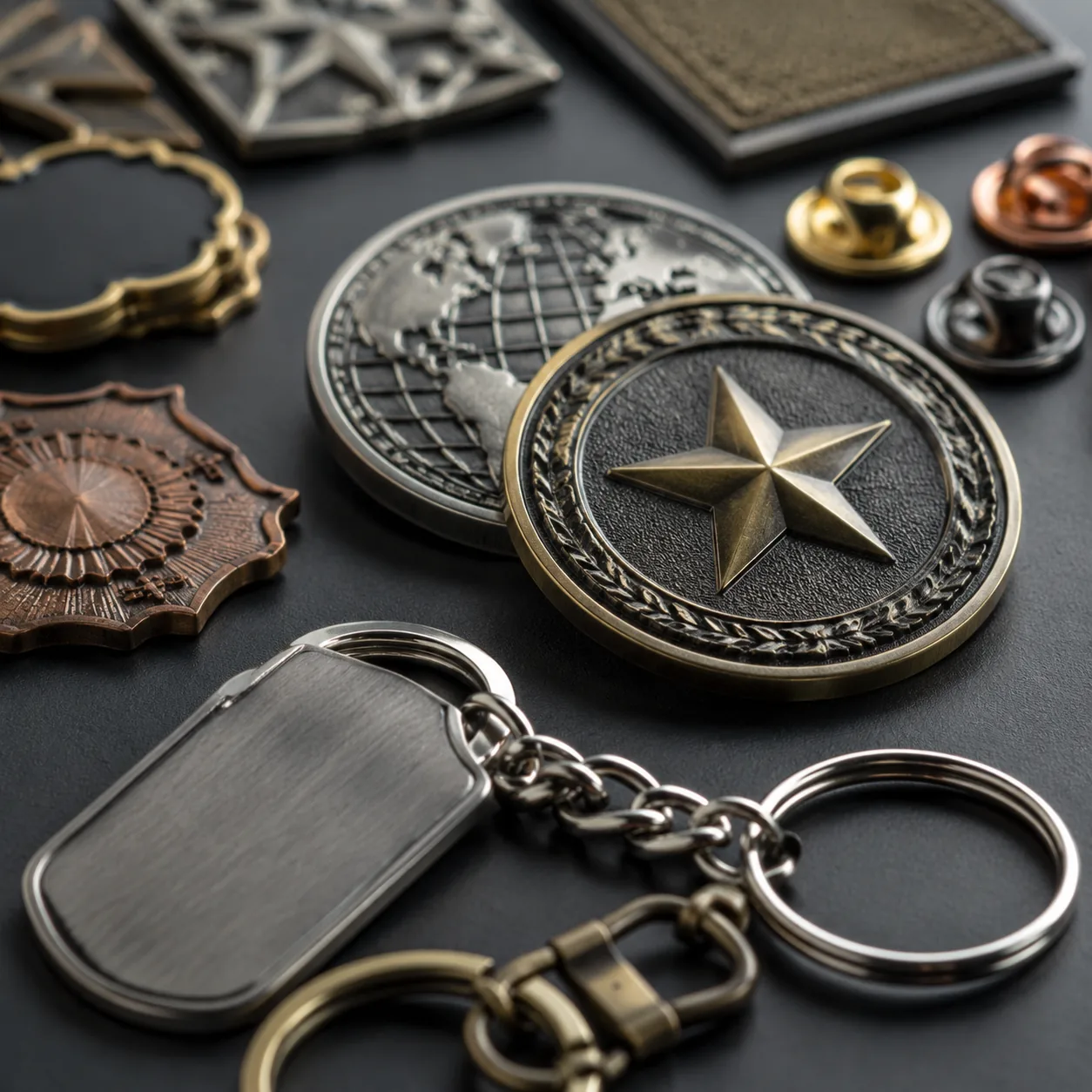
Why low-MOQ mixed metal sets fail when the individual SKUs look easy
A single custom pin or coin is usually straightforward. Problems start when a buyer combines 3 to 4 metal items into one assembled set at only 50 to 200 complete sets. At that volume, fixed setup and coordination risk dominate. Each SKU may need its own mold, plating rack arrangement, enamel fill sequence, hardware installation, and packing method, then all parts must be counted, matched, and hand-collated into one finished kit.
The order usually does not fail because a 32 mm pin or 55 mm coin is technically difficult. It fails because one component arrives late, short, scratched, misplated, or packed differently than expected. On a 75-set order, if four keychains are rejected for plating stains and three magnets fail bond strength, the shipment can no longer make 75 complete kits without rework or remake.
A common launch set might include a 32 mm soft enamel pin, a 50 mm die-cast keychain, a 57 mm challenge coin, and a 55 mm metal-face magnet. None is unusual alone. The disruption comes from inconsistent assumptions across SKUs: one item quoted in bright gold and another in imitation gold; one uses epoxy, others do not; one is iron stamped, another zinc alloy die-cast with visibly softer edge definition; one is bulk packed while the rest are pre-mounted. At low MOQs there is no scale buffer to absorb these mismatches.
That is why mixed-set sourcing is mainly a coordination job, not a unit-price exercise. Before PO release, procurement needs control at both SKU level and set level: tooling ownership, plating family, Pantone callouts, thickness, hardware, packaging flow, spare quantity, and whether one factory truly manages all steps or is subcontracting magnets, printed cards, or gift boxes. If even one element is outsourced, your real schedule becomes the longest subcontracted path, not the headline lead time on the quote.
What MOQ, lead time, and FOB pricing are actually workable in 2026
Buyers often ask for 50 complete sets and expect pricing close to a 300-piece single-SKU pin order. That is rarely realistic. At low quantity, mold charges, line setup, plating setup, color matching, sample approval, and hand assembly matter more than metal weight. For most 3- to 4-piece sets, 100 complete sets is the first stable MOQ where yield, pricing, and schedule become manageable.
Fifty sets can work if the design stays conservative: 2D relief, standard soft enamel or die-struck finish, one shared plating color, standard butterfly clutch or 25 mm split ring, and simple packing such as one backing card plus OPP bag. Once you add 3D relief, cut-outs, offset print, epoxy dome, spinners, rigid boxes, EVA trays, or multilingual inserts, the safer commercial MOQ usually shifts to 100 to 200 sets.
| SKU / set element | Typical workable MOQ | Pre-production sample lead time | Mass production lead time | Typical 2026 FOB range |
|---|---|---|---|---|
| Soft enamel pin, 32 mm, iron stamped or zinc alloy, 1.2-1.5 mm thick, 2 posts | 50-100 pcs | 4-6 days | 9-12 days | US$0.45-US$0.98 each |
| Keychain, 50 mm, zinc alloy die-cast, 3.0-4.0 mm thick, 25 mm split ring | 50-100 pcs | 5-7 days | 11-15 days | US$0.95-US$2.05 each |
| Challenge coin, 55-60 mm, iron or brass die-struck / zinc alloy die-cast, 3.0 mm thick | 50-100 pcs | 6-8 days | 12-16 days | US$1.45-US$3.25 each |
| Fridge magnet, 55 mm metal face, 1.2-1.5 mm face + ferrite or rubber magnet backing | 100 pcs | 5-7 days | 10-14 days | US$0.72-US$1.60 each |
| Assembly into 4-item set, card or tuck box | 50-100 sets | 1-3 days after parts approval | 3-5 days after all components complete | US$0.28-US$1.10 per set |
| Complete 4-item mixed set, retail-ready basic packing | 50-100 sets | 8-10 days total sampling | 15-22 days total production | US$4.40-US$10.20 per set FOB |
Those ranges assume production-ready vector artwork, standard plating such as bright gold, bright nickel, black nickel, antique silver, or antique brass, and standard export carton packing. They do not include DDP delivery, customs duty, tariff-inclusive landed cost, licensed artwork review, retail compliance testing, or third-party inspection fees. If the supplier is outsourcing boxes, magnets, or card printing, confirm that the quoted MOQ and lead time reflect the true bottleneck SKU, not just the easiest metal item.
Lock these set-level specifications before requesting quotes
The fastest way to create rework is to RFQ every item separately with no master set specification. Factories will fill gaps with their own defaults, and those defaults vary by workshop. One supplier may quote bright nickel as the default finish; another uses imitation rhodium; one factory interprets red as Pantone 186 C while another uses a warmer in-house enamel. On low MOQs, reducing ambiguity usually saves more money than negotiating another US$0.05 off one component.
- Use one plating family across all visible metal parts wherever possible: bright gold, bright nickel, black nickel, antique brass, antique copper, or antique silver. Mixing plating families increases scheduling complexity and makes the final set look less unified.
- Write actual dimensions and thicknesses, not 'standard': pin 1.5 mm, coin 3.0 mm, keychain 3.5 mm, magnet face 1.2-1.5 mm plus 2.0 mm magnet pad. For die-cast parts, state whether thickness excludes raised relief.
- Specify Pantone references for every enamel area and define practical acceptance as visual match under D65 or neutral white light at 30-50 cm. Exact instrument equivalence is unrealistic across different metals and finishes.
- Define hardware precisely: butterfly clutch or black rubber clutch, number and location of pin posts, split ring OD 25 mm or 30 mm, jump ring wire diameter 1.6 mm or 2.0 mm, and magnet format such as full-back rubber magnet or two ferrite pads 30 x 10 x 2 mm.
- State edge finish and surface treatment: polished edge, sandblasted recessed background, antique wash, brushed face, matte texture, or epoxy dome thickness such as 0.4-0.8 mm.
- Fix packaging at set level: bulk by SKU, individual polybag, complete set in OPP bag, slotted backing card, tuck box, or rigid gift box with EVA. At low volume, assembly labor typically adds US$0.20-US$1.20 per set before packaging material cost.
- State inspection standard in writing. AQL 2.5 major / 4.0 minor is common for promo sets; premium collector kits often tighten to AQL 1.5 / 2.5.
- Define logistics limits upfront if shipping to a 3PL or event venue: outer carton max 15 kg, inner pack quantity, barcode position, carton mark format, and pallet rules if required.
If appearance matters, ask the supplier to retain one approved plating swatch or one approved prior-production reference and one approved full-set image in the job file. That gives plating, coloring, QC, and assembly teams the same visual target instead of four separate interpretations.
Base metal and finish selection: coordinate the appearance, not just the metallurgy
Not every item should use the same base metal. Zinc alloy is usually the better choice for keychains, thicker relief, interior cut-outs, and irregular shapes because die-casting handles complex geometry and integrated loops well. Iron is often the lowest-cost choice for 2D stamped soft enamel pins with simple outlines. Brass usually gives cleaner fine-line die-struck detail than iron, especially on coins with narrow text or crisp border patterns, but at a higher material cost.
For low-MOQ promo sets, visual consistency is usually more important than forcing identical metallurgy across all SKUs. A black-nickel plated zinc alloy keychain, iron pin, and brass coin can still look coordinated if the polishing level, plating tone, background texture, and edge treatment are aligned. What may differ slightly is edge crispness, backside texture, and reflectivity. That is normally acceptable in promotional kits, though less acceptable in premium collector programs where tactile consistency is part of the perceived value.
There are exceptions. If you need mirror-polish reflectivity across all items, highly consistent fine-line die-struck detail, or a documented nickel-free program, simplify the design and define the requirement carefully. In some markets, nickel-free means no measurable nickel release from the finished surface. In others, buyers require no nickel layer anywhere in the plating stack. Those are different specifications with different process routes and costs.
The real cost drivers behind low-MOQ set pricing
The first cost driver is tooling fragmentation. A low headline quote can hide separate charges for each mold, each backing card die line, box setup, insert setup, and packaging revision. Practical 2026 tooling ranges for standard promo metalwork are roughly US$40-US$90 for a simple pin mold, US$60-US$140 for a keychain mold, US$70-US$160 for a 55-60 mm coin mold, and US$30-US$80 for a custom card die or slot layout. EVA trays and rigid boxes can add another US$80-US$200 in setup depending on structure and foam cut pattern.
The second driver is finish complexity. A set with bright gold on one item, antique silver on another, UV offset print on the coin, and epoxy on the keychain moves through more work cells and creates more handling points where scratches, dust, or color drift can occur. If the quote is based on bulk-packed loose SKUs rather than final assembled kits, the actual delivered cost will usually rise later.
The third driver is low-volume yield loss. On a 75-set job, even small reject counts matter. If three pins have weak posts, two magnets fail adhesion, and four keychains show plating burns or edge scratches, the supplier may have enough total pieces but not enough saleable matched sets. Ask whether pricing includes 100% hardware inspection, post-solder check, jump-ring closure check, and final complete-set count verification rather than only loose-SKU counting.
The fourth driver is packing labor. Hand insertion into a rigid box with EVA tray, tissue wrap, sticker seal, desiccant, and barcode can cost more than one of the simpler metal items inside. Always request a line-item breakout covering tooling, sample charges, unit FOB by SKU, packaging materials, set assembly labor, spare components, and export carton cost. Without this structure, supplier comparisons are misleading.
Sample in the right sequence to avoid duplicate cost and schedule slip
Do not start by requesting fully gift-packed samples of every item. That mixes product approval and packaging approval too early. If one SKU changes size or plating after review, the insert layout and outer pack may have to be redone. The better sequence is: first approve vector artwork with dimensions, Pantone codes, and hardware; second approve one pre-production sample per SKU, or at minimum detailed photo and video evidence with measurements; third approve one fully assembled golden set using confirmed production parts and final packaging.
For most low-MOQ projects, one pre-production sample per SKU plus one assembled golden set is sufficient. Sample charges are often creditable against mass production, but custom box and insert samples often are not. If timing is tight, ask for front and back photos, macro shots of enamel areas, plating close-ups, caliper readings, and packing photos before courier dispatch. That catches dimension or artwork errors the same day rather than after several days of transit.
Approval criteria should be numeric wherever possible. Practical examples: overall size tolerance ±0.20 mm for small stamped pins and ±0.30 mm for larger die-cast keychains; coin thickness tolerance ±0.15 mm; jump ring closure gap not more than 0.30 mm after closing; split ring OD tolerance ±0.50 mm; enamel surfaces free of obvious pinholes, overflow, or contamination at 30 cm under neutral indoor light; and no burrs or sharp edges that fail a normal finger-swipe safety check. For magnets, require 24-hour adhesive cure before packing and a manual peel test on the first article and during in-process QC.
If the order is launch-critical, require the factory to retain the approved golden set and timestamped approval photos in the production file. That reference should be available to plating, coloring, final QC, and assembly teams throughout mass production and on any repeat order.
QC points that determine whether complete sets can actually ship
QC for a mixed set is not just about the defect rate on each SKU. The practical question is whether enough complete kits can be assembled on time without cannibalizing components from other cartons. That makes in-process controls and final set verification more important than relying only on end-of-line AQL inspection.
| QC point | What to verify | Practical control target |
|---|---|---|
| Dimensions | Width, height, thickness, loop/post position | Typically ±0.20 to ±0.30 mm depending on SKU and feature |
| Plating consistency | Color tone versus approved reference, visible coverage on face and edges | No obvious cross-SKU tone mismatch at normal viewing distance |
| Enamel quality | Pantone accuracy, fill level, pinholes, overflow, dust points | No obvious defects at 30 cm under D65 or neutral indoor light |
| Hardware security | Pin post solder, clutch fit, jump ring closure, split ring hardness | No loose post; jump ring gap ≤0.30 mm; hardware functional |
| Magnet adhesion | Bond area, cure time, placement centering | 24-hour cure completed; no easy peel under manual test |
| Assembly accuracy | Correct SKU combination, orientation, insert version, barcode label | 100% complete-set verification before carton sealing |
| Spare policy | Extra components by SKU for loss/rework | 1%-3% spares or minimum 2-5 pcs per SKU on very small runs |
For standard promotional use, AQL 2.5 major and 4.0 minor is usually workable. For premium boxed kits, buyers often tighten to AQL 1.5 major and 2.5 minor and may add a third-party pre-shipment inspection. In both cases, complete-set verification is essential. A supplier can pass single-SKU inspection and still ship incomplete or mismatched kits if final collation control is weak.
Ask one more operational question that many buyers miss: when are spares added and at what level are they held? The safest answer is usually 1% to 3% spare components by SKU, retained until assembly closes, rather than packed loose into export cartons before the set count is confirmed.
When a mixed metal set is the wrong sourcing strategy—and what to send in the RFQ instead
A mixed set is the wrong choice when artwork is still changing, recipient counts are unstable, or packaging is undecided. Sets magnify indecision. If the event date, legal copy, QR destination, language version, or branded insert may still change, locking four custom components at once creates unnecessary obsolescence risk.
It is also a weak strategy when the budget target is too low for the intended product mix. If you want a 4-piece metal-heavy set below about US$3.00 FOB per set, the result is usually reduced thickness, lighter hardware, inconsistent plating, no meaningful spares, or minimal QC. In that situation, a hero-item strategy is often better: for example, one 38 mm soft enamel pin on a printed backing card plus one stock accessory or printed insert. That usually looks more deliberate than four under-specified custom pieces.
If you do proceed, send one RFQ pack for the full set, not separate category emails. Include a cover sheet listing all SKUs, required quantity in complete sets, ship-to country, in-hands date, Incoterm such as FOB Shenzhen, and whether you need bulk-packed components or final set assembly. Then attach one specification page per item covering artwork, finished size, thickness, base metal preference, plating, Pantone colors, hardware, backside requirements, and packaging notes.
Add a final page labeled non-negotiables: sample approval sequence, inspection standard, outer carton weight limit, spare policy, barcode rules, carton marking format, and whether tooling must be stored for reorders. Ask every supplier to break out tooling, sample charges, unit FOB by SKU, packaging material cost, assembly labor, and lead time by stage. The most reliable low-MOQ set is usually the one with fewer variables, not more items. Keep it to 2 to 4 pieces, unify plating and packaging, define tolerances numerically, and approve one assembled golden set before mass production. That is how buyers protect budget, schedule, and brand consistency without turning a small promo order into a large cleanup project.
Have a project? Send your artwork and target quantity and we’ll reply with a detailed quotation within 12 working hours.
Ready to get this made?
Send your sketch, target quantity and ship-date. Detailed quotation in 12 hours.



