Launching a Promo Set for a Trade Show: Spec It Once
The Order That Usually Goes Wrong
A trade-show promo set looks simple on the purchase order: one enamel pin, one keychain, one patch, one lanyard, and a backing card or box. In practice, the failure point is usually not decoration quality; it is inconsistency across the set. One item arrives in bright nickel, another in polished silver, the print density shifts between pieces, or the packaging does not hold the mix securely, so the campaign feels fragmented even when each SKU passes its own inspection.
The buyer problem is predictable. Marketing wants one campaign look, procurement wants one supplier, and the factory sees four product families with different tooling, finishing, and packing constraints. If you do not lock the set spec at the start, you end up approving individual samples that never quite belong together, then paying for rework, split shipments, or emergency replacement stock.
For mixed promo sets, treat the order as a small system, not a bundle of isolated items. That means writing one master specification, one approval standard, and one reorder reference before production starts.
Start With the Use Case, Not the SKU List
Define how the recipient will actually receive and use the set. A staff giveaway handed out at registration needs fast packing, low breakage risk, and presentation that survives carton stacking and transit vibration. A VIP gift set can justify a rigid box, tighter color matching, and more careful assembly because the unboxing moment matters more than unit cost.
The quantity mix should drive the spec. For a pilot, the practical range is usually 300 to 500 sets because every added SKU raises assembly complexity. Standard campaign runs are typically 1,000 to 3,000 sets. Reorders or multi-region launches often move to 3,000+ sets once the artwork is stable and packaging has been validated. If the same art will be reused, name one hero item that sets the visual standard, then align the other items to that reference instead of forcing identical process rules across everything.
A useful working rule is to choose the item that will be seen first by the end user and make that the anchor for finish, color, and perceived quality. If the pin is the hero, the keychain and patch should echo the same finish family and art tone; if the lanyard is the hero, the rest of the set should be designed to sit cleanly beside it in the box.
- Choose one hero item to anchor color and finish.
- Define whether the set is giveaway-grade or gift-grade.
- Fix quantity bands before asking for quotes.
- State whether all items ship assembled or as components.
- Confirm whether the campaign is one-time or reorderable.
Lock the Four Specs That Cause the Most Drift
Color, finish, thickness, and attachment strength create most of the mismatch between items. If the pin uses hard enamel with bright nickel while the keychain uses soft enamel with antique brass, the set will look like four unrelated products. For coherent sets, keep finish families close: bright nickel with bright nickel, matte black with matte black, or antique brass with antique brass. If a deliberate contrast is required, call it out explicitly and accept the visual break as part of the design.
Color tolerance should be written in measurable terms. For printed or filled items, ask for Pantone targets plus an agreed factory delta, typically within about ΔE 2.0 to 3.0 for campaign-grade work and tighter if the set is premium. For soft enamel, a practical production tolerance is about ±0.3 to 0.5 mm on line width and fill boundaries, depending on the design complexity. For metal badges and pins, overall size tolerance is commonly ±0.3 mm up to 30 mm parts and ±0.5 mm for larger pieces, with critical-fit features held tighter.
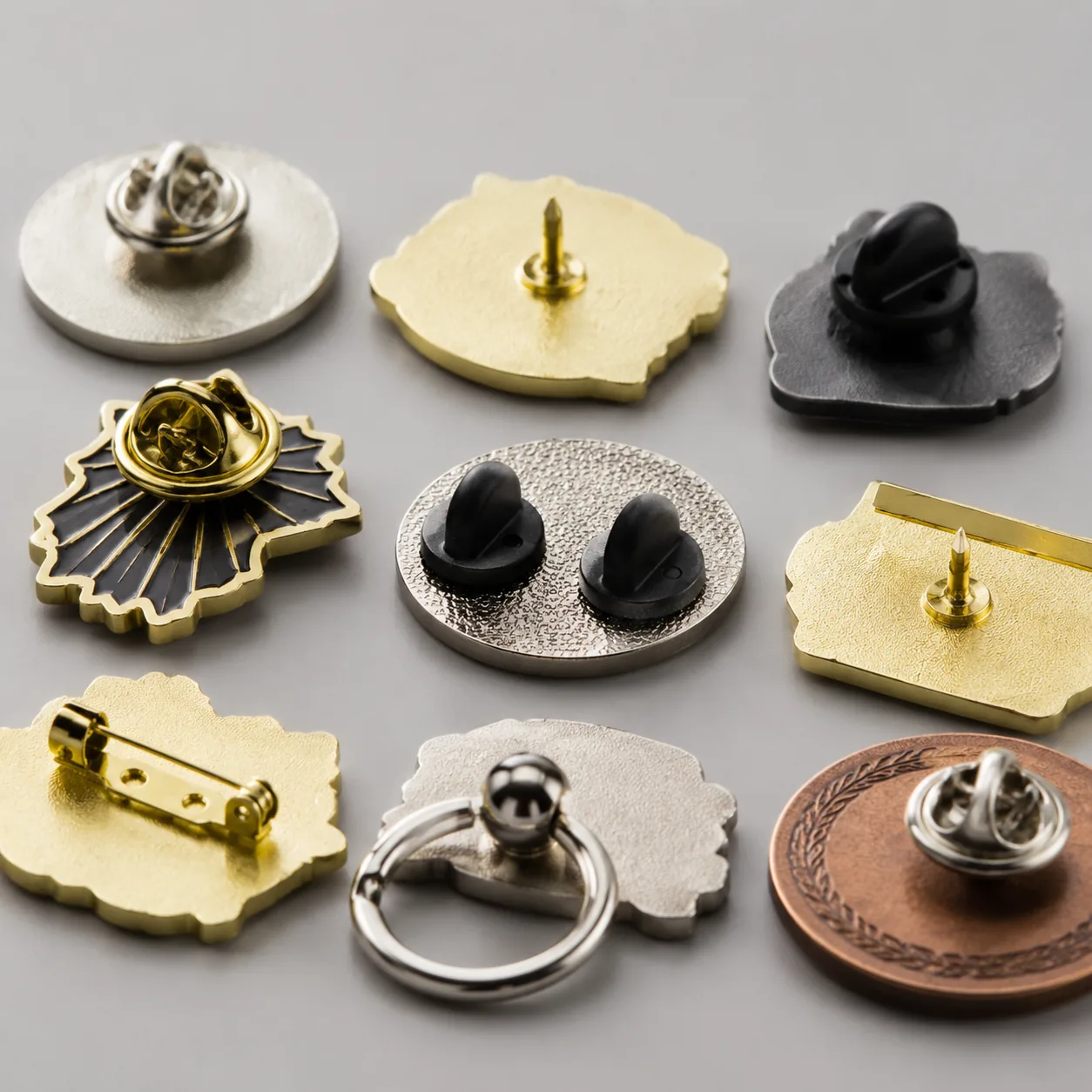
Thickness changes perceived value and balance. A 1.2 mm pin can look delicate next to a 2.5 mm keychain body unless the design language is intentionally different. For flat promo sets, typical workable thicknesses are 1.0 to 1.5 mm for pins, 1.5 to 2.5 mm for keychains, 1.2 to 1.8 mm for stitched or woven patches with edge binding, and 15 to 20 mm width for lanyards, with print or weave registration held to about ±1.0 mm. Hardware like split rings, lobster clasps, and badge clips should match in color and load rating; a 2.0 to 2.5 mm split ring and a 25 mm lobster clasp are common trade-show choices.
| Spec area | Recommended target | Typical tolerance / control | If ignored |
|---|---|---|---|
| Plating finish | One finish family across the set | Match vendor finish code; visual comparison under 4000K light | The set looks mismatched on camera and in hand |
| Color | Pantone target with agreed delta | ΔE 2.0–3.0 for campaign work | Brand colors drift between SKUs |
| Thickness | One visual weight band | Pins ±0.3 mm; larger parts ±0.5 mm | One item feels cheaper or heavier |
| Attachment strength | Matched to item load and use | Ring/clip pull test per SKU | Breakage, sagging, or returns |
| Packaging fit | One carton or box layout | No movement beyond 2–3 mm in tray | Scuffed finishes and bent cards |
Build the BOM Like a Production Engineer
A mixed promo set should start as one bill of materials, not four separate quotes. List the artwork file, dimensions, substrate, plating or print method, attachment type, packaging format, and carton target for each item. That lets the factory verify whether the lanyard clip, pin back, and keychain ring can be sourced in the same finish family and delivered in the same lead window.
For metal items, ask for the exact alloy or base metal. Zinc alloy is common for die-cast keychains and pins that need depth and cut lines; iron is often used for flatter stamped parts; brass or stainless can be justified when corrosion resistance or premium weight matters. For textile items, specify the fabric weight and construction: woven patches often run around 100 to 160 g/m² equivalent fabric weight, embroidered patches need a dense merrowed edge or laser cut, and sublimated lanyards commonly use 120 to 150 denier polyester with a 15 or 20 mm width.
Packaging changes the upstream schedule. Pins and keychains are usually packed after polishing and plating, while patches and lanyards may need separate bundling to avoid lint, creasing, or edge damage. If the final unit is a carded set or gift box, confirm whether assembly happens in-house or through a subcontractor. In many factories that choice affects lead time by 3 to 7 days, especially when the packaging insert or tray must be printed separately.
Specify the carton logic as clearly as the product logic. A set packed 1 kit per polybag, 50 kits per inner carton, and 200 kits per master carton is easy to count and rework. If the box is presentation-grade, call out the box board, insert material, and closure method so the factory does not substitute a loose tray for a fitted insert.
- Use one master BOM with item-level and set-level specs.
- State whether all items must share a finish family.
- Confirm who assembles the final set and where.
- Call out components that must not touch raw metal.
- Specify whether each unit ships pre-bagged or bulk packed.
Use a Spec Matrix Before You Approve Samples
The easiest way to control a multi-item campaign is to compare the items side by side before sample approval. A working spec matrix keeps the buyer focused on what must match and what may differ. It also prevents the common trap where each SKU looks acceptable alone but fails as a combined set.
| Item | Common build spec | Buyer watchout |
|---|---|---|
| Enamel pin | Zinc alloy or iron, 1.2 mm thick, 25–35 mm wide, bright nickel, soft or hard enamel | Check enamel fill level, edge crispness, and clutch retention |
| Keychain | Zinc alloy, iron, or brass, 1.5–2.5 mm thick, 35–50 mm body width, same finish family | Check ring strength, edge feel, and plating consistency |
| Patch | Merrowed or laser-cut, typically 70–90 mm, embroidered or woven construction | Check border consistency, curl, and thread density |
| Lanyard | 15–20 mm width, sublimated or woven, nickel-free hardware | Check print alignment, seam strength, and clip compatibility |
For most campaign buyers, this matrix is more useful than a generic sample approval note. It makes visible where each item can vary and where it cannot. If one item is intentionally allowed to differ, write the exception in the matrix instead of letting the factory improvise.
As a rule, a mixed set should be approved under one light source, on one table, with the items arranged as the end user will see them. That is the only way to catch the finish drift and color imbalance that individual SKU inspections miss.
Sample the Set as a Set
Single-item approvals are the classic trap. A pin sample can be perfect, a keychain sample can be perfect, and the set still fails because the plating tone shifts under the same lighting or the lanyard print is more saturated than the other components. Approval should happen with the full assembled set, not just the parts in isolation.
Use a simple sequence: first compare color and finish, then check mechanical fit, then review packaging. If the campaign requires reorders, lock the reference with exact dimensions, plating code, backing type, carton count, and assembly order. For mixed sets, keep one golden sample of each item plus one assembled master set. The individual samples protect the SKU details; the master set protects the visual relationship between them.
QC should include more than appearance. Ask for a pull test or retention check on the lanyard hardware, a clutch check on the pin back, and a ring-opening or tensile test on the keychain hardware. A practical supplier target for set-level packed goods is often AQL 2.5 for major defects and AQL 4.0 for minor defects, with tighter internal checks on the hero item if the brand is sensitive to finish variation.
- Review all items together under one neutral light.
- Approve individual samples and one assembled master set.
- Record exact dimensions, finishes, and attachment types.
- Keep the approved set as the reorder reference.
- Reject any item that breaks the visual hierarchy of the set.
Price, MOQ, and Lead Time Realistically
Mixed sets rarely price as a neat sum of catalog numbers. Tooling, assembly labor, packaging, and component sourcing all interact, so a low unit price on one item can disappear once set assembly and QC are added. For a typical trade-show set, realistic FOB pricing might be about USD 0.60 to 1.50 for a basic enamel pin, USD 0.80 to 2.20 for a keychain, USD 0.35 to 0.90 for a patch, and USD 0.25 to 0.70 for a printed lanyard component, before box assembly and freight. Premium finishes, hard enamel, or custom rigid boxes can push the total set higher.
MOQ should be negotiated at the set level, not just the SKU level. A factory may offer 100 to 300 pieces for a simple pin, but once you combine four SKUs plus kit packing, the practical pilot MOQ usually lands at 300 to 500 sets. Standard campaign MOQs often sit around 1,000 to 3,000 sets, while larger regional reorders can support 3,000+ sets if the component sourcing is stable and the art is frozen.
Lead times are usually longer than buyers expect because the slowest component controls the whole set. Typical sample lead times are 7 to 12 days for straightforward pieces and 12 to 18 days when packaging is custom. Production lead times are often 20 to 30 days for a simple mixed set, 25 to 35 days for a standard launch, and 30 to 45 days when the order includes rigid boxes, multiple decoration processes, or color-matched rework. If the order is time-sensitive, ask the factory to quote a critical-path schedule by step instead of a single blanket promise.
| Order type | Practical MOQ | Typical lead time | Common FOB impact |
|---|---|---|---|
| Pilot campaign | 300–500 sets | 20–30 days | Higher unit cost, lower inventory risk |
| Standard launch | 1,000–3,000 sets | 25–35 days | Best balance of tooling and packing cost |
| Regional reorder | 3,000+ sets | 30–45 days | Lower unit cost, tighter spec control |
A set-level price should always separate tooling, sample charges, production, assembly, and packaging. That is the only way to compare suppliers fairly and avoid a low headline quote that turns expensive after the assembly line is added.
What to Do Next
Before you send the RFQ, build one master sheet with artwork, dimensions, finish family, target Pantone references, packaging format, QC standard, and the approved quantity mix. Ask each supplier to quote the full set with separate line items for tooling, samples, production, assembly, and packaging so you can compare apples to apples.
If the campaign matters, request one assembled master sample before mass production and use that as the reorder anchor. The right supplier should be able to hold the finish family, manage the packing sequence, and keep the set coherent across repeat orders without forcing you to reapprove every SKU from scratch. The goal is not the cheapest single item; it is a set that arrives coherent, on time, and easy to reorder without surprises.
If you are comparing vendors, ask for a photograph of the assembled pre-shipment sample under neutral light, plus the carton packing plan and inspection standard. That small step catches most of the failures that show up too late in a trade-show timeline.
Have a project? Send your artwork and target quantity and we’ll reply with a detailed quotation within 12 working hours.
Ready to get this made?
Send your sketch, target quantity and ship-date. Detailed quotation in 12 hours.



