Launching 4 SKUs at 100 Units Each Without MOQ Pain
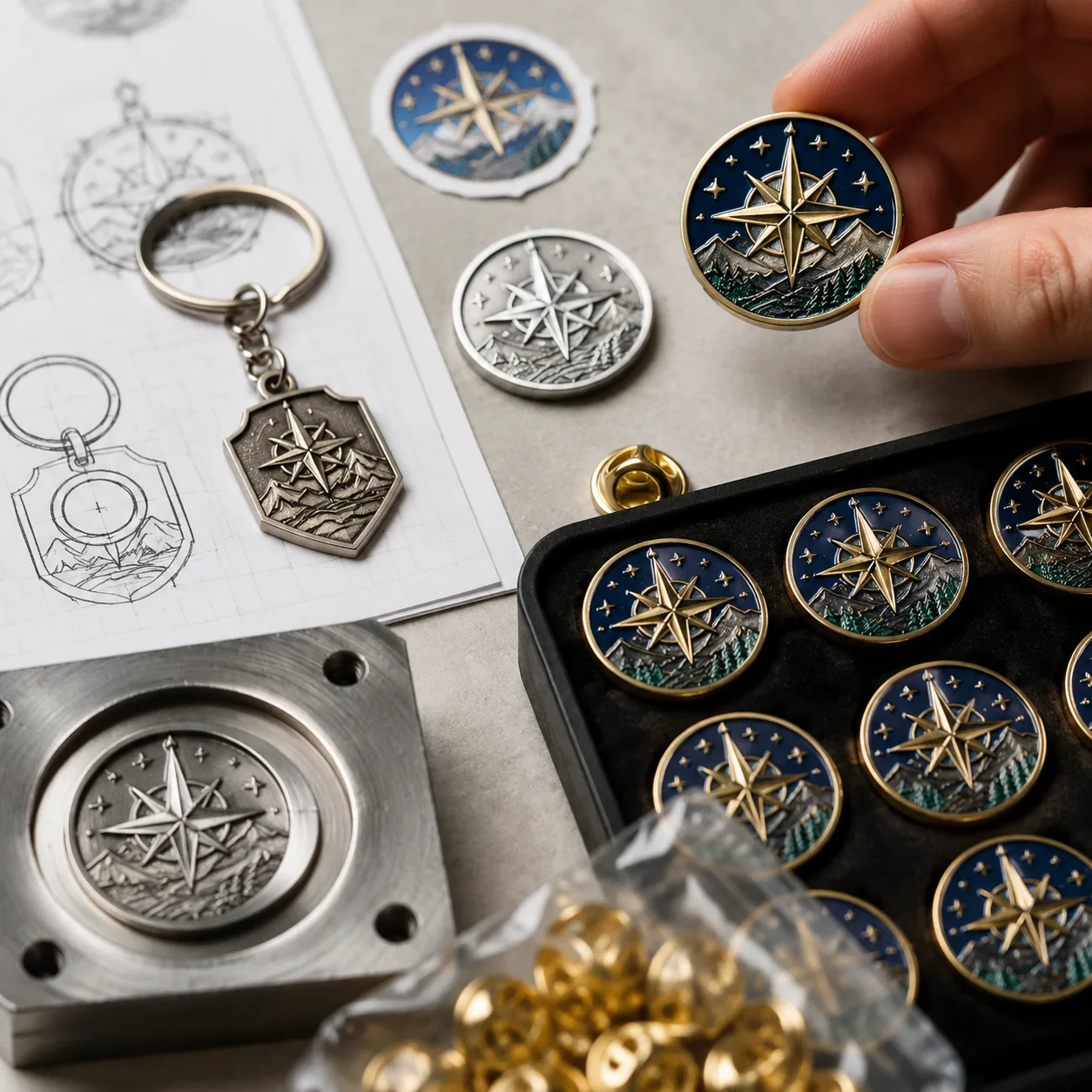
The constraint is not capability. It is low-volume economics and one fixed launch date.
Most established promo-product suppliers can produce a soft enamel pin, zinc alloy keychain, challenge coin, and woven patch. The difficulty at 100 units per SKU is not whether the factory knows the process. It is whether the project can be engineered and scheduled as one 400-piece launch program instead of four separate mini-jobs, each with its own tooling charge, proof cycle, packing logic, and production queue.
A realistic 2026 brief might be 100 soft enamel pins, 100 die-cast zinc alloy keychains, 100 challenge coins, and 100 woven patches, all aligned to one event date in 32 calendar days, with a target budget below USD 1,200 FOB. That target is achievable, but only if the buyer controls three variables early: feature complexity, handling labor, and the lead time of the slowest SKU. On projects this small, a single premium requirement such as individual retail cards, sequential numbering, or a 3D coin face can absorb the margin that was supposed to pay for the rest of the set.
Small mixed-SKU launches usually fail in predictable ways. First, each product family has different MOQ and setup logic; the patch may have little or no tooling, while the keychain and coin need new molds or dies. Second, production calendars do not match; a woven patch can often clear in 7-9 working days, while a coin may need 12-18 working days after proof approval. Third, packing becomes the hidden bottleneck. Polybagging, backing-card insertion, barcode labeling, and mixed-set kitting can add 1-4 working days even when the manufacturing itself is finished.
The practical approach is to design the order as one low-volume launch package: standard sizes, standard hardware, one plating family, minimal hand assembly, and artwork adapted to each process instead of forcing one exact graphic treatment onto all four materials. At 100 units per SKU, buyers rarely get maximum complexity, fastest lead time, and lowest cost at the same time. One of those three must give.
1) Rebuild the brief for 100-piece manufacturability, not for screen-perfect artwork
At this volume, manufacturability matters more than visual ambition. The first decision should be whether each design can run on standard tooling with acceptable yield and low hand rework. Features that often become uneconomic at 100 units include 3D coin sculpting, keychains above 60 mm, narrow internal cutouts under 1.0 mm, multi-part assemblies, tiny woven copy, glitter plus epoxy combinations, and retail packing that requires manual sort-and-pack.
A stable low-MOQ specification usually looks closer to this: soft enamel pin at 25-35 mm, 1.2-1.5 mm thickness, iron or brass base, 4-6 Pantone colors, one butterfly clutch; zinc alloy die-cast keychain at 45-50 mm, nominal 3.0-4.0 mm body thickness, one 25 mm split ring with a 25-30 mm short chain; challenge coin at 38-45 mm diameter, 2.0 mm nominal thickness, 2D relief, plain edge or rope edge; woven patch at 60-80 mm, 50D-75D yarn, 4-6 thread colors, merrow edge for regular shapes or heat-cut edge for custom outlines. These are the dimensions where most factories can keep yield and handling predictable.
Artwork translation needs explicit minimum-feature rules. For metal dies, keep recessed line width at or above 0.30-0.35 mm and raised metal lines at 0.25-0.30 mm minimum. For soft enamel, avoid isolated color islands below about 0.60 mm and text under roughly 1.2 mm cap height unless it is redrawn into simplified bold forms. For woven patches, positive text should be at least 1.2 mm high, with negative gaps around 0.8 mm or larger. If the art falls below those limits, digital proofs may still look clean while actual output suffers from fill inconsistency, blurred copy, plating bridges, or increased sorting rejects.
| Item | 100-pc spec that usually works | Spec that often becomes uneconomic at 100 pcs |
|---|---|---|
| Soft enamel pin | 25-35 mm, 1.2-1.5 mm thick, 4-6 colors, 1 post under 30 mm or 2 posts above 30 mm, standard polybag | Over 45 mm, 8+ colors, glitter + epoxy, sliding parts, custom rubber clutch, card insertion by hand |
| Metal keychain | 45-50 mm zinc alloy, 3.0-4.0 mm average thickness, one chain, one 25 mm split ring | Spinner, hinge, bottle-opener feature, two connectors, custom colored hardware, oversized 60+ mm body |
| Challenge coin | 38-45 mm, 2D relief, 2.0 mm thick, plain or rope edge, bulk packed | 50+ mm, 3D sculpt, cutouts, edge text, sequential numbering, capsule or velvet box packing |
| Woven patch | 60-80 mm, 4-6 colors, merrow or heat-cut edge, plain back or iron-on | Tiny text below 1.0-1.2 mm, metallic thread, hook-loop plus retail card, complex laser-cut points |
2) Cost the program by tooling, unit rate, and packing labor before comparing FOB piece price
For 100-piece runs, tooling and handling often matter more than raw unit rate. Many buyers compare only the FOB piece price and miss that one additional mold, one special attachment, or one inserted backing card can add more to project total than changing the pin base metal from iron to brass. The clean way to quote is to separate one-time tooling, repeatable unit price, and manual packing cost for each SKU.
Typical 2026 FOB pricing for standard 100-piece runs is approximately: soft enamel pins at USD 0.90-1.45 each plus USD 35-70 tooling; zinc alloy keychains at USD 1.35-2.25 each plus USD 55-100 mold cost; 40 mm challenge coins at USD 1.65-2.85 each plus USD 50-95 die cost; woven patches at USD 0.55-1.05 each with USD 0-25 setup on simple artwork. A one-sided 300-350 gsm printed backing card usually adds USD 0.10-0.18 each; double-sided laminated card runs about USD 0.18-0.32. Barcode labels add roughly USD 0.03-0.06 each. Hand-kitted mixed sets typically add USD 0.12-0.28 per set depending on insert count, fold/seal steps, and whether count verification is done during kitting.
MOQ tiers matter because they show how quickly tooling gets diluted. A pin at USD 1.15 each plus USD 50 tooling is effectively USD 1.65 FOB at 100 units before added packing, but around USD 0.87-1.22 all-in at 300 units depending on the revised rate, and lower again at 500. Even if the buyer only needs 100 now, asking for 100, 300, and 500 tiers reveals whether a later reorder will materially improve economics or whether the supplier is already pricing the first run at floor margin.
| SKU | 100 pcs FOB unit range | Typical tooling/setup | 300 pcs FOB unit range | 500 pcs FOB unit range |
|---|---|---|---|---|
| Soft enamel pin | USD 0.90-1.45 | USD 35-70 | USD 0.62-1.00 | USD 0.52-0.88 |
| Zinc alloy keychain | USD 1.35-2.25 | USD 55-100 | USD 0.98-1.65 | USD 0.84-1.42 |
| Challenge coin | USD 1.65-2.85 | USD 50-95 | USD 1.12-1.98 | USD 0.96-1.72 |
| Woven patch | USD 0.55-1.05 | USD 0-25 | USD 0.36-0.75 | USD 0.29-0.63 |
On a USD 1,200 FOB target, the safest structure is one hero SKU and three controlled support SKUs. For example, let the pin carry the custom backing card and highest color detail, while the keychain, coin, and patch stay on standard bulk or simple polybag packing. If every SKU is specified as premium, the cost usually comes back later as rush surcharges, downgraded QC tolerance, or a missed ship window.
3) Standardize finishes, hardware, and packaging so the set behaves like one program
Low-volume projects get expensive when each SKU behaves like a separate engineering experiment. Standardize anything the end user is unlikely to value enough to justify extra setup. On metal goods, keep all items in one plating family such as bright nickel, black nickel, antique brass, or imitation gold. Mixing bright nickel on the pin, antique silver on the keychain, and dual-plated gold/nickel on the coin increases changeover, approval time, and appearance variation across one small order.
Hardware should follow the same logic. Use standard butterfly clutches for pins, one standard chain-and-ring combination for keychains, and bulk or simple OPP bag packing unless shelf display is genuinely required. Custom rubber clutches, lobster clasps, velvet pouches, acrylic capsules, and individually inserted cards are all possible, but on 100-piece quantities they often add disproportionate labor cost and 1-3 working days of handling.
The strongest low-MOQ briefs align the set around one visual system: one plating tone, one approved logo lockup, one reduced Pantone palette, one approved front-facing orientation, and one packing format. That makes quoting faster, proofing cleaner, and replenishment simpler if the buyer later moves to 300 or 500 units.
- Keep plating consistent across the pin, keychain, and coin.
- Use the same Pantone references on all proofs, while accepting that enamel, thread, and print will not match exactly.
- Limit soft enamel and woven color count to 4-6 unless the artwork truly requires more.
- Use standard hardware unless the attachment is part of the product function.
- Reserve premium retail packing for the hero SKU, not the whole set.
- Ask the supplier to quote any manual insertion, labeling, or kitting as a separate line item.
4) Build one master artwork pack, then engineer process-specific versions
Mixed low-volume orders often lose more time in artwork engineering than in production. A logo can look sharp on screen but fail in die-struck metal or weaving because of hairlines, transparency effects, gradients, unsupported points, and very fine negative space. At 100 units, every redraw cycle matters because engineering time is spread over very little volume.
The best method is one master production sheet plus one adapted file per SKU. The master sheet should lock overall dimensions, Pantone references, border shape, text content, plating finish, hardware style, and packing assumptions. Then each process gets its own engineered version: enamel separation and post position for the pin, die map and attachment point balance for the keychain, front-and-back relief map for the coin, and weave simplification with edge method for the patch. This avoids a common failure mode where one SKU is approved first and only later the team discovers the same sharp corner creates a weak heat-cut patch tip or a twisting problem on the keychain.
Tolerance language should stay realistic for promo-grade production. For printed backing cards, registration tolerance of +/-1.0 mm is practical. For metal items below 50 mm, overall size tolerance of +/-0.5 mm is typical. For a coin at 2.0 mm nominal thickness, +/-0.15 mm is achievable on standard production. For woven patches, overall size tolerance of +/-1.5 mm is more realistic, especially on custom outlines. Demanding luxury-goods precision on budget promo goods usually creates disputes rather than better output.
If one supplier is producing all four categories, require one consolidated proof pack and one formal approval round. That is not only administrative convenience. It forces cross-process engineering feedback before tooling is cut, when changes are still cheap.
5) Set measurable QC criteria: AQL, tolerances, finish standards, and count control
A 100-piece-per-SKU order does not need a complex inspection manual, but it does need measurable acceptance criteria. The defects that most often damage small launch sets are visible plating or enamel defects, weak attachments, wrong counts, shallow coin relief, unreadable woven text, irregular patch edges, and pack-out mistakes that are discovered only after arrival.
For metal products, AQL 2.5 for major defects and 4.0 for minor defects is a practical baseline. Major defects should include missing enamel, detached split rings or clutches, accessible sharp burrs, severe plating burns on front-facing areas, wrong finish, wrong artwork, bent product beyond tolerance, or obvious underfill that changes the design. Minor defects can include light backside scratches, small polishing marks, or slight color variation within process limits when viewed at approximately 50 cm under normal indoor light. For woven patches, major defects include wrong shape, broken border, thread breaks affecting readability, incomplete merrow, unreadable text, or failed iron-on backing adhesion. Minor defects include small edge fuzz, slight thread shade shift, or loose trimming that does not affect use.
Plating specifications should also be realistic. Exact micron guarantees are uncommon at this price level unless the order is specified more like jewelry hardware than promo merchandise. A more useful requirement is consistent appearance, no exposed base metal on front-facing surfaces, and no blistering or peeling after normal handling. If a supplier does quote plating thickness, decorative flash nickel or imitation gold may be around 0.03-0.05 microns, while heavier decorative nickel can be around 0.5-1.0 microns. For this category, adhesion, coverage, and appearance consistency matter more than a nominal micron figure alone.
- Request a pre-production photo set for each SKU: front, back, side profile, and attachment detail.
- Specify deburring: no sharp accessible points or burrs on edges, posts, rings, or coin rim.
- Set coin thickness tolerance at +/-0.15 mm for nominal 2.0 mm coins.
- Define minimum readable text size for the woven patch before approval.
- Require pull-checks on keychain rings, pin posts, and patch backing adhesion before mass pack-out.
- Require count verification by SKU before carton sealing, especially for mixed packs or kitted sets.
- Ask for final carton data: SKU count, carton dimensions in cm, gross weight, net weight, and carton marks.
6) Build the schedule backward from the in-hands date, not from factory lead time alone
If the event is 32 calendar days away, the factory does not truly have 32 days. In practice, 2-3 days can disappear into quote confirmation, artwork cleanup, and commercial alignment; another 1-2 working days into proof approval; 7-18 working days into production depending on the slowest SKU; 2-4 working days into packing and export handling; and 4-8 calendar days into air transit and customs clearance. That leaves almost no slack for redesign, corrected proofs, or rework.
After final proof approval, realistic lead times for standard low-MOQ runs are usually 7-10 working days for woven patches, 10-14 working days for soft enamel pins, 10-15 working days for zinc alloy keychains, and 12-18 working days for challenge coins. Coins are often the pacing SKU because die preparation, polishing, plating, and relief appearance control take longer than patch production. Add 2-4 working days if the order includes custom cards, barcode application, set bundling, or any hand-insert assembly.
A workable backward plan for a 32-day launch looks like this: days 1-2 for RFQ confirmation and PO alignment; days 3-4 for art cleanup and proof issue; day 5 for final approval; days 6-15 for patch production; days 6-18 for pin and keychain production; days 6-21 for coin production; days 22-23 for final QC and count verification; days 24-26 for packing, labeling, and export handover; days 27-32 for air shipment, customs clearance, and delivery buffer. If production-ready artwork is not available on day one, the schedule becomes fragile immediately.
One useful control tactic is staged completion. Ask the supplier to inspect, pack, and cartonize each SKU as soon as it clears QC rather than waiting for all four categories to finish before beginning any pack-out. That will not shorten the coin lead time, but it reduces end-of-line congestion and preserves the option to split-ship one delayed SKU if the event can tolerate it.
7) Choose the sourcing model by deadline risk and coordination load, not just line-item price
One factory for all four items is not automatically the lowest-cost route. A specialist patch supplier may quote lower on patches, and a coin specialist may offer cleaner relief or slightly lower die cost on standard military-style coins. But those savings often shrink once duplicate freight minimums, multiple payment cycles, separate proof chains, and internal coordination time are included. On a 32-day deadline, coordination risk is a real cost.
Bundling usually makes the most sense when the launch date is fixed, artwork is shared, packing must be coordinated, and the buyer wants one accountable QC owner. Category specialists make more sense when the deadline is looser and the primary objective is best unit economics by SKU. A trading company can help if the buyer wants one commercial contact without directly managing several factories, but process transparency and engineering feedback are often weaker than with a capable direct supplier.
| Buying route | Best for | Main risk |
|---|---|---|
| One mixed-process factory | Tight deadlines, shared artwork, coordinated packing, one QC owner | One category may not be the lowest unit price |
| Category specialists | Best probable unit cost by SKU, deeper single-process expertise | Higher admin load, proof mismatch, split freight, schedule risk |
| Trading company managing multiple factories | One commercial contact without direct supplier management | Lower technical transparency and slower engineering feedback |
What to do next: force a side-by-side commercial decision before issuing the PO
For a 4 x 100 launch set, issue one concise item sheet per SKU plus one master sheet for the full program. Each item sheet should state size, thickness, finish, attachment, color count, backing, packing method, target FOB range, and required ship date. The master sheet should define the common plating family, shared logo system, approved Pantone references, and any process limits already accepted by the buyer.
Then require the supplier to quote two versions side by side: the original concept and an optimized low-MOQ version. The quote should show MOQ tiers at 100, 300, and 500 units; tooling separated from unit price; lead time by SKU in working days; packing assumptions; carton estimates; and any feature likely to reduce yield. That comparison usually surfaces the real cost drivers quickly: oversized coin diameter, custom attachments, premium packing, tiny woven text, or detail below process limits.
Finally, rank the three project priorities before placing the order: date, budget, or complexity. If date is first, simplify finishes and remove manual assembly. If budget is first, make one item the hero and standardize the rest. If complexity is first, accept tooling-heavy pricing and a production window closer to 15-20 working days on the slowest SKU. That discipline is what turns a stressful 4-SKU launch into a controlled low-MOQ program instead of four rushed prototype jobs.
Have a project? Send your artwork and target quantity and we’ll reply with a detailed quotation within 12 working hours.
Ready to get this made?
Send your sketch, target quantity and ship-date. Detailed quotation in 12 hours.



