Lanyard Hardware Specs: Breakaways, Clips and Badge Holders
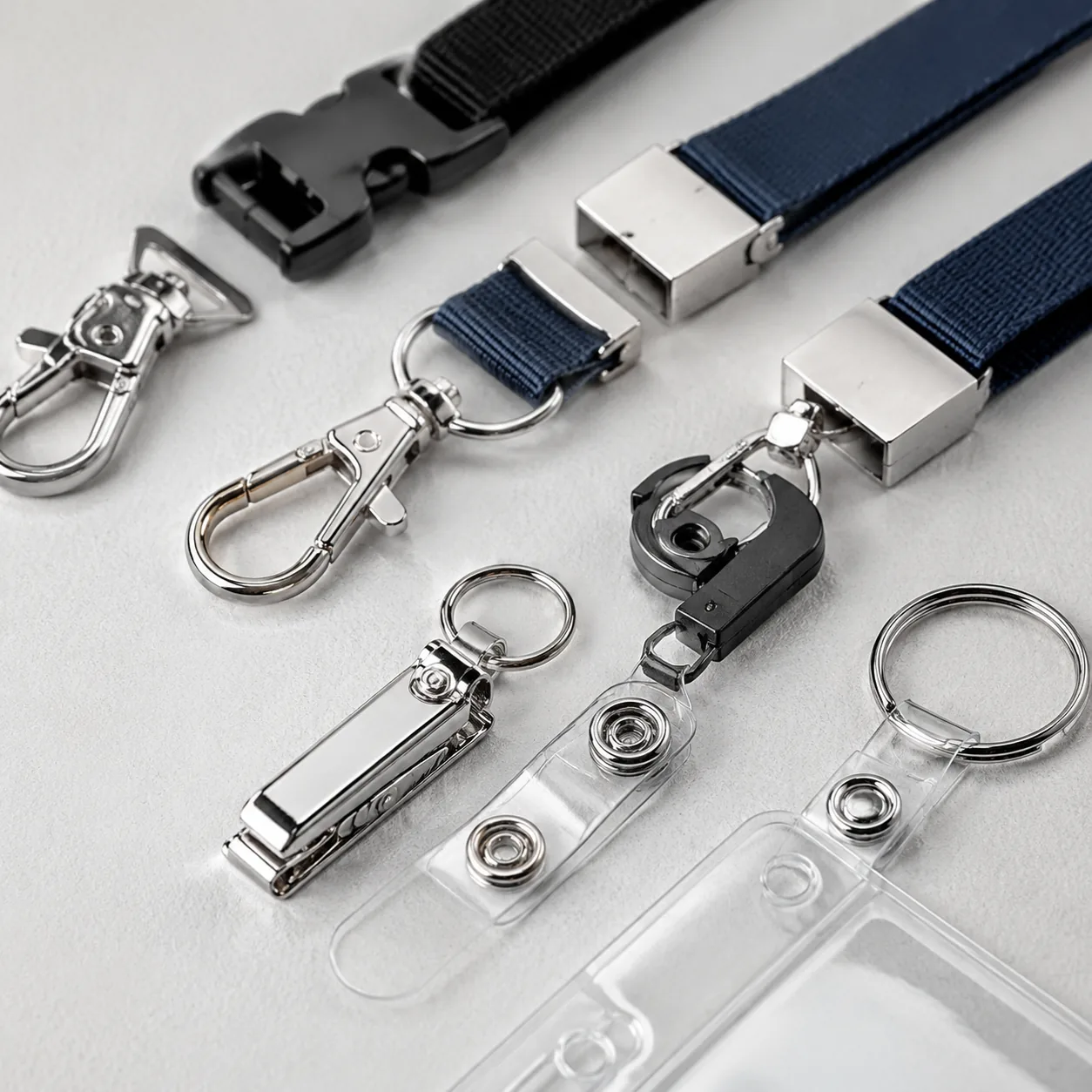
Why badge failures start with the hardware spec
A lanyard order can have correct artwork, accurate Pantone matching, and clean print registration, then still fail at check-in. The usual weak points are not the polyester strap. They are thin swivel hooks that open under load, non-breakaway neck straps used in unsafe settings, brittle badge holders, and punched slots that tear after a few hours of movement.
Treat the lanyard as an assembled product, not a printed ribbon with accessories. A useful RFQ states strap width, finished length, attachment type, breakaway release force, badge weight, holder format, holder film thickness, packing method, and inspection standard. Changing a hook from economy wire to heavy-duty zinc alloy can add only a few cents, but it may also change lead time, carton weight, and the way the badge hangs on the chest.
As a practical baseline, most event lanyards use 15 mm, 20 mm, or 25 mm polyester or RPET webbing, with 0.8 to 1.2 mm strap thickness. Standard badge inserts are often 86 x 54 mm for card-size credentials, 100 x 70 mm for small event passes, or A6-size for conference agendas. A 10,000 piece order using stock 20 mm polyester webbing, one metal hook, one breakaway, and a common PVC holder normally requires 12 to 20 production days after sample approval. Colour-matched plastic parts, custom holder dies, woven straps, or mixed accessory kits can push production to 20 to 30 days.
Start with badge weight, duration, and risk setting
The attachment should be selected after the finished badge load is known. A paper insert in a light PVC sleeve may weigh 8 to 15 g. A laminated RFID card with a holder, meal voucher, and printed agenda insert can reach 25 to 45 g. A VIP pouch, hotel key, or metal charm can take the assembly above 60 g. Low-cost hooks may pass a quick visual check but deform when a heavy badge swings all day.
For indoor one-day conferences, an attachment static pull capacity of 1.5 kg for 10 seconds is usually adequate when the badge weighs under 25 g. For trade shows, schools, factories, logistics teams, outdoor queues, or multi-day staff passes, specify at least 2.5 kg static pull capacity and a swing or wear simulation using the actual holder. For heavy credential pouches above 50 g, specify 3.5 kg minimum static pull or use double-ended clips to distribute the load.
Do not overspecify strength where safety release matters. In schools, factories, warehouses, transport events, healthcare sites, and venues with moving barriers, the breakaway should release before the strap or metal clip becomes the failure point. Common production tolerances are ±5 mm on finished strap length, ±1 mm on strap width, ±1.0 mm on standard holder outside dimensions, and ±0.2 mm on punched slot position for PVC holders.
| Use case | Typical badge load | Recommended strap | Recommended hardware | Main failure to control |
|---|---|---|---|---|
| One-day conference | 8 to 20 g | 15 or 20 mm polyester | Economy metal swivel hook or plastic J-hook | Slot tearing on light holders |
| Trade show exhibitor | 20 to 45 g | 20 mm polyester or RPET | Medium metal swivel hook or bulldog clip | Badge twisting and hook gate opening |
| School or youth event | 8 to 25 g | 15 or 20 mm polyester | Plastic hook with tested breakaway | Neck snagging hazard |
| Factory visitor pass | 15 to 40 g | 20 or 25 mm polyester | Breakaway plus metal swivel hook | Snagging on equipment |
| VIP pouch or agenda badge | 40 to 80 g | 25 mm polyester | Heavy-duty hook or double-ended clips | Badge droop and single-slot tearing |
Breakaway release force is not a yes-or-no option
A breakaway is the plastic safety component that opens when the lanyard is pulled. Buyers often write only “with safety breakaway,” which leaves the factory to choose a stock part. That is too vague. Release force changes with mould design, resin grade, strap thickness, webbing stiffness, ultrasonic welding, and even whether the pull is straight or angled.
For adult event lanyards, a practical straight-pull release range is 1.5 to 3.0 kgf, equal to about 15 to 29 N. For children’s use, many buyers request 0.8 to 1.5 kgf, or about 8 to 15 N, but the exact requirement should follow the destination market’s rules and the buyer’s risk assessment. If release force is too low, the lanyard opens during normal walking, coat removal, or bag handling. If it is too high, it does not work as a safety feature.
Breakaways are commonly made from PP, POM, or ABS. PP is economical and slightly flexible. POM gives a cleaner repeated snap action and better dimensional stability. ABS is easy to colour match but can crack if the wall section is thin or the event is in cold weather. For reusable staff lanyards, ask for five open-close cycles before the pull test, then verify the part still holds the normal badge load without looseness.
- State the release force range in kgf or newtons, not only “safety breakaway”.
- Confirm the breakaway position: back of neck, side of neck, or near the clip.
- Use colour-matched plastic only if the MOQ and approval time are acceptable.
- Approve pre-production samples made with the final strap thickness and moulded part.
- Reject sharp parting lines, loose snap fit, stress whitening, and uneven weld marks.
- Inspect breakaways under AQL 2.5 for major defects and AQL 1.5 for critical safety defects.
Choose clips by load, rotation, and registration speed
The clip controls how the badge hangs, rotates, and survives pulling. A metal swivel hook is the default conference choice because it rotates freely and fits most holder slots. Economy hooks often use 1.2 to 1.6 mm wire or stamped metal. Stronger hooks use 1.8 to 2.2 mm sections or heavier zinc alloy bodies. Standard nickel plating for indoor promotional use is commonly 3 to 5 microns; humid storage, outdoor events, or long distribution windows may require thicker plating, lacquer, stainless steel, or anti-rust packing.
Bulldog clips keep a badge flatter against clothing and are useful for paper credentials, staff IDs, and front-facing name badges. They can mark unlaminated paper and fail if the punched card is too thin. Plastic J-hooks are inexpensive and light, often used for schools and very large giveaways, but they can deform in hot cartons and are not suitable for heavy PVC pouches. Split rings are secure for keys and charms, but they slow registration teams and can tear soft holder slots unless the slot is reinforced. Double clips reduce badge rotation on wide VIP passes, but they add assembly time and are unnecessary for small 86 x 54 mm cards.
A good clip specification includes material, finish, gate opening, wire or body thickness, pull requirement, and cycling requirement. For stamped metal parts, ±0.1 mm material thickness is common, but functional control matters more: the gate should close fully after 20 opening cycles, with no burrs that cut the holder or strap.
| Attachment | Best use | Typical FOB adder | Minimum functional check | Avoid when |
|---|---|---|---|---|
| Plastic J-hook | Light badges, youth events, high-volume giveaways | 0.005 to 0.025 USD | Holds 1.0 kg for 10 seconds | Badge set exceeds 25 g or storage is hot |
| Metal swivel hook | General conferences and trade shows | 0.015 to 0.060 USD | Holds 1.5 to 2.5 kg for 10 seconds | Heavy pouch uses a thin economy hook |
| Bulldog clip | Flat paper badges and staff IDs | 0.020 to 0.070 USD | Spring closes after 20 cycles | Card stock is thin or unlaminated |
| Split ring | Keys, charms, durable passes | 0.010 to 0.045 USD | Ring returns without gap after opening | Fast on-site assembly is required |
| Double-ended clips | Wide VIP credentials and pouches | 0.060 to 0.150 USD | Both clips hold evenly under load | Small card-size badges are used |
Badge holders: gauge, slot design, and insert clearance
Badge holder quality is often judged after the cards are already printed, which is too late. For a standard 86 x 54 mm card, the internal pocket should allow loading without excessive movement; a common inside size is 90 x 60 mm, depending on weld width and card thickness. For A6 credentials, outside sizes around 115 x 170 mm or 120 x 180 mm are common, but the RFQ should give the exact insert size, orientation, and whether the card is top-load, side-load, or sealed.
PVC holder thickness is usually stated in microns or millimetres per film layer. Economy sleeves use about 120 to 180 microns, or 0.12 to 0.18 mm. Better event holders use 200 to 300 microns, or 0.20 to 0.30 mm. For multi-day staff passes, 250 microns is a safer baseline. For one-day giveaways, 150 microns can be acceptable if the badge is light and the slot area is reinforced. Heavy-duty reusable pouches may use 300 to 500 microns, especially when they carry folded agendas or multiple cards.
The slot is the highest-stress area. A clean oblong slot around 13 x 3 mm works for many swivel hooks, while wider clips may require 15 x 4 mm or a dual-hole format. Slot position should be centred and far enough from the heat-sealed edge to avoid tearing; 5 to 7 mm edge distance is a practical minimum for many soft PVC holders. If the holder has a zip seal, leave at least 3 mm clearance above the printed card so the insert does not push against the closure.
- Specify insert size, outside holder size, orientation, opening style, and slot format.
- Use 250 micron soft PVC or thicker for multi-day credentials and staff passes.
- Match the slot to the actual hook sample, not a generic catalogue drawing.
- Request rounded corners and no weld flash, sharp edges, or cloudy film patches.
- Pack holders flat with clips separated when possible to prevent dents and scratches.
- For cold-weather shipments, avoid folding PVC because creases may not recover.
MOQ, lead time, and FOB price impact
Standard lanyards with stock clips and common holders can start at 500 pieces, but the useful price breaks are usually 1,000, 3,000, 5,000, and 10,000 pieces. Strap printing scales easily. Custom plastic hardware does not. A colour-matched breakaway often requires 3,000 to 5,000 pieces because resin matching, sampling, and line setup add cost. A new moulded plastic component may require 10,000 pieces or more plus tooling.
For reference, a 20 mm polyester lanyard with one-colour screen print and a standard metal swivel hook may run about 0.18 to 0.38 USD FOB China at 1,000 to 5,000 pieces. Adding a stock breakaway commonly adds 0.025 to 0.080 USD. A standard PVC badge holder adds about 0.035 to 0.120 USD, depending on size and gauge. Sublimation printing, RPET webbing, double clips, woven logos, premium pouches, or individual polybags can move the complete set into the 0.45 to 1.20 USD range.
Lead time depends on the slowest approved component. Stock metal hooks and standard PVC sleeves add little delay if inventory is available. Colour-matched clips require masterbatch or resin approval. Custom holders require dieline confirmation, heat-seal tooling checks, and sometimes a revised slot punch. Mixed kits with pins, keychains, coins, patches, or badge reels should not enter mass production until the hardware list is locked.
| Spec level | Typical MOQ | Sample time | Mass lead time | Common FOB range |
|---|---|---|---|---|
| Stock clip lanyard only | 500 pcs | 3 to 5 days | 8 to 14 days | 0.12 to 0.32 USD |
| Stock clip plus PVC holder | 500 to 1,000 pcs | 4 to 7 days | 10 to 18 days | 0.20 to 0.50 USD |
| Breakaway plus metal hook | 1,000 pcs | 5 to 8 days | 12 to 20 days | 0.24 to 0.60 USD |
| Colour-matched plastic hardware | 3,000 to 5,000 pcs | 7 to 12 days | 18 to 28 days | 0.30 to 0.80 USD |
| Custom holder or pouch | 3,000 pcs | 8 to 14 days | 20 to 30 days | 0.45 to 1.20 USD |
| New moulded hardware | 10,000 pcs plus tooling | 12 to 20 days | 25 to 40 days | Quoted with tooling |
Pre-shipment QC tests that prevent returns
Lanyard hardware inspection should combine appearance checks, measurements, and functional tests. For mass orders, a common plan is AQL 1.5 for critical defects, AQL 2.5 for major defects, and AQL 4.0 for minor defects. Critical defects include sharp edges, broken clips, non-functioning breakaways, wrong attachment type, exposed rust, and any substitution that changes the intended safety or load performance.
Functional tests must be measurable. For hooks, apply the agreed static load for 10 seconds and check for permanent opening, cracked plating, or strap damage. For breakaways, test release force after the lanyard is fully assembled, not as a loose plastic part. For holders, hang a weight-matched insert for 24 hours and inspect slot tearing, weld separation, film stretching, and deformation. For reusable staff lanyards, add 20 clip-opening cycles and five breakaway open-close cycles before final pull testing.
Packing is part of QC. Metal clips can scratch PVC holders if packed loose in bulk. Soft PVC can block together in hot cartons or become stiff in cold transit. For orders stored more than 60 days before the event, specify inner polybags, clip separation where needed, dry cartons, and desiccant for humid routes. Carton marks should identify hardware version, holder size, quantity, and PO number so replacement stock can be traced quickly.
- Measure finished strap length at ±5 mm and strap width at ±1 mm.
- Verify holder gauge with a thickness gauge, not by hand feel.
- Check nickel, black nickel, or imitation gold plating for pits, burrs, rust, and exposed base metal.
- Confirm clip gates close after 20 cycles and do not leave an open gap.
- Test breakaway release force within the approved kgf or N range after assembly.
- Hang the actual badge weight for 24 hours to check slot and weld strength.
- Inspect carton packing so hardware does not scratch or crease holders in transit.
PO checklist: lock the full assembled sample
The most common purchasing mistake is approving strap artwork but not the assembled lanyard. Hardware changes logo position, badge angle, wearer comfort, and field durability. A bulldog clip may keep the badge front-facing but shorten the visible drop. A double-ended lanyard may stabilise a VIP pouch but requires two punched slots. A heavier hook may improve strength but increase carton weight and cost.
Before issuing the PO, create a one-page hardware specification sheet. Include strap material, width, finished length, print method, attachment type, breakaway release range, holder inside and outside size, holder gauge in microns, insert weight, packing quantity per bag and carton, inspection level, and approved sample reference. This prevents a supplier from substituting a visually similar but weaker component.
For orders above 5,000 pieces, or any child, school, factory, warehouse, or staff-use programme, approve one assembled pre-production sample made with production materials. If the event date is tight, close-up photos and short pull-test videos can support approval, but they should not replace physical testing for safety-sensitive or heavy-badge orders. When sending ZheCraft an RFQ, include the event date, destination country, wearing duration, badge dimensions, estimated badge weight, and whether breakaway release is mandatory. With those details, the hardware can be quoted for safety, cost, lead time, and inspection risk instead of only the lowest visible lanyard price.
Have a project? Send your artwork and target quantity and we’ll reply with a detailed quotation within 12 working hours.
Ready to get this made?
Send your sketch, target quantity and ship-date. Detailed quotation in 12 hours.



