Lanyard Breakaway Specs That Prevent Safety and Fit Problems
Start With the Use Case, Not the Strap Color
Most lanyard problems are small but visible: a VIP badge hangs at the waist, a staff credential rotates backward all day, or the breakaway opens every time the wearer removes a jacket. For conferences, schools, hospitals, visitor management and controlled factory areas, the lanyard is not only a branding item. It is also a neck-worn safety component, a badge-positioning tool and a daily-use accessory.
The common RFQ line “20 mm polyester lanyard with safety buckle” is too vague for repeatable production. It does not define release force, finished drop, clip direction, logo interruption, stitch position, plastic material, packing pressure or inspection limits. Two factories can quote that same line and deliver products that look similar in photos but perform differently on site.
A better RFQ starts with the wearer and attachment load. State whether the user is an adult visitor, school child, healthcare worker, factory operator or event staff member. Then define the badge holder, card, medal, keys or device being carried. A 12 g PVC card in a soft holder needs different hardware from a 70 g medal or a bundle of access keys. This information should be fixed before artwork approval, because breakaway placement, print repeat and lower connector choice all affect final fit.
Specify the Breakaway by Release Force and Material
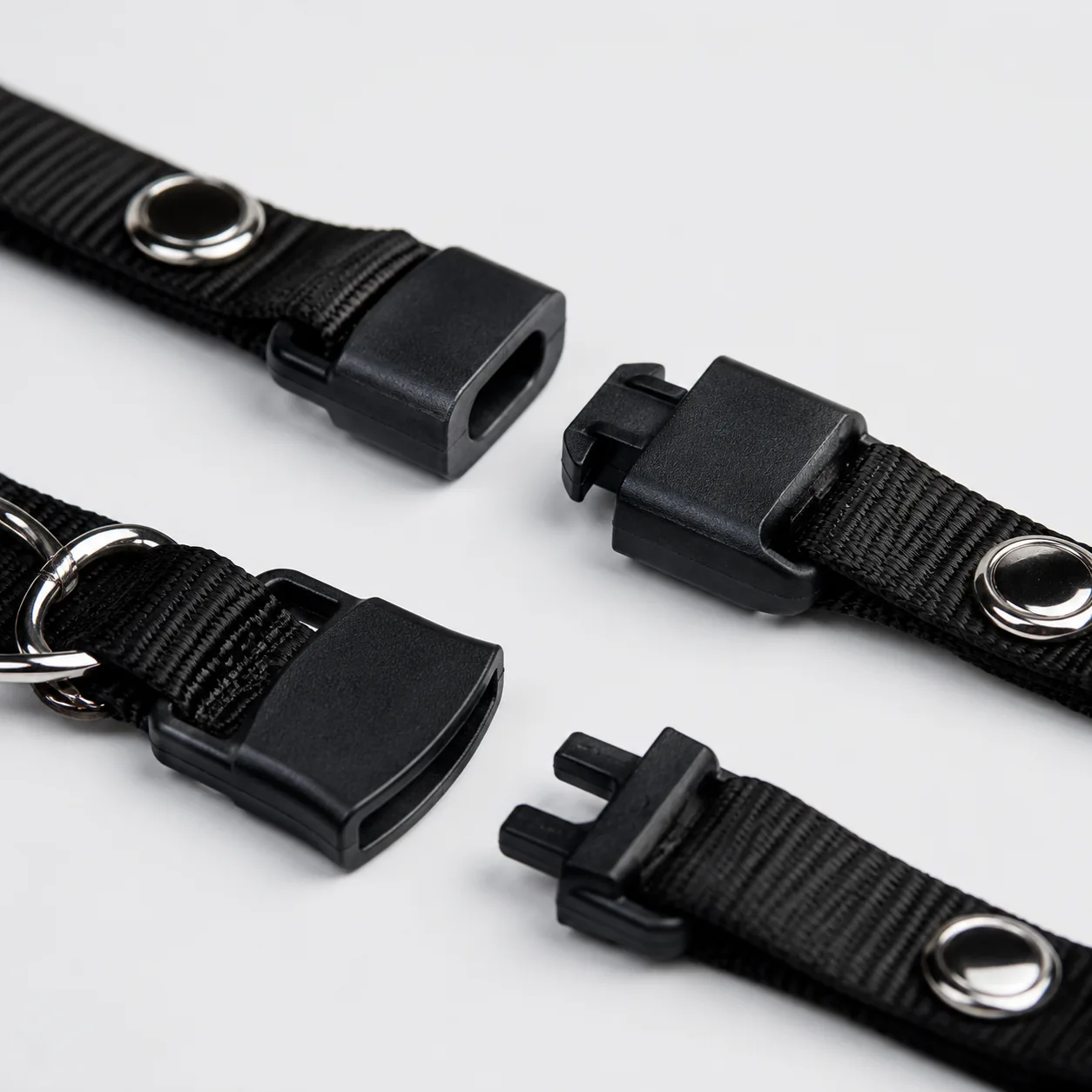
The breakaway is the plastic safety connector positioned at the back of the neck or on both sides of the strap. Its function is to open under controlled load and reconnect repeatedly without cracking, whitening or becoming loose. For adult event lanyards, a practical release-force target is 25 N to 50 N, approximately 2.5 kgf to 5.0 kgf, measured with a steady pull on a tensile gauge. For children’s programs, lower ranges such as 15 N to 25 N are often requested, but the final requirement should follow the buyer’s market and safety policy.
Rear-neck single breakaways are the default for trade shows and office visitor passes because the connector stays behind the neck and keeps the front print clean. Dual-side breakaways release from more directions and are better for schools, healthcare, food production and light industrial areas, but they add plastic parts, assembly time and visible interruptions near the collarbone. Non-breakaway lanyards are more stable for premium key straps, outdoor promotional straps and heavy medals, but they should not be used where neck entanglement risk is part of the specification.
For connector material, specify virgin or high-grade POM or ABS instead of “plastic.” POM normally gives smoother repeated opening and closing, while ABS is common for short-term promotional use. Request connector wall thickness of 1.2 mm to 1.8 mm and reject brittle parts, flashing that scratches skin, or recycled material that shows color streaking. Standard stocked colors are usually black, white, clear, navy and sometimes grey. Custom-molded breakaway colors can require 3,000 to 5,000 pieces, or a surcharge if produced below that level.
| Breakaway Type | Best Use | Target Release Force | Key Control Point |
|---|---|---|---|
| Rear-neck single breakaway | Adult conferences, exhibitions, office visitors | 30 N to 50 N | Connector centered within ±10 mm of rear fold |
| Dual-side breakaway | Schools, hospitals, controlled production areas | 25 N to 40 N per side | Both sides must release and reconnect evenly |
| Low-force child breakaway | Children’s programs, school trips, youth promotions | 15 N to 25 N | Not suitable for heavy badge holders or metal medals |
| No breakaway | Premium key straps, outdoor giveaways, heavy carry items | Not applicable | Use only when neck-safety release is not required |
Control Width, Length and Finished Drop Together
Width and length should be specified as a set. A 10 mm strap with a large A6 badge holder looks under-specified and twists easily. A 25 mm strap provides more branding area but can feel heavy for a one-day visitor pass. Standard widths are 10 mm, 15 mm, 20 mm and 25 mm. For most B2B events, 20 mm flat polyester gives the best balance of print area, comfort, cost and hardware compatibility.
Adult lanyards are commonly specified at 900 mm flat circumference before lower hardware, producing a finished hanging drop of about 430 mm to 460 mm depending on the hook, badge slot and holder height. Staff programs often use 850 mm to keep the badge higher on the chest. Children’s lanyards are commonly 760 mm to 820 mm, but local safety requirements and school policy should decide the final dimension. Do not approve length only from a flat product photo; measure the lanyard with the actual badge attached.
Use measurable tolerances. For standard cut-and-heat-sealed polyester, specify finished flat length at ±10 mm for normal production and treat anything outside ±20 mm as a major defect. Webbing width should be ±0.5 mm for 10 mm to 25 mm flat polyester. Print placement from the lower fold should stay within ±3 mm, and the centerline of a repeated logo should not drift more than 5 mm across a batch. Heat-cut ends should be sealed without hard melted lumps that can rub the neck.
Load also affects width. For total hanging weight under 30 g, 15 mm or 20 mm webbing is usually acceptable. From 30 g to 60 g, 20 mm is safer. Above 60 g, such as medals, multiple keys or thick rigid holders, specify 20 mm or 25 mm webbing, reinforced stitching and a metal hook with enough wire diameter. Narrow tubular straps can be economical, but they rotate more and offer less stable logo orientation than flat woven polyester.
Match the Lower Clip to the Badge System
The lower connector determines whether the badge faces forward, swings cleanly and survives repeated handling. A J-hook is the lowest-cost option and suits light punched cards, but it allows rotation and can let the badge face backward. A bulldog clip grips paper inserts and soft holders flat, but spring quality varies. A swivel lobster hook is better for punched PVC cards, split rings, key tags and heavier items because it rotates without twisting the strap. A detachable buckle near the lower end is useful when staff need to scan or present a badge without removing the lanyard.
Specify the badge interface in dimensions, not descriptions. A typical PVC badge holder slot is about 13 mm wide by 3 mm high, but holders vary. The clip tongue must enter the slot without bending the holder or scraping the print. For metal hooks, 1.2 mm to 1.5 mm wire diameter is common for light badges, while 1.8 mm to 2.2 mm is more appropriate for medals, keyrings or multi-day staff use. If the attachment load exceeds 60 g, request a pull check on the lower connector, not only a visual check.
Plating should match the use environment. Nickel, black nickel, gunmetal and painted black finishes are common. Promotional hardware is often plated at 3 microns to 5 microns, while 6 microns to 8 microns is safer for humid storage, outdoor events or repeated handling. Nickel-free claims should be verified component by component, especially for healthcare, school or skin-contact programs. Also check for burrs at the hook tip and clip hinge; sharp edges are major defects, not cosmetic issues.
- State the exact lower attachment: J-hook, bulldog clip, swivel lobster hook, split ring, phone loop or detachable buckle.
- Provide the card hole or badge holder slot size, including material thickness and slot width.
- Confirm whether the logo must face outward when the badge hangs naturally on a wearer.
- Set a minimum hook wire diameter for any item above 40 g total hanging weight.
- Require three open-close cycles on clips and five reconnect cycles on breakaways during sample approval.
- Approve the badge holder and lanyard together if they are supplied by different vendors.
Choose Print Method Around Artwork and Breakaway Placement
Screen printing is economical for simple logos, one to three spot colors and clean text. It works well on flat polyester but should not be used for complex gradients or photographic artwork. Sublimation is better for full-color artwork, edge-to-edge designs, QR-style background patterns and small color transitions, but it requires white polyester base material and can shift color under heat. Woven or jacquard lanyards are durable and premium-looking, but small text below 5 mm cap height usually loses sharpness. Tubular polyester is inexpensive and soft, but print alignment is less stable because the strap surface is rounded.
Breakaways interrupt the design, so the artwork file needs no-logo zones. For a rear-neck breakaway, keep critical logos at least 70 mm away from the connector on both sides. For dual-side breakaways, reserve 45 mm to 60 mm around each plastic part because folding, sewing and connector housings distort small print. If a repeating logo must appear centered on the chest, define the distance from the lower fold to the first logo, not only the repeat length.
Pantone matching on textile should be treated as controlled approximation, not a perfect match to paper, enamel or PVC. On polyester webbing, a realistic tolerance is Delta E 3 to 5 under D65 lighting, depending on the print method, fabric base and ink system. For brand-critical programs, approve a physical pre-production strip or full sample. Screen proof approval alone is not enough because monitors cannot show polyester sheen, heat-transfer density or edge bleeding.
| Construction | Typical MOQ | FOB Range USD | Sample Time | Mass Production Time |
|---|---|---|---|---|
| Screen printed flat polyester, 20 mm, rear breakaway, J-hook | 300 pcs | 0.28 to 0.65 per pc | 5 to 7 days | 10 to 15 days |
| Sublimation flat polyester, 20 mm, rear breakaway, J-hook | 300 pcs | 0.35 to 0.85 per pc | 5 to 8 days | 12 to 18 days |
| Woven or jacquard polyester, 20 mm, standard hook | 500 pcs | 0.55 to 1.20 per pc | 7 to 10 days | 15 to 22 days |
| Dual-side breakaway sublimation lanyard with swivel hook | 500 pcs | 0.60 to 1.15 per pc | 6 to 9 days | 14 to 22 days |
| Tubular polyester with simple screen print and J-hook | 500 pcs | 0.25 to 0.55 per pc | 5 to 7 days | 10 to 16 days |
Use Inspection Criteria a Factory Can Measure
Lanyard inspection should not stop at spelling and color. The inspection sheet should include finished flat length, width, print position, breakaway release, clip operation, stitch strength, sharp edges, packing count and carton protection. For promotional lanyards, AQL 2.5 for major defects and AQL 4.0 for minor defects is a practical default. Safety-critical or regulated programs may require tighter sampling, documented tensile results or buyer-specific inspection plans.
Define major and minor defects before production starts. Major defects should include missing or broken breakaways, wrong clip type, unsafe burrs, reversed logo direction, unreadable main branding, open stitches, loose lower connector, wrong finished length outside ±20 mm, and breakaway release outside the approved range. Minor defects can include print specks under 1 mm, thread ends shorter than 5 mm, slight heat-seal marks, or shade variation within the signed sample limit.
Stitching deserves its own line item. For folded webbing ends, request bar tack or box stitch with 8 to 12 stitches across a 20 mm strap, using matched, black or specified contrast thread. Stitch offset should remain within ±2 mm from the approved sample. If the lower connector is a swivel hook or detachable buckle, the fold length must allow free movement without pinching the hardware. For bulk-packed lanyards, clips should not press directly into printed webbing for long periods; inner bags of 50 or 100 pieces are common, with carton separators if heavy metal hooks are used.
Price the Full Assembly, Not Only the Strap
Most cost variation comes from webbing width, print method, breakaway count, hook type, labor steps and packing. At 1,000 pieces, a 20 mm sublimation polyester lanyard with rear breakaway and J-hook often falls around USD 0.40 to 0.75 FOB China. Adding dual-side breakaways, a swivel lobster hook and individual OPP packing can move the same project to about USD 0.65 to 1.05. At 300 pieces, setup and handling are spread across fewer units, so unit cost can be 20% to 45% higher than the 1,000-piece level.
MOQ is usually negotiable, but efficiency thresholds are real. Simple screen printed or sublimated polyester can often start at 300 pieces. Woven lanyards are more realistic at 500 pieces because loom setup takes longer. Custom hardware colors, custom-molded breakaways or special plated clips may require 3,000 to 5,000 pieces unless the factory uses stock components. If a supplier offers a very low MOQ for exact custom plastic color with no surcharge, confirm whether the part is actually molded, painted or only matched from available stock.
Packing changes both price and lead time. Bulk packing in inner bags of 50 or 100 pieces is the most economical and works well for registration desks. Individual OPP bags usually add USD 0.03 to 0.08 per piece and 1 to 3 production days. Printed backing cards or paper sleeves can add USD 0.08 to 0.25 per piece, depending on size, print coverage, insertion labor and carton volume. For mixed kits with badges, pins or keychains, define whether the lanyard ships assembled to the badge holder or packed separately to prevent scratching.
Approve Samples Before Mass Production
A digital proof can confirm artwork position, but it cannot prove neck feel, release force, clip direction or badge balance. For new programs, approve a physical pre-production sample with actual hardware. If timing is tight, approve at least a printed webbing strip plus the exact breakaway and lower connector. Typical sample lead time is 5 to 10 days, depending on print method, stock hardware availability and whether custom colors are needed.
Test the sample as the end user will wear it. Attach the real badge holder, card, medal or keychain. Wear it over a shirt and jacket, then check finished drop, badge orientation and comfort. Pull the breakaway slowly from the front, side and back. It should release within the agreed range without requiring a dangerous jerk, and it should not open during normal handling. Reconnect it at least five times and check whether the plastic loosens or shows stress marks.
Before mass production, keep one signed golden sample with the order file. Record webbing width, finished length, breakaway code, hook type, print file version, Pantone target, packing method and AQL level. For repeat programs, this is more reliable than asking a production team to match last year’s photo. When requesting quotes, send suppliers the artwork, badge dimensions, estimated hanging weight, required delivery date and quantity tiers such as 300, 1,000 and 3,000 pieces. That allows the factory to quote the complete lanyard assembly instead of guessing from a strap description.
- Approve actual hardware, not only a rendering of the printed strap.
- Measure flat length, hanging drop and logo position with the intended badge attached.
- Check breakaway release after at least five reconnect cycles.
- Rub the printed logo 20 cycles with a dry white cloth to check obvious color transfer.
- Confirm carton packing so hooks and clips do not dent printed webbing during transport.
- Photograph the approved sample beside a ruler, showing the breakaway, lower clip and badge holder.
Have a project? Send your artwork and target quantity and we’ll reply with a detailed quotation within 12 working hours.
Ready to get this made?
Send your sketch, target quantity and ship-date. Detailed quotation in 12 hours.



