Kitting and Labeling Specs for Custom Promo Orders
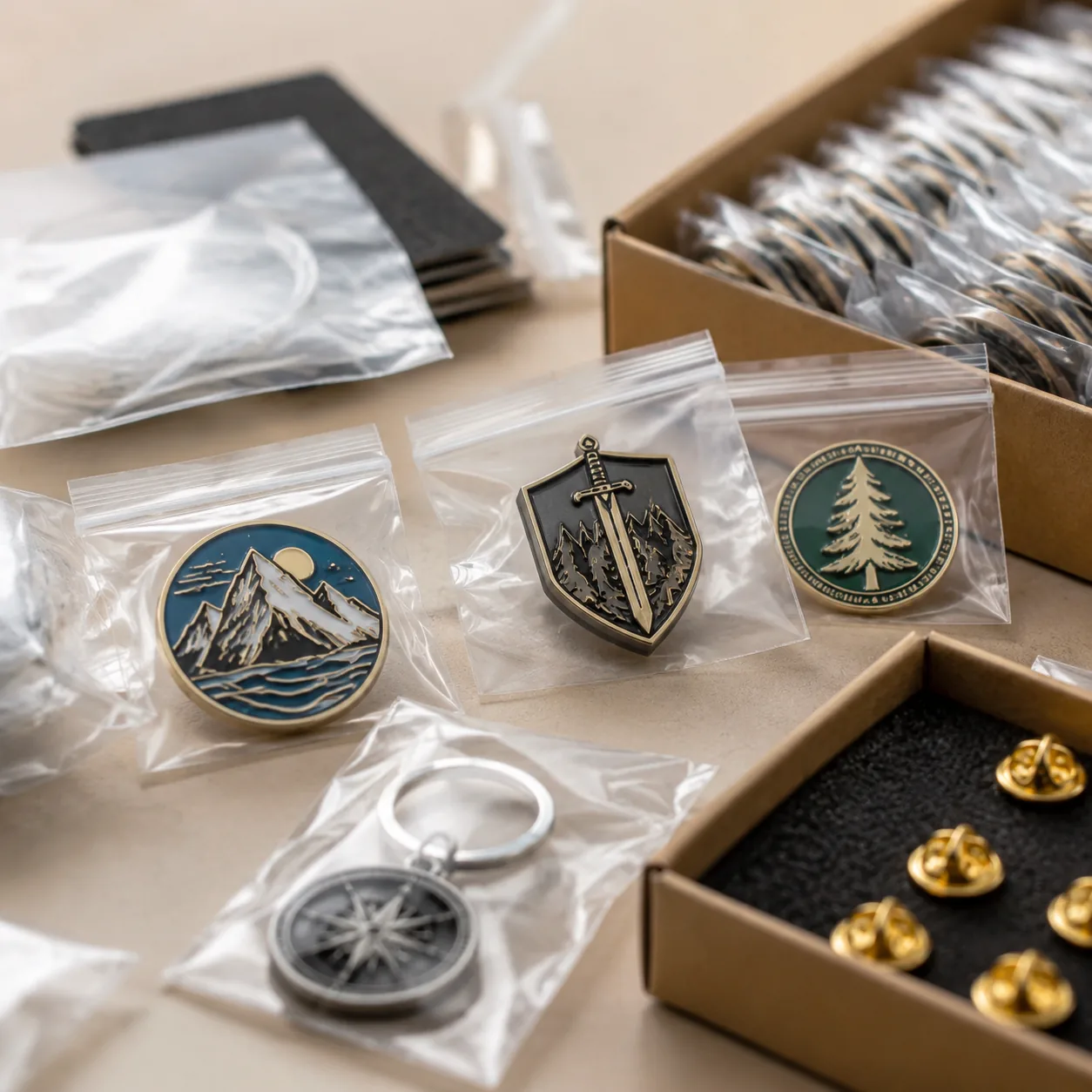
Why Correct Products Still Arrive Unusable
A buyer can approve excellent enamel pins, challenge coins, patches, keychains, magnets, or lanyards and still lose a week after delivery because the cartons cannot be received cleanly. The product is acceptable, but the logistics data is wrong: SKU labels do not match the purchase order, mixed colors are packed under one carton mark, store allocations are split across cartons, or barcodes fail at the 3PL dock.
This is not a product-defect issue. It is a packing specification issue. For custom promotional orders, kitting instructions must be treated like artwork, plating, thread color, or mold size. They affect backing cards, polybags, label stock, inner carton counts, carton marks, inspection sampling, and the final packing sequence.
Origin kitting is most useful for distributor programs, retail launch kits, franchise rollouts, conference welcome packs, employee onboarding boxes, and multi-location campaigns. It works best when the factory receives the packing hierarchy before mass production starts. If kitting is added after goods are sealed, labor can double, labels must be reprinted, cartons are opened twice, and damage risk increases.
A practical kitting brief should define the packing logic, label sizes, barcode requirements, carton weight limits, spare quantities, acceptable tolerances, inspection rules, and final data file. Without those details, the factory can ship good products in cartons your warehouse cannot use without relabeling or hand sorting.
Select the Packing Logic Before Quoting
There are four common packing logics: bulk by item, retail-ready by SKU, fixed-count kits, and destination kits. Bulk by item is cheapest because each design or color is packed together. Retail-ready packing adds a bag, card, barcode, or hangable pack so the item can be sold or handed out individually. Fixed-count kits use the same mix in every kit. Destination kits vary by store, region, event, or account.
The packing logic changes the quote more than many buyers expect. A 1,000-piece soft enamel pin order in one design may pack into 10 inner cartons and 1-2 master cartons if bulk packed. The same order split into 100 kits of 10 pins with printed insert cards, SKU labels, and carton-level destination marks may require 100 inner packs, 103-105 printed labels to allow for setup waste, and a separate carton audit.
For mixed promo kits, count the touches. A lanyard with badge holder, a coin in a capsule, a patch in a bag, and a pin on a card may require four SKU picks, four item checks, one insert, one outer box, one kit label, one weight check, and one carton scan. That is a controlled assembly job, not standard export packing.
| Packing logic | Best use case | Typical MOQ | Added lead time | Typical FOB cost impact |
|---|---|---|---|---|
| Bulk by item | Warehouse sorts by SKU after arrival | 100 pcs per design | 0 days | Included or USD 0.01-0.03 per pc |
| Retail-ready by SKU | Individual sale, giveaway, or 3PL scan-in | 300 pcs per SKU | 1-3 days | USD 0.04-0.18 per pc for bag, card, and label |
| Fixed-count kits | Same contents in every event or welcome kit | 100 kits | 2-5 days | USD 0.18-0.80 per kit excluding printed box |
| Destination kits | Different contents by store, region, or account | 50 destination cartons | 3-7 days | USD 0.35-1.50 per carton or kit |
| Serialized kits | Unique QR, barcode, warranty, or redemption code | 500 serials | 4-8 days | USD 0.06-0.25 per code plus setup |
Set Item-Level Label and Barcode Specifications
The label must identify the item without opening the bag. For small metal products such as pins, keychains, zipper pulls, magnets, and coins, the smallest dependable item label is usually 30 x 20 mm. It can hold a short SKU, color name, quantity, and compact Code 128 barcode, but it is too small for long descriptions. For lanyards, patches, bagged textile items, and retail packs, 40 x 30 mm or 50 x 30 mm labels are easier to scan and read.
Specify label placement by corner and tolerance. A common standard is label top-right on the back of the bag, plus or minus 3 mm. For hangable retail packs, keep labels at least 5 mm away from Euro holes, warning text, legal marks, and artwork. If a label may be removed by the end user, test removable adhesive on the actual surface; it performs differently on matte polybags, coated cards, metal tins, and velvet pouches.
For export orders, thermal-transfer labels are safer than direct thermal labels. Direct thermal stock is cheaper, but it can darken in hot containers, long sea freight, or unconditioned warehouse storage. For six-month shelf life, use thermal-transfer paper or synthetic PP label stock with acrylic adhesive. For humid routes or Amazon-style receiving, synthetic labels reduce peeling and edge curl.
Barcode geometry should be defined before label artwork is approved. For Code 128, keep the printed code at least 25 mm wide and 8 mm high for short SKUs, with quiet zones of at least 3 mm on both sides. For UPC-A or EAN-13, allow roughly 37 x 25 mm including human-readable digits and quiet zones. Require ANSI/ISO print grade C or better after application; grade B is preferred for retail or marketplace receiving where scanner rejection creates chargebacks.
Match Bags, Cards, and Cartons to Product Weight
Packing components must be specified as a system. A backing card approved in isolation may not fit the selected polybag, and a visually attractive kit box may exceed courier weight limits after metal items are added. For enamel pins and brooches, 250-350 gsm C1S card is common; 300 gsm is a practical middle point for 30-45 mm pins. For larger pin sets, use 350 gsm or add an insert tray so posts and clutches do not press through the card.
Polybags should state material, thickness, closure, and warning-print requirement. For low-cost pins, patches, or acrylic keychains, 0.04-0.06 mm OPP self-seal bags are common. For zinc alloy keychains, coins, bottle openers, or items above 35 g, use 0.06-0.08 mm PE or CPP bags to reduce corner tearing. If the item has sharp posts, split rings, clutch backs, or opener edges, add tissue wrap, a backing card, or a small compartment bag to prevent punctures during vibration.
Inner carton counts should be based on weight and crush risk, not only piece count. For 30-40 mm metal pins on 55 x 85 mm cards, 100 pcs per inner carton is usually manageable. For 45 mm challenge coins, 50 pcs per inner carton is safer, especially when each coin is in a capsule or pouch. For lanyards with hooks, 50-100 pcs per inner carton prevents tangling and makes counting easier.
Keep inner carton gross weight below 8 kg and master carton gross weight below 18 kg for courier handling. For ocean freight or palletized retail programs, a 12-15 kg master carton is often better because cartons stack with less edge crush. Carton burst strength should match weight: 5-ply corrugated is normally preferred above 12 kg or when metal products are packed in dense layers.
Control Quantities, Spares, and Tolerances
Manufacturing tolerance and kitting accuracy are different controls. Custom metal and textile items often carry a normal production tolerance of plus or minus 3-5 percent unless exact quantity is required. Kitting, however, usually requires exact distribution by SKU, kit, or destination. If the order requires 97 kits for Store 018 and 143 kits for Store 081, the factory must produce enough extra units, remove rejects, and pack exact counts.
State tolerance by SKU, not only for the full order. A total overrun of 3 percent does not help if the shortage is concentrated in one color or one destination. For enamel pins, keychains, and similar metal items, a 2 percent spare allowance is practical. For epoxy-coated items, moving parts, or retail carded goods, 3 percent is safer because packaging damage and cosmetic rejects are more common. For simple woven patches or lanyards, 1 percent may be enough when artwork is stable.
Spares should be controlled. Do not hide extra pieces inside active destination cartons unless the allocation file says to do so. Pack spare products, spare clutches, rubber backs, split rings, badge holders, or lanyard hooks in a separate carton marked “SPARES,” with SKU, quantity, PO number, and gross weight. This prevents receiving teams from counting spares as sellable destination stock.
Inspection standards should separate cosmetic defects from logistics errors. Many B2B promotional orders use AQL 2.5 for major product defects and AQL 4.0 for minor defects. For kit accuracy, use zero critical defects for wrong SKU, wrong barcode, wrong destination mark, missing item, substituted item, or quantity shortage. A scratched backing card may be minor; a carton labeled Store 018 that contains Store 081 inventory is a critical failure.
- Confirm exact quantity or normal production tolerance before order placement.
- Define overrun and underrun limits by SKU, color, and destination.
- Reserve 1-3 percent spare goods for rejects, damaged packaging, and inspection samples.
- Pack spare accessories in a separate marked carton, not inside active kits.
- Apply zero-critical-defect rules to SKU mix, barcode, destination label, and quantity accuracy.
- Approve the kit file before final assembly and lock changes through a revision number.
Use a Factory-Readable Kitting File
The most reliable kitting instruction is a spreadsheet or CSV with one row per carton, kit, or destination. Email instructions are difficult to control because revisions get buried in message threads. Each row should include PO number, destination code, carton number, SKU, product description, quantity, item label text, barcode number, net weight target, gross weight target, and any special packing note.
Keep factory-facing and customer-facing data in separate columns. A short SKU such as PIN-BLK-32 is easier for packers to follow than a long retail description such as “Black nickel soft enamel lapel pin with butterfly clutch.” If the order has multiple languages, define exactly which language appears on the item label, inner carton, and master carton. Mixed-language label files are a common source of receiving errors.
Version control should be strict. Use file names such as KitPlan_PO4587_v03_Approved_2026-03-12 instead of “final latest.” Once production starts, treat kitting changes like artwork changes. Moving 20 pins from one destination to another may require opening sealed cartons, reprinting labels, repeating scans, updating weights, and reissuing the packing list.
For programs with more than 30 SKUs or 100 destination cartons, run a pre-pack mockup before full assembly. A 5-10 kit pilot catches carton-size problems, label overflow, unreadable barcodes, incorrect accessory pairings, and weight variance before the packing team repeats the error hundreds of times.
Budget Realistic Cost and Lead Time
Origin kitting saves receiving labor, relabeling cost, and domestic sorting time, but it is not free. Cost depends on the number of touches and verification steps. A single enamel pin in a labeled OPP bag may add USD 0.04-0.08 per piece FOB. A pin on a printed card with a barcode label may add USD 0.08-0.18 per piece. A mixed event kit with lanyard, badge holder, coin, patch, insert card, and outer box can add USD 0.45-1.20 per kit before the printed box cost.
Lead time must include packing setup, not only product manufacturing. A simple 1,000-piece enamel pin order may take 12-18 days after artwork approval, with 2-4 additional days if a pre-production sample is required. Retail-ready labeling usually adds 1-3 days. Multi-SKU kitting adds 3-7 days depending on SKU count, carton count, and destination complexity. Serialized QR, variable barcode, or redemption-code projects can add 4-8 days because codes must be generated, printed, scanned, and reconciled.
Rush kitting creates predictable failures: wrong clutches packed with pins, lanyard colors mixed, patch sizes swapped, or inner cartons sealed before barcode checks. If the shipment has a fixed event date, reserve at least one full day for carton audit on orders under 50 cartons and two to three days for larger multi-destination orders. For air freight, also allow time to adjust carton weight and dimensions before the forwarder books chargeable weight.
Inspect Before Master Cartons Are Sealed
A strong inspection plan checks the full packing hierarchy. Start with product quality: plating, enamel fill, printing, embroidery density, attachment strength, and surface condition. Then inspect the unit pack: correct bag, card, accessory, label, barcode, and seal. After that, check inner cartons and master cartons against the approved kitting file. The inspector should scan barcodes, not only compare printed numbers by eye.
Use carton-level sampling for mixed kits. On orders under 20 cartons, check every carton for destination mark, carton number, gross weight, and visible damage. On 21-150 cartons, check at least the square root of the carton count, plus all high-value, urgent, or retailer-controlled destinations. For serialized orders, scan 100 percent of serials if duplicate or missing codes would affect warranty, redemption, or customer service.
Weight checks are an efficient final guard. If a 100-piece pin inner carton should weigh 2.80 kg net, a carton at 2.55 kg or 3.05 kg should be opened. Set acceptable carton weight tolerance at plus or minus 3 percent for uniform products and plus or minus 5 percent for mixed kits. Weight cannot replace counting, but it quickly identifies shortages, duplicate packs, and accessory omissions.
| Checkpoint | Recommended standard | Reject or rework trigger |
|---|---|---|
| Unit label | Correct SKU text; barcode scans grade C or better | Wrong SKU, unreadable code, missing quiet zone |
| Bag or pouch | Correct material, thickness, and sealed closure | Torn bag, open seal, product puncture |
| Kit contents | Exact SKU mix and quantity per approved file | Missing, extra, or substituted item |
| Inner carton | Correct count, inner mark, and weight within tolerance | Count mismatch or weight outside 3-5 percent limit |
| Master carton | Destination mark, PO, carton number, gross/net weight | Wrong destination, duplicate carton number, missing mark |
| Spare carton | Clearly marked spares with SKU and quantity | Unmarked spares or spares hidden in active kits |
Lock the Spec Before Purchase Order Release
Before requesting a final price, decide whether the order needs bulk packing, retail-ready SKU packing, fixed-count kits, or destination-specific cartons. Send artwork, packing hierarchy, label requirements, and carton rules together. Include card dimensions, bag thickness, carton weight limits, barcode type, scan-grade requirement, spare percentage, and whether exact quantity is mandatory.
If labels or carton marks must match a retailer, marketplace, distributor portal, or 3PL format, provide a sample before mass production. For multi-destination orders, request one digital packing mockup and one physical pilot kit before full packing. The small approval step is much cheaper than reopening 100 cartons after production.
At ZheCraft, the cleanest kitted orders are released with three locked files: artwork proof, packing specification, and kitting spreadsheet. That gives production, QC, and packing teams the same reference. Build kitting rules into the first RFQ, and the factory can quote realistic labor, lead time, carton dimensions, and inspection scope before the order becomes urgent.
Have a project? Send your artwork and target quantity and we’ll reply with a detailed quotation within 12 working hours.
Ready to get this made?
Send your sketch, target quantity and ship-date. Detailed quotation in 12 hours.



