Keychain Hardware Specs That Prevent Returns and Breakage
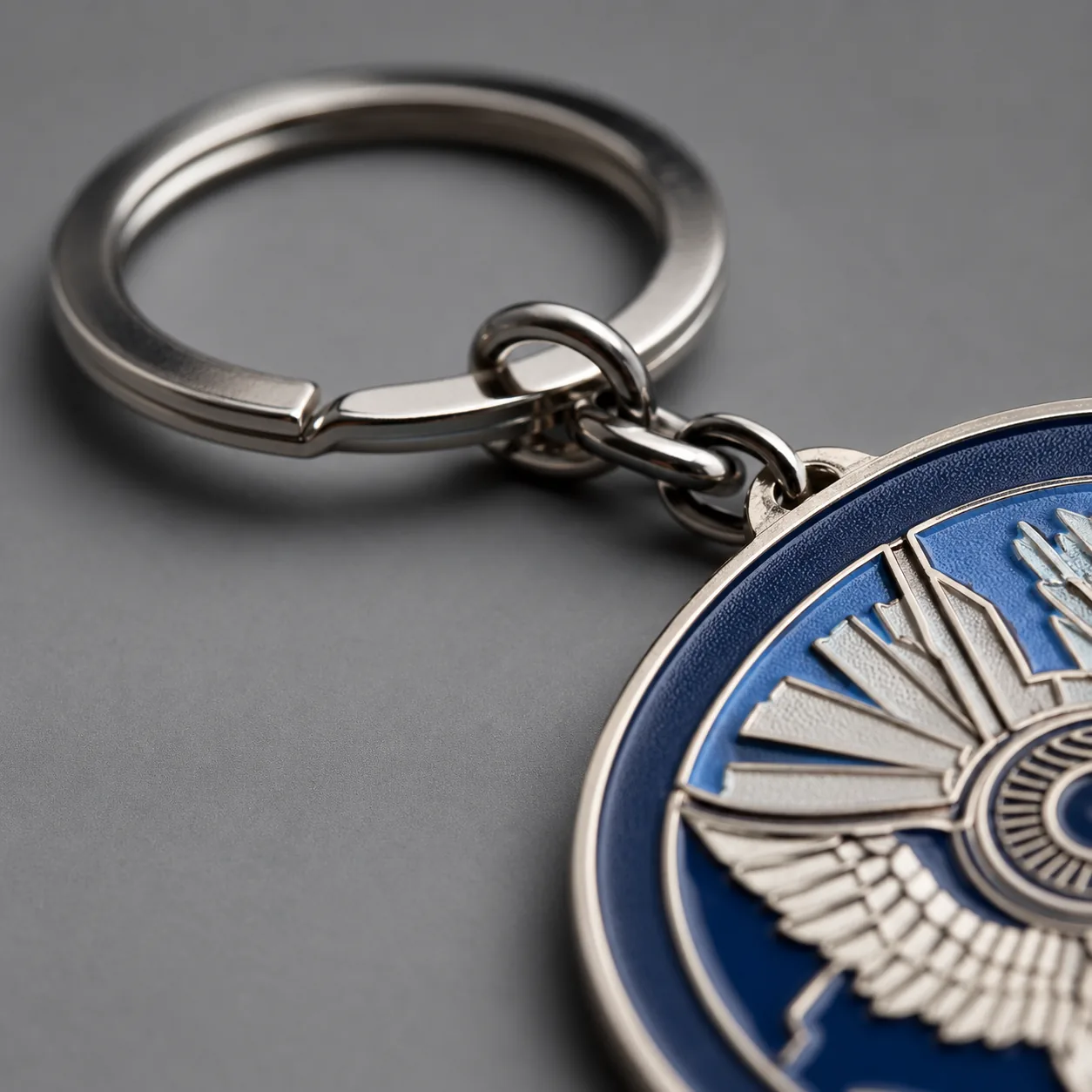
Hardware failures start with vague RFQs
A zinc alloy, enamel or PVC keychain can pass artwork approval and still fail in the field because the split ring opens, the jump ring pulls apart, the clasp spring weakens or the plating wears through at the contact point. Hardware is the part users touch, twist and overload every day. In promotional programs, even a 2 to 3 percent hardware failure rate can create more complaints than a small enamel color shift because the product stops functioning.
For most custom metal keychains, the charm is only part of the functional assembly. Performance also depends on ring wire diameter, connector closure, chain link gauge, eyelet geometry, plating thickness, burr removal and final pull testing. Rework usually appears when the RFQ says only “standard keyring,” “silver chain” or “normal clasp,” leaving the factory to choose the cheapest compatible stock part.
A usable hardware spec does not need to be long, but it must be measurable. State the attachment type, outside diameter, wire diameter, material, finish, connector style, pull-test requirement and AQL level. Those details let suppliers quote the same build, sample the correct assembly and inspect production without arguing about what “strong enough” means after goods arrive.
Select the attachment system by use case
The first decision is how the end user will attach and carry keys, not which metal color looks best. A 30 mm outside-diameter split ring is the safest default for corporate gifts, retail packs and daily key use because it accepts normal house keys, access fobs and many car keys. A 25 mm ring can work for small event souvenirs, but it feels cramped once the user adds more than two keys.
Heavy charms need stress relief between the decorative body and the split ring. A 3 to 5 link curb chain, usually 18 to 28 mm overall length, lets the charm hang flat and reduces twisting at the eyelet. Connecting a 50 mm die-cast charm directly to a split ring with one small open jump ring saves a few cents, but it concentrates force at one cut joint and increases pull-apart risk.
For bags, zipper pulls, lanyards and staff credentials, a lobster clasp or swivel hook may be more practical than a split ring because users can remove it quickly. These parts should not be treated as equal substitutes for daily key carrying. The spring, swivel rivet or gate is usually the weakest point. For 6 to 12 months of regular key use, avoid decorative clasps under 23 mm unless the total assembly is under about 20 g.
| Hardware type | Practical specification | Best use | Avoid when |
|---|---|---|---|
| Split ring | 25 to 32 mm OD, 1.6 to 2.2 mm wire | Daily key use, retail keychains, corporate gifts | Quick removal is more important than retention |
| Curb chain | 3 to 5 links, 1.8 to 2.5 mm link wire | Heavy die-cast charms, bottle openers, coin keychains | The design needs a rigid, short hang point |
| Cable chain | 18 to 28 mm length, 1.4 to 2.0 mm wire | Small enamel or PVC charms with a softer look | The charm exceeds 45 g or twists during packing |
| Ball chain | 2.4 or 3.2 mm balls, 100 to 150 mm loop | Tags, luggage labels, low-cost souvenirs | Daily key bundles or children’s products |
| Lobster clasp | 23 to 35 mm length, steel spring | Bag charms, zipper pulls, removable promotions | High-load daily keychains |
| Swivel hook | 30 to 45 mm length, rotating joint | Lanyard keyholders and staff access items | Low-profile retail packaging is required |
Split ring dimensions that control retention
A split ring should be specified by outside diameter, wire diameter, material and finish. The common production sizes are 25 mm, 28 mm, 30 mm and 32 mm OD. For most B2B metal keychains under 45 g, 30 mm OD with 1.8 mm wire is a reliable starting point. For bottle openers, thick challenge coins or charms above 45 g, use 2.0 mm wire if the artwork hole, ring gap and packaging cavity allow it.
Material affects spring-back. Hardened carbon steel is the usual commercial choice because it gives good recovery and plates well. Soft low-carbon wire can permanently open after keys are inserted, leaving a visible gap that catches on key cuts. Stainless steel 304 costs more and may not match plated zinc alloy perfectly, but it is better for outdoor, marine, gym, hospitality or long-use programs where corrosion complaints are likely.
Tolerances should be written into the order. For split ring OD, allow ±0.5 mm. For wire diameter, allow ±0.08 mm. After inserting a 2.0 mm test blade once, the split gap should recover to less than 0.4 mm; for higher-retention retail orders, set the recovery limit at 0.3 mm. Burrs at the cut end should not scratch skin or snag a polybag when rubbed by hand.
- Specify split ring OD in millimeters; do not write only “standard ring.”
- Use 30 mm OD x 1.8 mm hardened steel for most metal keychains under 45 g.
- Use 32 mm OD x 2.0 mm wire for heavier bottle openers or thick coin keychains.
- Use stainless steel 304 when corrosion resistance matters more than exact plated color match.
- Avoid 25 mm rings for retail keychains unless the product is clearly a small charm.
- Confirm the ring fits the final packaging insert or blister cavity before mass production.
Jump rings and eyelets are the usual weak points
A jump ring normally fails by opening, not by snapping. The cut ends were not closed, the wire was too thin, the ring was twisted during assembly or the charm eyelet forced the ring to bind. For a 30 to 50 g zinc alloy keychain, a connector jump ring should generally be 7 to 10 mm OD with 1.2 to 1.6 mm wire. Below 1.0 mm wire, the connector should be limited to light charms and short-term promotions.
Open jump rings are acceptable for many standard promotional orders when the load is moderate and operators close them consistently. For heavy goods, welded or soldered rings are safer, especially when the charm has only one small eyelet. Welding adds cost and may discolor plating at the joint if the process is poorly controlled, so it should be specified where strength justifies the extra handling, not as a default for every low-cost giveaway.
The charm eyelet needs enough metal around it. For die-cast zinc alloy, keep at least 1.5 mm wall thickness around the hole; 2.0 mm is better for heavy pieces. The hole should be 0.3 to 0.5 mm larger than the connector wire so the ring rotates without binding. If the hole is too tight, the ring twists open. If it is oversized, the charm hangs crooked and wears plating at one contact point.
| Finished product weight | Suggested connector | Pull-test target | Design note |
|---|---|---|---|
| Under 20 g | 6 to 7 mm OD jump ring, 1.0 to 1.2 mm wire | 8 kg for 10 seconds | Suitable for acrylic, PVC and small enamel charms |
| 20 to 45 g | 7 to 9 mm OD jump ring, 1.2 to 1.5 mm wire | 12 kg for 10 seconds | Default range for most zinc alloy keychains |
| 45 to 80 g | 9 to 10 mm OD jump ring, 1.5 to 1.8 mm wire or short curb chain | 18 kg for 10 seconds | Use a larger eyelet and inspect closure after assembly |
| Above 80 g | Welded ring, reinforced chain or riveted connector | 25 kg for 10 seconds | Recommended for bottle openers and large coin keychains |
Match chain style to weight and handling
Curb chain is the most common chain for custom metal keychains because it lies flat, plates evenly and spreads load across multiple links. A practical default is 4 links, 2.0 mm wire, 18 to 24 mm assembled length, nickel or black nickel plating over steel, with all links fully closed. For premium retail items, brass chain can improve warm gold or antique brass color, but it is softer and usually costs more than plated steel.
Cable chain has rounded links and a cleaner jewelry look. It works well for small enamel, acrylic or soft PVC charms under about 30 g, especially when visual lightness matters. It is less stable for heavier metal pieces because the chain can twist during packaging and concentrate wear at one link. If the product will be packed in a tight card slot, test the final chain length before approving production.
Ball chain is useful for tags, luggage identifiers and low-cost souvenir loops because it is flexible, inexpensive and easy to cut. It is not a good daily keychain connector. A 2.4 mm ball chain can separate at the coupling under relatively low force, while 3.2 mm performs better but still should not be treated like a split ring or curb chain. For ball chain, specify ball diameter, total loop length, connector type and whether the cut ends must be crimped or closed.
- Use curb chain for die-cast, bottle opener and challenge coin keychains.
- Use cable chain when appearance matters more than load capacity.
- Use ball chain for tags, packaging hang loops and light souvenirs, not heavy keys.
- Specify chain length by link count and total assembled length, usually 18 to 28 mm.
- Confirm link wire diameter after plating, because heavy plating can mask thin base wire.
- Reject chain links with visible open gaps, sharp seams or rough plating inside the link.
Plating, corrosion and wear specifications
Hardware plating wears faster than charm plating because keys rub directly against rings, chains and clasps. For nickel, black nickel, imitation gold and antique finishes on steel hardware, 3 to 5 microns is a practical commercial thickness for standard indoor promotional use. For better abrasion resistance on retail or long-use programs, specify 6 to 8 microns and expect a modest price increase plus 1 to 3 extra plating days.
Gold-tone hardware needs special control. Flash gold under 1 micron can photograph well but rub through quickly on split rings and clasp gates. For gift and retail orders, specify imitation gold or brass-tone plating at 3 microns minimum, with clear electrophoretic coating if the hand feel and color are acceptable. The clear coat improves wear but can slightly change shade and make moving parts feel tighter if applied too heavily.
Antique finishes require physical approval, not only a Pantone reference or photo. Oxidation can remain inside chain gaps and feel dirty, while aggressive polishing can expose base metal on raised points. For antique brass, antique nickel and antique copper, approve a retained sample and set visual limits for black residue, bare edges, patchy polishing and shade variation at a normal viewing distance of 30 cm.
| Finish | Recommended thickness | Salt spray guidance | Buyer caution |
|---|---|---|---|
| Nickel | 3 to 5 microns standard; 6 to 8 microns upgraded | 12 to 24 hours neutral salt spray for indoor promotional use | Review nickel restrictions for sensitive markets |
| Black nickel | 4 to 6 microns | 12 hours is more realistic than 24 hours on moving parts | Shade varies by bath, base metal and rack position |
| Imitation gold | 3 to 5 microns plus clear coat if required | 12 hours for standard indoor use | Split rings show rubbing earlier than flat charms |
| Antique brass | 4 to 6 microns before antique process | Salt spray results vary because oxidation is intentional | Approve shade and residue by physical sample |
| Stainless steel 304 natural | No decorative plating required | 24 to 48 hours typical on 304 hardware | May not match plated zinc alloy charm color exactly |
Cost, MOQ and lead-time trade-offs
Better hardware is usually cheaper than replacing defective goods, but it changes the quotation. On a 1,000 piece custom keychain order, a standard 30 mm split ring with one 7 mm jump ring commonly adds about USD 0.035 to 0.070 FOB per unit, depending on finish and sourcing. Upgrading to thicker wire, a short chain or welded connector typically adds USD 0.030 to 0.120 per unit. Custom plated clasps and swivel hooks can add USD 0.080 to 0.250 per unit.
MOQ depends on whether hardware is stock or must be plated as a separate batch. Standard nickel, black nickel, imitation gold and antique brass split rings can often be sourced from stock at 100 to 300 pieces. Oversized rings, stainless 304 hardware, custom electrophoretic colors or special clasps usually require 500 to 1,000 pieces. If the order quantity is below the plating MOQ, the supplier may charge a small-lot surcharge instead of raising the unit price.
Standard hardware normally fits inside the keychain production schedule. For a typical custom metal keychain, sampling takes 7 to 10 days after artwork approval and mass production takes 14 to 22 days after sample approval. Add 3 to 7 days for custom plated hardware, welded connector processing, special corrosion testing or a documented pull-test report with retained samples.
| Hardware choice | Typical MOQ | FOB add-on per unit | Lead-time effect |
|---|---|---|---|
| Standard split ring and jump ring | 100 to 300 pcs | USD 0.035 to 0.070 | Usually no extra days |
| 2.0 mm thick split ring upgrade | 300 pcs | USD 0.020 to 0.050 above standard | No extra days if stock is available |
| Short curb chain assembly | 300 pcs | USD 0.050 to 0.120 | 0 to 3 extra days |
| Welded connector ring | 500 pcs | USD 0.040 to 0.100 | 2 to 5 extra days |
| Custom plated clasp or swivel hook | 500 to 1,000 pcs | USD 0.080 to 0.250 | 3 to 7 extra days |
| Stainless steel 304 hardware set | 500 pcs typical | USD 0.060 to 0.180 above plated steel | 1 to 5 extra days depending on stock |
Inspection criteria that prevent disputes
Inspect hardware before assembly and again after assembly. Incoming inspection catches wrong ring size, weak split-ring recovery, plating scratches, sharp burrs and open chain links before they are attached to finished charms. Final inspection confirms that the complete keychain is correctly closed, aligned and able to withstand the agreed pull load.
For general promotional orders, AQL general inspection level II with critical 0, major 2.5 and minor 4.0 is a workable baseline. Missing hardware, open jump rings, failed pull tests, sharp burrs and broken clasp springs should be treated as major or critical defects depending on the market and age group. Minor shade variation may be accepted if it matches the approved sample range and is not obvious at 30 cm under normal light.
The pull test should be performed on the assembled product, not only on loose hardware. For most metal keychains under 45 g, specify 12 kg for 10 seconds with no opening, separation or permanent deformation. For heavy bottle openers or large coin keychains, use 18 to 25 kg if the eyelet, connector and chain were designed for it. Do not set a high number after tooling if the eyelet is too small to support it.
- Measure split ring OD, wire diameter and spring-back before assembly.
- Reject jump rings with visible gaps over 0.2 mm after closing.
- Run pull tests on complete assemblies from production, not only sample-room parts.
- Inspect for sharp burrs at ring cuts, chain seams, clasp gates and welded joints.
- Check plating coverage inside chain links and around connector contact points.
- Keep approved hardware samples with the signed pre-production sample and inspection file.
- Record defect photos by lot so replacement hardware can be traced quickly.
RFQ wording that gives factories no room to guess
For a normal corporate keychain under 45 g, a solid starting specification is: 30 mm OD split ring, 1.8 mm hardened steel wire, 7 to 9 mm OD jump ring with 1.2 to 1.5 mm wire, nickel or selected plating at 3 to 5 microns, complete assembly pull test at 12 kg for 10 seconds, AQL II with critical 0, major 2.5 and minor 4.0. This is specific enough for quoting and realistic for standard production.
For heavier zinc alloy, bottle opener or challenge coin keychains, move to a 32 mm OD x 2.0 mm split ring and add a 3 to 5 link curb chain or welded connector. Increase the pull-test target to 18 kg or 25 kg only if the charm eyelet has enough wall thickness and the connector wire is sized accordingly. Strength is an assembly result; a strong split ring cannot compensate for a thin eyelet or poorly closed jump ring.
Before mass production, approve a physical sample that includes final hardware, final plating and final packaging position. At ZheCraft, hardware builds can be quoted side by side, such as standard split ring, upgraded curb chain or welded connector, so buyers can see the price, MOQ and strength trade-off before approving tooling. The lowest-cost time to prevent returns is before the artwork locks the eyelet size and connector path.
Have a project? Send your artwork and target quantity and we’ll reply with a detailed quotation within 12 working hours.
Ready to get this made?
Send your sketch, target quantity and ship-date. Detailed quotation in 12 hours.



