Inspection Documents for Custom Promo Products: Buyer Specs
Why good promo products still fail receiving
A custom enamel pin, challenge coin, woven patch or lanyard can match the approved sample and still be held at a retailer DC because the document trail is incomplete. Receiving teams do not only check appearance. They verify PO numbers, SKU labels, carton counts, barcode placement, country-of-origin marking, packing method, material claims and final inspection status before stock is released or payment is approved.
The risk increases when documents are requested after goods are packed. A factory can reopen cartons and take photos, but it may not be able to prove which production lot was inspected, which cartons were sampled, whether the last carton was short, or whether the correct barcode was applied before sealing. That gap creates avoidable disputes between buyer, distributor, factory and freight forwarder.
For custom metal and textile promotional products, the document pack should be treated like artwork, dimensions and plating: specified before production, controlled by revision, and checked before shipment. A compact but useful set normally includes approved artwork, sample approval photos, material and finish specs, in-process checkpoints, final AQL report, packing list, carton labels and sealed-carton photos. A 300-piece club giveaway may need only Level 1 records. A 20,000-piece retailer or multinational event order should usually require Level 2 or Level 3 controls.
Set the document pack before PI approval
The best time to define documents is before the proforma invoice is signed and the deposit is paid. At that point the factory can price the order, reserve inspection time and build the right checkpoints into production. Adding barcode scan logs, third-party inspection, lab testing or special carton labels after packing can add repacking cost, delay shipment by several days, or make compliance claims impossible to support.
A practical RFQ should state which documents are mandatory, which are optional, who signs them off and when they are due. Send the relevant 5 to 10 pages of a retailer vendor manual, not a 90-page PDF with no highlighted requirements. If the buyer needs GS1 barcode placement, suffocation warning text, carton drop-test evidence or a signed material declaration, those details belong in the RFQ package, not in a final-week email.
| Document | Best timing | Typical cost impact | Skip when |
|---|---|---|---|
| Approved artwork sheet | Before tooling, molding, printing or weaving | Usually included | Only for exact repeat orders with locked sample and PO reference |
| Pre-production sample photos | Before mass production release | Usually included; physical sample adds 5-10 production days plus courier time | Rush orders where buyer accepts digital approval risk |
| In-process photos | During stamping, casting, enamel filling, printing, sewing or packing | Usually included for B2B orders above MOQ | Simple orders under 100 pcs with low receiving risk |
| Final AQL report | After packing, before balance payment or shipment release | Included on many orders; formal template may add USD 30-80 | One-off handmade items where each unit is intentionally variable |
| Third-party inspection | After 100% packed, before shipment | USD 180-350 per inspector day in China, excluding travel surcharges | Orders below USD 1,000 unless retailer or compliance rules require it |
| Lab test report | Before bulk material use or from finished batch, depending on test | USD 80-450 per material/color group; more for multi-standard panels | Internal adult giveaways with no restricted-substance requirement |
Control artwork, samples and revisions
The artwork record is the first quality-control document. It should show final size in millimeters, metal or fabric base, thickness, Pantone references, plating or thread colors, attachment type, backstamp, packaging, barcode position and tolerances. For die-struck or soft enamel pins, common dimensional tolerance is +/-0.2 mm on outline size and +/-0.3 mm on complex internal cutouts. For challenge coins, thickness tolerance is often +/-0.2 mm and diameter tolerance +/-0.3 mm unless a tighter CNC or minting spec is priced.
Decorative plating should be described accurately. Many promo pins use flash electroplating; a typical decorative nickel, gold or black nickel layer may be around 0.03-0.08 micron unless the buyer specifies heavier plating. If corrosion resistance or extended wear is important, call out the required plating stack and test target, such as 24-hour neutral salt spray for selected finishes. Do not imply jewelry-grade durability unless the process and price support it.
Every revision needs a version number and approval date. Avoid file names such as final-new-approved. Use a controlled name like EventPin_32mm_BlackNickel_V05_Approved_2026-03-18. For repeat POs, reference the previous order and golden sample, then list changes clearly: same as PO 241108 except backstamp year changes to 2026 and backing card barcode changes to SKU-A17.
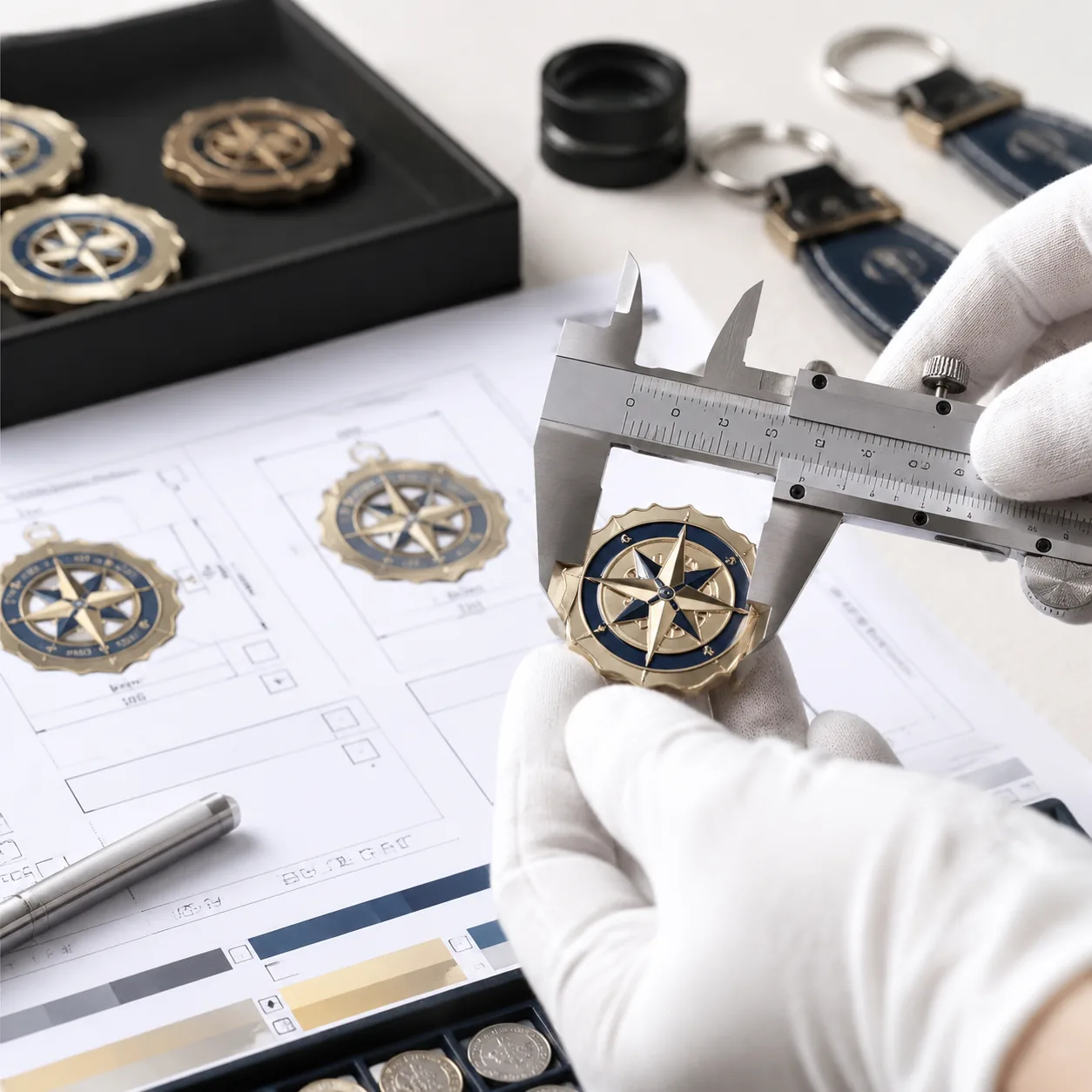
For physical pre-production samples, request front, back, side-thickness and attachment photos before international dispatch. Metal samples should be photographed beside calipers and the approved artwork. Enamel and printed items should be photographed under neutral lighting, ideally 5000-6500K, because warm desk lighting can hide color drift. If color is critical, approve against a physical Pantone chip or the signed golden sample, not only a compressed phone image.
Write AQL requirements that can be inspected
A final inspection report is useful only when it states lot size, sample size, inspection level, AQL limits and defect definitions. For promotional pins, coins, medals, keychains, magnets, patches and lanyards, many buyers use ANSI/ASQ Z1.4 or ISO 2859-1 sampling with General Inspection Level II. A common setting is AQL 0 for critical defects, AQL 2.5 for major defects and AQL 4.0 for minor defects.
Major defects should include wrong logo, wrong plating, incorrect Pantone color beyond approved range, missing attachment, broken clasp, sharp burr, unreadable QR code, magnet detachment, incorrect retail barcode, wrong backing card and wrong carton quantity. Minor defects may include tiny surface dots, slight enamel underfill inside the approved limit, small thread tails on patches, minor embroidery fuzz or slight print offset on lanyards. Critical defects include exposed sharp points, loose small parts on child-targeted items, mold contamination, heavy odor, blood or insect contamination, and any safety issue that makes the product unfit for use.
| Packed lot size | General Level II sample size | AQL 2.5 major accept/reject | AQL 4.0 minor accept/reject |
|---|---|---|---|
| 501-1,200 pcs | 80 pcs | 5 accept / 6 reject | 7 accept / 8 reject |
| 1,201-3,200 pcs | 125 pcs | 7 accept / 8 reject | 10 accept / 11 reject |
| 3,201-10,000 pcs | 200 pcs | 10 accept / 11 reject | 14 accept / 15 reject |
| 10,001-35,000 pcs | 315 pcs | 14 accept / 15 reject | 21 accept / 22 reject |
Do not request AQL 0 for normal cosmetic flaws unless you are paying for 100% sorting. On a 10,000-piece enamel pin order, full cosmetic sorting can add 1-3 days and USD 0.01-0.04 per piece depending on defect criteria. If the buyer wants no visible enamel dust, no plating dots under 0.2 mm and no backstamp fill variation, those standards must be priced and inspected as explicit limits, not assumed.
Declare materials and finishes without overclaiming
Buyers often ask for certificates, but most custom promo items do not have one universal certificate that proves every claim. A responsible factory can provide a material declaration, supplier safety data, plating specification or test report for a defined regulation and batch. It should not claim compliance with a standard that was never tested on the actual material set or a representative production batch.
For metal pins, coins and keychains, the declaration should identify base material, such as zinc alloy, iron, brass or stainless steel, plus plating color, lacquer or epoxy coating, magnet type and attachment material. If nickel-free is required, specify the test or market requirement. For EU skin-contact parts, nickel release under EN 1811 may be relevant. For child-targeted items, small-parts evaluation, accessible sharp points, lead, cadmium and phthalate requirements may apply depending on market and age grading.
For textile products, the useful record is different. A polyester sublimation lanyard should list width, length, fabric weight if specified, print method, clip style, breakaway type and dye lot control. Typical tolerance is +/-1 mm on a 20 mm lanyard width and +/-10 mm on finished length. Woven or embroidered patches should record thread colors, backing material, border type and adhesive or hook-and-loop specification. A patch with heat-seal backing may need application temperature, pressure and dwell-time guidance if the buyer will apply it later.
Request photo evidence that proves identity and packing
Random workshop photos are weak evidence. A useful photo set proves identity, construction, quantity and packing. For a 3,000-piece challenge coin order, the final record should include bulk trays before bagging, front and back close-ups, edge view if reeding or edge text is specified, thickness and diameter checks, unit packing, inner cartons and sealed master cartons with labels visible.
For pins and brooches, request attachment photos or short pull-check videos when failure risk is high. A butterfly clutch post should be soldered or riveted squarely, without front-side burn-through or wobble. For magnets, the record should show magnet diameter, adhesive coverage and placement. A single 10 mm magnet may be inadequate for a heavy 50 mm zinc alloy badge unless holding force was specified and verified.
- Front and back close-up of approved mass-production units
- Side view showing thickness, epoxy dome, relief depth or woven edge where relevant
- Caliper photo for width, height and thickness from the first packed lot
- Attachment photo for pin post, brooch bar, split ring, lobster clasp, magnet or lanyard clip
- Packing photo showing unit bag, backing card, inner box and master carton
- Carton label photo showing SKU, PO, quantity, gross weight and carton number
- Random open-carton photo from at least 3 cartons for orders over 2,000 pcs
Specify file quality if your team reviews remotely. Images with at least 1600 pixels on the short side are usually enough for cosmetic review. QR codes, serial numbers, tiny backstamps and woven text may need macro photos. Do not approve final shipment from heavily compressed chat-app images when the decision affects payment or retailer acceptance.
Make packing lists and cartons traceable
Packing documents must match the physical shipment. A common receiving failure occurs when the commercial invoice states 5,000 pieces, the packing list says 10 cartons, and carton labels show mixed quantities because the last carton is short but not marked. That may not be a product defect, but it slows inbound count, creates shortage claims and can trigger chargebacks.
Custom promo products are often limited by carton weight before volume. Pins and coins commonly ship in master cartons around 10-18 kg gross weight to reduce breakage and manual-handling risk. Lanyards and patches are lighter but bulkier. A practical gross-weight tolerance is +/-0.5 kg for cartons with the same contents, with the final short carton clearly labeled.
Traceability does not need to be complicated. For most orders, carton marks should include PO number, buyer SKU, item description, units per carton, carton sequence and country of origin where required. For multi-item kits, label inner bags or inner boxes so the warehouse can identify pin, patch, coin and lanyard components without opening every retail pack.
| Carton field | Recommended format | Why it matters |
|---|---|---|
| PO number | Buyer PO plus factory order number | Connects receiving to purchasing and payment records |
| SKU or item code | Exact buyer SKU, not only artwork name | Prevents mixed-item receiving errors |
| Quantity | Units per carton and total cartons | Supports fast count verification |
| Carton number | 1 of N sequence | Identifies missing, duplicated or short cartons |
| Gross/net weight | KG to one decimal place | Supports freight, customs and warehouse checks |
| Country of origin | Made in China where required | Supports customs entry and retail receiving rules |
Plan lead time, MOQ and FOB impact
Documentation adds the least cost when it is planned into the production route. Typical production after artwork approval is 15-25 days for soft enamel pins, 18-30 days for challenge coins, 12-20 days for woven patches and 10-18 days for polyester lanyards. A physical pre-production sample normally adds 7-12 days including courier time. Third-party inspection usually adds 1-3 days after packing, longer if the first inspection fails and sorting or rework is required.
Typical MOQs for custom promo manufacturing are 100 pcs for pins and keychains, 50-100 pcs for challenge coins, 100 pcs for patches and 100 pcs for lanyards. Basic factory photos, packing list and a simple inspection record are often included above those quantities. Costs rise for retailer-specific templates, bilingual declarations, barcode scan logs, special carton label printing, lab testing and repacking after failed inspection.
FOB price also determines the documentation level that makes economic sense. As a planning range at 1,000 pcs, a 25-35 mm soft enamel pin may be USD 0.45-1.20 FOB, a 50 mm zinc alloy keychain USD 0.80-2.00, a 45 mm challenge coin USD 1.80-4.50, a 75 mm woven patch USD 0.35-1.10 and a 20 mm polyester lanyard USD 0.45-1.50 depending on attachment, packaging and print method. A USD 300 third-party inspection may be excessive for a USD 700 internal giveaway but inexpensive compared with a retailer rejection or event launch failure.
Use a three-level document checklist
The simplest way to manage inspection documents is to classify each order before deposit. Level 1 is for low-risk internal giveaways and includes approved artwork, final photos and packing list. Level 2 is for distributor, corporate and repeat-program orders and adds sample approval records, AQL report, carton label photos and traceable packing records. Level 3 is for retailer, child-related, compliance-sensitive or high-value shipments and adds third-party inspection, lab testing, barcode verification and retailer label checks.
Send requirements with the RFQ, then carry them into the PI and production file. Include PO format, SKU list, carton label template, AQL level, defect definitions, packing method, declaration wording and any destination-market requirements. Keeping the final document pack with the reorder file also reduces risk on the next PO, because the factory can compare new production against the same approved standard instead of rebuilding requirements from memory.
- Choose Level 1, Level 2 or Level 3 before deposit payment
- Attach artwork, packing instructions and carton label rules in one RFQ package
- Specify AQL level, sample-size logic and major, minor and critical defects
- Confirm whether test reports must be batch-specific or material-specific
- Approve sample photos with version numbers before mass production starts
- Request final inspection and packing photos before balance payment
- Save the final document pack with the reorder file for the next PO
Have a project? Send your artwork and target quantity and we’ll reply with a detailed quotation within 12 working hours.
Ready to get this made?
Send your sketch, target quantity and ship-date. Detailed quotation in 12 hours.



