Incoming QC Plan for Custom Pins, Coins and Keychains
Why Incoming QC Protects Metal Promotional Orders
Incoming QC is the inspection performed when goods arrive at your warehouse, distributor hub, event kitting center or 3PL. It is not a substitute for artwork approval, pre-production sample approval, in-process control or pre-shipment inspection at the factory. Its purpose is narrower: confirm the shipment that arrived is the shipment you bought, catch transit damage, identify mixed cartons, verify packing accuracy and stop defective goods before they enter sellable or event inventory.
The common failure is rarely a full container of unusable pins. More often, 2% of clutches are loose, 1.5% of gold-plated pieces have dark stains, 1% have the wrong backstamp, and several cartons are short-counted. Nobody notices until staff start packing VIP bags two days before launch. At that point, even a cooperative supplier cannot remake, air freight and clear customs in time.
For custom enamel pins, challenge coins and metal keychains, a practical incoming inspection should take about 2 to 4 hours per SKU for lots from 1,000 to 10,000 pieces. It should use clear accept/reject limits, not subjective notes such as acceptable appearance. The same plan also improves supplier claims because the factory receives defect counts, photos, carton numbers and evidence tied to the original purchase specification.
Set AQL and Sampling Before Shipment
Define the incoming QC standard in the RFQ, purchase order or approved production specification before mass production starts. For most finished promotional metal items, ANSI/ASQ Z1.4 or ISO 2859-1 single sampling, general inspection level II, normal inspection is the practical default. It gives enough coverage for commercial decisions without turning a USD 2,000 to USD 15,000 order into a 100% sorting project.
A balanced starting point is AQL 0 or 0.65 for critical defects, AQL 1.5 for major defects and AQL 4.0 for minor defects. Critical defects include sharp edges that can cut skin, exposed pin posts through packaging, incorrect safety or material declarations, detached magnets on child-oriented products, and restricted substances above agreed limits. Major defects include wrong logo, wrong Pantone, wrong plating finish, missing attachments, broken split rings, severe plating peel, incorrect quantity, mixed SKU or unreadable barcode. Minor defects include tiny enamel specks, faint polishing haze or backing card scuffs within the approved tolerance.
Tighten the plan for children’s products, licensed retail, medical events, luxury gifting and employee recognition awards where a visible defect damages brand value. Use AQL 0 for defined safety defects and consider 100% functional checks for magnets, pin posts or bottle opener features. For low-cost giveaways at roughly USD 0.45 to USD 0.90 FOB, do not impose jewelry-grade cosmetic limits unless the supplier has priced the extra sorting and rejection risk.
| Order size per SKU | Level II sample size | Critical AQL | Major AQL | Minor AQL |
|---|---|---|---|---|
| 501-1,200 pcs | 80 pcs | 0 or 0.65 | 1.5 | 4.0 |
| 1,201-3,200 pcs | 125 pcs | 0 or 0.65 | 1.5 | 4.0 |
| 3,201-10,000 pcs | 200 pcs | 0 or 0.65 | 1.5 | 4.0 |
| 10,001-35,000 pcs | 315 pcs | 0 or 0.65 | 1.0-1.5 | 2.5-4.0 |
Define Defects With Measurable Tolerances
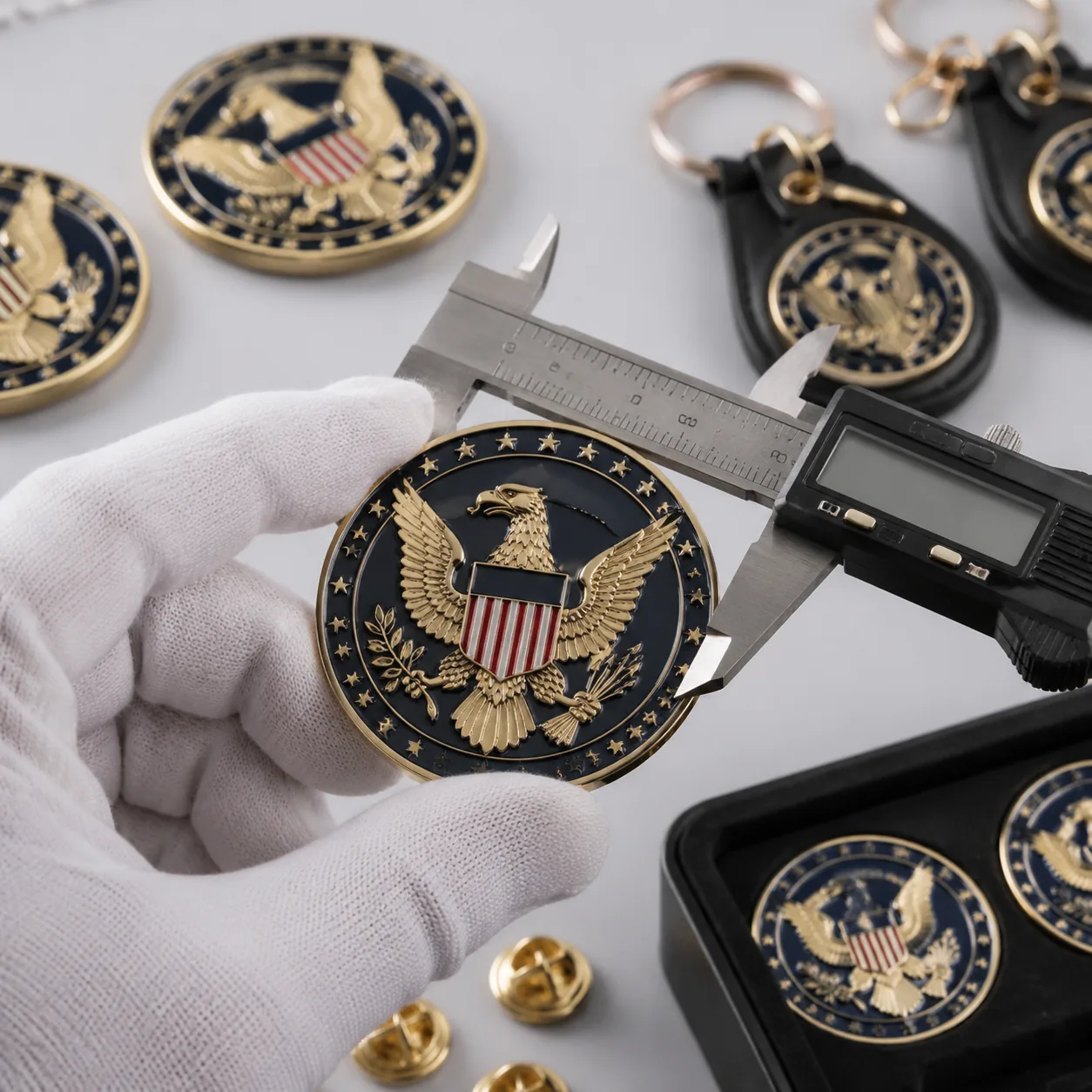
Incoming QC fails when a checklist says good plating, clean enamel and strong attachment without measurable limits. Inspectors need tolerances they can verify with digital calipers, a scale, a pull gauge, a light box and a 10x loupe. For die-struck or cast metal items, a common dimensional tolerance is ±0.20 mm for widths under 30 mm, ±0.30 mm for 30 to 60 mm, and ±0.50 mm for larger coins, magnets or bottle openers. Thickness tolerance is often ±0.20 mm for pins and ±0.30 mm for coins, unless the design has heavy 3D relief or an intentionally raised rim.
Weight should be specified per piece, especially for challenge coins and premium keychains. A 45 mm zinc alloy keychain may reasonably vary by ±5% without functional impact, while a 50 mm brass challenge coin should usually stay within ±3% after plating. If the buyer specifies only diameter and artwork, a factory chasing a low quote may reduce thickness, hollow the reverse or use a lighter alloy.
Color should be judged against the approved production sample under D65 daylight or a controlled 5000K to 6500K light source. For enamel, a visual match within about Delta E 2.0 to 3.0 is reasonable for solid fills when a spectrophotometer reading is available, but metallic plating and curved surfaces can make instrument readings unreliable. For printed backing cards, inserts and barcode labels, tighter print control is realistic because the substrate is flat and matte.
- Confirm outer dimensions with digital calipers at 0.01 mm resolution on 5 to 10 pieces from different cartons.
- Check weight on a 0.01 g scale for pins and keychains, or a 0.1 g scale for heavy coins.
- Compare enamel and print colors to the approved sample under daylight-equivalent lighting.
- Reject burrs or sharp points that catch a cotton glove or scratch copy paper during a light rub test.
- Record defect type, quantity, carton number and photo evidence before samples are returned to stock.
Inspect Plating, Enamel and Epoxy Separately
Plating, enamel and epoxy fail in different ways, so they should not be grouped under one cosmetic line. A fingerprint or polishing residue can often be wiped off; blistering, exposed base metal and poor surface preparation cannot. Standard decorative nickel, gold, black nickel, antique brass or rose gold plating on pins and keychains commonly falls in the 3 to 8 micron range. Premium programs or high-handling items may specify 8 to 12 microns, but thicker plating increases cost and can soften fine recessed detail if the tooling was not designed for it.
During receiving, check for exposed zinc or brass on high points, dark stains near recessed lines, cloudy lacquer, plating blisters and inconsistent tone between cartons. Slight color variation is normal across plating baths, especially between brass, iron and zinc alloy substrates, so the approved sample should come from the same production method. A USD 0.60 soft enamel giveaway pin should not be judged against the same cosmetic standard as a USD 4.50 boxed challenge coin.
Soft enamel should sit below raised metal lines, commonly by 0.10 to 0.30 mm depending on line height and design. Hard enamel should be polished nearly flush, usually within ±0.05 to ±0.10 mm of the metal surface. Epoxy domes should be centered, glossy and clear; bubbles under 0.30 mm may be acceptable if sparse and away from logos, QR codes and small text.
| Area | Practical acceptance standard | Major defect example | Inspection method |
|---|---|---|---|
| Plating | Uniform tone, no exposed base metal, 3-8 microns for standard decorative finish | Peeling, blistering, visible zinc or copper at edges | Approved sample, 10x loupe, tape adhesion check |
| Soft enamel | Clean fill, recessed 0.10-0.30 mm, no overflow onto metal lines | Wrong color, missing fill, dust over logo | Light box, approved sample, depth probe |
| Hard enamel | Polished nearly flush within ±0.05-0.10 mm, smooth surface | Pits, waves, underfilled zones, color bleeding | Side light, fingertip check, approved sample |
| Epoxy dome | Centered, transparent, glossy, no yellowing | Cloudy dome, lifting edge, bubbles over text | Side light, 10x loupe |
Stress-Test Attachments and Moving Parts
Many real-world returns come from hardware failure, not artwork defects. Incoming QC should include functional checks for butterfly clutches, rubber clutches, safety pins, magnets, split rings, jump rings, lobster clasps, spinners, sliders and bottle opener edges. These tests are quick and often catch problems that a visual inspection misses.
For lapel pins, posts should be straight within about 5 degrees from perpendicular and firmly soldered or brazed. A practical pull test is 2 to 3 kgf for standard promotional pins and 4 to 5 kgf for heavier brooches or dual-post designs, held for 5 seconds without detachment. Rubber and butterfly clutches should resist light finger pull but remain removable without tools. If clutches are too loose, the buyer may lose the pin; if too tight, end users bend posts during removal.
For keychains, split rings should return closed after opening and show no cracks or permanent gaps. A 25 mm or 30 mm steel split ring with 1.6 to 2.0 mm wire is more suitable for automotive, hotel or outdoor use than a thin 1.2 to 1.4 mm decorative ring. Heavy charms over 35 g should use welded, double-loop or reinforced connectors rather than a single soft jump ring.
- Pull-test pin posts, key rings and jump rings on at least 20 pieces or 10% of the inspection sample, whichever is lower.
- Rotate spinner or sliding parts 20 cycles and check for scraping, loose rivets or metal dust.
- Open and close lobster clasps 10 cycles, confirming the spring returns fully each time.
- Slide-test magnets on a painted steel panel and reject pieces where the magnet separates from the body.
- Test bottle opener keychains on 3 to 5 caps when opening function is part of the sales promise.
Treat Packing as Part of the Product
Packing defects cause chargebacks, fulfillment delays and product damage even when the metal item itself is acceptable. Incoming QC should verify OPP bags, backing cards, barcode labels, carton markings, master carton strength, SKU separation and country-of-origin labeling where required. A pin that passes loose inspection may still fail if its post pierces the card or scratches neighboring pieces in transit.
Common individual packing for small pins is one pin in a 60 to 80 micron OPP bag, or one pin mounted on a 300 to 400 gsm backing card inside an OPP bag. Heavier coins and keychains may need thicker OPP, paper sleeves, EVA foam, velvet pouches, acrylic capsules or rigid gift boxes. A 50 mm coin capsule may add roughly USD 0.12 to USD 0.28 FOB, while a magnetic gift box can add USD 0.60 to USD 1.50 FOB depending on size, insert material and order quantity.
Carton specifications should match the approved packing plan. Dense metal goods should normally stay below 15 kg gross weight per export carton for safe manual handling, and below 12 kg when cartons are compact. Inner packs should use fixed quantities such as 50 or 100 pieces. Unless the PO allows variance, a short count is a major defect. For Amazon, retail distribution centers and event kitting, barcode, SKU or carton-label errors should be treated as major defects, and sometimes critical if they trigger chargebacks or missed launch dates.
| Packing point | Practical specification | Reason to inspect |
|---|---|---|
| Individual bag | 60-80 micron OPP for pins; thicker film or sleeve for heavy keychains | Prevents rubbing, tarnish and lost attachments |
| Backing card | 300-400 gsm card, hole position tolerance ±1.0 mm | Keeps retail display aligned and prevents sagging |
| Inner carton | Fixed quantity, commonly 50 or 100 pcs per inner | Speeds receiving, kitting and cycle counts |
| Master carton | Usually below 15 kg gross for dense metal goods | Reduces crushing and manual handling complaints |
| Carton label | SKU, PO, quantity, carton count, country of origin if required | Prevents mixed inventory and receiving delays |
Scale QC to MOQ, Price and Lead Time
A useful QC plan is proportionate to the order value and risk. Spending USD 500 on third-party receiving inspection for a USD 900 repeat order of simple 25 mm soft enamel pins may not be commercial if the supplier has a stable record and the event date has buffer. The same inspection cost is cheap insurance for a USD 12,000 mixed shipment of coins, keychains, patches and lanyards going directly to a distributor warehouse.
MOQ and price level affect what can reasonably be demanded. Many pin factories accept 100 pieces per design, but more stable pricing usually starts at 300 to 500 pieces. Standard 25 to 35 mm soft enamel pins commonly range from USD 0.55 to USD 1.50 FOB depending on quantity, size, metal, color count, plating and attachment. Challenge coins at 40 to 50 mm often range from USD 1.80 to USD 5.50 FOB, with antique plating, dual-sided enamel, sequential numbering and edge engraving adding cost. Custom metal keychains commonly range from USD 0.80 to USD 3.50 FOB. These ranges exclude licensing audits, lab testing, unusual packaging, urgent tooling changes and air freight.
Lead time is just as important as price. A normal custom metal order usually needs 2 to 4 days for artwork proofing, 5 to 8 days for tooling and pre-production sample, then 12 to 25 days for mass production after approval. Express small runs may finish faster, but plating, epoxy curing and packing still create bottlenecks. If incoming QC after sea freight fails, replacement can take 20 to 45 days including remake and transport. For fixed-date events, use factory-side final inspection before shipment and reserve incoming QC for transit condition, quantity and fulfillment readiness.
- Use lighter incoming QC for repeat SKUs with approved golden samples, stable suppliers and no date-critical launch.
- Use stricter incoming QC for first orders, licensed goods, retail programs, children’s products and multi-SKU kitting.
- Do not demand premium cosmetic limits on low-cost giveaways unless the quote includes extra sorting and rejection risk.
- Budget for third-party pre-shipment inspection when a failed lot would cost more than the inspection fee.
- Add 1% to 2% spare quantity for event orders where minor damage during kitting or distribution is likely.
Build the Supplier Evidence Pack
Before the next shipment leaves the factory, create a one-page incoming QC sheet for each SKU. Include artwork revision, golden sample photos, dimensions, thickness, weight, plating finish, enamel type, attachment type, packing method, carton quantity, barcode requirements and AQL levels. Keep the wording simple enough for warehouse staff to use without calling the buyer for every judgment.
Ask the supplier to provide evidence in the same categories before shipment. Useful documents include final inspection photos, carton label photos, packing list, weight and dimension records, material declaration, plating or color confirmation, and pull-test results for hardware where relevant. For higher-risk programs, request a short inspection video showing random carton selection, functional tests and sealed cartons after inspection. This does not replace independent inspection, but it reduces disputes because both sides use the same defect definitions.
At receiving, photograph every major defect with a ruler or caliper in the frame, record carton numbers and separate suspect goods before they enter inventory. If the lot fails, do not immediately scrap it. Sort defects by type, estimate usable quantity and agree with the factory whether replacement, credit, rework, spare parts or partial acceptance is the fastest commercial fix. A clear incoming QC plan turns a vague quality complaint into a solvable business decision.
Have a project? Send your artwork and target quantity and we’ll reply with a detailed quotation within 12 working hours.
Ready to get this made?
Send your sketch, target quantity and ship-date. Detailed quotation in 12 hours.



