Incoming QC Checklist for Custom Pins and Keychains in 2026
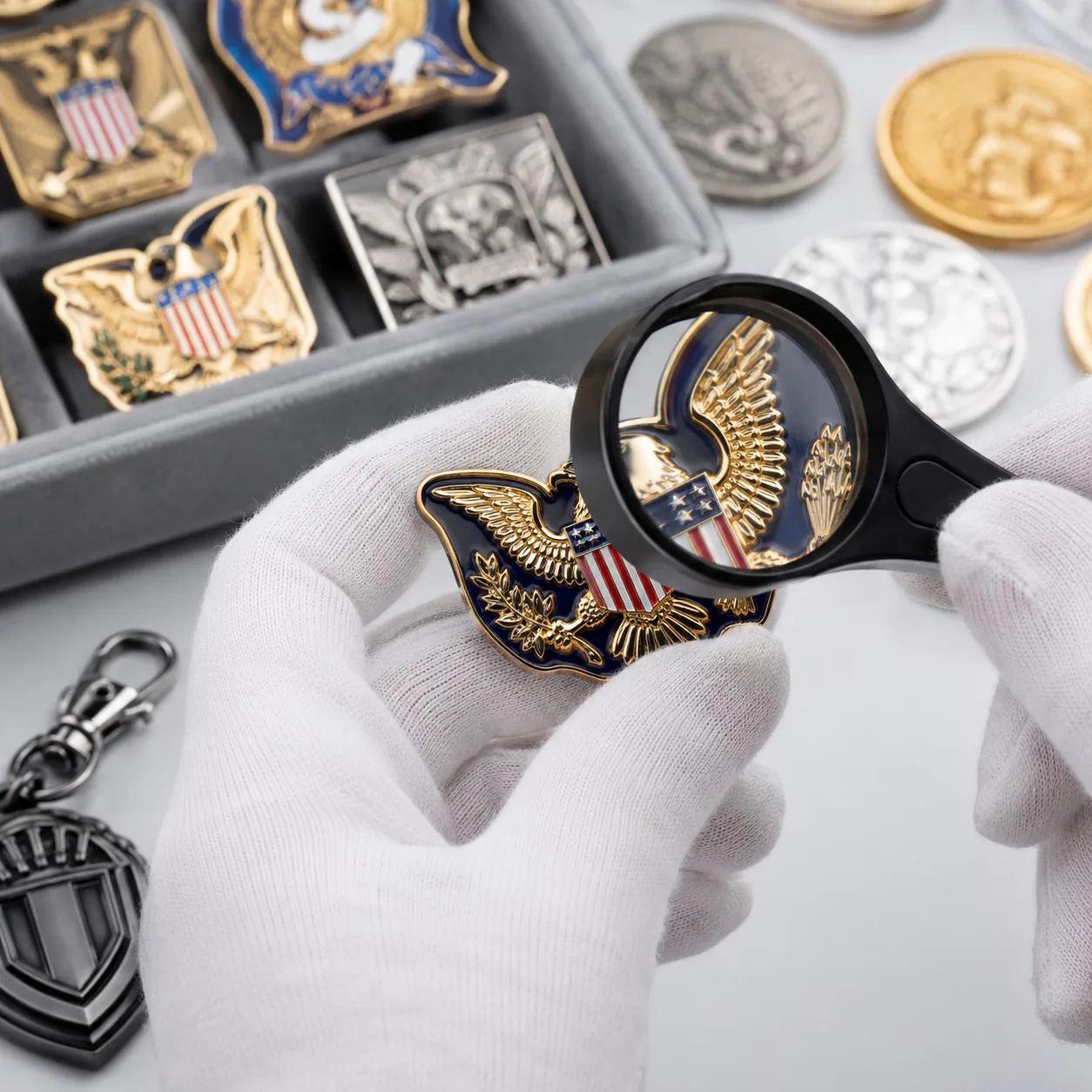
Why approved samples still fail at warehouse intake
A golden sample can be correct and a factory final random inspection can still pass, yet the shipment creates rejects when it reaches your warehouse or 3PL. The usual cause is not one catastrophic defect. It is a cluster of smaller misses that were never controlled at intake: plating tone drift between cartons, pin-post spacing that lets a two-post pin rotate on fabric, split rings with a visible opening gap, mixed hardware finish within one SKU, barcode labels tied to the wrong SKU, backing cards inserted upside down, or carton counts that do not match the ASN.
In 2026, incoming QC for decorative metal goods is mainly a downstream cost-control step. A marginal lot can trigger relabeling labor, retailer chargebacks, event-date misses, distributor credits, and warehouse sorting that wipes out margin on a low-cost item. Buyer-side intake should therefore focus on release blockers: SKU accuracy, count accuracy, hardware function, visible finish consistency, retail-pack compliance, and safety issues such as sharp burrs or weak magnets.
Factory outgoing inspection often follows ANSI/ASQ Z1.4 or ISO 2859-1 with Critical 0, Major AQL 2.5, Minor AQL 4.0. That is a workable shipping gate, but incoming QC should be stricter on the few defects that create immediate business risk. The goal is not to repeat a full final inspection. It is to make a fast release, sort, or hold decision in 30 to 90 minutes per SKU using checks your warehouse can actually perform.
Set hold criteria before opening the first carton
Warehouse teams need an objective defect taxonomy before inspection starts. Without that, staff make subjective calls and borderline lots slip through. On custom pins, immediate-hold defects usually include wrong artwork revision, wrong plating family, detached or loose posts, burrs sharp enough to cut skin, missing clutches, magnetic backs below pull-force spec, and count shortages beyond PO tolerance. On keychains, add cracked acrylic or PVC parts, broken jump rings, jammed swivel snaps, mixed hardware finish within one SKU, and incorrect retail barcode or country-of-origin marking.
Use three action classes. Critical defects always mean hold because they create safety, legal, or functional failure. Major defects mean hold if the defect rate exceeds the agreed acceptance number. Minor defects can be sorted if the economics work. A faint polishing line on the back of a pin is usually minor. Exposed base metal on the front face is major. A sharp burr on a keychain edge or pin point is critical.
- Immediate hold: wrong SKU, wrong artwork revision, missing component, detached pin post, unsafe sharp edge, magnet pull below agreed minimum, hardware breakage during first function test, retail barcode mismatch
- Sort and monitor: small dust point in recessed area, slight enamel shade drift within approved visual tolerance, faint back-side polishing line, minor epoxy flow mark outside front-facing zone
- Accept with note: outer carton scuffing with no unit damage, light polybag wrinkles, unit-weight variation within agreed range, minor carton-label smudge with readable data
Write functional specs as numbers, not adjectives. For magnetic badge backs on a 35 mm to 45 mm pin, a practical minimum retention is often 0.8 to 1.2 kgf measured on a simple pull gauge, depending on garment thickness and magnet size. For standard 25 mm OD split rings made from 1.8 to 2.0 mm wire, set a maximum ring opening gap after assembly of 0.15 mm. For butterfly clutch posts, standard post diameter is typically 0.80 to 0.90 mm; if posts measure below about 0.75 mm, retention failures become more likely.
Use a realistic sampling plan for 500 to 20,000 units
Incoming inspection should be faster than factory final inspection but still structured. For small runs of 500 to 3,000 units, a tightened sample of 32 to 80 pieces is usually enough if it is spread across cartons and SKUs. For larger runs, use ANSI/ASQ Z1.4 or ISO 2859-1 logic, normal or tightened depending on supplier history, and always stratify by carton, SKU, and lot date. If production ran across multiple plating days or outsourced assembly lots, sample by lot code as well.
A practical incoming benchmark for retail, museum, membership, and premium corporate merchandise is Critical 0, Major AQL 1.0 to 2.5, Minor AQL 4.0. For lower-risk promotional giveaways, many buyers still accept Major 2.5 and Minor 4.0. Do not pool five designs into one sample just because they shipped together. A 5,000-unit shipment with five SKUs still needs SKU-level sampling because plating, enamel fill, print registration, carding, and hardware are separate risks.
| Order size | Typical MOQ context | Buyer-side incoming sample | Suggested defect limits | Notes |
|---|---|---|---|---|
| 500-1,000 units | Common MOQ for custom metal pins or keychains | 32-50 pcs across 3-5 cartons | Critical 0, Major AQL 1.0-2.5, Minor 4.0 | Count-check 5-10% of cartons; inspect each SKU separately |
| 1,001-3,000 units | Standard run for event merch and membership items | 50-80 pcs across 5-8 cartons | Critical 0, Major 2.5, Minor 4.0 | Add function test on 10 pcs per SKU; open cartons from different pallet layers |
| 3,001-10,000 units | Retail and distributor orders | 80-125 pcs across 8-13 cartons | Critical 0, Major 1.0-2.5, Minor 4.0 | Break sample by lot date if production spanned multiple days or plating batches |
| 10,001-20,000 units | National campaigns or chain retail | 125-200 pcs across 13-20 cartons | Critical 0, Major 1.0-2.5, Minor 4.0 | Separate sampling by SKU, finish, pack style, and hardware source; verify pallet and carton map |
As a floor, incoming sample size should not drop below 13 pieces per SKU, even on mixed orders, because function defects such as loose clutches, weak solder joints, or ring gaps often hide in one carton or one hardware lot. If the supplier used multiple plating batches, mixed hardware vendors, or split production between subcontractors, increase the sample instead of assuming visual uniformity.
For exact-count retail orders, pair defect sampling with quantity verification. A practical rule is to physically count 10% of cartons on runs up to 3,000 units, then at least 5 cartons per SKU on larger runs. If any sampled carton is short, over, or mixed, place the lot on hold and expand counting immediately. On blind-assort or pre-ticketed retail orders, one mixed carton is usually enough to justify 100% verification of that SKU.
Measure only dimensions that predict fit, use, and failure
Do not ask warehouse staff to measure decorative contours that do not affect use. Measure dimensions that correlate with fit, appearance, and downstream failure. For pins, that usually means overall width and height, metal thickness, post location, post spacing on two-post items, post diameter, and backing-card size if retail packed. For keychains, measure body size, metal thickness, total assembled length, split-ring outside diameter, split-ring wire diameter, and jump-ring wire diameter.
Typical tolerances should be on the PO, not left to factory interpretation. On a 35 mm die-struck or soft-enamel pin, outline tolerance of plus or minus 0.30 mm is common. Post location should usually stay within plus or minus 0.50 mm from centerline, and two-post spacing within plus or minus 0.40 mm to preserve anti-rotation. Metal thickness on standard pins is commonly 1.2 to 1.5 mm with intake tolerance of plus or minus 0.10 mm. Heavier key fobs often run 2.0 to 3.0 mm thickness with tolerance of plus or minus 0.15 mm. Standard split rings are often 25 mm or 30 mm OD with tolerance of plus or minus 0.50 mm and wire diameter around 1.8 to 2.0 mm. Jump rings are commonly 1.2 to 1.6 mm wire, and closure gap should be no more than 0.10 to 0.20 mm depending on use.
Use a digital caliper with 0.01 mm resolution, a go or no-go template for post spacing, a 5x loupe for ring closure and print registration, a small force gauge for magnet pull or snap force, and a 1 g-resolution scale for sample and carton weight checks. Do not infer thickness from weight alone. Cutouts, recessed areas, attachment count, and alloy choice can change mass enough to hide a thickness problem.
Make the checks concrete. Example 1: on a 38 mm two-post soft-enamel pin sold on a 90 x 55 mm backing card, inspect 13 pieces for width and height, 5 pieces for thickness, 10 pieces for post spacing using a template, and 5 carded units for card size and hole position. Example 2: on a 50 mm zinc-alloy keychain with 30 mm split ring and swivel clasp, inspect 13 bodies for outline, 10 rings for OD and wire diameter, 10 jump rings for closure gap, and 10 assembled units for overall length and clasp movement.
Judge plating, enamel, and epoxy under controlled visual standards
Most warehouses do not have XRF, adhesion labs, or salt-spray capability, so incoming QC has to rely on controlled visual inspection plus limited function checks. Decorative plating on promotional metal goods is usually specified by appearance, not by heavy corrosion class. Bright nickel, black nickel, imitation gold, rose gold, and gunmetal on pins and keychains are often only about 0.03 to 0.10 microns as a decorative top layer over copper and nickel undercoats. Premium retail runs may specify heavier decorative stacks or e-coat, but many standard promotional goods do not. That matters when comparing quote tiers and expected wear resistance.
Inspect against the approved sample or retain sample under neutral white light, ideally 5000 to 6500 K at around 800 to 1200 lux. First confirm the finish family: bright nickel versus matte silver, black nickel versus gunmetal, imitation gold versus rose-gold drift. Then check edge coverage, patchiness near posts or loops, plating build-up in recesses, burn marks, and exposed base metal on front-facing high points. On moving keychain hardware, look closely at joints where excess plating can cause binding.
For soft enamel, check that fills are even and typically sit 0.05 to 0.15 mm below the raised metal line unless the approved sample shows a deeper recess. Hard enamel or imitation hard enamel should feel flatter and smoother, with less visible level difference. Practical major thresholds for retail goods are fill voids, overflow onto metal lines, pinholes visible at 30 cm, or color drift obvious against the retain sample under standard light. For screen-printed details on enamel or epoxy, registration drift beyond 0.20 mm is a useful incoming hold threshold on small logos or text.
For epoxy-coated items, inspect at a low angle for dome centering, edge creep, trapped bubbles, sink marks, and scratches. A bubble larger than about 0.5 mm visible at 30 cm is a workable major defect for most retail orders. Edge lift, cloudy resin, off-center doming, or a deep front scratch should also trigger hold or sorting depending on defect rate.
| Feature | Typical spec to check | Incoming QC method | Hold threshold |
|---|---|---|---|
| Plating appearance | Match approved sample; no exposed base metal on face | Visual under 5000-6500 K light | Color-family mismatch, patchy plating, exposed base metal on front |
| Soft enamel fill | Even fill, normally 0.05-0.15 mm below metal line | Visual and fingertip check | Pinholes, overflow, voids, or uneven fill visible at 30 cm |
| Epoxy dome | Smooth, centered, no major bubbles or edge lift | Visual at angled light | Bubble over about 0.5 mm, edge creep onto metal border, deep front scratch |
| Printed detail | Registration within about 0.20 mm on fine artwork | 5x loupe and visual check | Misregistration that affects text, logo edge, or border alignment |
| Post/loop attachment | No movement at weld or solder point | Manual twist and pull on sample pieces | Any detachment or visible movement |
| Split ring or snap function | Operates smoothly for agreed cycle count | 10-cycle test for clutches/snaps; 20-cycle swivel test | Breakage, binding, permanent deformation, or plating flake affecting use |
Target hardware failures that shipping vibration exposes
Transit vibration and carton compression expose weaknesses that are easy to miss at the factory table. Butterfly clutches loosen when post diameter is undersized, often below about 0.75 to 0.80 mm on standard posts. Rubber clutches split when compound hardness is inconsistent. Split rings gap open if temper or wire gauge is weak. Lobster clasps and swivel snaps jam when plating builds up at moving joints. These are classic incoming failures because the units looked acceptable when packed but fail after transport shock or simple handling.
Run short function tests on a deliberate sample. For pins, attach and remove the clutch 10 times on 10 pieces per SKU, then check retention and whether plating flakes from the post. For two-post pins, pin them through a fabric test card of consistent thickness, such as 1.0 to 1.5 mm, to confirm anti-rotation. For magnetic backs, measure pull on at least 5 pieces per SKU. For keychains, rotate swivels 20 cycles, open snaps 10 cycles, and inspect jump-ring closure under 5x magnification. Even a 0.20 to 0.30 mm ring gap can become a field failure once the item is on a key set or bag.
Price often predicts hardware risk. At 1,000 units FOB, simple 25 to 38 mm 2D soft-enamel pins commonly land around USD 0.28 to 0.70 depending on size, number of colors, plating, backing type, and packaging. At 3,000 to 5,000 units, the same pin may drop to roughly USD 0.20 to 0.48 FOB. A 38 to 45 mm stamped or die-cast metal keychain often runs about USD 0.65 to 1.50 FOB at 1,000 units, while heavier cast bodies, spinner parts, premium swivel snaps, or custom retail cards can push FOB to USD 1.60 to 2.80 or higher. Ultra-low quotes usually save cost first on ring gauge, clutch quality, plating consistency, or pack-out labor.
Lead times should reflect process complexity. Standard custom enamel pins often run 10 to 18 calendar days after art approval. Stamped or die-cast metal keychains typically take 12 to 20 days. Add 2 to 5 days if you require lot segregation, exact-count verification by SKU, carton photos, drop-test-ready master cartons, or extra outgoing function testing. On rush builds, hardware and pack-out are often the first areas where discipline slips, so incoming QC should tighten there first.
Treat packaging, labeling, and count accuracy as hard release points
Many incoming failures are packaging failures rather than product failures. Units may be acceptable, but wrong quantities per inner bag, reversed backing cards, missing desiccants where specified, mixed orientations, or incorrect carton labels can stop fulfillment as fast as a bad product. Retail, e-commerce prep, and blind-assort programs are especially sensitive because one label error can force a full recount, relabel, or ASN correction.
For carded pins and retail-packed keychains, check card stock, die-cut hole position, barcode readability, print color, and insertion consistency. A common backing-card spec is 300 to 400 gsm coated paper with dimensional tolerance of plus or minus 1.0 mm. Polybags should match the agreed gauge, often 40 to 60 microns for standard individual bags, and include suffocation warning print where required by destination market. Master cartons should suit the gross weight; many buyers cap them at 12 to 15 kg for manual handling and lower crush risk.
Count tolerance must be explicit on the PO. Bulk promo goods may allow plus or minus 1.0% by SKU, but retail-packed orders usually require exact count. Weighing cartons can help flag outliers, but it is not a substitute for physical count because card orientation, insert omission, or mixed hardware can leave weight near nominal. Any carton more than 3% above or below listed gross weight should be opened and recounted. If inner packs are specified as exact 25, 50, or 100 units, count the inner packs too; a correct master-carton total with mixed inner quantities still creates fulfillment waste.
- Verify sampled carton labels against PO, packing list, and ASN: SKU, description, finish, quantity, batch date or lot code
- Open cartons from top, middle, and bottom pallet positions to catch mixed-pack or compression damage
- Count pieces in sampled inner packs, not just master-carton totals
- Scan retail barcodes and confirm they resolve to the correct SKU; do not rely on human-readable text alone
- Check backing cards for orientation, print registration, bent corners, and hole position
- Record gross and net carton weight; investigate any outlier beyond 3% of packing-list weight
- Confirm required country-of-origin mark, age warning, or magnet warning is present and legible
Turn incoming QC findings into tighter specs on the next PO
Incoming QC only pays off if the findings change the next order. If the current lot shows post drift, ring gaps, plating mismatch, barcode errors, or carding inconsistency, convert those issues into measurable PO specs rather than generic comments like 'improve quality.' On standard pins at 1,000 units, tighter post-position control, stronger clutch retention, and better outgoing inspection may add about USD 0.02 to 0.08 per piece. On metal keychains with heavier hardware, better ring-closure control, upgraded swivels, and stricter carton segregation often add USD 0.05 to 0.15 per piece.
Before the next PO, build a one-page incoming QC sheet by SKU family. Limit it to checks that actually drive cost: dimensions, attachment position, finish family, hardware function, barcode, count, and pack-out. Write each key spec in measurable terms: mm, microns where relevant, cycle counts, count tolerance, AQL, carton quantity, gross-weight range, and lead time. Keep both the approved pre-production sample and a production retain sample at warehouse level. On repeat orders, the retain sample often catches plating-tone and hardware drift faster than any written note.
- Set measurable tolerances on the PO: overall size, thickness, post location, ring wire diameter, card size, carton quantity, and count tolerance
- Assign defect classes and hold actions before goods arrive
- Sample by SKU and lot date, not by shipment total alone
- Keep one approved sample and one production retain sample at warehouse level
- Require carton labels with SKU, quantity, finish, and batch date or lot code
- Use stricter incoming QC for premium, retail-bound, museum, membership, and event-critical orders; simplify for low-risk giveaways
Have a project? Send your artwork and target quantity and we’ll reply with a detailed quotation within 12 working hours.
Ready to get this made?
Send your sketch, target quantity and ship-date. Detailed quotation in 12 hours.



