Incoming Inspection Plan for Custom Pins, Coins and Keychains
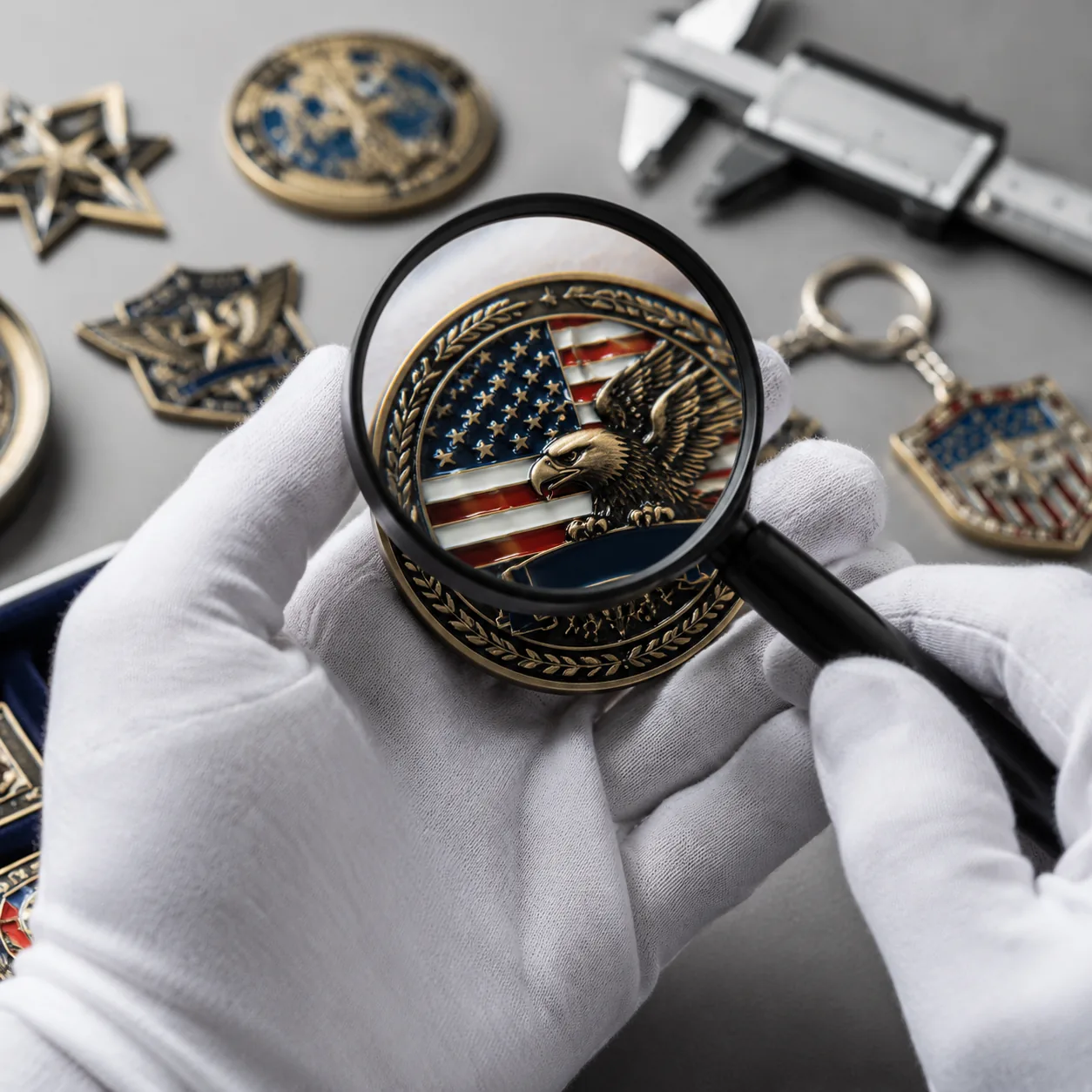
The problem: your shipment passes visually, then fails in use
A buyer receives 5,000 custom enamel pins for a product launch. The cartons look clean, the colors seem close enough under office lighting, and the supplier’s photos showed no obvious defects. Two weeks later, the complaints start: butterfly clutches fall off, a few pins have sharp burrs, the gold plating darkens after handling, and 3 percent of the backing cards are scuffed badly enough for retail to reject.
The issue is usually not that nobody inspected the order. The issue is that the inspection plan was too vague: “check quality before shipment” gives a factory no measurable pass-fail line. For metal promotional products, a useful incoming or pre-shipment inspection plan must define sample size, AQL level, defect categories, tolerances, functional tests, packaging checks and what happens if the lot fails.
At ZheCraft, we see the best results when buyers approve a golden sample first, then attach a one-page inspection standard to the purchase order. This article explains how to write that standard for custom pins, brooches, coins, keychains, magnets and similar small metal items without turning a promotional order into an automotive-grade audit.
Choose the inspection timing before you choose the AQL
For most custom metal giveaways, there are three practical inspection points: pre-production sample approval, in-process inspection, and final random inspection before shipment. A pre-production sample confirms the build: base metal, plating finish, enamel fill, attachment, dimensions, packaging and artwork position. It does not prove that the full batch is consistent.
In-process inspection is useful when the order is large, urgent or technically risky. For example, a 30,000-piece spinner keychain with epoxy, split rings and moving rivets should be checked after casting or stamping, after plating, and before final packing. For a simple 500-piece soft enamel pin reorder from locked specs, a final inspection may be enough.
Final random inspection normally happens when 80 to 100 percent of goods are produced and at least 80 percent are packed. If cartons are not packed, packaging defects cannot be checked properly. If goods are not finished, a supplier can unintentionally cherry-pick better pieces for inspection while late-stage rejects remain outside the sample.
| Inspection point | Best used for | Typical timing | Trade-off |
|---|---|---|---|
| Pre-production sample | New design, new mold, new plating, retail packaging | 7 to 12 days after artwork approval for pins; 10 to 15 days for coins or complex keychains | Catches design risk but cannot measure batch consistency |
| In-process inspection | Orders above 10,000 pcs, moving parts, tight color matching, urgent event orders | After 30 to 50 percent production completion | Adds 1 to 2 days but prevents late discovery of systemic defects |
| Final random inspection | Most B2B promotional orders before balance payment or shipment release | When 80 to 100 percent finished and 80 percent packed | Best overall lot decision, but rework may affect schedule |
| Incoming inspection | Distributor warehouse or buyer receiving dock | Within 2 to 5 days after delivery | Confirms received quality but freight and event deadlines are already at risk |
Set AQL levels that match promotional risk
AQL means Acceptable Quality Limit. It is not a guarantee that the defect rate is exactly that number. It is a sampling method that tells the inspector how many pieces to check and how many defects can be accepted before the lot fails.
For custom pins, keychains and challenge coins, a common practical setup is AQL 0 for critical defects, AQL 2.5 for major defects and AQL 4.0 for minor defects under ISO 2859-1 general inspection level II. For premium retail, museum shops, licensed brand merchandise or paid collectibles, buyers often tighten major defects to AQL 1.5 and minor defects to AQL 2.5. For low-cost event handouts, AQL 2.5 and 4.0 is usually realistic.
Do not set every category to AQL 0 unless you are prepared to pay for 100 percent sorting and longer lead time. A small enamel dot under 0.2 mm on the back of a pin should not carry the same consequence as a loose pin needle or exposed sharp burr. The inspection plan should protect the end user and brand first, then control cosmetic consistency.
| Defect class | Recommended AQL | Examples | Typical decision |
|---|---|---|---|
| Critical | 0 | Sharp exposed burr over 0.1 mm, broken pin post, loose magnet that can detach, wrong safety warning for child-targeted item | Any finding fails the lot until sorted or reworked |
| Major | 1.5 to 2.5 | Wrong plating color, visible enamel overflow, attachment pull failure, wrong logo, dimension outside ±0.3 mm on a 25 mm pin | Fail if accept number is exceeded |
| Minor | 2.5 to 4.0 | Tiny back-side plating speck, slight card scuff, enamel dot under agreed limit, non-facing packaging wrinkle | Accept within AQL limit or negotiate sorting |
| Informational | Not AQL counted | Carton mark style difference, harmless shade shift within Delta E target, slight polybag fold | Record only unless repeated enough to affect presentation |
Define measurable cosmetic standards, not subjective taste
The weakest inspection instructions use words like “beautiful,” “clean,” “premium” or “no defects.” Inspectors need distance, lighting, viewing time and measurable tolerances. For most custom metal promotional products, visual inspection should be done at 30 to 40 cm distance under 600 to 1,000 lux neutral white light, with normal corrected vision and no magnification unless the item is sold as a collectible.
A practical cosmetic rule for enamel pins is to count front-facing defects visible at 30 cm within 5 seconds. Enamel pits over 0.3 mm on the front face can be major defects; pits from 0.15 to 0.3 mm can be minor if there are no more than two per piece; back-side pits below 0.3 mm can often be minor. For hard enamel, the polished surface should be flush within about ±0.05 mm to ±0.10 mm; for soft enamel, recessed fill depth is usually 0.15 to 0.35 mm below the metal lines.
Plating should also be specified. Decorative zinc alloy or brass pins commonly use 3 to 5 microns total plating thickness for standard indoor promotional use, while premium coins or keychains may use 5 to 8 microns depending on finish and budget. If the item will be handled daily, avoid ultra-thin bright gold flash and specify nickel underplating plus final color plating with clear lacquer where appropriate.
- Inspect front-facing logo and artwork at 30 to 40 cm distance under 600 to 1,000 lux light.
- Use the approved golden sample as the color, plating and finish reference, not a screen image.
- Define enamel pit limits by diameter and location: front face, edge, back face or hidden area.
- Set dimensional tolerance before production: common pin size tolerance is ±0.3 mm; coin diameter tolerance is often ±0.2 mm to ±0.4 mm depending on casting or stamping.
- Specify acceptable plating thickness range, such as 3 to 5 microns for standard decorative use or 5 to 8 microns for heavier handling.
- Separate customer-visible retail defects from harmless back-side process marks.
Test hardware like a user, not just an inspector
Hardware failures create more returns than small cosmetic marks. A pin can look perfect and still fail if the post weld is weak, the clutch is loose, the split ring opens, or the brooch bar rotates on fabric. The inspection plan should include simple functional tests on a defined sample size, usually 20 to 50 pieces per SKU for small orders and 80 to 125 pieces for larger lots.
For pin posts, a practical pull test is 2.0 to 3.0 kgf for standard lapel pins and 3.0 to 5.0 kgf for heavier badges over 35 mm, held for 5 seconds without detachment. For magnetic backs, test both magnet retention to the badge and holding force on fabric or a steel plate; a 25 to 30 mm badge often needs two magnets if the badge exceeds 12 g. For keychains, split rings should withstand repeated opening without permanent deformation, and the connector jump ring gap should be closed to below 0.2 mm.
Challenge coins need fewer moving hardware checks, but edge, weight and finish matter. A 40 mm die-struck coin is often 3.0 to 4.0 mm thick, while heavier premium coins run 4.5 to 5.0 mm. Weight tolerance should be agreed, commonly ±5 percent for cast or struck metal items, because a lighter-than-approved coin feels cheap even if diameter is correct.
| Item | Functional check | Suggested pass line | When to tighten |
|---|---|---|---|
| Lapel pin | Post pull test | 2.0 to 3.0 kgf for 5 seconds with no detachment | Heavy pins, uniforms, paid merchandise |
| Brooch badge | Bar pin opening and rotation | Opens and closes 10 cycles; no loose hinge or sharp catch | Fabric safety matters or badge is over 40 mm |
| Keychain | Split ring and connector gap | No permanent opening after 10 cycles; jump ring gap below 0.2 mm | Daily-use retail keychains |
| Fridge magnet | Magnet retention and slide test | No magnet detachment; holds its own weight on vertical powder-coated steel | Thick PVC or metal magnet over 20 g |
| Challenge coin | Drop and edge inspection | No plating flake or sharp dent after 1 m drop onto wood, if specified | Police, military, collector or retail coins |
Check color and branding with realistic tolerances
Color disputes often happen because buyers expect Pantone-perfect enamel, but enamel, PVC, woven thread, printed lanyard ink and coated paper all reflect light differently. For custom metal pieces, Pantone solid coated references are useful, but the approved physical sample is more reliable than a digital proof. If a buyer needs tight control across pins, coins and lanyards, specify both Pantone target and acceptable visual deviation.
For enamel and printed inserts, many B2B buyers accept a Delta E range of 2.0 to 3.0 for important brand colors when measured on comparable material, but this requires a color meter and controlled conditions. For normal promotional use, a visual match to the approved sample under D65 or neutral white light is more practical. Metallic plating colors such as antique gold, bright gold, black nickel and rose gold should be compared to plated metal reference chips, not Pantone paper.
Logo placement also needs numeric rules. A printed backing card may allow ±1.0 mm artwork position tolerance, while a small pin mold should stay within ±0.2 mm to ±0.3 mm for raised logo placement. For laser engraving on keychains or coins, set a minimum stroke width of 0.12 to 0.15 mm and inspect readability at normal viewing distance.
Do not ignore packaging in the inspection plan
Packaging is often the difference between an acceptable factory product and a rejected retail shipment. A pin may pass inspection, but if 8 percent of backing cards are scratched, barcodes are unreadable, or carton quantities are mixed, the buyer still has a warehouse problem. Packaging checks should be part of the same AQL plan, not an afterthought.
For individual polybags, specify bag thickness, usually 0.03 to 0.05 mm for standard pins and keychains, and whether suffocation warnings are required for bags with openings above local threshold sizes. For backing cards, common card thickness is 250 to 350 gsm for promotional pins and 350 to 450 gsm for retail presentation. Hang holes, barcode position and pin hole spacing should be checked against the approved dieline.
Cartons should be checked for count, weight and drop risk. A practical export carton for pins or keychains is often kept under 15 kg gross weight to reduce handling damage. Inner boxes of 100 to 250 pieces help isolate defects and simplify counting. Carton marks should include SKU, quantity, carton number, gross weight, net weight, dimensions and country of origin if required by the buyer’s import process.
- Verify individual quantity per bag, card, inner box and master carton against the packing instruction.
- Check barcode scanability on at least 20 retail packs per SKU, if barcodes are used.
- Confirm backing card thickness, print side, finish and hole position against the approved sample.
- Inspect carton strength, tape closure, moisture damage and crushed corners before shipment release.
- Record actual carton dimensions and gross weight because freight quotes often change when packed size differs.
- Keep mixed-SKU cartons clearly labeled, or avoid mixed cartons for distributor warehouse orders.
Write rework and fail rules before there is a dispute
An inspection plan is incomplete if it says what to check but not what happens when the lot fails. Buyers should define whether the factory must sort 100 percent, rework defective pieces, remake the failed quantity, offer a credit, or hold shipment until reinspection. Without this agreement, both sides lose time negotiating while the event date gets closer.
Sorting is suitable for random cosmetic defects, loose clutches or packaging scuffs. Rework may be possible for attachment replacement, repacking, card replacement or light polishing, but it is often not practical for plated defects, wrong enamel colors, wrong mold dimensions or deep casting pits. Remake is usually the only clean solution when the logo, metal mold, plating finish or approved size is wrong.
Lead time impact should be realistic. Sorting 5,000 pins may take 1 to 2 working days; replacing backing cards may take 2 to 4 days if spare cards are available; replating or remaking a metal item can add 7 to 18 days depending on process and queue. If sea freight is already booked, a failed inspection can cost more in missed vessel schedules than in piece-price difference.
| Failure type | Likely action | Typical extra time | Cost responsibility to define |
|---|---|---|---|
| Random loose clutches | 100 percent sort and replace clutches | 1 to 2 days | Factory if hardware was supplied by factory |
| Backing card scuffs | Replace cards or repack affected units | 2 to 4 days if spare cards exist | Depends on approved packing method and card protection |
| Wrong plating shade | Negotiate acceptance, replate if possible, or remake | 5 to 12 days for replate; 10 to 18 days for remake | Factory if not matching approved sample |
| Wrong mold size | Remake mold and goods | 10 to 20 days | Factory if approved artwork specified correct size |
| High minor defect rate | Sort to agreed AQL or offer discount | 1 to 3 days for common small batches | Commercial decision based on use case |
What to do next: attach a one-page inspection standard
Before your next custom pin, coin, keychain or magnet order, convert your quality expectations into one page that the factory, inspector and warehouse can all follow. Start with the approved sample number, product drawing, material, plating, color references, dimensions, attachment type, packaging method and carton plan. Then add AQL levels, defect definitions and the small functional tests that matter for your product.
For a standard promotional order, a balanced inspection setup is general inspection level II with AQL 0 critical, 2.5 major and 4.0 minor. For retail or licensed brand goods, consider AQL 0 critical, 1.5 major and 2.5 minor, plus tighter packaging checks. For budget event giveaways, do not over-specify collectible-grade standards unless the budget and lead time support them.
If you work with ZheCraft, send the inspection standard with the RFQ rather than after production starts. Our Yiwu team can flag unrealistic tolerances, suggest whether stamping, casting or etching fits the defect limits, and quote any added sorting, testing or packaging control as a real cost instead of hiding it in vague promises. That makes the shipment easier to approve and much harder to argue about later.
- Attach golden sample photos and sample approval date to the purchase order.
- State AQL levels for critical, major and minor defects before production begins.
- List measurable tolerances for size, thickness, weight, enamel fill, plating and logo position.
- Define functional tests for posts, magnets, split rings, brooch bars or moving parts.
- Include packaging acceptance rules for cards, polybags, barcodes, inner boxes and cartons.
- Agree rework, sorting, remake and reinspection responsibility before paying the balance.
Have a project? Send your artwork and target quantity and we’ll reply with a detailed quotation within 12 working hours.
Ready to get this made?
Send your sketch, target quantity and ship-date. Detailed quotation in 12 hours.



