How to Specify Retail-Ready Header Cards for Pins and Keychains
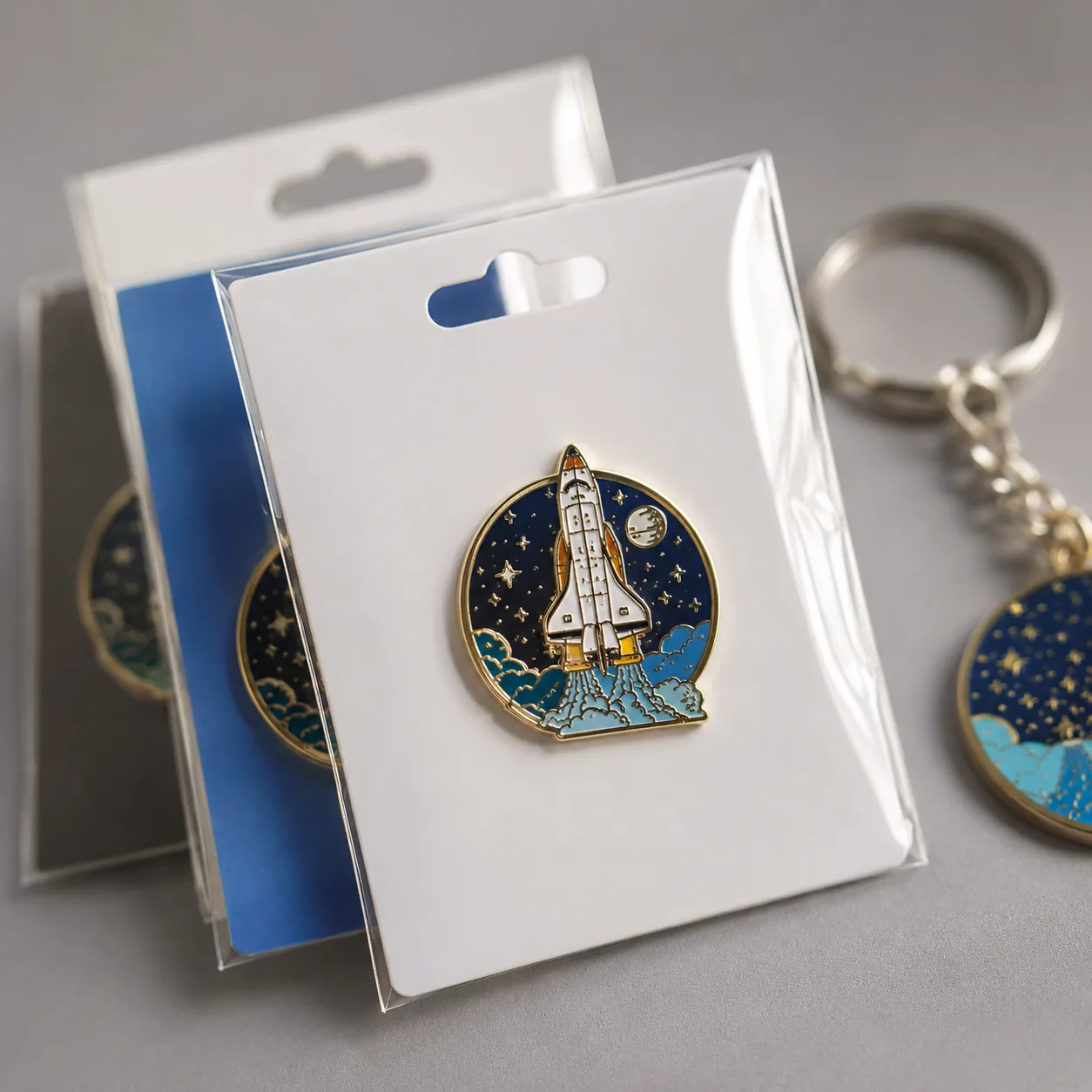
Why Header Cards Fail Buyers
Buyers often treat header cards as artwork-only, then discover the real problems after sampling: weak board, poor die-cut control, blurred barcodes, and cards that curl once a product is attached. For pins, keychains, magnets, and small promo accessories, the card is a retail component, not a filler item. It needs a defined structure: board grade, caliper, print method, coating, hole geometry, hanging format, and assembly method. When those details are missing, suppliers make assumptions, and those assumptions are usually visible on the shelf.
The common failure pattern is predictable. A buyer approves a nice mockup, but the finished card bends under a 20 g pin, the euro-slot tears after a few peg tests, or the barcode lands too close to the fold and will not scan. For retail programs, that means rejected samples, reprint cost, and delayed launch. For distributor packs, it also means harder receiving, because cartons that should contain cleanly packed units arrive with damaged corners, crushed edges, or inconsistent counts.
When Header Cards Make Sense
Header cards are worth the extra cost when the packaging itself supports sell-through: peg-hook display, branded gifting, licensed merchandise, or small accessories where the front face must carry most of the perceived value. They are also useful when the item needs a barcode, SKU, country-of-origin line, warning text, or a hangable format for retail planograms. If the product is being sold through independent gift shops or souvenir channels, the card often does more work than the accessory inside it.
They are less useful for internal giveaways, trade-show handouts, or warehouse kitting where the item will be distributed loose. In those cases, individual cards add carton volume, packing labor, and freight without improving conversion. A bulk tray, simple polybag, or shared master sleeve is usually the better economic choice. The rule is simple: if the package has to win the customer in-store, specify a real header card; if it only has to survive distribution, keep it lean.
Core Card Specs To Lock
The minimum useful spec sheet should include board type, thickness, print coverage, coating, die-cut tolerance, and hanging-hole geometry. For most retail sets, solid bleached sulfate (SBS) or coated paperboard is the default choice. A practical range is 250 to 400 gsm, which usually corresponds to about 0.30 to 0.55 mm caliper depending on coating and fiber mix. For lightweight pins and small keychains, 300 to 350 gsm is often enough. For heavier zinc-alloy pieces or multi-item sets, 350 to 400 gsm gives better stiffness and resists shelf curl.
Tolerance control matters more than buyers expect. For standard flat cards, keep trim size within ±1.0 mm and hole position within ±0.8 mm; if the card uses a euro-slot or multiple punched features, ±0.5 mm is better. A typical euro-slot is 32 x 8 mm or 30 x 6 mm, but the exact slot must match the retail peg or hook that will actually be used. If the slot is too tight, the card will tear at retail. If it is too loose, it can tilt or slide off the display peg.
Printing should be specified as vector-ready artwork at full size with 300 dpi images minimum, CMYK build, and a clearly marked dieline layer. If the card includes tiny legal text, keep text height above 5 pt for coated board and above 6 pt if the design is reversed out of dark color. For barcode areas, insist on a quiet zone of at least 2.5 mm on all sides and verify scanability on the final printed size. A great-looking barcode that fails a handheld scan is a packaging defect, not a design preference.
| Card type | Best use | Typical board spec | Typical FOB price range |
|---|---|---|---|
| Flat single-sided card | Simple pin or keychain retail packs | 250–300 gsm SBS, 0.30–0.38 mm | USD 0.03–0.08 per set |
| Fold-over card | Extra branding, instructions, barcode area | 300–350 gsm SBS, 0.38–0.45 mm | USD 0.06–0.15 per set |
| Laminated reinforced card | Heavier items, longer shelf life, less bending | 350–400 gsm board with gloss or matte lamination | USD 0.10–0.25 per set |
| Euro-slot reinforced card | Peg-hook retail display, repeated handling | 350–400 gsm board with patch or double-layer support | USD 0.12–0.30 per set |
Do not default to the most complex build. If the product ships in an e-commerce mailer, extra stiffness may not improve sell-through and can increase carton volume, freight weight, and packing time. If the buyer cares more about landed cost than shelf presentation, a clean flat card with controlled die-cutting and a protective polybag is usually the better balance.
Printable Surfaces And Finishes
Finish choice should be driven by handling and legibility, not just aesthetics. Gloss aqueous or gloss lamination gives better scuff resistance and a brighter retail look, especially for saturated colors and licensed graphics. Matte lamination reduces glare under store lighting and can feel more premium, but it will show fingerprints and edge wear more readily on dark designs. Soft-touch adds perceived value, yet it also raises cost and is more likely to show abrasion during carton rubbing if the pack is tight.
For special effects, ask for a production sample before approving mass print. Foil stamping, spot UV, embossing, and debossing can improve shelf impact, but they add setup time and create tighter registration demands. If the dieline is not stable, foil or UV elements can drift relative to the cut edge and make the pack look misaligned. A practical rule is to keep special effects at least 2.0 mm away from trim, folds, and slots, and 3.0 mm away from any punched hole.
Color management also needs to be specified clearly. Dark flood coats on unlaminated board can show scuffing and roller marks, while large white areas can show dirt from handling if the cards are packed loose. If the artwork uses deep black, red, or navy fields, ask for a protective coating and request an actual press proof or digital match proof under D50 lighting. For retail packaging, visual consistency matters more than perfect lab numbers, but the color should still stay within a reasonable delta E target of about 3 to 5 on key brand elements.
Hardware, Assembly, And Pack Method
The way the product is attached to the card changes labor cost, defect risk, and shelf appearance. Manual insertion is flexible for mixed SKUs and short runs, but it is slower and more dependent on operator skill. Heat-sealed polybag packs are efficient for dust protection and count control, yet they can look less premium unless the printed card does the heavy lifting. For higher-volume retail programs, buyers should ask whether the factory is packing by hand, using semi-automatic bagging, or running a dedicated insert line, because the method affects lead time and reject rate.
A complete pack spec should state the operation order: incoming product inspection, card print inspection, product placement, bagging, sealing, carton count, and outer-carton labeling. If the item is a keychain or pin with a reflective finish, specify whether the product must be centered, offset, or locked with a tie so it does not rotate during shipment. Scratches usually happen from internal contact inside the pack, not from freight shock alone. If the accessory has sharp edges, add a protective sleeve or tissue separator before sealing.
For heavier items, ask the factory to confirm whether the card should carry the load itself or whether a secondary retention method is needed. A 25 g to 40 g pin may be fine on a single punch. A 50 g to 80 g keychain often benefits from a reinforced slot, double-layer fold, or blister-style retention. That difference is small in the artwork stage and expensive to discover after the first assembly trial.
QC Checks That Prevent Rework
Sampling must include the assembled unit, not just the printed card. A loose card can pass print inspection and still fail once a product is inserted and the weight pulls the hole crooked or curls the bottom edge. For any pack intended for chain retail or Amazon, request an assembled sample, a carton drop check, and a rub test after packing. The card should remain flat, the hang hole should not tear, and the barcode should still scan after normal handling.
Good QC targets are straightforward. For visual print defects, an AQL 2.5 is common for major defects and AQL 4.0 for minor cosmetic defects on low-risk programs; for premium licensed retail, some buyers push to AQL 1.5 on major defects. For die-cut quality, define no crushed edges, no exposed fibers at the slot, and no tears longer than 1 mm at the hanging point. For assembly, state count accuracy, orientation, and seal integrity clearly so the factory knows what to measure and what to reject.
- Confirm final peg, hook, or display size before artwork starts
- Specify board weight in gsm and caliper in mm
- Lock finish type: gloss, matte, or soft-touch
- Set safe margins around slots, folds, and trim
- Require assembled samples before mass packing
- Define AQL levels for print, cut, and assembly
- Test barcode scanability at final print size
- Approve carton count, overage, and label format
Lead Times, MOQ, And Cost Ranges
MOQ depends on whether the supplier is printing cards only or also assembling finished packs. For stand-alone printed header cards, 500 to 1,000 pcs is a common starting tier, especially for simple single-color or short-run digital jobs. For assembled retail packs, 1,000 to 3,000 sets is more realistic because manual packing labor makes very small runs inefficient. For larger offset runs, factories often become price-competitive at 5,000 to 10,000 sets or more, where setup is spread across a bigger order.
Lead time also changes with complexity. Simple printed cards can often ship in 7 to 12 days after artwork approval. Laminated or die-cut cards usually need 10 to 15 days. Fully assembled retail packs with bagging, insertion, and carton labeling commonly need 12 to 20 days, and specialty finishes or large-volume runs can stretch to 18 to 25 days. If the artwork is not final, add proofing time on top of that. Buyers who need launch-date certainty should build in at least one sampling cycle and one correction cycle.
FOB pricing varies by size, board, finish, and assembly labor. A basic printed header card usually lands around USD 0.03 to 0.12 per piece. Reinforced, laminated, or specialty-finish cards often move into the USD 0.12 to 0.35 range before the product is inserted. If assembly is included, expect labor to add roughly USD 0.02 to 0.08 per set for simple packs and more for irregular parts, multi-piece sets, or hand-tied formats. When comparing suppliers, ask them to separate card print, die-cut, assembly, polybag, and outer carton costs so the real cost drivers are visible.
The cheapest quote is not always the lowest landed cost. A slightly thicker board can reduce bent-card rejects, and a cleaner die cut can prevent shelf returns and distributor complaints. Ask for a clear breakdown of price per set, overage allowance, packing method, master carton count, and shipping weight estimate. That makes it much easier to compare suppliers on the same basis instead of comparing one factory’s card-only quote with another factory’s fully packed offer.
What To Do Next
For the next RFQ, send your supplier five items: final product dimensions, intended retail hook or display size, board target, finish preference, and pack count per outer carton. Add your target MOQ, required lead time, and whether you want card-only supply or full assembly. If the item will be sold in retail channels, include the barcode format, AQL target, and any special effects such as foil or spot UV. The more specific the spec, the closer the first sample will be to final production.
If you want to move faster, build one spec sheet for each SKU family: pins, keychains, magnets, and mixed promo sets. That avoids one-off decisions on every order and gives the factory a stable baseline for print, die-cut, and pack validation. A clear card spec saves more time than a polished mockup, because it answers the questions that actually affect production.
Have a project? Send your artwork and target quantity and we’ll reply with a detailed quotation within 12 working hours.
Ready to get this made?
Send your sketch, target quantity and ship-date. Detailed quotation in 12 hours.



