How to Specify PVC Keychains Without Warping or Weak Details
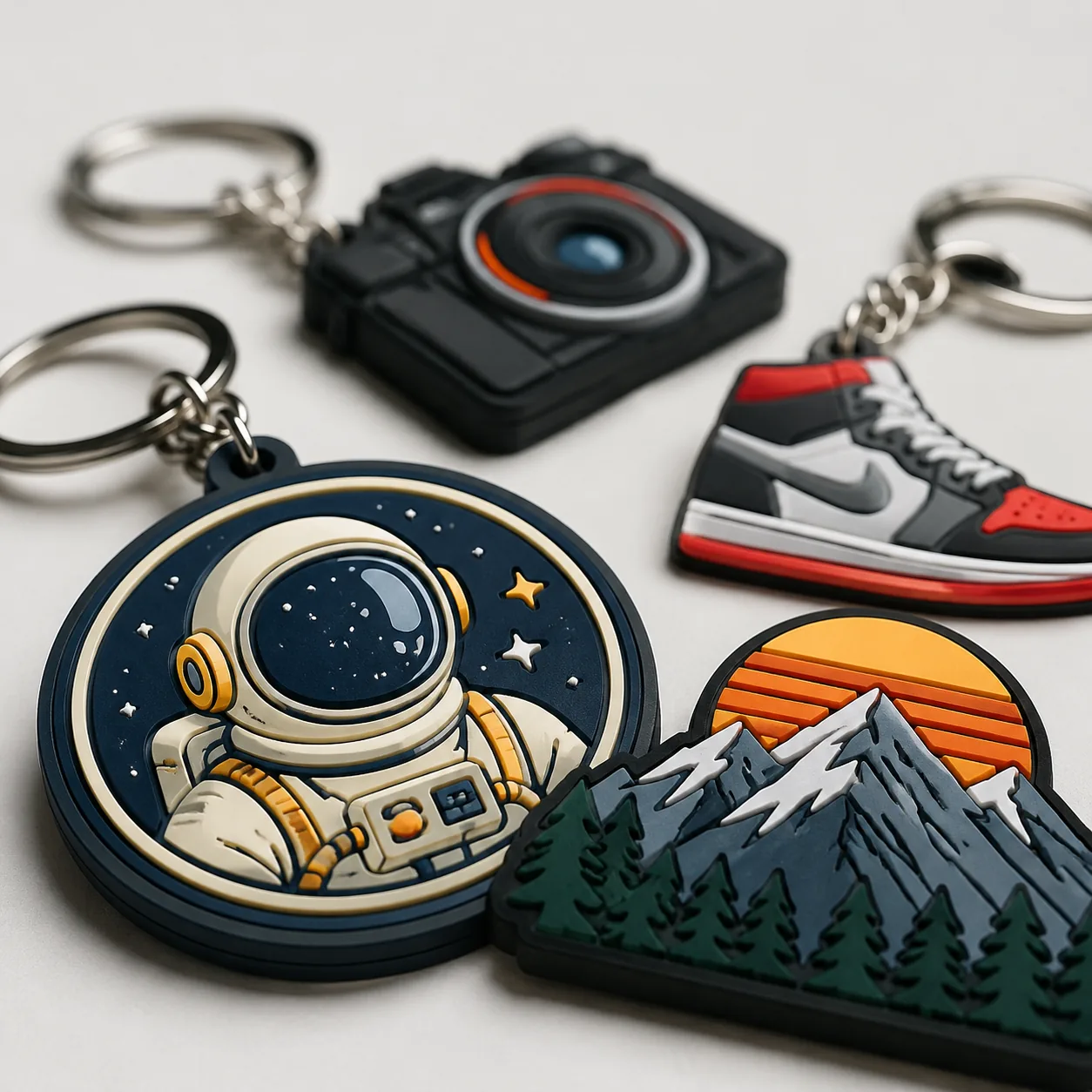
Start With the Failure Modes, Not the Artwork
PVC keychains are often quoted from a flat logo file, but the delivery problems usually come from missing engineering details: body thickness, Shore A hardness, separator wall width, color-fill depth, attachment reinforcement, hardware grade, and acceptable flatness. A 60 mm soft PVC keychain can look correct in a PDF and still arrive with curled edges, shallow text, color bleed, weak split rings, heavy odor, or flash around the hole.
The same design behaves differently at 2.5 mm, 3.5 mm, and 5.0 mm thickness. A thin, soft body can feel cheap and twist in retail packaging; an overbuilt body can become too heavy for direct mail or too stiff for a child-friendly giveaway. If the supplier chooses hardness and relief depth without written limits, the approved sample may not represent stable mass production.
Treat the item as a molded flexible part. A complete purchase specification should define longest side, thickness, Shore A hardness, number of PVC colors, raised and recessed levels, minimum line widths, attachment hole geometry, hardware finish, packing, inspection level, and lead-time milestones before the mold is cut.
Use PVC Where Its Strengths Fit the Product
Soft PVC is a strong choice for bright solid colors, custom silhouettes, waterproof use, rounded edges, mascot shapes, and medium to high-volume promotional items. It suits tourism souvenirs, school mascots, sports clubs, animation IP, outdoor events, and giveaways where a rubber-like feel is part of the appeal.
It is weaker for luxury positioning, tiny typography, metallic effects, mirror finishes, and crisp engraving. If the design depends on 0.2 mm metal lines, plated texture, enamel-like gloss, or jewelry weight, zinc alloy or iron with soft enamel is usually cleaner. If the buyer needs transparent edges, photographic graphics, QR clarity under 20 mm, or very light mailing weight, acrylic or printed plastic may be more suitable.
| Buyer goal | PVC is suitable when | Choose another material when |
|---|---|---|
| Low-cost character keychain | 40 to 80 mm body, 3 to 6 solid colors, bold raised separators | Premium metal weight or fine plated texture is required |
| Waterproof event giveaway | Soft touch, rounded edges, simple logo, matte surface | Thin lettering below 1.0 mm must remain sharp |
| School or youth product | Flexible body, no sharp corners, reinforced hole, simple packing | Small detachable charms cannot be avoided |
| Retail souvenir | Custom outline, double-sided molded color, card or blister packing | Luxury plated finish is part of the brand promise |
| QR, serial, or photo detail | Large flat printed panel, protected from abrasion | Permanent laser marking or photo-level print resolution is required |
Lock Size, Thickness, and Shore A Together
For most PVC keychains, the practical body size is 45 to 75 mm on the longest side. Below 35 mm, color zones, text, and the attachment hole compete for space. Above 90 mm, the part may curl or feel heavy unless thickness, hardness, cooling time, and internal layout are upgraded.
Thickness is not only a price variable. A 2.5 mm body is economical but can flex too much on a 70 mm design. A 3.5 to 4.0 mm body is the common B2B standard because it balances cost, stiffness, and hand feel. A 4.5 to 5.5 mm body supports deeper relief and better flatness, but it increases material use, cooling time, carton weight, and FOB cost.
Hardness should be specified in Shore A, not described as soft or firm. A 55 to 60 Shore A compound gives a soft souvenir feel but is more prone to hole elongation and edge curl. A 60 to 70 Shore A compound is more stable for brand and retail programs. Above 75 Shore A, the part becomes firmer and more dimensionally stable, but it may no longer feel like soft PVC.
| Spec item | Economy giveaway | Standard brand order | Retail or heavy-duty order |
|---|---|---|---|
| Longest side | 40 to 55 mm | 55 to 75 mm | 70 to 95 mm |
| Body thickness | 2.5 to 3.0 mm | 3.5 to 4.0 mm | 4.5 to 5.5 mm |
| Hardness | 55 to 60 Shore A | 60 to 70 Shore A | 68 to 75 Shore A |
| Size tolerance | ±0.8 mm | ±0.6 mm | ±0.5 mm |
| Flatness tolerance | Edge lift ≤1.5 mm | Edge lift ≤1.0 mm | Edge lift ≤0.8 mm |
| Typical FOB at 1,000 pcs | USD 0.32 to 0.55 | USD 0.48 to 0.85 | USD 0.75 to 1.35 |
Define Relief, Line Width, and Mold Depth
Soft PVC parts are normally made by filling colored PVC into a mold by color zone. Raised separator walls keep colors apart, but those walls need real width and height. Hairline borders, tiny gaps, thin script, and small enclosed shapes may pass a digital mockup and fail during filling, heating, trimming, or demolding.
A practical minimum raised separator width is 0.8 mm for simple shapes and 1.0 to 1.2 mm for stable repeat production above 1,000 pieces. Recessed color channels should be at least 1.0 mm wide. Normal raised relief height is 0.5 to 0.8 mm above the base. Deeper 1.0 to 1.2 mm relief gives stronger tactile contrast but can trap dust, slow filling, and make small areas harder to clean.
For lettering, use at least 5 mm capital height for positive filled PVC text and 6 to 7 mm for reversed text cut out of a colored background. Keep internal gaps above 0.7 mm. For mascots, simplify eyelashes, teeth, stars, whiskers, and small shadows before tooling. If a logo requires fine detail, place it on a flat printed panel instead of forcing it into molded PVC.
- Specify raised separator lines at 0.8 mm minimum, preferably 1.0 mm for repeat orders.
- Keep recessed color-fill channels at 1.0 mm minimum width to avoid incomplete filling.
- Set standard relief height at 0.5 to 0.8 mm; use 1.0 to 1.2 mm only for deliberate tactile effects.
- Use 5 mm or larger positive lettering and 6 mm or larger reversed lettering.
- Avoid isolated PVC islands below 1.5 mm because they can tear, shift, or fill unevenly.
- Approve a 1:1 mold drawing with line widths and hole position before paying tooling.
Control Color, Finish, and Printable Detail
PVC color matching is approximate, not identical to enamel, offset print, or screen ink. The compound is mixed before molding, and shade can shift with pigment load, base resin, heating, and batch size. For corporate colors, specify Pantone Solid Coated references and agree to Delta E 2 to 4 for normal production. For strict retail color control, approve physical PVC chips before bulk production.
Each added color increases filling steps, inspection time, and defect risk. Two to five molded colors are usually efficient. Six to eight colors are workable if the areas are large enough. Above eight colors, consider screen printing, pad printing, acrylic print, or simplifying the artwork. Small printed details on PVC should be placed on a raised flat panel, with the buyer accepting lower abrasion resistance than molded color.
Matte PVC hides small scratches and gives a rubber-like look. Gloss PVC looks brighter but shows fingerprints, flow marks, and unevenness on broad flat areas. For a single-color background wider than 40 mm, matte or light texture is usually safer than full gloss. If the product will be packed in tight polybags, confirm that gloss surfaces will not stick, mark, or transfer color under pressure.
| Choice | Practical specification | Buyer trade-off |
|---|---|---|
| Standard molded color | Pantone Solid Coated target, Delta E 2 to 4 | Cost-effective with slight batch variation |
| Critical brand color | Physical PVC chip approval before mass production | Adds 2 to 4 days before bulk start |
| Matte surface | Low gloss, rubber-like hand feel | Less bright but hides scratches and flow marks |
| Gloss surface | High shine on raised or flat areas | Shows fingerprints and molding variation more easily |
| Printed detail | Screen or pad print on flat raised panel | Useful for small logos but less durable than molded PVC |
Reinforce the Attachment and Specify Hardware
The most common functional failure is the connection point, not the PVC body. A small unreinforced hole near the edge can tear or stretch after short use, especially on 55 Shore A material. Keep the hole center at least 5 mm from the nearest edge for small keychains and 6 to 8 mm for heavier bodies. Add a reinforced boss or tab instead of cutting a bare hole through a thin shape.
For a 50 to 70 mm PVC keychain, a 3.0 to 4.0 mm hole diameter normally works with standard jump rings. The reinforced area should be at least 8 mm wide and 3.5 mm thick. If using a metal eyelet, specify material, internal diameter, outside flange diameter, and corrosion resistance. For humid markets or outdoor use, nickel-plated steel, black nickel, or stainless hardware is safer than bare iron.
Hardware belongs in the specification. Standard split rings are commonly 25 to 30 mm outside diameter with 1.8 to 2.2 mm wire. Jump rings are commonly 8 to 10 mm outside diameter with 1.0 to 1.2 mm wire. For plated steel, 3 to 5 microns nickel plating is suitable for indoor giveaways; 5 to 8 microns or stainless steel is better for retail, coastal, or long-storage programs.
- Set the attachment hole center at least 5 mm from the PVC edge, or 6 to 8 mm for large bodies.
- Use a reinforced tab or boss at least 8 mm wide for soft PVC constructions.
- Specify split ring outside diameter, wire diameter, material, and finish, not just keyring.
- Use 3 to 5 microns plating for standard giveaways and 5 to 8 microns for humid markets.
- Avoid heavy secondary charms on thin PVC bodies because the hole can elongate over time.
- Use a lobster clasp, ball chain, or zipper-pull loop when the product is not intended for keys.
Plan MOQ, Tooling, FOB Price, and Lead Time
PVC tooling is usually less expensive than metal die tooling, but it still depends on part size, cavity count, relief levels, and whether the design is one-sided or two-sided. A simple one-sided mold is commonly USD 45 to 90. A two-sided or layered 3D mold often runs USD 90 to 180. Large bodies, tight flatness requirements, or multi-cavity tools can exceed this range.
A 300-piece order is possible for simple designs, but the best unit economics usually start at 1,000 pieces because setup, color mixing, and mold handling are spread across more units. At 300 pieces, FOB pricing may be USD 0.75 to 1.60 per piece depending on size, color count, hardware, and packing. At 1,000 pieces, a standard 60 mm, 4-color, 3.5 mm thick PVC keychain with split ring usually falls around USD 0.45 to 0.90 FOB. At 5,000 pieces with simple packing, the same construction may fall to USD 0.28 to 0.65 FOB.
Normal timing is 2 to 3 days for artwork review, 2 to 4 days for the 1:1 mold drawing, 5 to 8 days for sampling after mold approval, and 10 to 22 days for mass production after sample approval depending on quantity. Add 3 to 5 days for color chip approval, custom cards, barcode labels, or blister packing. Rushing cooling and inspection can increase warp, odor, and color contamination, so rush orders should use simple geometry and limited colors.
| Order tier | MOQ reality | Typical FOB unit range | Usual timing after sample approval |
|---|---|---|---|
| 300 pcs | Possible for simple designs | USD 0.75 to 1.60 | 10 to 14 days bulk |
| 1,000 pcs | Best entry tier for B2B orders | USD 0.45 to 0.90 | 12 to 16 days bulk |
| 3,000 pcs | Efficient for event programs | USD 0.34 to 0.75 | 14 to 18 days bulk |
| 5,000 pcs and up | Best for retail or national campaigns | USD 0.28 to 0.65 | 16 to 22 days bulk |
Inspect Against Written AQL and Functional Tests
PVC inspection should cover appearance, dimensions, flatness, hardness, odor, color, attachment strength, hardware, and packing. For general promotional orders, AQL 2.5 for major defects and AQL 4.0 for minor defects is practical. For retail programs, use AQL 1.5 major and 2.5 minor, with the expectation that inspection will take longer and may increase cost.
Major defects include wrong color, wrong hardware, broken split rings, torn attachment holes, missing color fill, severe embedded dirt, sharp flash, strong solvent odor, or dimensions outside tolerance. Minor defects include small flow marks, tiny dots, light trimming marks, slight gloss variation, or minor color specks that are not visible at 50 cm under normal lighting. Define the viewing distance and defect classification before production because molded PVC will not look like machined metal or printed paper.
Functional tests are simple and useful. Pull the split ring and PVC body with 3 to 5 kg force for 10 seconds on standard keychains, or 5 to 8 kg for heavier retail items. Bend soft PVC bodies 180 degrees for 10 cycles and check for cracking, whitening, or color separation. For odor, seal samples in a polybag for 24 hours, then open and evaluate; a light PVC smell is normal, while strong solvent odor should trigger airing, material review, or rejection depending on the market.
- Measure size with calipers against the agreed ±0.5 to ±0.8 mm tolerance.
- Check flatness on glass and measure edge lift at the worst point.
- Compare PVC colors with the approved sample or chip under D65 lighting when available.
- Pull test the attachment area and ring before shipment approval.
- Inspect flash around the perimeter and hole because it affects hand feel and safety.
- Use AQL 2.5 major and 4.0 minor unless retail requirements call for tighter limits.
Prepare a Clean RFQ Before Tooling Starts
Before asking for pricing, send a one-page specification instead of only a logo file. Include longest side in millimeters, target thickness, Shore A hardness, one-sided or two-sided construction, Pantone colors, relief heights, minimum line widths, attachment hole location, hardware model, packing method, order quantity, target delivery date, and AQL standard. This forces every supplier to quote the same product instead of guessing different constructions.
For a first order, require a 1:1 mold drawing and one physical pre-production sample before mass production. Check stiffness, edge curl, line clarity, odor, color, flash, packing fit, and ring strength. Once approved, freeze that sample as the production reference. For reorders, record the mold number, PVC hardness, color formulas, body thickness, hardware specification, packing artwork, and approved inspection limits.
If the artwork may be better suited to PVC, metal, acrylic, or woven patch construction, send ZheCraft the artwork, quantity, use case, destination market, delivery deadline, and budget range. Our Yiwu team can flag weak lines, risky hole positions, excessive color count, and unrealistic tolerances before tooling, then quote practical MOQ, lead time, and USD FOB ranges for the most stable construction.
Have a project? Send your artwork and target quantity and we’ll reply with a detailed quotation within 12 working hours.
Ready to get this made?
Send your sketch, target quantity and ship-date. Detailed quotation in 12 hours.



