How to Specify Promo Product Samples That Prevent Rework
What problem are buyers really solving with samples?
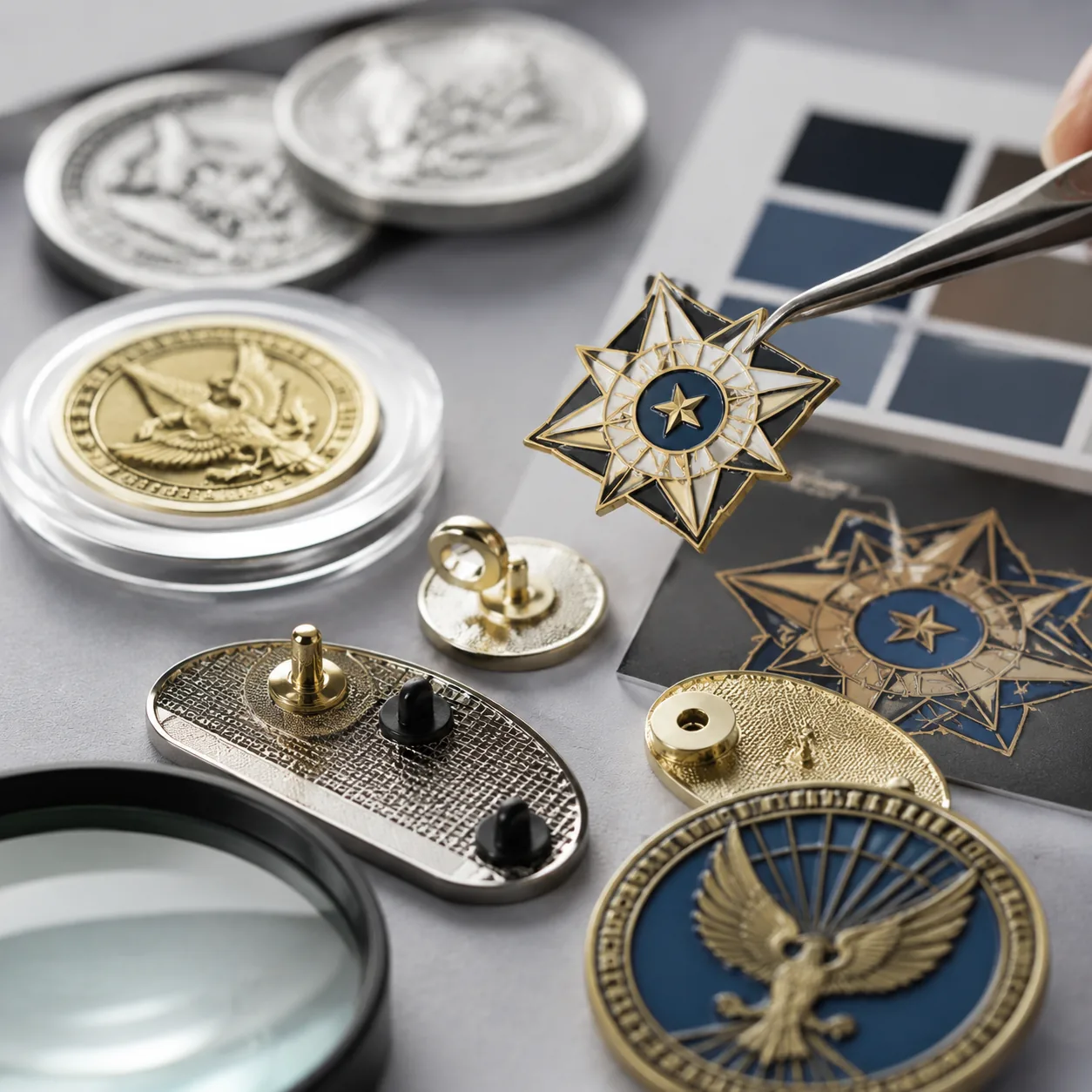
Most sample failures are not about appearance; they are about whether the sample answers the production question. A polished sales sample can still be useless as a manufacturing reference if it does not lock material, plating, color, thickness, attachment, print method, and packaging. Procurement is trying to remove uncertainty before tooling, decoration, assembly, and packing are repeated at scale.
For custom enamel pins, keychains, coins, patches, lanyards, and fridge magnets, the sample stage should prove repeatability within agreed tolerances. A factory that can hand-finish one perfect piece is not automatically a factory that can ship 5,000 pieces to the same standard. Treat sample approval as a control gate, not a courtesy sign-off.
The right question is simple: if the sample is approved, what exactly is frozen for production? If the answer is vague, the buyer will later absorb avoidable rework, extra freight, or schedule slip. Good sample control is one of the cheapest ways to protect margin on promotional goods.
In practice, a proper sample file should define the exact artwork revision, substrate, surface finish, attachment, and packing state. If those items are not written down, different factories can build different parts and still claim they met the request.
Which sample type do I need?
Buyers often mix up three different sample types. A digital mockup checks layout and content. A pre-production sample checks the final build before mass production. A production sample checks line consistency after the factory has started the order. Each answers a different risk, and each should be approved for a different reason.
| Sample type | What it proves | When to use it | Typical risk if misused |
|---|---|---|---|
| Digital mockup | Artwork placement, text, and layout | Before quoting or tooling | High if treated as a final physical reference |
| Pre-production sample | Material, finish, build method, and feasibility | After order confirmation, before mass production | Medium, especially if tolerances are not written down |
| Production sample | Repeatability from the actual run | Before shipment or during first-run verification | Lower, but still needs inspection against the master |
For mixed promo programs, one order may need more than one sample. A metal lapel pin may need a plated physical sample, while its backing card needs a print proof and die-cut fit check. A patch set may need both a stitched sample and a packaging sample. Ask for coordinated approval if color, size, and presentation must match across SKUs.
Typical timing is 5 to 10 days for a simple rerun sample, 7 to 12 days for a sample that needs new artwork or minor spec changes, and 10 to 20 days for a sample that requires tooling, multi-step decoration, or assembly. If a supplier promises a “sample” in 2 or 3 days for a complex item, confirm whether it is a mockup, a hand-built prototype, or a true pre-production sample.
What must be written into the sample request?
A sample request should be detailed enough that two factories would build the same part. Start with product type, intended use, dimensions, thickness, material, finish, artwork version, and packaging requirement. Then add the commercial limits that matter: retail resale, event giveaway, or direct skin contact. That context changes what is acceptable and what must be documented.
For example, a soft enamel pin should state zinc alloy or iron base, finished width and height, metal thickness such as 1.2 mm to 1.5 mm, recessed enamel fill, and plating type such as bright nickel, antique brass, or black nickel. If the pin is intended for skin contact or sale in regulated markets, request nickel-release compliance or a written finish declaration instead of assuming it is included.
The biggest gap is tolerance. “Make it like the sample” is not measurable. Better language is specific: width ±0.3 mm, thickness ±0.1 mm, plating tone matched to the approved master sample, enamel fill flush within 0.2 mm, and no visible pits or chips at a normal viewing distance of about 30 cm. For patches, specify stitch density and edge method; for lanyards, specify print scale and seam strength; for magnets, specify pull force and magnet position; for coins, specify rim profile, relief depth, and edge type.
If artwork is involved, use one locked file version and one color reference system. Pantone is common for print and enamel, but the factory still needs a physical target if the finish is matte, metallic, translucent, or antique. If a color must be exact, say whether the acceptable deviation is visual match only or a measured match against an approved standard.
A useful rule: every critical attribute should have a number, a reference, or a binary pass/fail decision. If a requirement cannot be tested, a supplier can interpret it too loosely.
- State the exact product name and use case.
- List material, finish, thickness, and hardware.
- Lock the artwork file version and color references.
- Define measurable tolerances and visible defect limits.
- Specify packaging, labeling, and carton requirements.
- Name who approves the sample and in what format.
Which checkpoints should be approved before mass production?
Approval should happen in sequence, not as one vague green light. First approve the artwork and structure, then the physical sample, then the golden sample if the factory uses one, and finally the pre-shipment lot. Each step answers a different question: does the design work, can it be built, can it be repeated, and does the shipment match the approved reference?
This matters most when tooling is involved. If cavity depth is wrong on a coin or pin mold, relief can wash out during polishing. If edge radius is not defined, burrs can survive into packing. If plating is not locked, one run may come back bright and another slightly dull or warmer, even from the same supplier. Clear checkpoints prevent those “close enough” disputes later.
| Checkpoint | Buyer asks | Factory should confirm |
|---|---|---|
| Artwork approval | Is the design complete and scalable? | File version, dimensions, copy, and color references |
| Physical sample | Does the part meet the spec? | Material, finish, thickness, attachment, and defect limits |
| Golden sample | What becomes the production reference? | Signed master sample and retained control piece |
| Pre-shipment check | Does the lot match approval? | Quantity, appearance, packing, labeling, and carton marks |
In high-volume promo programs, a supplier may also provide a sealed retained sample from the approved run. Keep one buyer copy and one factory copy. If later production drifts, both sides can compare against the same reference instead of debating memory or photos.
For repeat programs, create an approval ladder: drawing, sample, golden sample, first article, then lot inspection. That sequence is especially useful when different teams handle design, sourcing, and receiving.
How do I judge whether the sample is good enough?
A good sample is not just attractive; it is manufacturable with low risk. Check edge quality, symmetry, plating coverage, fill height, print registration, and attachment strength. If the sample depends on manual touch-up to look acceptable, the line may not reproduce it without extra labor, higher scrap, or longer lead time.
Use the same inspection logic across item types. For pins, check post alignment, enamel level, and back stamp placement. For keychains, check ring movement, clasp action, and whether the body hangs level. For patches, check border integrity, stitch density, and curling. For lanyards, check print contrast, seam strength, and crimp quality. For magnets, verify magnet placement and holding force on the intended substrate.
A functional check should mimic end use. A lapel pin should close securely and not rotate excessively. A zipper pull should survive repeated open-close cycles without loosening. A patch should lay flat after pressing or sewing. A magnet should hold the advertised weight on the intended surface. If function fails, cosmetic approval is irrelevant.
When possible, quantify what “good enough” means. For example, a pin might allow minor plating variation but no exposed base metal on the face, no burrs on the rear, and no enamel sink deeper than 0.2 mm below the metal wall. A coin might allow a small color shift in antique finish but not loss of raised detail. Specific limits reduce subjectivity and speed up approval.
If the product uses print, specify the acceptable register error. A practical tolerance for small promo items is often ±0.3 mm to ±0.5 mm for multi-color alignment, while larger textiles may allow a little more depending on the graphic. The key is to write the number into the approval record before production starts.
What should the sample checklist include?
A checklist prevents the common mistake of approving a sample because it feels right while missing the one variable that later causes a production dispute. Keep the list short enough to use every time, but detailed enough to catch the defects that cost money in mass production. The goal is a repeatable sign-off process, not a ceremonial one.
- Product name and revision number confirmed.
- Dimensions measured against drawing or spec sheet.
- Material and finish match the approved requirement.
- Artwork, text, and logo placement match the final file.
- Color reference checked against the approved standard.
- Attachment, hardware, and moving parts tested.
- Packaging, inserts, and labels verified.
- Photos archived with date, approver name, and comments.
For many buyers, the most useful addition is a reject rule. Define what fails automatically: color off beyond the approved reference, plating exposed through the face, loose hardware, unreadable print, poor stitch closure, or packaging that does not fit. If the team has to argue about every defect, approvals slow down and quality becomes inconsistent.
It also helps to define who can overrule a defect and under what conditions. For example, a merchandising team may accept a cosmetic variance on a giveaway item, but not on a retail item with paid packaging. The acceptance authority should match the end market.
How do sample terms affect cost, MOQ, and lead time?
Sample terms signal the likely production path. A basic revision sample can be inexpensive, but once the order requires new tooling, special plating, multiple colors, or assembly, the sample becomes a paid engineering step. For custom metal promo products, simple revision samples often run about USD 30 to USD 60 FOB-equivalent, while more complex pre-production samples commonly run USD 60 to USD 150. New molds or intricate multi-part assemblies can be higher.
MOQ and lead time should be read together, not separately. Standard soft enamel pins, basic keychains, and simple coins often sit around 100 to 300 pieces per design for lower-cost pricing tiers, with better unit economics at 500, 1,000, or 3,000 pieces. Patches and lanyards may start around 50 to 100 pieces for digitally printed runs, but woven or stitched versions often price better at 100 to 500 pieces. Exact thresholds vary by factory, but the pattern is consistent: more setup complexity means a higher practical MOQ or a higher per-piece cost.
Typical mass-production lead times after approval are usually 10 to 20 days for straightforward metal products, 15 to 25 days for patches or lanyards with custom print and finishing, and 20 to 35 days for more complex multi-item sets, packaging, or mixed finishing. If the sample keeps changing, the real lead time is the lead time after the last revision is frozen, not the first promise you received.
For reference, FOB pricing for common promo items often falls into these working bands: soft enamel pins about USD 0.45 to USD 1.80 per piece at 500 to 5,000 units; metal keychains about USD 0.70 to USD 2.50; challenge coins about USD 1.20 to USD 4.00; woven patches about USD 0.25 to USD 0.90; and printed lanyards about USD 0.18 to USD 0.75. The exact price depends on size, finish, attachment, packing, and order quantity, but these ranges help buyers sanity-check quotes.
For quality-sensitive programs, ask the supplier to state the defect standard in writing. A common starting point is AQL 2.5 for major defects and AQL 4.0 for minor defects, with any critical defect set to zero acceptance. If the item is small and decorative, the buyer may choose a stricter cosmetic limit even when the functional risk is low.
| Order condition | Typical sample fee | Typical lead time impact | Buyer risk |
|---|---|---|---|
| Simple rerun with no new tooling | USD 30-60 | 3-7 extra days | Low |
| New artwork or spec revision | USD 60-150 | 5-10 extra days | Medium |
| New mold or complex assembly | USD 100-250+ | 7-15 extra days | High |
A good quoting discipline is to separate sample cost, tooling cost, and production cost. That way the buyer can see whether a higher sample fee is a one-time engineering charge or a warning sign that the whole program is more complex than expected.
What should I do next?
Turn sample approval into a reusable process for every supplier and every product family. Send one written spec sheet, one approved artwork file, one reference photo or master sample, and one checklist with measurable acceptance criteria. If the factory cannot repeat the sample under those terms, the sample is not a production standard; it is only a prototype.
Before placing the order, ask for three things: a signed control sample, a written confirmation of all tolerances, and a statement of what changes trigger a new approval. That discipline usually saves more money than negotiating the lowest sample fee. It also makes the next order faster because the supplier already knows exactly what “approved” means.
If you manage repeat promo programs, build one approval template for pins, coins, keychains, patches, magnets, and lanyards. Include a drawing field, tolerances, color references, packing requirements, inspection photos, and a sign-off box for buyer and factory. The more often you reuse the same structure, the fewer reworks you will pay for.
Have a project? Send your artwork and target quantity and we’ll reply with a detailed quotation within 12 working hours.
Ready to get this made?
Send your sketch, target quantity and ship-date. Detailed quotation in 12 hours.



