How to Specify Print vs Dye-Sublimated Lanyards
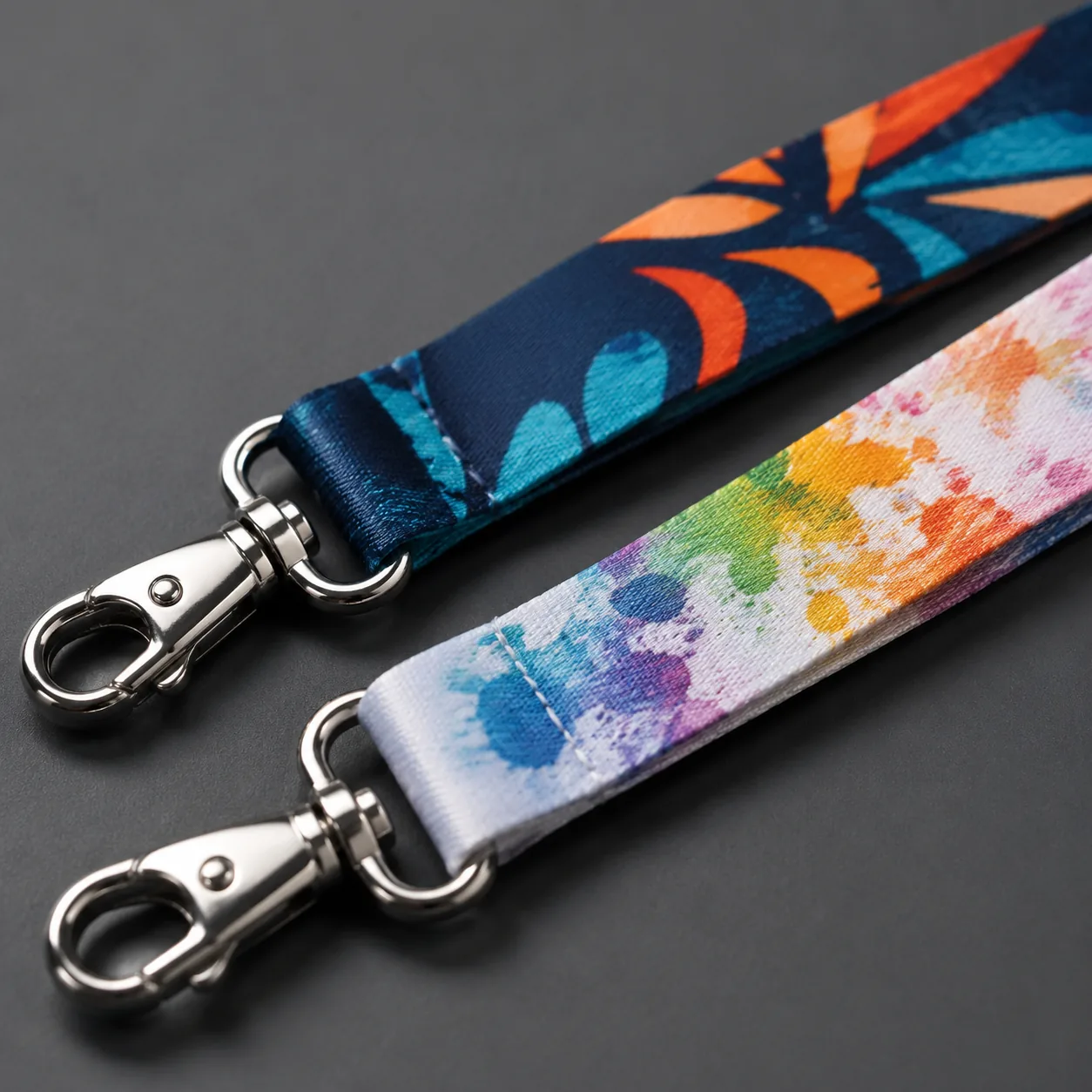
Start With the Production Risk, Not the Artwork Preview
Lanyards are low-cost items, but decoration mistakes are expensive because they usually appear after the strap has already been cut, printed, sewn, and packed. A logo that looks sharp in a PDF can fail when it is reduced to a 15 mm strap, printed over textured polyester, or repeated across 5,000 pieces with variable webbing tension. The correct decoration method affects MOQ, setup cost, approval time, color accuracy, durability, and whether the supplier can hold the artwork within a practical tolerance during mass production.
For procurement teams, the goal is not to choose the most decorative option. The goal is to match the branding requirement to a process that can reproduce it consistently at the required quantity and price. A one-color event lanyard, a full-color sponsor lanyard, and a premium staff lanyard should not be specified the same way. Before quoting, define the artwork complexity, strap width, base material, hardware load, safety requirement, packing method, and inspection standard. Without those variables, suppliers will quote different products while appearing to compete on the same item.
Decoration Methods and Commercial Ranges
The three main options are screen print, dye-sublimation, and woven jacquard. Screen print applies ink onto the strap surface and is best for bold logos with limited colors. Dye-sublimation transfers full-color artwork into polyester fibers using heat, making it stronger for gradients, sponsor walls, and edge-to-edge graphics. Woven jacquard forms the logo inside the strap structure, giving a durable, premium look but limiting fine detail and increasing setup complexity.
The commercial ranges below assume standard polyester lanyards, 900 mm finished circumference unless otherwise specified, common metal hooks, bulk export packing, and FOB China or Southeast Asia factory pricing. Prices move with hardware, strap width, packing, safety buckles, local labor cost, and exchange rate. Very small orders can carry higher setup charges even when the stated MOQ is low.
| Method | Best Use | Practical MOQ | Production Lead Time | Typical FOB Range | Key Technical Limit |
|---|---|---|---|---|---|
| Screen print | 1-3 solid-color logos on promotional or staff lanyards | 100-300 pcs; better pricing from 1,000 pcs | 7-12 days after artwork approval; 3-5 days for strike-off | USD 0.18-0.48 each for 15-20 mm polyester | Minimum positive line about 0.25-0.35 mm; small reversed text can fill in |
| Dye-sublimation | Full-color artwork, gradients, sponsor logos, photographic effects | 100-200 pcs; efficient from 500 pcs | 8-15 days after approval; add 2-4 days for color strike-off | USD 0.24-0.68 each for 15-20 mm polyester | Best on white or light polyester; dark base colors reduce vibrancy |
| Woven jacquard | Premium repeat programs, membership, hotel, campus, or retail use | 500-1,000 pcs; lower only with surcharge | 12-22 days after loom setup approval | USD 0.38-0.95 each for 20-25 mm strap | Fine type, gradients, and thin curves must be simplified |
A useful first filter is artwork density. If the logo must be readable at arm’s length and uses one or two solid colors, screen print is usually the economical choice. If the design contains multiple sponsor marks, fades, or a full-surface pattern, sublimation is usually safer. If the buyer values tactile quality and long-term brand consistency more than detailed artwork, woven jacquard can justify the higher MOQ and setup time.
When Screen Print Is the Right Answer
Screen print is the most efficient choice for simple, repeatable branding. It works well on standard flat polyester webbing in 15, 20, or 25 mm widths, especially where the artwork has bold shapes and limited colors. A 20 mm strap gives noticeably more print area than 15 mm and often prevents the common problem of shrinking a logo until text becomes unreadable. For small type, avoid anything below 5 pt on a 15 mm strap or 4 pt on a 20 mm strap unless the supplier confirms a physical strike-off.
Screen printing is controlled by ink viscosity, mesh selection, strap texture, curing temperature, and operator registration. For a clean result, specify vector artwork, Pantone references, and minimum line widths. A practical tolerance for print placement is ±2 mm along the strap width and ±3 mm near sewn or heat-cut ends. Color matching can normally be held to Delta E 2-3 against an approved production sample, but only if the base webbing color is also controlled. A white logo printed on black polyester is easier to approve than a mid-tone brand color printed on red or navy webbing.
Cost rises with each color because each color requires separate screen setup and registration. For a 1,000-piece order, a one-color 15 mm polyester lanyard with a standard swivel hook may land around USD 0.22-0.32 FOB. A three-color version on 20 mm strap with a breakaway buckle may move toward USD 0.40-0.55. Screen print becomes less attractive when the artwork requires gradients, tonal images, or many small sponsor logos. In those cases, the setup cost and approval risk can exceed the savings.
When Dye-Sublimation Solves the Artwork Problem
Dye-sublimation is the strongest option when artwork complexity is high. It allows full-color printing, gradients, repeating patterns, QR-style graphic elements, and multiple sponsor marks without separate screens for each color. The print penetrates polyester fibers instead of sitting only on the surface, so it generally resists cracking better than heavy surface ink. It is commonly specified for conferences, events, retail promotions, fan merchandise, and corporate programs where design flexibility matters more than having a dyed-color base strap.
The key limitation is substrate. Sublimation needs polyester and performs best on white or very light strap material. A buyer who wants a black lanyard with bright full-color artwork should not expect sublimation to behave like ink on coated paper. The usual solution is to sublimate a black background as part of the artwork onto white polyester, then control edge bleed carefully. This can look good, but the reverse side, cut edge, or fold area may reveal the base material if the construction is not specified.
For production control, require a strike-off for critical brand colors and approve the actual strap, not only a digital mockup. Artwork should include 2-3 mm bleed where the design reaches the edge. Center alignment should be held within ±2 mm across the strap width, with finished length tolerance normally ±10 mm for standard sewn lanyards. Sublimated lanyards with full-surface printing often quote at USD 0.28-0.50 FOB at 1,000 pcs for 15-20 mm width, with higher pricing for soft satin polyester, upgraded hooks, double-sided printing, card holders, or individual OPP bags.
When Woven Jacquard Is Worth the Setup
Woven jacquard is not a printing process. The logo is formed by yarns in the strap itself, which gives a more integrated and durable appearance. It is suitable for staff ID programs, universities, hotels, clubs, membership products, and brands that reorder the same lanyard throughout the year. The hand feel is usually heavier than basic printed polyester, and the decoration does not rub off in the same way as a surface print.
The trade-off is resolution. Jacquard cannot reproduce photographic shading, soft gradients, or very fine typography. Artwork needs to be simplified into yarn colors and larger shapes. For legibility, plan on 20-25 mm strap width for logos with letters, icons, or multiple elements. Very narrow strokes below about 0.6-0.8 mm are risky, and reversed text is especially vulnerable because the surrounding yarn can close the open areas. If the logo has more than 6-8 small internal details, simplify the mark before sampling rather than forcing the loom to imitate a print file.
MOQ is normally higher because loom setup takes time. A realistic starting point is 500 pcs, with better unit costs at 1,000-3,000 pcs. Lead time is commonly 12-22 days after approval, and sampling may add 5-7 days if a new pattern is required. Pricing for a 20 mm woven lanyard with standard metal hook often ranges from USD 0.45-0.75 FOB at 1,000 pcs, rising with custom yarn colors, thicker webbing, safety release, premium hardware, or retail packing. Woven jacquard is poor for one-off campaigns with late artwork changes, but strong for stable programs where durability and perceived value matter.
Specification Checklist Before RFQ
Most quote confusion comes from missing specifications, not supplier dishonesty. If one factory quotes 15 mm polyester with a swivel hook and bulk packing while another quotes 20 mm satin polyester with a lobster clasp, breakaway buckle, and individual bag, the lower price is not necessarily better. Send one controlled RFQ and require each supplier to quote against the same build.
Lock these details before requesting final pricing:
For MOQ tiers, ask suppliers to separate fixed setup cost from unit cost. A factory may accept 100 pcs for screen print or sublimation, but the economic price often starts at 500-1,000 pcs. Woven jacquard below 500 pcs is possible in some factories, but the unit price can look inflated because loom setup is spread over too few pieces.
Hardware, Finishing, and Inspection Controls
Hardware can change cost and failure risk as much as the decoration method. A basic swivel hook is economical and suitable for lightweight ID cards. A lobster clasp feels more secure but costs more and adds weight. A bulldog clip is useful for event badges but may rotate or mark card stock. Badge reels, phone loops, detachable buckles, and dual attachments should be specified by use case rather than selected as catalog extras.
Finishing should also be controlled. Heat-cut ends are low cost and common, but sewn ends provide a cleaner, stronger finish when hardware load is higher. If the lanyard carries heavy PVC card holders, metal badge reels, keys, or multi-item promotional packs, ask for a pull test target. A practical internal requirement is that sewn attachment points withstand 5-8 kgf for light ID use and 10 kgf or more for heavier accessories, unless local safety standards require controlled breakaway release. Breakaway buckles should open reliably under the specified load and not separate during normal wear.
| Spec Item | Economy Choice | Controlled Choice | Why It Changes the Quote |
|---|---|---|---|
| Base strap | 15 mm flat polyester | 20 mm satin polyester or RPET | Affects print area, hand feel, and perceived value |
| Decoration | 1-color screen print | Double-sided sublimation or jacquard | Changes setup, sampling, and inspection requirements |
| Hardware | Standard swivel hook | Lobster clasp, buckle, badge reel, or dual fittings | Adds material cost and assembly labor |
| Safety | No breakaway | Breakaway buckle with pull-function check | Required for many school, event, and workplace policies |
| Finishing | Heat-cut and bulk packed | Sewn ends, individual bag, insert card, carton marks | Improves presentation but increases labor and packing cost |
Inspection should be written into the purchase order. For general visible defects, AQL 2.5 is a common target; for major functional defects such as missing hardware, failed stitching, incorrect safety buckle, or unreadable logo, use tighter controls or 100% checks on critical functions. Define acceptable defects before shipment: print offset beyond ±2-3 mm, logo color outside approved tolerance, frayed edges, oil marks, weak stitches, incorrect hook type, and mixed packing should all be listed as rejectable conditions.
Approval Flow and Buying Recommendation
A reliable approval flow prevents most disputes. Start with a digital layout only to confirm size, logo repeat, hardware position, and orientation. Do not treat it as color approval. For screen print and sublimation, request a physical strike-off when brand color matters or when the design is complex. For woven jacquard, approve a loom sample because the artwork will change when converted to yarn. Keep one signed golden sample at the buyer side and one at the supplier side, then reference it on every repeat order.
Lead time should be counted from final artwork and sample approval, not from the first email. A practical schedule is 1-2 days for quotation, 2-5 days for artwork adjustment, 3-7 days for physical sampling, 7-22 days for production depending on method, and 3-10 days for export consolidation before transit. Air freight is faster but can exceed the value of low-cost lanyards on small orders, so late approvals often cost more than the decoration upgrade itself.
For a simple budget order, specify 15 or 20 mm polyester with one-color screen print, standard swivel hook, and bulk packing. For full-color event or sponsor artwork, specify dye-sublimation on white polyester with 2-3 mm bleed and a physical strike-off. For premium repeat use, specify 20-25 mm woven jacquard, simplified logo geometry, and a confirmed golden sample. At ZheCraft, we recommend comparing quotes only after these variables are fixed; otherwise the lowest price usually reflects a different lanyard, not a better factory.
Have a project? Send your artwork and target quantity and we’ll reply with a detailed quotation within 12 working hours.
Ready to get this made?
Send your sketch, target quantity and ship-date. Detailed quotation in 12 hours.



