How to Specify Packaging Inserts for Custom Promo Products
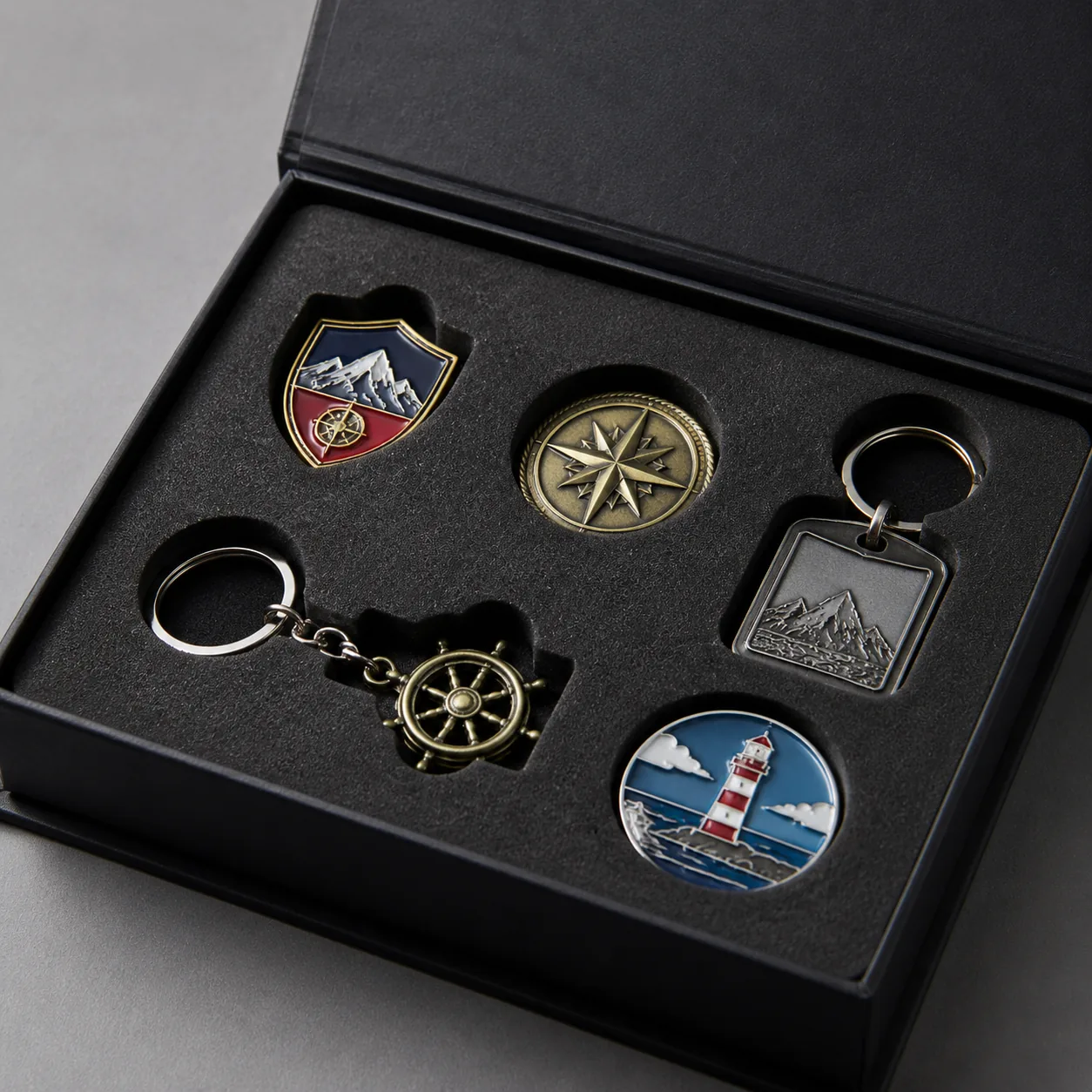
Why inserts are the main damage control point
Most promo-product damage is not caused by the product itself. It happens because the insert allows too much movement, too much surface contact, or too much load inside the carton. A pin, coin, keychain, badge, or small gift set can pass artwork approval and still arrive scratched, bent, or rattling if the cavity is loose or the packout shifts in transit.
For custom metal giveaways, the insert matters more once the item has plated surfaces, enamel fill, moving parts, or a premium retail presentation. The insert must control three things at once: positional movement, contact pressure, and pack density. If those are not defined up front, the factory will improvise, and the result is usually inconsistent across the run.
A practical spec starts with the product envelope, not just the nominal size. Measure the maximum length, width, thickness, and any protrusions such as key rings, clasp backs, magnets, or pin posts. Then define how the item sits in the insert, what can touch it, and what must remain suspended.
Choose the insert material by risk and presentation
Insert material should be selected by product weight, surface sensitivity, and whether the box is retail-facing or transit-only. For most metal promo products, EVA foam is the most reliable default because it cuts cleanly, holds a crisp cavity, and resists vibration better than soft open-cell foam. Typical EVA densities for packaging are 40 to 60 kg/m³ for lighter items and 60 to 80 kg/m³ for heavier coins or multi-piece sets. Common thicknesses are 2.0, 3.0, 5.0, and 10.0 mm, often layered to reach the final depth.
EPE foam is cheaper and lighter, but it compresses more and looks less refined. Paperboard die-cuts are fine for flat, low-risk items such as basic lapel pins on cards, but they do little to prevent rub marks on polished metal. Velvet-coated board improves presentation and reduces micro-scratches, but it adds cost and can attract dust if the flock quality is poor. Molded pulp works for eco-focused programs, although it needs looser tolerances and is rarely the best option for mirror plating.
Do not select a softer material just because it feels premium. A soft insert can let a 28 mm coin or heavy keychain sink during vibration and rub against the lid. For mixed sets, a layered build is usually better: a firmer base for support, a cut cavity layer for location, and a top restraint layer to stop vertical bounce.
| Insert material | Typical density or build | Best use case | Main limitation | FOB price range (USD/pc) |
|---|---|---|---|---|
| EVA foam | 40-80 kg/m³; 2-10 mm layers | Pins, coins, keychains, small sets | Higher cost than paperboard | 0.08-0.35 |
| EPE foam | 20-35 kg/m³; 3-15 mm layers | Low-cost transit protection | Less precise fit, more compression | 0.05-0.18 |
| Paperboard die-cut | 350-650 gsm board | Flat pins, cards, light items | Weak vibration control | 0.03-0.12 |
| Velvet-coated board | 1.0-2.0 mm board with flock finish | Gift-ready retail packaging | Dust/lint risk, higher cost | 0.20-0.75 |
| Molded pulp | 0.8-2.0 mm wall typical | Eco programs, simple shapes | Looser fit, rougher appearance | 0.12-0.40 |
| Thermoformed tray | 0.3-0.8 mm PET/PS tray | Repeat packs, multi-item sets | Tooling cost and less flexibility | 0.18-0.90 |
Set cavity size, depth, and tolerance explicitly
The most important spec is the cavity relative to the product envelope. For rigid inserts, a practical starting clearance is 0.3 to 0.8 mm per side for precise metal parts and 0.8 to 1.5 mm per side for softer or more forgiving materials. For molded pulp or paperboard, the usable clearance is usually wider because the material edges are less exact. If the item has relief, a clasp, a chain, or a post on the back, measure the true maximum envelope, not just the front-facing outline.
The drawing should state four numbers, not one: product size, cavity opening size, cavity depth, and permitted movement. For example, a 45.0 mm challenge coin may need a 45.6 to 46.0 mm cavity with 2.5 to 3.5 mm depth support on each face, while a 32 x 20 mm keychain body may need a separate recess for the ring so the hardware does not press into the visible face. If the finish is high-polish, even light point loading can leave rub lines.
Factory cutting tolerance matters as much as nominal size. For foam and board die-cuts, a realistic production tolerance is usually ±0.5 mm on a well-controlled tool and ±1.0 mm on lower-cost or denser materials. If you need tighter than that, say so in the RFQ and expect higher scrap or slower packing. In most promo-product programs, the correct tolerance is the one that matches the geometry and shipping load, not the smallest number on paper.
Lead times depend on whether the insert is a stock material, a custom die-cut, or a new molded tool. For common EVA or EPE die-cuts, samples usually take 5 to 7 days and mass production 10 to 18 days. Velvet-coated board or multi-layer retail inserts generally need 10 to 15 days for samples and 15 to 25 days for production. Thermoformed trays often require 12 to 20 days for samples and 20 to 30 days for first production, mainly because tooling and setup are slower.
Match the insert to the product type
Different promo products fail in different ways. Pins need surface protection and flat retention. Coins need edge control and anti-rattle support. Keychains need chain containment. Magnets need separation from other magnets and from steel surfaces. Lanyards and soft goods usually need folding control more than crush resistance. There is no universal insert that works equally well for all of them.
| Product type | Recommended insert | Typical cavity note | Avoid |
|---|---|---|---|
| Custom enamel pins | EVA foam or velvet board | 0.5 mm per side clearance; shallow recess | Loose paperboard for high-gloss plating |
| Challenge coins | EVA foam or molded tray | Edge grip with 2.5-3.5 mm face support | Soft foam that lets the coin wobble |
| Keychains | Layered foam or die-cut board | Separate body and ring; add chain slot | Single flat cavity for bulky hardware |
| Fridge magnets | Paperboard, EVA, or tray | Keep faces separated and polarity controlled | Shared cavities for multiple pieces |
| Lanyards | Folded board or paper sleeve | Control fold length and clip position | Deep foam unless the set includes accessories |
For mixed sets, each item needs its own retention logic. A pin and a keychain should not share a broad cavity unless both shapes are simple and the pack value is low. Premium gift sets benefit from separate cavities because the product looks organized and can be removed without snagging adjacent items. That also reduces assembly errors on the packing line.
As a sourcing baseline, many factories set MOQ at 300 to 500 pcs for simple paperboard or EPE inserts, 500 to 1,000 pcs for custom EVA die-cuts, and 1,000 pcs or more for thermoformed trays with dedicated tooling. FOB pricing typically moves down as quantity rises: small runs may sit at the top of the ranges above, while 5,000+ pcs usually cut unit cost by 15% to 35% depending on material and nesting efficiency.
Specify finish, touch points, and scratch risk
Many packaging specs fail because they ignore contact surfaces. If a plated coin rests against a hard edge, the edge can leave a visible mark during vibration. If a pin sits with its back against rough board, the post or clutch can scuff the metal. If a soft enamel piece sits too close to the lid, the raised metal lines can pick up gloss rub marks. The insert spec should define where the item may touch and where it must float.
A good method is to classify surfaces as contact-allowed, contact-limited, or no-contact. For example, the flat back may be allowed to touch, the outer edge may be contact-limited, and the enamel face or mirror-plated rim may be no-contact. For high-polish finishes, a velvet layer or top tissue sheet can reduce micro-scratches, but only if the material is clean and low-lint. Otherwise, the finish solution becomes a contamination problem.
If the item includes a magnet, clasp, chain, or moving part, call that out separately. Hardware should be restrained so it cannot strike the visible face in transit. For keychains, a small retention slit or secondary slot for the ring is usually better than one oversized open cavity. For magnetic products, state polarity orientation if paired items must mate correctly in the box.
- Identify all no-contact surfaces before tooling.
- Specify which side faces up in the box.
- State whether hardware may rest on the insert.
- Require a clean, low-lint finish for retail-facing packs.
- Ask for a shake test on the first packed sample.
- Approve one physical golden sample before mass packing.
Use carton packout to support the insert
The insert is only one layer of protection; the carton packout determines how much shock the insert must absorb. If the inner box is loose inside the master carton, even a precise insert can fail because the whole pack shifts. The RFQ should define inner quantities, master carton quantities, carton wall grade, and whether void fill is allowed. If the product can move inside the carton, the insert will eventually show it.
For lightweight promo items, a common inner packout is 24 to 100 pcs per inner carton, depending on product size and insert geometry. Heavier metal products usually need smaller inner quantities, often 12 to 48 pcs, so stacking load does not deform the lower layer. For air freight, compact packout helps reduce volumetric charge. For sea freight, protection and stackability usually matter more than saving a few cubic centimeters.
Carton spec should include board grade and test standard. A typical master carton for export promo goods is 5-ply corrugated with an ECT of 32 to 44 and a burst strength around 200 to 275 lb, depending on product weight. If cartons will be palletized, specify pallet pattern, stacking limit, and whether corner protection is required. These details reduce crushed cartons and inconsistent compression across the shipment.
If the insert is retail-facing, appearance matters as much as protection. Clean die edges, consistent color, and stable print registration become important. Transit-only inserts can be simpler and cheaper, because function overrides presentation. In practice, retail-facing inserts often cost 20% to 60% more than plain transit inserts, but they lower the risk of customer-facing defects.
What to put in the RFQ and how to validate it
The most effective way to prevent rework is to write the insert spec in the RFQ, not in follow-up messages. State the product envelope, cavity dimensions, allowable movement, material, thickness, finish, and carton packout in the same document. If there are multiple SKUs, attach a layout drawing for each one rather than describing them in one shared note.
A clean RFQ should also name the sample path. Ask for a pre-production insert drawing, a first physical sample, and a packed approval sample. For production control, request a simple drop or vibration check on the first lot. For example, a 60 to 80 cm packed drop from corner and flat positions is often enough to expose loose fit, while a short vibration test can show whether the cavity is too generous or the lid is pressing on the product.
Use the checklist below before approval:
- Product envelope measured at the widest points
- Cavity opening and depth shown on drawing
- Material and thickness specified by SKU
- Allowed and forbidden touch points marked
- Inner and master carton quantities confirmed
- Void fill policy and stacking limit stated
- First packed sample approved before mass run
If you need a practical starting point, use EVA foam for most pins, coins, keychains, and badge sets; use paperboard or EPE only for low-risk or price-driven packs; and move to velvet board or thermoformed trays when the unboxing experience matters. The right insert is rarely the cheapest one. It is the one that keeps the product stable, protects the finish, and packs efficiently at scale.
ZheCraft can translate product geometry into a production-ready insert spec for pins, coins, keychains, magnets, badges, and lanyard sets, including cavity drawings, material recommendations, and carton packout guidance. That is usually faster and cheaper than correcting damage after the first shipment.
Have a project? Send your artwork and target quantity and we’ll reply with a detailed quotation within 12 working hours.
Ready to get this made?
Send your sketch, target quantity and ship-date. Detailed quotation in 12 hours.



