How to Specify Mixed-Finish Promo Sets Without Rework
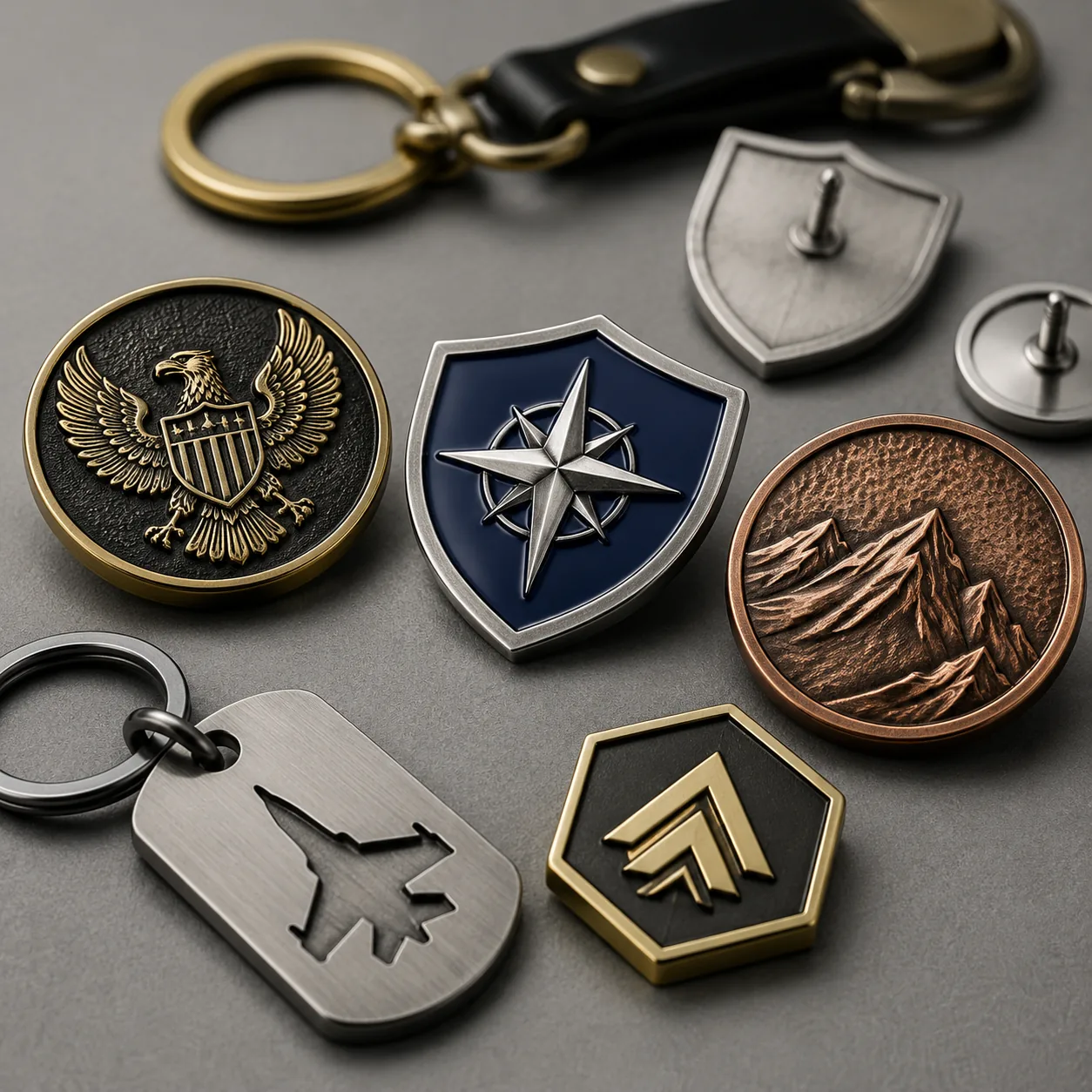
Why Mixed-Finish Sets Drift in Production
A mixed promo set looks controlled on a mockup: one enamel pin, one challenge coin, one keychain, one patch, and one lanyard carrying the same campaign identity. In production, those items may pass through die casting, stamping, plating, enamel filling, embroidery, sublimation, cutting, stitching, paper printing, and final packing. Each process has its own material behavior and tolerance range. The failure is usually not a broken part; it is a set that looks slightly wrong together.
The common symptoms are practical and easy to miss until final inspection: a coin reads warmer than the pin, a lanyard red looks orange beside a printed card, the patch border is 2 mm wider than approved, or the packed set rattles because the insert cavity is too deep. Any one issue may be acceptable on a standalone SKU. In a kit, the mismatch becomes visible because the customer evaluates the items side by side.
The root cause is usually a specification written item by item instead of set by set. A pin drawing, coin drawing, lanyard proof, and packaging dieline may all be technically correct, but no document states which attributes must visually match across substrates. For a coordinated campaign, the master specification must control the relationship between parts before it controls decorative details.
Build One Master Standard Before Sampling
Start with a master visual standard that every component derives from. It should include approved Pantone values, CMYK or LAB references for printed paper, logo proportions, minimum line widths, finish family, and a physical color chip or printed proof where possible. For most promotional sets, one or two colors should be treated as critical. A practical tolerance is Delta E 2.0 to 3.0 for printed paper under D65 light, while textiles and enamel may need a wider visual tolerance because of texture, resin depth, and yarn absorption.
Metal finishes need the same discipline. Do not write “gold,” “silver,” or “antique” without defining the intended appearance. Gold may mean bright imitation gold, pale champagne gold, warm brass, or antique brass with blackened recesses. Silver may mean chrome, nickel, brushed nickel, gunmetal, or antique silver. Decorative plating thickness is commonly specified around 0.10 to 0.30 microns for economy promotional items and 0.30 to 0.50 microns for higher-wear keychains or coins, but thickness alone does not define color temperature. The approved plated swatch remains the control sample.
Approve the packaging artwork early when paper is part of the presentation. Backing cards, insert cards, and rigid boxes often become the visual bridge between metal and textile items. Paper proofing is faster and less expensive than remaking a die-cast mold or replating a metal batch, so it is often the best place to lock campaign color before the supplier releases hard tooling.
Separate Shared Rules From SKU Rules
A clean mixed-set specification has three layers. Shared campaign rules define color, logo geometry, copy, finish direction, barcode or warning text, and pack-out order. Product family rules define what applies to metal, textile, PVC, or paper components. SKU-level rules define dimensions, attachments, tooling, and item-specific tolerances. This structure prevents the buyer from applying one unrealistic tolerance to every part.
For example, a die-struck coin may hold diameter within plus or minus 0.20 mm and thickness within plus or minus 0.10 mm after plating. A woven patch may need plus or minus 1.0 mm on overall size and plus or minus 1.5 mm on border position because fabric relaxes after cutting and heat sealing. A lanyard may be specified by 20 mm or 25 mm width, plus or minus 1.0 mm, with print placement within plus or minus 2.0 mm along the repeat. These are not defects if they are defined before production.
| Spec layer | What to lock | Typical numeric control | Common buyer error |
|---|---|---|---|
| Shared campaign standard | Critical colors, logo ratio, finish family, copy | Pantone target; Delta E 2.0-3.0 for paper proof | Approving only a screen PDF |
| Metal components | Base metal, plating tone, thickness, attachments | 0.10-0.50 micron decorative plating; +/-0.20 mm diameter | Calling chrome and nickel the same silver |
| Textile components | Material, weave or print method, border, stitch margin | +/-1.0 mm size; +/-1.5 mm border position | Expecting fabric to match enamel exactly |
| Paper and packaging | Card stock, insert fit, box cavity, carton count | 350-400 gsm card; 1.0-2.0 mm cavity clearance | Approving items before checking pack fit |
| Release control | Golden sample, inspection lighting, AQL level | D65 light; AQL 2.5 major, 4.0 minor | Letting each item pass separately |
The table should be part of the purchase order package, not an informal email. If one vendor proposes brushed nickel for the pin and another proposes chrome for the coin, the shared standard gives procurement a basis to reject the mismatch before samples are made.
Classify Attributes as Match, Coordinate, or Vary
Not every feature should match. Forcing identical finishes across different materials can make a set look cheaper, not better. A pin may need polished plating to keep logo edges crisp, while a coin may need sandblasted recesses for depth. A patch may need a merrowed edge for durability, while the lanyard uses heat-cut ends and metal crimp hardware. The specification should state the intended relationship between items rather than demanding sameness everywhere.
Use three classifications. “Match” applies to critical brand elements such as the main Pantone color, logo proportion, spelling, orientation, and legal copy. “Coordinate” applies to finish families such as warm metals, muted textiles, or matte surfaces. “Vary” applies to process-driven features such as coin rim texture, keychain ring style, patch backing, or lanyard clip type. This wording gives the factory room to choose the right process without changing the brand system.
Concrete example: if the campaign color is PMS 186 C, the hard enamel pin may use PMS 186 C enamel, the coin may use PMS 186 C soft enamel in recessed areas, the paper card may target a Delta E under 3.0 against the approved proof, and the polyester lanyard may be approved visually because sublimation on fabric will not match enamel under every light source. That is a controlled variation, not an uncontrolled mismatch.
Control the Dimensions That Affect Fit
Mixed sets often fail after decoration is complete because the parts do not assemble cleanly. The most important dimensions are usually not the decorative ones; they are the dimensions that affect hanging, stacking, insertion, and packing. Lock the pin post location, clutch clearance, coin thickness, split-ring inside diameter, keychain loop opening, patch backing size, lanyard clip orientation, insert cavity depth, and carton pack count.
For common promotional hardware, a split ring may need an inside diameter of 20 to 25 mm for comfortable handling, while the metal loop on a keychain charm should leave at least 1.5 mm material around the hole after plating to reduce cracking or deformation. Pin posts should be positioned so the item does not rotate on the card; for pins wider than 30 mm, two posts are often safer than one. Insert cavities should allow roughly 1.0 to 2.0 mm clearance around rigid metal parts, while soft patches may need less but must not be compressed enough to curl.
Define tolerances by risk. A logo line that is 0.05 mm thicker may not matter, but a 0.5 mm undersized hole can stop assembly. For enamel pins and coins, minimum recessed enamel line width is often 0.30 to 0.35 mm for stable fill, with raised metal lines around 0.20 to 0.30 mm depending on tooling. For woven patches, very small text below 5 mm cap height may lose clarity; embroidery often needs larger letters, typically 6 to 7 mm or more, depending on thread and stitch density.
Choose Process Families That Look Intentional
A premium set does not require the most expensive process on every item. It requires compatible surface language. If the pin uses mirror-polished plating and glossy hard enamel, a heavily antiqued coin may look like it belongs to a different campaign unless the contrast is intentional. If the lanyard uses bright full-color sublimation, an ultra-muted patch and antique brass keychain may pull the set in another direction.
For a clean corporate look, use bright nickel or chrome, hard enamel or epoxy-coated soft enamel, sublimated polyester lanyards, and a crisp printed card. For a heritage or military-style set, use antique brass or antique silver, die-struck coins with recessed enamel, woven or embroidered patches, and kraft or matte black packaging. For retail gifting, use a rigid box with EVA or paperboard insert, consistent hardware color, and a controlled finish contrast between matte packaging and reflective metal.
Cost also follows process choices. Soft enamel pins are usually less expensive than hard enamel at the same size because polishing and curing requirements differ. Sublimated lanyards are efficient for gradients and full-color art, while screen-printed lanyards can look stronger for one- or two-color logos. Woven patches suit fine detail better than embroidery, but embroidery gives a raised texture that some buyers prefer. Specify the visual goal first, then let the process support it.
Inspect the Assembled Set, Not Only the Parts
Final QC must include both item-level inspection and set-level inspection. A coin can pass diameter checks and still fail the kit if its antique wash is too dark beside the pin. A lanyard can pass print registration and still fail if it is packed with the clip facing the wrong direction. A backing card can pass print color and still fail if the pin holes sit 3 mm off center.
A practical inspection plan uses AQL for component defects and a separate presentation check for the packed set. For many promotional orders, AQL 2.5 for major defects and AQL 4.0 for minor defects is common; critical defects should be zero tolerance. For executive gifts, retail resale, or event kits where missing components cause immediate complaints, add 100 percent count verification at packing and photograph the first approved carton before full shipment.
- Approve one complete physical golden set before mass production.
- Inspect under controlled light, preferably D65 or a documented light booth setting.
- Check metal tone, print color, fabric color, sheen, and logo orientation together.
- Measure only critical fit points: posts, holes, loops, insert cavities, and pack height.
- Require first-carton photos showing item order, carton marks, and inner packaging.
- Define AQL levels for components and a separate pass/fail rule for assembled presentation.
- Hold one retained sample at the factory and one with the buyer for dispute resolution.
The golden sample should show the exact pack-out: item position, polybag or tissue use, card orientation, warning labels, carton quantity, and any spare parts. If retail and event versions share the same items but use different packaging, issue separate approval samples. Reusing one sample across versions is a common cause of wrong inserts, wrong barcodes, and mixed carton labels.
Plan MOQ, FOB Cost, and Lead Time Realistically
Mixed sets become expensive because every item may carry its own tooling, proofing, and line setup. A simple enamel pin may require a mold charge, a coin another mold, a PVC keychain another mold, and a custom insert a dieline and cutting setup. Even when unit prices are low, coordination cost appears in sampling, color correction, packing labor, and rejected partial lots.
For FOB China planning, simple mixed sets with standard attachments and shared paper packaging often fall around USD 2.80 to 6.80 per set at 300 to 500 sets. Mid-complex sets with one or two custom metal tools, a lanyard, patch, backing card, and polybag or tuck box may run USD 6.80 to 11.50. Premium sets with multiple plated metal pieces, woven or embroidered patch, custom rigid box, EVA insert, serial numbering, or retail labeling often run USD 11.50 to 18.00 or more. These ranges move with size, plating, carton weight, and order quantity.
MOQ is driven by the least flexible component. Standard lanyards may start around 100 to 300 pieces, but custom woven patches, plated coins, or rigid boxes often push practical MOQ to 500 sets. If the order uses custom Pantone-dyed fabric, custom molded PVC, or special packaging materials, 1,000 sets may be more realistic. Ask for MOQ by component, not only by finished set, so you know where overproduction or price breaks occur.
| Set type | Typical MOQ | FOB price range per set | Sample lead time | Mass lead time after approval |
|---|---|---|---|---|
| Basic pin, keychain, lanyard, card | 100-300 sets | USD 2.80-6.80 | 5-8 days | 15-22 days |
| Mid-complex metal, patch, lanyard, tuck box | 300-500 sets | USD 6.80-11.50 | 7-12 days | 20-32 days |
| Premium coin, pin, patch, rigid box insert | 500-1,000 sets | USD 11.50-18.00+ | 10-18 days | 28-45 days |
| Event rush using existing tools | 100-300 sets | USD 3.50-9.00 | 3-6 days | 10-18 days if materials are in stock |
Build schedule buffer around the slowest approval. Plating corrections can add 3 to 5 days. Reprinting cards after a color issue can add 2 to 4 days. Rigid box inserts can add 5 to 10 days if the cavity is wrong. For event-driven projects, request a first-article set and a packed carton photo before authorizing the full run, then keep at least 5 to 7 days for final inspection and freight handoff.
Quote With a Set-Level Approval Package
Before requesting quotes, consolidate the artwork into one master spec sheet and mark each attribute as match, coordinate, or vary. Attach the color standard, item drawings, packaging dieline, pack-out diagram, inspection requirements, and target delivery date. Suppliers should quote the set as one coordinated program, not as five unrelated SKUs.
The quote should identify mold charges, sample charges, MOQ by component, FOB unit price by quantity tier, sample lead time, mass lead time, carton dimensions, estimated gross weight, and any assumptions about plating, fabric, paper stock, or packaging. Useful tiers are usually 100, 300, 500, 1,000, and 2,500 sets. If the supplier cannot state the process, tolerance, and inspection basis behind the price, the quote is not ready for approval.
The final release point is one complete approved sample set. It should be signed off by procurement, marketing, and quality before mass production starts. That single approval step removes the biggest source of rework: separate components that each look acceptable alone but fail as a campaign when they arrive in the same box.
Have a project? Send your artwork and target quantity and we’ll reply with a detailed quotation within 12 working hours.
Ready to get this made?
Send your sketch, target quantity and ship-date. Detailed quotation in 12 hours.



