How to Specify Color Accuracy Across Mixed Promo Products
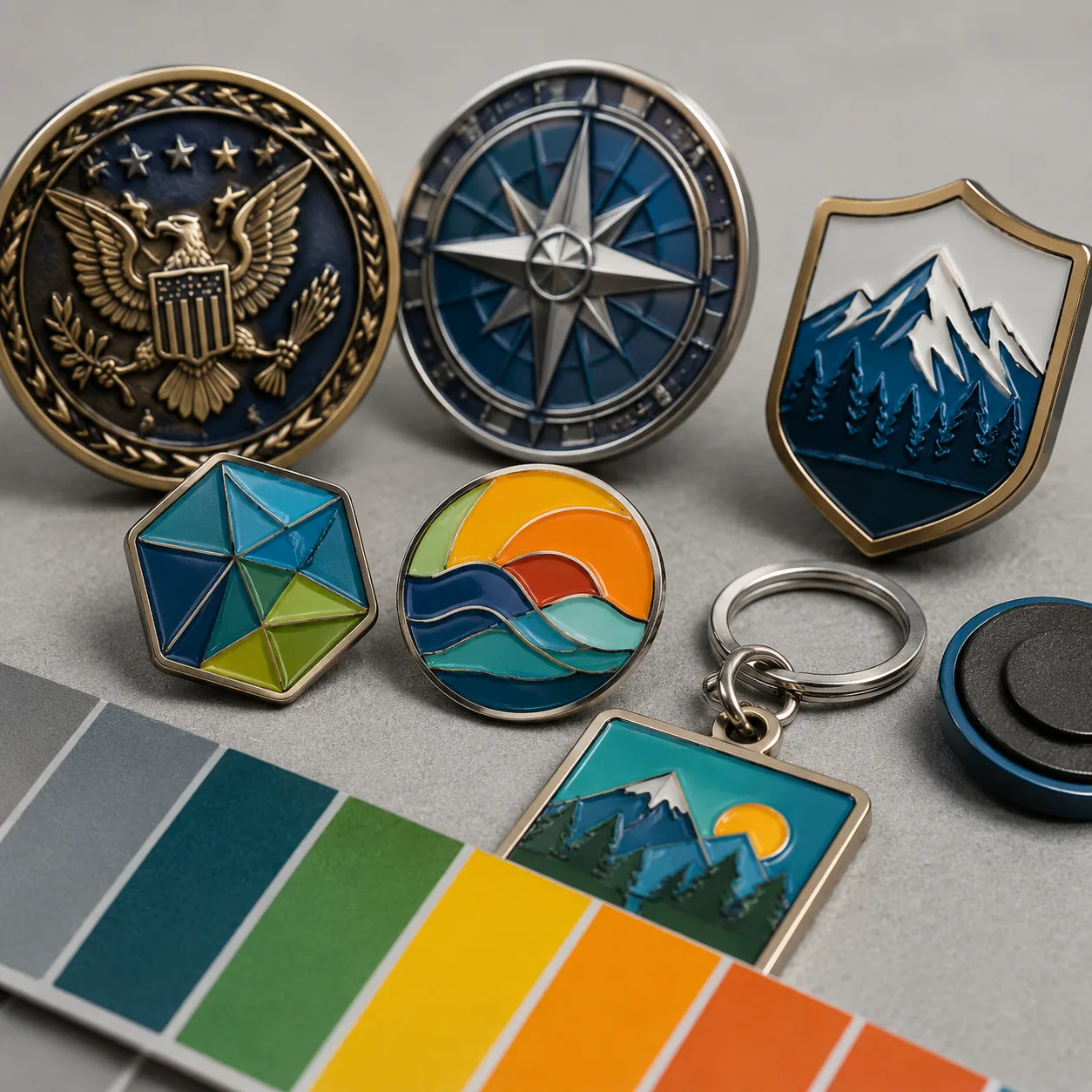
When one brand color has to work across five products
The most common failure in multi-item promo programs is not bad artwork; it is inconsistent color translation across substrates and processes. A navy that is correct on a printed lanyard can look flatter on enamel, darker on woven patches, and slightly warmer on a plated keychain because gloss, texture, and base metal all affect perception. If one campaign depends on a single brand color across multiple item types, the color-control method has to be defined before quoting, not after sampling.
ZheCraft sees this most often in event kits, retail launches, and distributor programs where buyers assume one digital file can control every process. It cannot. Enamel uses filled cavities, print relies on inks and curing, woven patches depend on thread availability and stitch density, and metal items introduce reflection from nickel, brass, black nickel, or dye-plated finishes. If you specify color only as a hex code, most factories will still interpret it differently by product line.
The practical goal is not mathematical sameness. It is controlled visual consistency under a defined light source, with a known tolerance and an approved sample for each process.
What color systems actually work in production
For factory communication, the most reliable reference is a physical Pantone chip plus a digital file for artwork handling. Pantone Solid Coated is the usual baseline for enamel, printed inserts, and plated metal products. Pantone Uncoated is more useful for paper-based packaging and some textile references, but it is not a substitute for a physical thread or yarn card. Hex and RGB are fine for design software; they are not production controls.
A good RFQ should state the master reference, the acceptable deviation, and the viewing condition. In production, color is usually judged under D65 daylight or a standard light booth such as CIE D65 / 6500K with neutral gray surroundings. If the supplier inspects under warm warehouse light, a color can look off even when it is technically within tolerance.
For mixed promo products, use a hierarchy: physical Pantone chip first, then a product-specific sample, then a digital file for recordkeeping. That hierarchy matters because some products can only approximate the master color. Soft enamel may land close to the chip; woven thread may need the nearest available yarn; sublimation may reproduce the hue but with lower saturation.
| Product type | Best reference | Typical production tolerance | What to approve |
|---|---|---|---|
| Soft enamel pins | Pantone Solid Coated chip | ΔE 2.0-4.0 visually acceptable | Filled sample under D65 light |
| Hard enamel pins | Pantone Solid Coated chip | ΔE 1.5-3.0 preferred | Polished sample with final plating |
| Woven patches | Pantone + thread chart | 1-2 thread shades off is normal | Stitch-out and weave density |
| Printed lanyards | Pantone master + print proof | ΔE 3.0-5.0 on fabric is common | Strike-off on actual polyester |
| PVC keychains | Pantone chip + molded sample | Small hue shift acceptable due to gloss | Final molded sample with surface finish |
| Fridge magnets | Pantone proof + coating check | ΔE 2.0-4.0 after lamination | Final print plus topcoat sample |
How materials distort the same brand color
Metal products are strongly affected by plating tone, recess depth, and adjacent line color. A red fill on bright nickel typically reads cleaner than the same red on gold or black nickel because the reflective base changes contrast and warmth. If the item is brand-critical, the plating finish is part of the color decision, not a separate decoration choice.
Fabric behaves differently. Embroidered and woven products both depend on available thread libraries, and high stitch density makes colors appear darker. Jacquard lanyards usually look less saturated than printed polyester because the weave interrupts solid coverage, while dye-sublimated lanyards can reproduce gradients but often lose some punch in dark brand solids. On a 20 mm polyester lanyard, a rich red may read 5-10 percent darker after heat transfer than it does on screen.
Plastic and rubber are influenced by gloss, wall thickness, and pigment load. A glossy PVC keychain can look lighter than the same pigment in a matte finish because the reflected highlight lifts the eye’s perception. That is why a physical sample is mandatory for molded products. A flat artwork file cannot predict how a 0.8-1.5 mm raised surface will read once light hits it.
The right expectation is product-specific consistency. One brand color should have a master reference, but each material needs its own acceptable appearance and approval method.
The spec fields that prevent argument later
A workable color spec needs more than a swatch attachment. You should state the master Pantone reference, the production method, the tolerance, the viewing condition, and who approves the golden sample. If the program includes multiple substrates, define whether all items must match the same reference exactly or simply coordinate as a set.
- Specify one master Pantone target for each brand color.
- State whether the reference is Solid Coated, Uncoated, or a physical chip number.
- Define the approval light source as D65 daylight or a comparable booth standard.
- Name the finish: nickel, black nickel, gold, matte, gloss, soft-touch, or clear coat.
- Require a signed golden sample before mass production.
- Allow separate tolerances for enamel, textile, print, and molded plastic.
The best RFQs also include hard procurement details. For a typical promo factory, MOQ may be 100-300 pcs for woven patches, 300-500 pcs for printed lanyards, 100-200 pcs for soft enamel pins, and 500-1,000 pcs for PVC keychains depending on mold count and number of colors. Lead time is usually 7-12 days for samples and 15-30 days for bulk production after approval, assuming no new tooling or special plating is needed. FOB pricing can vary widely, but as a working range: soft enamel pins often land around USD 0.35-1.20 each, woven patches USD 0.25-0.90, printed lanyards USD 0.35-1.50, and PVC keychains USD 0.45-1.80, with plating, packing, and rush service adding to cost.
Best practices by product category
For enamel pins, keep the color count low and choose shades that survive fill shrinkage and polishing. Soft enamel is more forgiving for saturated colors because the recessed areas hold more visual separation, while hard enamel needs tighter control because the final polish can slightly alter how edges read. If the design includes fine text or narrow borders, adjacent color contrast matters as much as the exact hue.
For patches and lanyards, use thread or yarn charts early. Ask the supplier to identify unsupported shades before sampling, because a close Pantone match on paper may not exist in stock thread. A realistic woven patch tolerance is usually within 1-2 thread shades, and buyers should decide whether that is acceptable before artwork is approved. For sublimated lanyards, ask for a strike-off on the actual 100 percent polyester substrate rather than a PDF proof.
For PVC and rubber items, gloss can make a color appear lighter or deeper than the same pigment on matte material. That effect becomes more noticeable on raised details below about 1 mm and on darker colors with high sheen. Approve molded samples, not renderings, and confirm whether the final product uses soft PVC, hard PVC, or TPR because each surface changes the perceived color.
For printed hard goods such as fridge magnets and metal badges, request final coating details: gloss lamination, matte lamination, epoxy dome, UV varnish, or direct print. A clear coat can shift brightness enough to matter on corporate blues, reds, and grays.
Comparison: color control methods by item type
The right control method depends on how the product is made. This comparison is useful when you are building a mixed set and need one approval system that still respects each process.
| Item type | Primary control | Risk if ignored | Buyer takeaway |
|---|---|---|---|
| Enamel pins | Pantone chip + golden sample | Color drift after fill, polishing, or plating | Approve under real metal and finish |
| Woven patches | Thread chart + stitch-out | Muted or unavailable shades | Check stock thread before order |
| Printed lanyards | CMYK proof + fabric strike-off | Artwork looks different on polyester | Approve on actual substrate |
| PVC keychains | Physical sample + Pantone reference | Gloss changes perceived shade | Expect a small visual shift |
| Fridge magnets | Print proof + coating check | Topcoat changes brightness | Confirm the final coating type |
For mixed kits, do not force every item to meet the same numeric value. Instead, define which items are color-critical and which are visually coordinated. A pin and lanyard may need close brand alignment, while a patch may only need to read as the same family of blue under retail lighting.
RFQ language that gets better quotes
Factories quote more accurately when the color instructions are unambiguous. A strong RFQ says which items must match exactly, which items only need to appear coordinated, and which colors may be substituted if the requested shade is unavailable. It also tells the supplier whether they can propose the nearest match or must stop and request written approval before proceeding.
One useful rule is to separate brand-critical colors from decorative colors. Brand-critical colors require either a physical match or a documented deviation approval; decorative accents can follow the factory’s standard palette if they remain visually compatible. This reduces sample rounds and prevents late-stage blame when one item in the set is intentionally different.
A practical RFQ line might read: ‘Brand blue must match Pantone 287 C within a visual tolerance of ΔE 2-4 on coated metal and printed substrates; woven thread may use nearest available thread card subject to buyer approval. Supplier must provide a pre-production sample, confirm plating finish, and quote FOB Shenzhen with sample lead time, bulk lead time, and MOQ by item.’ That is far more useful than ‘match blue.’
Sample approval and mass-production control
Color approval should happen in two steps: first on the single-item sample, then on the full mixed set. A pin may pass individually but still look wrong when placed next to a lanyard or patch because surrounding textures change human perception. Review the set together under the same light, with the same background, and with the original Pantone chips present.
In mass production, the goal is repeatability, not perfection. Ask for an approved master sample to stay at the factory and require the production line to reference it at the start of each shift. For larger orders, a common overall QC standard is AQL 2.5 for appearance and AQL 4.0 for minor functional defects, but color-critical zones should be checked more strictly than the rest of the item. For example, logo fills, brand fields, and plated borders should be inspected at 100 percent on the first article and spot-checked during the run.
If the order is large or color-sensitive, request a pre-production meeting photo set: raw material, first sample, plated or printed result, and final packed sample. This gives you a clear audit trail if the bulk run drifts from the approved tone.
What to do next before you place the order
If your next program includes more than one product type, build a short color control sheet before you request quotes. List the master Pantone numbers, the item-by-item tolerance notes, finish choices, MOQ, lead time, and the final approval method. It takes minutes to prepare and usually saves at least one sample round, especially when the order includes enamel pins, lanyards, patches, and keychains in the same campaign.
A simple checklist works well:
- Create one master Pantone reference per brand color.
- Assign a product-specific tolerance and approval method.
- Confirm MOQ and bulk lead time for each item type.
- Specify plating, gloss, and substrate before sampling.
- Approve a golden sample under D65 light.
- Require written sign-off for any color substitution.
If you want fewer surprises, ask ZheCraft to review the full set as one system rather than item by item. We can flag where the same color needs separate treatment, suggest which items should use physical chips instead of digital references, and help lock the golden sample before production. The best time to solve color mismatch is before tooling, not after the first sample arrives.
Have a project? Send your artwork and target quantity and we’ll reply with a detailed quotation within 12 working hours.
Ready to get this made?
Send your sketch, target quantity and ship-date. Detailed quotation in 12 hours.



