How to Specify Child-Safe Custom Pins and Keychains
Start with age grade, market and foreseeable use
A custom pin, keychain, magnet or coin is not automatically treated as a simple promotional giveaway. If the design is cartoon-led, sold in a museum shop, distributed at a school event or packed with a children’s activity kit, the buyer should specify it as a children’s-accessible product from the RFQ stage. Waiting until mass production to discuss safety usually leaves only expensive options: rework, relabeling, air freight replacement or scrapping finished goods.
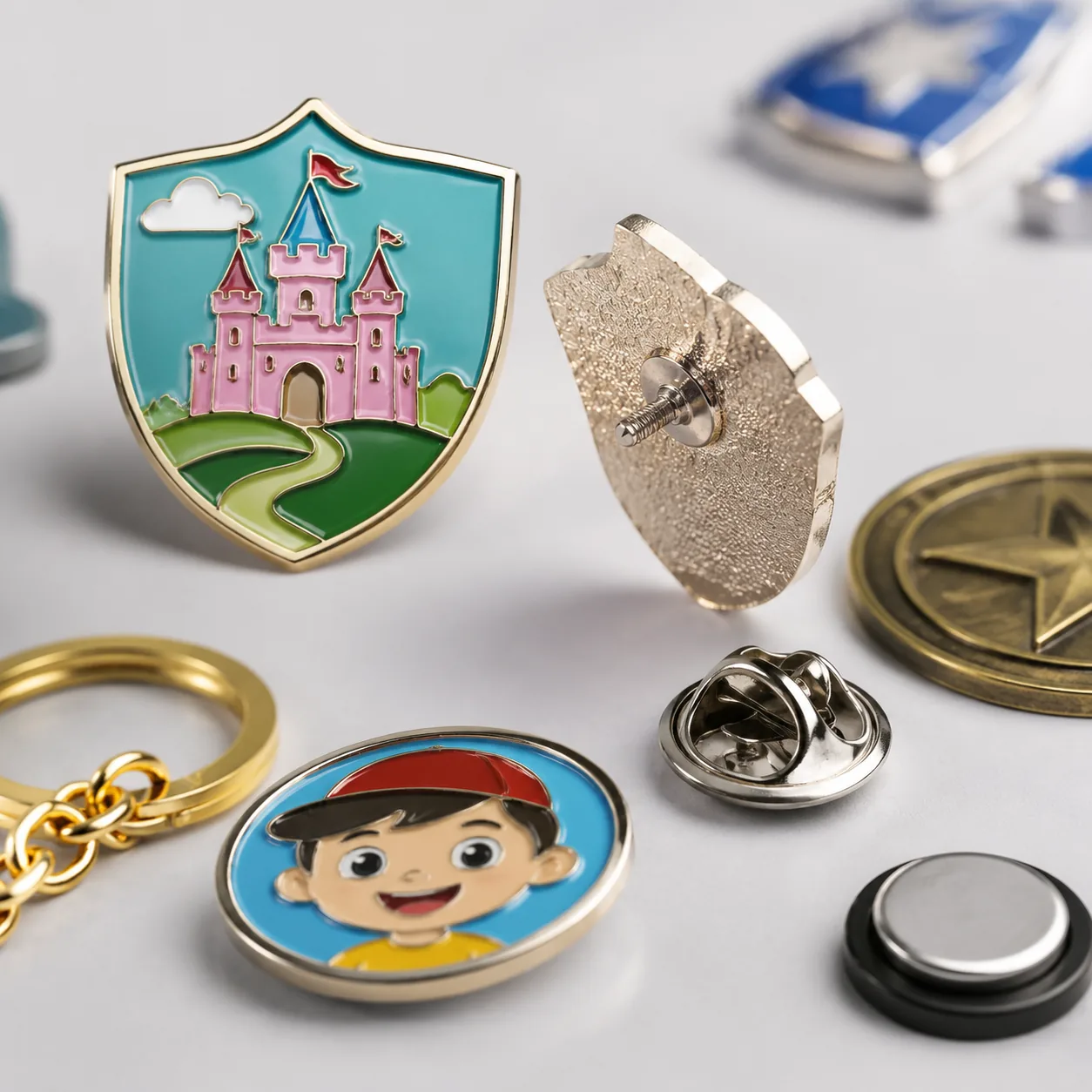
The practical risk is easy to underestimate. A 25 mm enamel pin with a butterfly clutch can separate into a sharp post and a small clutch. A 50 mm PVC keychain can lose an open jump ring. A 45 mm fridge magnet can shed a glued ferrite disc. If any detached part fits a small-parts cylinder, fails a pull test or contains restricted heavy metals, the issue becomes a safety and compliance problem, not a cosmetic defect.
The first specification should therefore be intended user age and destination market, not plating color. US, EU, UK, Canadian and Australian requirements are not identical, and retailers may impose stricter house standards than the law. A conservative factory brief should state whether the item is adult-only, a general-use promotional item, a children’s product for ages 3 plus, or a toy-like item. For children under 3, metal pins, small magnets and detachable charms are normally the wrong construction.
| Use case | Conservative age assumption | Preferred construction | Avoid |
|---|---|---|---|
| Adult trade show lapel pin | Adult use only | 0.9-1.0 mm post with 8-11 mm clutch or locking brooch | Loose distribution to children |
| School fundraiser badge | Ages 6 plus with supervision | Locking safety brooch, sewn patch or large button badge | Sharp post pin with removable clutch |
| Kids retail keychain | Ages 8 plus | 25-30 mm split ring with welded or closed connector | Open jump rings below 1.2 mm wire |
| Toddler gift item | Under 3 | Textile patch, woven label or non-detachable soft accessory | Pins, magnets, coins and small charms |
| Fridge magnet souvenir | Adult or supervised use | Full-back flexible magnet sheet on body over 60 mm | Small glued magnets under 30 mm |
As a working rule, treat products under 57 mm in their longest dimension as small-part-sensitive if they include detachable components. This is not a substitute for formal testing, but it is a useful engineering filter when choosing attachments, adhesives and packaging.
Specify metals, enamel and plating in measurable terms
Unspecified alloy is a common source of chemical and durability problems. For die-cast pins, keychains and coins, specify Zamak 3 or an equivalent controlled zinc alloy. For stamped brass pins, C2600 or C2680 brass is typical. For budget soft-enamel pins, SPCC or low-carbon iron can be acceptable for adult promotions, but exposed edges need reliable plating and sealing because iron rusts quickly after abrasion or salt-spray exposure.
For enamel, state the required compliance scope instead of using vague terms such as non-toxic. Depending on market and age grade, this may include total lead, soluble heavy metals, cadmium, phthalates in soft PVC, nickel release for skin-contact parts, or REACH and CPSIA-related restrictions. If epoxy dome coating is used, confirm that the coating itself is included in the accessible-material test, not only the metal substrate.
A practical plating callout for commercial enamel pins is 3-5 microns nickel underplating plus 0.05-0.20 microns final gold, imitation gold, silver, black nickel or antique finish. For higher-wear keychains and coins, specify 5-8 microns total plating where budget allows. Typical dimensional tolerance for die-cast zinc items is plus or minus 0.2 mm on thickness and plus or minus 0.3 mm on overall size after polishing; tighter tolerances should be agreed before tooling.
- State destination market: US, EU, UK, Canada, Australia or mixed retail channels.
- Define product status: toy, children’s product, adult collectible or general promotion.
- Specify base metal, enamel type, plating finish, plating thickness and epoxy use.
- Confirm nickel-free or low-nickel requirements before sample tooling.
- Require production-material testing if compliance is contract-critical.
Control mechanical hazards: posts, rings, magnets and edges
Most field failures are mechanical. A sample can look correct in photos while the pin post is weak, the jump ring is soft, or the magnet adhesive is still uncured. For child-accessible orders, the purchase order should define the hardware and the factory check method, not leave attachment selection to the lowest-cost default.
For pin posts, specify 0.9-1.2 mm post diameter and 7-8 mm post length. The solder or welded foot should be at least 2.5 mm diameter where the artwork allows. Badges above 35 mm, above 12 g, or with a dangling/spinning element should use two posts, a locking brooch, or a wider bar attachment. A single post on a large badge is a predictable rotation and pull-off failure.
For keychains, the split ring and connector are usually the weak points. A normal 40-60 mm metal keychain should use a 25-30 mm split ring made from 1.2-1.5 mm wire. Avoid hand-closed open jump rings below 1.0 mm wire for adult promotions and below 1.2 mm for children’s-accessible items. Heavy charms should use welded rings, cast closed loops or machine-closed connectors.
| Component | Practical specification | Inspection tolerance | Factory check |
|---|---|---|---|
| Pin post | 0.9-1.2 mm diameter, 7-8 mm length | Plus or minus 0.2 mm | Pull test 5-8 kgf or buyer-defined force |
| Butterfly clutch | Brass or iron, 8-11 mm diameter | No wobble on approved post | Retention check on sampled units |
| Rubber clutch | PVC or silicone, 10-12 mm diameter | 45-65 Shore A hardness | Push-on and pull-off feel check |
| Split ring | 25-30 mm OD, 1.2-1.5 mm wire | Plus or minus 1 mm OD | Gap and spring-back check |
| Magnet sheet | 0.8-1.5 mm flexible magnet | Plus or minus 0.2 mm thickness | Adhesion and slide test on steel plate |
| Exposed edge | No sharp burr over 0.1 mm | Visual and touch standard | 100 percent deburr on critical edges |
Edges deserve separate attention on stamped iron, brass and hard-enamel pins because polishing can leave sharp points at the outline. For children’s-accessible items, define sharp edges, sharp points, loose plating flakes, exposed wire ends and detached hardware as critical defects with zero acceptance.
Treat magnets as a critical safety component
Magnets require stricter control because swallowed magnets can cause serious injury, especially if more than one magnet is ingested. Any magnet that can detach from the product body should be treated as a critical defect. This applies to fridge magnets, magnetic pin backs, bookmarks, bottle openers and zinc-alloy souvenirs with glued ferrite discs.
For souvenir fridge magnets, a full-back flexible magnet sheet is safer than small glued disc magnets because it is larger, flatter and harder to swallow if separated. A common specification is 0.8-1.0 mm flexible magnet sheet for lightweight PVC, acrylic or paper-laminated magnets, and 1.2-1.5 mm sheet for heavier zinc-alloy bodies. For a 60 mm zinc magnet over 25 g, test holding force on painted steel after adhesive curing rather than relying only on magnet grade.
If disc magnets are unavoidable, specify magnet diameter, thickness, adhesive type and curing time. For example, a 12 mm by 2 mm ferrite disc bonded with two-part epoxy should not be pull-tested immediately after gluing; many adhesives need 24 hours at room temperature to reach useful strength and 48-72 hours for stable results. Cyanoacrylate glue is fast but can become brittle under impact, so it is not ideal for heavier cast bodies.
Magnetic pin backs are suitable for adult corporate wear because they avoid holes in garments, but they are poor choices for school giveaways. They add about 4-6 mm total thickness, raise FOB cost by roughly USD 0.15-0.45 per unit depending on size, and separate into small magnetic parts. Use them only where the sales channel and age grade support that risk.
Make packaging and labeling part of the RFQ
Packaging is a safety control, not just presentation. A loose pin in a polybag may be acceptable for an adult conference, but it is weak for retail children’s products because the clutch can be removed before purchase and warnings are easy to miss. Backing cards, sealed OPP bags, blister packs and clamshells help control access, labeling and traceability.
For enamel pins and brooches, a 300-400 gsm printed backing card with two post holes and a sealed OPP bag is a standard low-cost option. Typical FOB packaging adders are USD 0.03-0.08 for a printed card, USD 0.01-0.03 for OPP bagging, USD 0.12-0.35 for a small blister or clamshell, and USD 0.02-0.06 for carton or inner-bag batch labeling. Costs vary by size, print coverage and quantity, but these ranges are realistic for 1,000-5,000 piece orders.
Warning labels should be supplied by the buyer or retailer, not invented by the factory. Specify exact wording, language, age grade, country of origin, importer or distributor address, barcode position and batch code format. Keep warning text at 6 pt minimum; 7-8 pt is safer for multilingual packs. If the product is sold online and in stores, make sure age grading and warnings are consistent across packaging artwork, product listings and master cartons.
- Use sealed packaging for pins, magnets and products with detachable accessories.
- Put age grade and warnings on retail packaging, not only on shipping cartons.
- Add batch codes to cartons and inner bags for recall traceability.
- Confirm whether packaging must pass retail drop testing or only protect in transit.
- Approve printed packaging proofs before mass production, including barcode scan tests.
Set AQL levels, test samples and acceptance rules
A good inspection plan separates critical safety defects from cosmetic variation. Enamel overflow, minor plating shade variation and small polishing marks can be managed by AQL. Sharp points, detached magnets, failed pull tests, broken rings, missing warnings and restricted-substance failures should normally be critical defects with zero accepted.
For promotional metal goods, a common pre-shipment setup is AQL 0 for critical defects, AQL 1.5 for major defects and AQL 2.5 or 4.0 for minor defects under general inspection level II. On a 5,000 piece order, level II commonly produces a 200 piece visual inspection sample. Destructive tests such as pull, torque, drop or adhesion checks should use a separate defined sample, often 5-20 pieces per batch or per production lot, because tested units cannot be shipped.
Chemical testing should use actual production materials and finishes. If the finished item includes black enamel, gold plating, epoxy coating, rubber clutch and printed packaging, the lab may need samples representing each accessible material. Build 5-10 extra finished pieces into the order for testing and retained samples. Third-party lab timing is typically 5-10 working days after sample receipt, longer if the test scope includes multiple materials or retailer-specific protocols.
| Check type | Suggested acceptance | Sample timing | Buyer note |
|---|---|---|---|
| Sharp edge and burrs | Critical defect, zero accepted | Pre-shipment inspection | Important on stamped iron and brass |
| Pin post pull | No detachment at agreed kgf | Pre-production and production | Define force before sample approval |
| Magnet adhesion | No separation after pull/drop check | After adhesive cure | Do not test immediately after gluing |
| Plating thickness | Within agreed micron range | Sample audit or PSI | Use XRF when thickness is contractual |
| Color match | Approved Pantone or signed sample | Sample and line check | Hard enamel may shift after polishing |
| Restricted substances | Pass required lab scope | Production-material test | Allow 5-10 working days |
Budget realistic MOQ, FOB cost and lead time
Safer specifications add cost, but they usually cost less than emergency rework. For enamel pins, changing from one post to two posts typically adds USD 0.03-0.08 per piece. A locking brooch can add USD 0.06-0.18. Upgrading from open jump rings to welded or closed connectors on keychains can add USD 0.04-0.12. Nickel-free plating may add 8-20 percent, depending on finish and volume.
As FOB planning ranges, a 25-30 mm soft-enamel iron pin for 1,000 pieces may land around USD 0.45-0.95 before premium packaging or testing. A zinc-alloy keychain at 45-60 mm may run USD 0.90-2.20 depending on thickness, plating and attachments. A full-back flexible fridge magnet may range from USD 0.35-1.20 for PVC or printed laminated designs, and USD 1.20-2.80 for heavier zinc bodies. These are quoting ranges, not fixed prices; mold complexity, color count, polishing time and packaging can move them materially.
Lead time also needs space. A normal custom pin or keychain order of 500-5,000 pieces often requires 5-7 days for artwork, tooling and pre-production sample, then 12-20 days for mass production after sample approval. Add 3-5 days for detailed safety sample review, 5-10 working days for third-party lab testing, and 1-2 days for enhanced inspection, relabeling or repacking. Air freight may save transit time, but it will not recover time lost to failed testing.
MOQ matters because compliance overhead is easier to absorb at volume. Safety-controlled production is more practical from 300 pieces upward for pins and 500 pieces upward for keychains or magnets. Below 100 pieces, tooling, extra samples, lab fees and inspection time can exceed the product value. For small runs, simplify the construction: fewer detachable parts, standard plating, sealed packaging and one approved attachment method.
Use a safety-focused RFQ and lock the control sample
Before requesting quotes, classify the product honestly. If it is adult-only, say so and keep the specification practical. If it may be handled by children, do not let the lowest unit price decide the attachment, magnet style, plating or packaging. The RFQ should include artwork, size, quantity, destination market, intended age group, material preference, attachment type, packaging format, compliance scope, inspection level and target delivery date.
A competent factory response should mention more than unit price. For a pin, expect post diameter, clutch type, plating stack, enamel process, epoxy use, packaging and pull-test method. For a keychain, expect ring wire diameter, connector type, body thickness, plating, weight estimate and carton packing. For a magnet, expect magnet size, thickness, adhesive, curing time and adhesion check. If the answer is only “safe material” or “can pass test,” ask for the actual specification.
For first production, approve a physical pre-production sample and retain one signed control sample with the buyer and one with the factory. For reorders, lock the material, plating, enamel colors, attachment, magnet, packaging artwork, AQL levels and test reports in the purchase file. ZheCraft can help convert a design into a production-ready safety specification, but the buyer must define the market, age grade and compliance target before tooling starts.
Have a project? Send your artwork and target quantity and we’ll reply with a detailed quotation within 12 working hours.
Ready to get this made?
Send your sketch, target quantity and ship-date. Detailed quotation in 12 hours.



