How to Specify Carded Packaging for Promo Pins and Keychains
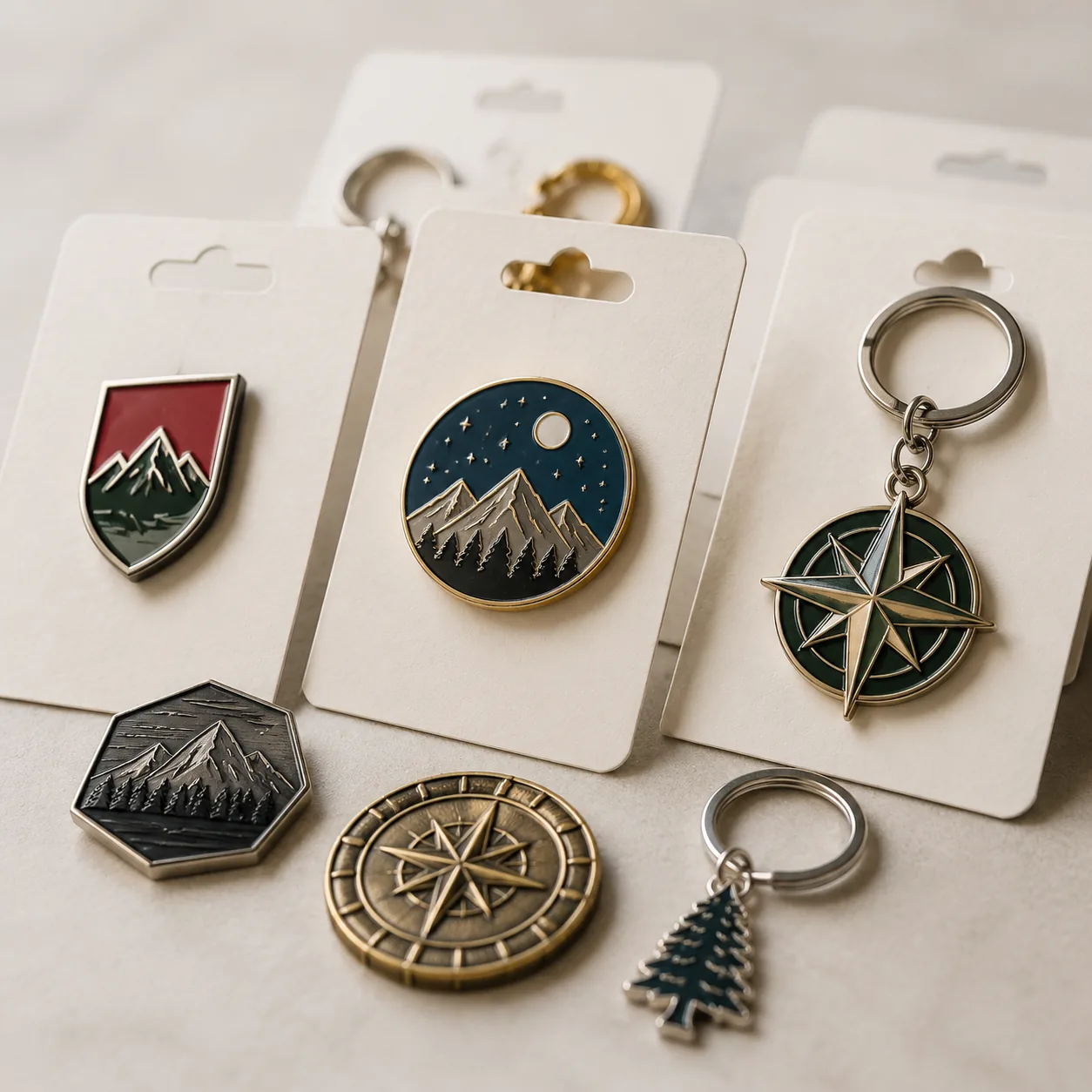
Why carded packaging causes preventable rework
Carded packaging is often treated like a branding add-on, but in production it is a fit system. The most common failure is simple: the pin or keychain is approved first, then the card hole, blister cavity, hang tab, or clip position is guessed later. That leads to bent cards, scratched plating, loose parts in transit, or a last-minute reprint when freight is already booked for a launch or event.
For promo pins, enamel badges, and keychains, the packaging spec should be written at the same time as the product spec. ZheCraft sees fewer delays when buyers define card size, stock, finish, attachment method, and carton layout in one RFQ, instead of leaving the factory to improvise around a finished metal sample. This matters most for mixed sets, because one bad insert dimension can affect every SKU in the carton.
The basic rule is to design packaging around the actual finished hardware, not the artwork mockup. A 1.2 mm pin post, a 25 mm split ring, and a 40 mm chain all load the card differently, and each one changes the minimum clearance the pack needs to survive shipping without deformation.
- Define the finished product first, then the card cavity or cutout.
- Confirm whether the package is display-only or export-safe.
- State the retail channel: peg hook, shelf, mailer, or giveaway box.
Choose the right card format for the channel
A retail card for a gift shop is not the same as a branded insert for a conference handout. For short-run promotions, a 300 gsm coated card is often enough. For retail or mail-order, buyers usually need 350–400 gsm art paper or ivory board, with matte or gloss lamination and a stiffer backer so the card does not curl in humid transit.
Typical dimensions are driven by the product size and display channel. A single lapel pin often fits well on 60 x 90 mm, 70 x 100 mm, or 80 x 120 mm cards. Larger keychains with multiple charms usually need 90 x 140 mm or custom die-cut shapes. If the pack will hang on a peg hook, the hanger hole should be specified to match the retailer fixture rather than relying on the supplier’s default slot size.
For most export programs, practical packaging tolerances are tighter than buyers expect. Card size tolerance of ±1.0 mm is usually safe for standard die-cut cards, while fold or window alignment should be held to ±1.5 mm. If the product is near the edge of the card, keep at least 2.5 mm from any cut edge and 4.0 mm from a fold line to reduce tearing during handling.
| Channel | Typical card build | When to use | Trade-off |
|---|---|---|---|
| Event giveaway | 250–300 gsm coated card, no lamination | Low cost, short shelf life, fast packing | Less rigid, easier to bend |
| Retail hang sell | 350–400 gsm card, matte or gloss lamination | Display plus shipping protection | Higher unit cost, longer print lead time |
| Premium gift set | Rigid board or folded insert with sleeve | Higher perceived value, multi-piece sets | More packing labor and carton volume |
| Mail-order | Thicker card plus polybag or blister | Needs transit protection | More materials, more assembly steps |
Specify fit, hole position, and attachment method
Most packaging failures start at the attachment point. A pin card needs the hole position, hole diameter, and face clearance defined against the actual pin post or backing clutch. If the hole is centered only on the artwork, the badge may sit crooked or tilt enough to scuff the print. Keychains are similar: a split ring, lobster clasp, or ball chain changes the hanging point and the required cavity depth by several millimeters.
A usable spec should include the product’s maximum thickness at the attachment zone, the distance from the top edge to the hanger, and the allowable side-to-side movement. For a standard butterfly-clutch pin, the card should keep the attachment zone clear of folds and be sized so the post is not forced against the paper edge. For a keychain with a 25 mm ring, a reinforced hang tab or slot with a minimum 3.0 mm margin is more reliable than a plain slit. In factory terms, you are not buying a print card; you are buying controlled clearance around the product.
For standard promo hardware, common fit targets are straightforward. Pin post holes are typically 1.5–2.0 mm diameter depending on the post, while slot openings for chains or tabs often need 3.0–5.0 mm width. If the item is packed through a blister or window insert, specify the cavity depth to the nearest 0.5 mm and ask for a physical check using the final plated sample, not a 3D drawing alone.
- State hole diameter, slot width, or blister cavity depth in millimeters.
- Give the exact attachment type: butterfly clutch, rubber clutch, brooch pin, ring, clasp, or chain.
- Keep at least 2.5 mm edge clearance around any cutout.
- Ask for a physical pre-production fit check with the finished metal sample.
Paper, print, and surface finish choices
Paper stock and finish affect both appearance and production stability. Standard art paper prints cleanly and is economical, but uncoated stock can scuff during packing. Full gloss can show fingerprints and makes handwriting or sticker placement less reliable. Matte lamination is the most balanced option for many international buyers because it resists abrasion without making the card look overly plastic.
For color-critical brands, print method matters more than many teams expect. Offset printing is best for larger volumes and consistent logos. Digital print works for lower MOQs or frequent artwork changes. If you need metallic foil, spot UV, embossing, or a die-cut window, define the exact area and line weight early; those effects increase proofing complexity and commonly add 3–7 days to the print schedule, especially when physical samples are required.
A good technical note is to specify the surface target, not just the marketing finish. For example: 350 gsm C2S art paper, 1-side matte lamination, CMYK offset print, 0.3 mm registration tolerance on logo elements, and no more than 5% visible color shift against the approved proof under D65 light. That gives the factory a real target instead of a vague style instruction.
| Finish | Best for | Risk | Typical MOQ effect |
|---|---|---|---|
| No lamination | Low-cost giveaways | Scratching and curl | Lowest |
| Matte lamination | Most branded cards | Slightly higher cost | Moderate |
| Gloss lamination | High visual impact | Fingerprints and glare | Moderate |
| Spot UV or foil | Premium retail presentation | Longer proofing and setup | Higher |
How to pack pins and keychains inside the card
The pack-out method should match hardware weight and sales channel. Small pins can be fixed with one or two slits plus a backing clutch cover. Heavier keychains often need a tie-through hole, twist tie, or molded insert so the item does not swing and mark the print surface. If the product has sharp edges, enamel points, or moving parts, a simple slit card may not be enough for safe shipment.
For pins with delicate plating, the cleanest method is usually a card plus OPP bag or polybag, then an inner carton. For keychains above about 25 g, use a reinforced backer or insert so the assembly does not rotate in transit. If the item contains multiple pieces, ask for a pack diagram that shows the exact order: product on card, protective sleeve or bag, then inner box, then master carton. That sequence matters because each added contact surface raises scuff risk.
For mixed sets, ask the factory to show the exact pack sequence before mass production. ZheCraft usually recommends a physical pack test for any order with openwork edges, metal-on-metal contact, or more than one SKU in the same outer carton. Changing a card slot before production is inexpensive; reworking 5,000 hand-packed sets is not.
- Use polybags when the card surface is premium or easily scuffed.
- Use a tie or molded insert when the product is heavy or swings in transit.
- Ask whether the product can be machine packed or must be hand inserted.
- Confirm if backing clutches are attached before or after card insertion.
Buyer checklist for a clean RFQ
A good packaging RFQ should let the supplier quote without guessing. Include finished product dimensions, attachment type, card size, paper stock, print side, finish, hanger-hole style, pack quantity per inner box, and whether the order needs retail-ready labeling. If any of those are missing, factories will make assumptions, and assumptions are where surprises start.
For technical clarity, include tolerance and inspection targets. Ask the supplier to hold die-cut dimensions to ±1.0 mm, hanger position to ±1.5 mm, and printed color within an agreed proof standard. If the project is for retail, define the AQL level before production. A common acceptance target is AQL 2.5 for major defects and AQL 4.0 for minor defects, with zero tolerance for wrong SKU, missing hardware, or damaged print on the front face.
The fastest RFQs are the ones that include pack-out and carton data on day one. Specify inner count, master carton count, carton strength, and any drop-test requirement. For export packaging, 5-ply master cartons are common, and buyers often ask for a 10–12 kg gross weight target per carton so handling stays practical. If the cartons will travel by air, also confirm whether the carton must fit standard pallet or courier dimensions.
| RFQ item | Minimum detail to provide | Why it matters |
|---|---|---|
| Product dimensions | Finished width, height, and max thickness | Determines cavity and card fit |
| Attachment type | Post, clutch, ring, clasp, chain, or brooch pin | Controls hole placement and clearance |
| Card format | Flat card, folded card, blister, or insert | Changes print, assembly, and shipping |
| Print finish | Matte, gloss, foil, UV, or uncoated | Affects appearance and scuff resistance |
| Packing unit | 1 pc, 2 pc, or set per card | Affects labor and carton count |
| Carton spec | Inner count and master count | Controls transit protection and freight efficiency |
Cost, MOQ, and lead-time expectations
Packaging costs are easy to underestimate because the unit price looks small until assembly is included. A plain printed card for a pin can be inexpensive at scale, but adding lamination, die cutting, special inserts, or manual bagging changes the economics quickly. For short-run campaigns, packaging can become a meaningful share of total landed cost, which is normal as long as it is intentional.
Practical market ranges are useful when building a quote benchmark. Simple printed cards usually start around 100–300 sets MOQ, while custom die-cut or premium retail formats are more comfortable at 500–1,000 sets and above. FOB pricing for a basic 350 gsm printed card with simple hand assembly often lands around USD 0.12–0.35 per set at moderate quantities, depending on size and print coverage. Add matte lamination, foil, or special inserts, and a more realistic FOB range is USD 0.35–0.95 per set. Blister-style or rigid retail packs can run higher, especially if assembly is manual.
Lead time depends on how many proof stages are required. A straightforward printed card can be ready in 5–8 days after artwork approval, while die-cut windows, foil, or custom inserts often take 8–14 days before assembly. Full pack-out usually adds another 2–5 days, and first-order sampling may add 3–7 days if the supplier needs a physical fit test. For urgent programs, the critical path is often not printing itself but approval of the finished card size and placement of the hang hole.
If the product itself is inexpensive, packaging may become the dominant cost line. That is not a mistake. It only becomes a mistake when the team expects premium pack aesthetics at giveaway pricing or leaves insertion labor unquoted until the week before shipment.
- Use simple cards for giveaways, conferences, and low-margin campaigns.
- Use premium packaging only when shelf display or gifting justifies it.
- Ask the supplier to quote product and packaging separately.
- Check whether MOQ is driven by print setup, die cutting, or hand assembly.
What to do next
Before you request quotes, lock the packaging spec into the same sheet as the product spec. Include finished item dimensions, attachment type, card format, print finish, pack count, carton count, and inspection target. Then ask for a physical fit sample before mass production. If your program includes both pins and keychains, create one packaging standard for each family so the factory does not improvise per SKU.
If you want the lowest risk, start with a simple carded format and only add premium finishes after the first run is stable. ZheCraft can help buyers translate a finished pin or keychain into a pack-ready spec, including card size, cutout clearance, carton layout, and assembly sequence, so the order ships cleanly instead of requiring rework at the packing stage.
Have a project? Send your artwork and target quantity and we’ll reply with a detailed quotation within 12 working hours.
Ready to get this made?
Send your sketch, target quantity and ship-date. Detailed quotation in 12 hours.



