How to Specify Attachment Strength for Pins and Keychains
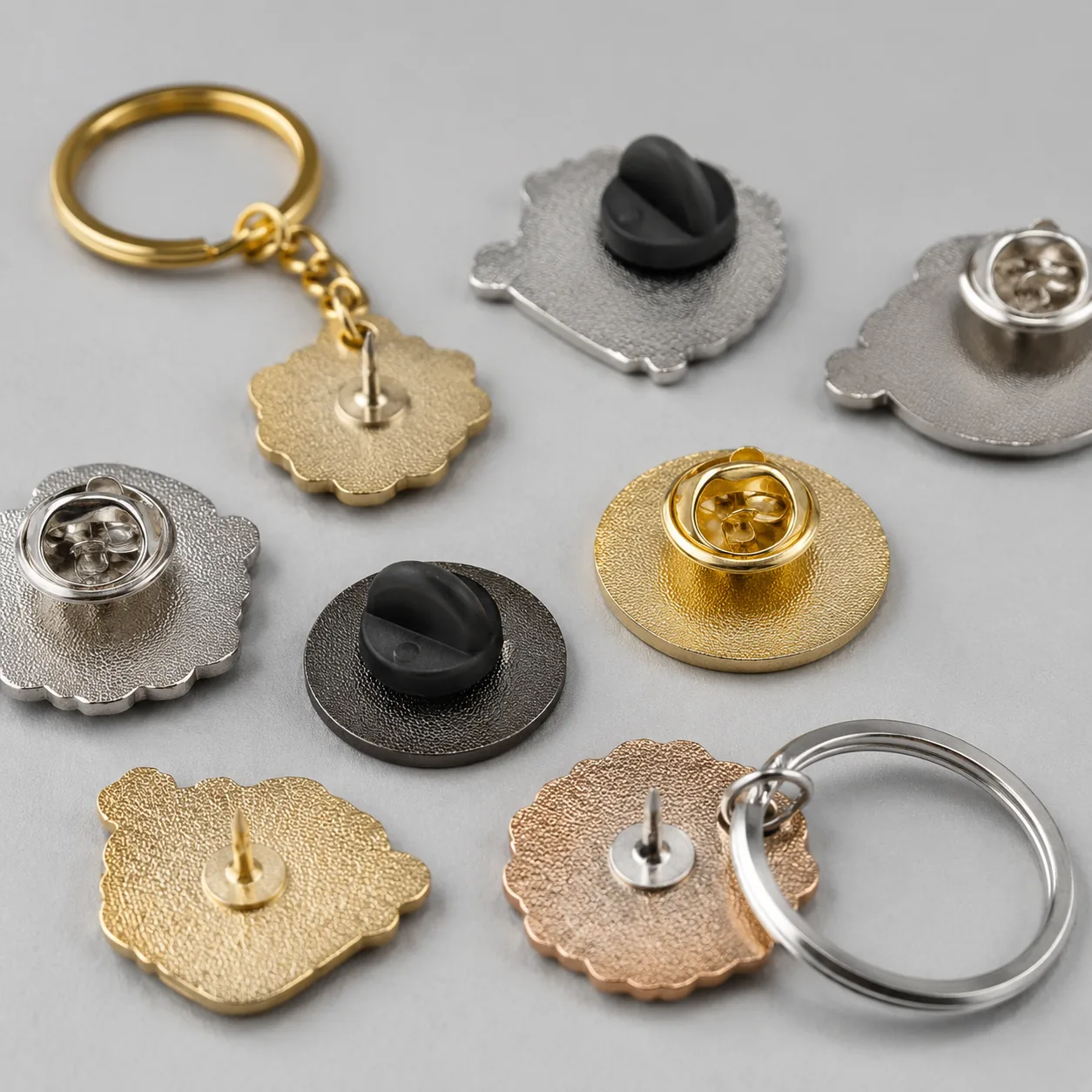
Why attachment strength fails even when the product looks perfect
Most pin and keychain complaints do not start with the artwork, plating color, or logo alignment. They start when a lapel pin spins off a blazer, a split ring opens in a bag, or a magnetic badge slides down a uniform after 20 minutes of wear. If the buyer only approves appearance and overall size, the factory can still ship a product that looks correct but fails in use. Attachment strength is a hardware specification, not a visual one, and it needs to be written that way in the RFQ.
The commercial risk is larger than one replacement. A weak clutch or undersized ring can create repeat claims, freight costs on replenishment, and brand damage that is hard to measure but easy to feel. The fix is usually low-cost at source if it is defined early: choose the attachment type, state material and wire thickness, define pull-force or retention targets, and tie those requirements to sampling and AQL checks.
For pins, keychains, badges, and lanyard accessories, ZheCraft sees the same failure modes repeatedly: spring steel clutches that relax, jump rings that deform under torsion, magnets that are strong in the lab but weak through fabric, and posts that are welded well but placed too close to the edge. This guide gives buyers the numbers that matter so they can specify hardware instead of hoping for it.
Start with the use case, not the attachment catalog
Attachment strength should match the real load case. A conference badge pinned to cotton is a different problem from a heavy brooch on knitwear, and a bottle-opener keychain sees repeated impact loads that a decorative acrylic charm never will. The first mistake is asking for the strongest option by default; that often creates excess thickness, bad drape, or fabric damage.
For clothing, the key variables are garment thickness, movement, and whether the item must rotate freely. For bags and keys, the main issue is repeated shock loading and torsion. For magnetic products, the question is not only pull force but also the actual substrate stack: wool coat, uniform placket, pocket lining, canvas tote, or a layered jacket front. A quoted 3 kg pull force is meaningless if it was measured on bare steel and your real use case includes 1.5 to 3.0 mm of fabric plus movement.
A useful RFQ should describe the scenario in plain language: daily-wear blazer pin, event giveaway keychain, outdoor bag charm, premium retail brooch, or no-pierce badge for uniforms. Once the use case is defined, the factory can choose the attachment structure, material grade, and acceptance criteria. That step eliminates most rework before tooling starts.
Choose the right attachment type and define it by spec
Clutches, pins, magnets, split rings, lobster clasps, and swivel hooks all behave differently under load. Butterfly clutches are compact and inexpensive, but they are not ideal for heavy pins or repeated removal. Rubber clutches improve comfort and reduce scratching, but they can age faster in heat and may loosen if the pin is removed daily. Ball-chain and safety-pin styles have niche uses, but they should still be specified by size, material, and closure performance, not just by name.
For keychains, split rings remain the standard because they are reliable and low cost, but the wire gauge matters. A ring with soft temper or thin wire can gap open after repeated twisting, especially on heavy zinc-alloy charms or products used with large key sets. Lobster clasps and swivel hooks are better when the buyer wants a more premium feel or easier bag attachment, but they add bulk and cost. Magnetic backing is often the cleanest option for delicate fabrics because it avoids piercing holes, but it trades away anti-slip security.
Do not specify only the style name. Specify the physical dimensions, the base material, the plating system, and the performance target. A factory can quote much more accurately when the request says, for example, 'stainless steel split ring, 1.5 mm wire, 10 mm outer diameter, nickel-free plating, no visible opening after 200 torsion cycles,' instead of 'strong ring.'
{table}
| Attachment | Typical use | Spec to request | Typical FOB range (USD) | Common risk | |---|---|---|---|---| | Butterfly clutch | Light lapel pins, promo badges | Spring steel or brass, 0.6-0.8 mm thickness, firm snap fit | 0.01-0.04 per piece | Can loosen with repeated removal | | Rubber clutch | Comfort-focused lapel pins | TPE or silicone-type clutch, snug fit on 0.9-1.0 mm post | 0.02-0.06 per piece | May soften in heat or UV | | Magnetic backing | Uniforms, delicate fabrics | Neodymium pair, stated pull force, matched plate size | 0.08-0.30 per pair | Can slide on smooth fabric | | Split ring | Standard keychains | Stainless or carbon steel, 1.2-1.5 mm wire, closed gap control | 0.03-0.10 per piece | Can deform if wire is too soft | | Lobster clasp | Bag charms, premium keychains | Zinc alloy or stainless, spring return tested | 0.08-0.25 per piece | Adds cost and bulk | | Safety pin back | Large soft accessories | Steel pin, locking geometry, bend resistance | 0.03-0.12 per piece | Can snag fabric if oversized |
The numbers that matter: diameter, wire, pull force, and tolerance
For pins, the post is usually the hidden failure point. A standard lapel pin post is commonly 0.9 to 1.0 mm in diameter, but the important part is how it is fixed to the back plate and whether the solder or weld can survive repeated bending. For items above roughly 15 g, or for anything intended for outerwear, dual posts are often safer because they reduce rotation and distribute load. A heavy hard-enamel pin with a single post may look fine in photos and still spin on a wool coat.
For keychains, split ring wire gauge should be stated in the RFQ, not assumed. Typical promotional keychains use 1.2 to 1.5 mm wire, while heavier retail pieces often need 1.6 mm wire or a reinforced clasp path. For a charm over 30 g, adding a second connection point or a larger ring can reduce twisting stress. If the design includes a moving element, specify minimum jump-ring inner diameter and metal hardness so the link does not deform at the first torsion event.
For magnets, pull force is the right number, but it must be interpreted in context. Ask the supplier to state whether the figure is per single magnet or per paired set, what substrate was used, and whether the value was measured at direct pull or slide-off resistance. A practical request is 1.5-2.0 kg per pair for light badges and 2.5-4.0 kg per pair for heavier garments, then confirm that performance through the actual fabric stack. If the garment is thick or lined, the working hold can drop sharply even when the lab number looks strong.
Tolerances should be explicit. Post placement on metal badges is usually controlled within ±0.3 mm on well-run lines; ±0.5 mm is more realistic for simpler mass-production items. Ring inner diameter, clasp opening, and magnet spacing should also be defined, especially when the accessory is small. For example, a 25 mm keychain with a clasp that is off by 1 mm can feel loose, rub plating, or create assembly problems. Good factories inspect those values; better RFQs make them acceptance criteria before tooling begins.
Plating also affects attachment performance. Nickel plating thickness is commonly controlled around 3-5 microns for general hardware, with 0.1-0.3 micron of clear topcoat only when required by the finish system. If the spec calls for nickel-free or low-nickel compliance, state it clearly, because plating choice can change spring behavior, corrosion resistance, and even friction at the post or ring interface.
A checklist that keeps buyers out of trouble
- State the end use: garment, bag, key set, badge holder, or retail display.
- Specify the attachment type and exact base material.
- Add physical dimensions: post diameter, ring wire gauge, clasp opening, magnet size, and plating thickness.
- Define performance: pull force, retention, or no-slip requirement on the intended substrate.
- Call out fabric sensitivity if the item must not pierce, scratch, or dent.
- Ask for a pre-production sample with the same hardware lot and same plating batch.
- Require incoming and final checks on hardware fit, snap force, rotation, and assembly torque.
Do not skip the sample stage even if the hardware is standard. The same attachment name can hide very different supplier inputs, including spring hardness, wire temper, magnet grade, and plating thickness. A sample with the actual hardware lot is the fastest way to catch loose clutches, weak rings, or magnets that are too thick to sit flush.
If the product uses multiple parts, request a combined fit check. A 1.0 mm pin post may be fine with one clutch brand and too loose with another. A 1.5 mm split ring may perform well with a 20 mm charm but fail when the charm is 40 mm and the leverage triples. This is why sample approval should include the final assembled part, not only loose components.
Factory-side quality control: what should be inspected
Hardware inspection should be treated separately from decoration inspection. AQL for cosmetics may catch plating spots or enamel fill defects, but it will not reliably detect a weak clutch spring or a ring that opens too easily. The factory should perform both visual inspection and functional checks, such as insertion force, pull retention, and simple cyclic handling tests.
For pins, the factory should check post alignment, clutch fit, and rotation resistance on representative samples from each lot. For keychains, ring gap, clasp spring return, and swivel movement should be checked after assembly, not only before. For magnets, the actual hold on a reference substrate should be tested with the final backing and plating stack, because thickness changes the working distance.
A practical QC plan is usually more useful than a vague 'check quality' note. For example: AQL 1.0 for critical defects, AQL 2.5 for major defects, and AQL 4.0 for minor surface issues is a common starting point for accessory hardware. Functional sampling can be set at 8-13 pieces per lot for small orders and 20-32 pieces for higher-volume shipments, with pull tests or retention checks recorded in grams or kilograms. If the item is going to retail, ask for photo evidence of the test setup and results.
Define failure clearly. A clutch that can be removed without intentional force is a defect. A split ring that opens after repeated twisting is a defect. A magnet that slides under normal bag movement is a defect. Small statements like these reduce disputes later because the supplier knows which failure mode matters and how it will be judged.
For lead time planning, standard hardware is usually fastest. Small custom runs of pins or keychains with off-the-shelf attachments often need 7-12 days for samples and 18-30 days for mass production after approval. More complex builds with custom molds, special plating, or low-nickel requirements can extend to 30-45 days. MOQ tiers also matter: many factories can support 100-300 pieces for sample-to-market tests, 500-1,000 pieces for standard custom orders, and 3,000+ pieces for the best unit pricing.
When not to choose the strongest hardware
Stronger is not always better. A heavy-duty clasp may be correct for a premium bag charm, but it can look oversized on a small promotional pin. A very strong magnet can be too thick for a clean garment profile, and an aggressive post can damage delicate fabric and create the exact complaint the buyer was trying to avoid.
If the item is an event giveaway, comfort and cost efficiency often matter more than maximum retention. If the item is a retail collectible or a long-life branded accessory, paying more for better spring steel, tighter tolerances, or a reinforced ring is usually justified. The right decision depends on user behavior, not just product category.
As a rule of thumb, a lightweight badge under 10 g can usually use standard clutch hardware, while products between 10 g and 25 g should be reviewed for stronger backings or dual-post support. Above 25 g, the attachment strategy should be treated as part of the engineering design, not a packaging detail. This is especially true when the item will be worn on outerwear, used on keys, or handled daily.
What to send the supplier before you quote
Before you request quotes, write one line for the use case and one line for the attachment target. Then add the exact hardware dimensions, the substrate it must hold to, and the sample acceptance rule. If the item is a pin, keychain, or magnetic badge, ask for a pre-production sample with the final attachment lot and confirm it on the intended material.
A supplier-ready brief can be very short if it is precise. For example: '1000 pcs, zinc alloy enamel keychain, 38 mm charm, 1.5 mm stainless split ring, nickel-free finish, no ring opening after 200 hand-twist cycles, sample in 10 days, mass production in 25 days, FOB target USD 0.42-0.68 per piece at 1000 pcs.' That level of detail removes most quoting ambiguity and gives you a basis for comparing factories fairly.
If you want, the next step is to turn your current product into a one-page attachment spec sheet with recommended dimensions, retention targets, MOQ tiers, and inspection points for pins, keychains, or badges.
Have a project? Send your artwork and target quantity and we’ll reply with a detailed quotation within 12 working hours.
Ready to get this made?
Send your sketch, target quantity and ship-date. Detailed quotation in 12 hours.



