How to Specify Aging and Corrosion Tests for Promo Metals
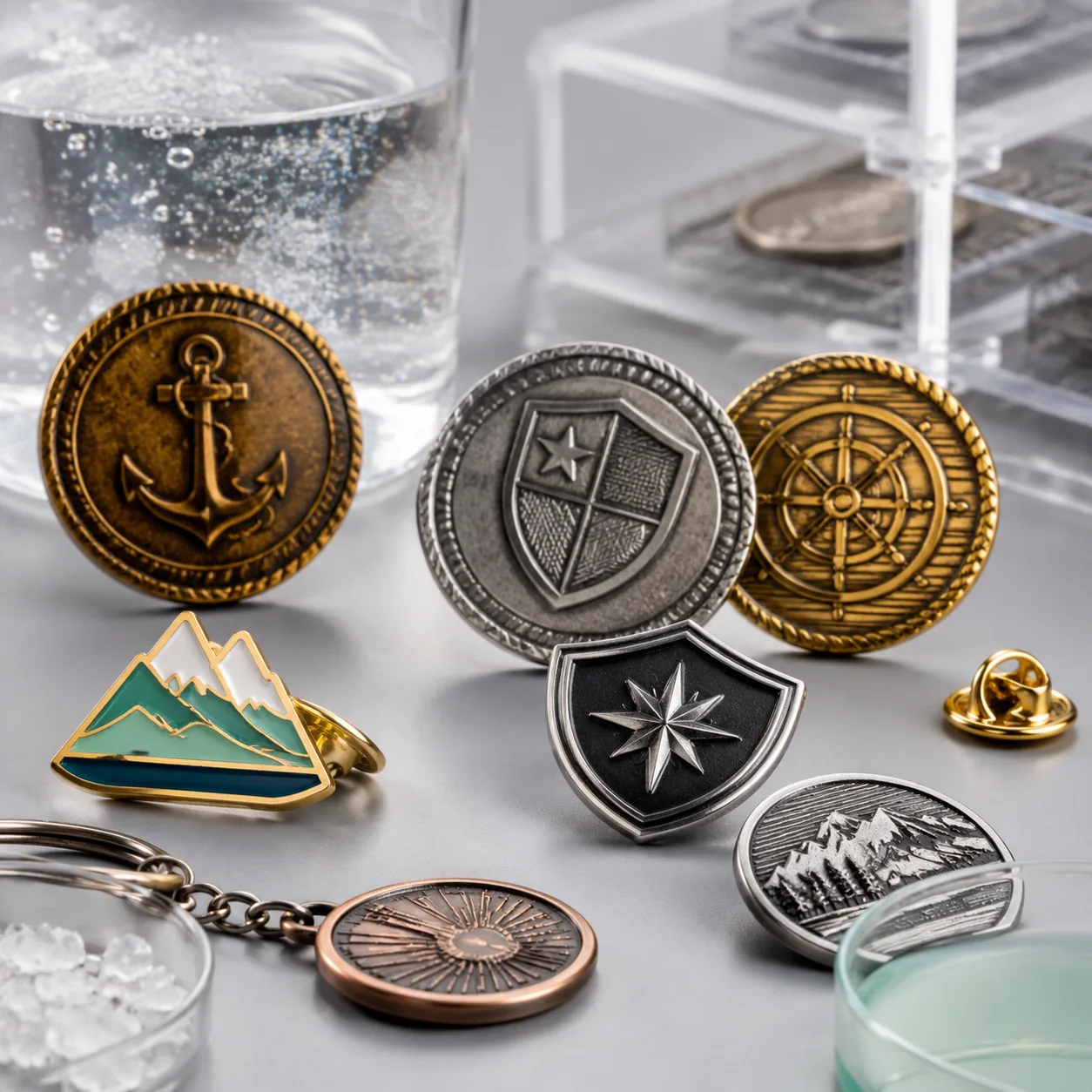
Why metal promo items fail after approval
Custom pins, coins, badges, and keychains often pass a clean pre-production sample and then fail after a few weeks in the field: dull plating, green staining, rust freckles, lifted enamel, loose jump rings, or scratched faces. The cause is usually not the artwork or mold; it is that the buyer approved appearance without defining the aging and corrosion conditions the item must survive. If the product will be worn on clothing, handled daily, shipped through humid routes, or packed against paper backing cards, the order needs a testable durability spec before production starts.
The highest-risk constructions are plated zinc alloy, iron, and brass, especially when the finish is bright nickel, black nickel, antique brass, antique silver, or soft enamel with epoxy dome. Thin decorative plating, incomplete rinsing, trapped polishing compounds, and abrasion from packaging can all create early failure. A factory can only control what is written into the PO: test method, duration, sample count, acceptance limit, and whether the requirement applies to exposed faces only or to the whole assembly, including backs, hooks, chains, and pins.
As a practical buying rule, the spec should match the actual use environment. A desk-coin for executive gifting does not need the same corrosion threshold as a lapel pin worn in a humid climate, and a keychain in a retail box needs more abrasion control than a badge that ships loose in a polybag.
Match the test to the failure mode
Different products fail in different ways, so a vague requirement like “must be durable” is not enough. Corrosion on a plated pin usually starts at cut edges, recesses, and attachment points; a keychain often wears through at the split ring or chain; a coin may show edge rash from carton contact; and a fridge magnet can fail where the metal face meets the sealed backing and traps moisture.
Cosmetic and functional failures should be separated. Epoxy dome, glitter fill, and transparent enamel can cloud, yellow, or crack even when the base metal stays intact. Pins and badges often fail at the needle or clutch after repeated use, while die-cast keychains fail at joints, jump rings, or swivel clasps. The right test is the one that reproduces the real risk, not the harshest test you can name.
| Likely failure mode | Best primary test | Typical buyer concern |
|---|---|---|
| Plating rust or haze | Neutral salt spray | Surface corrosion after shipping or wear |
| Sweat or skin exposure | Artificial perspiration | Darkening, skin-contact corrosion, staining |
| Packaging abrasion | Rubbing or tumble abrasion | Scratches during transit or kitting |
| Humidity storage | Damp heat / high humidity | Oxidation in warehouse or container |
| Hardware fatigue | Cycle or pull testing | Broken rings, clasps, chains, or needles |
Core tests buyers should request
For most promotional metal products, the baseline test stack is simple: neutral salt spray for corrosion resistance, high humidity or damp heat for storage exposure, abrasion for surface wear, and a mechanical cycle test for moving parts. The value is in consistency. If the supplier cannot tell you whether the sample passed 24, 48, or 72 hours of salt spray, the number is not meaningful for procurement.
Neutral salt spray is the most common screen for plated iron and zinc alloy. For general promo quality, buyers typically request 24 to 48 hours; for higher-appearance retail or gift programs, 72 hours is more defensible; for harsher distribution or coastal exposure, 96 hours or more is reasonable. Salt spray is a comparative corrosion indicator, not a guarantee of outdoor life, so the pass/fail standard should state visible limits such as no red rust, no blistering, no peeling, and no obvious pitting on exposed faces. On hidden backs, slight discoloration may be acceptable if the front remains clean and functional.
Humidity or damp heat testing matters when items will be boxed, warehoused, or shipped through tropical routes. A common spec is 48 to 72 hours at high humidity, with no visible oxidation, no adhesive breakdown, no edge swelling on printed inserts, and no color migration into paper cards or foam trays. For glued parts, ask for an adhesive check as well; many failures come from glue before metal. If a product uses a printed insert, UV ink, or paper card, the packaging can fail before the metal does.
Artificial perspiration is the better choice for items worn against skin, such as lapel pins, brooches, and badges. It catches finish problems that neutral salt fog does not always reveal, especially on low-cost iron bases with thin nickel flash. A practical buyer target is no green staining, no black spotting, and no peeling after exposure, with acceptance focused on the front face and visible contact points.
Use a matrix, not one generic requirement
A good sourcing spec is built from four variables: product type, base metal, plating system, and intended use. A hard enamel pin for indoor corporate gifting should not be judged against the same threshold as a keychain sold for daily use in a humid market. Antique brass can tolerate a bit more visual variation, while bright nickel usually needs tighter control because haze, micro-scratches, and spotting show up faster on reflective surfaces.
The same logic applies to mechanical tolerances. A loose clasp or oversized ring creates fretting wear and exposes base metal more quickly than a tight assembly. If the item has moving parts, state the cycle count and the maximum acceptable looseness after test. Do not leave the factory to decide what “normal wear” means.
| Product type | Suggested baseline tests | Buyer target |
|---|---|---|
| Enamel pins | Salt spray, abrasion, clutch cycle | 24-48h salt spray, no visible rust, secure clutch |
| Challenge coins | Salt spray, edge rub, humidity | 48-72h salt spray, no pitting on high points |
| Keychains | Salt spray, pull cycle, abrasion | 48h salt spray, no hardware breakage |
| Badges / brooches | Salt spray, perspiration, pin cycle | 24-48h salt spray, no needle discoloration |
| Fridge magnets | Humidity, edge seal check, abrasion | 72h humidity, no face haze or edge corrosion |
How to write a usable test specification
A usable spec tells the factory what to test, how long to test, how many samples to test, and what counts as failure. For example: “Neutral salt spray 48 hours on 3 pcs per SKU; no red rust, blistering, or plating peel on exposed areas; slight darkening on hidden backside acceptable.” That is far more actionable than “must be corrosion resistant,” because it removes interpretation risk during inspection.
Plating thickness should also be defined where appearance or durability is important. Decorative flash plating around 0.03 to 0.05 microns is common but very thin and mostly cosmetic. For better stability, buyers often specify a practical decorative range around 0.1 to 0.3 microns, depending on the finish and substrate. For premium or frequently handled items, ask for the full plating stack, including base layer, barrier layer, and top finish. Corrosion performance depends on the stack, not just the final color.
For fit and wear points, use dimensional tolerance and functional limits. A useful clause might read: “Split ring opening tolerance ±0.2 mm; no separation, cracking, or functional failure after 50 open-close cycles.” For pin backs or clasps, define what loose means in measurable terms, such as no free play that allows visible wobble or repeated rubbing against the base. If tolerances are not written down, the same assembly can pass one inspector and fail another.
For small custom runs, test enough samples to catch process variation, not just one hand-picked display piece. Three to five samples per SKU is a practical minimum for corrosion and abrasion checks; larger orders should sample from multiple trays, cartons, or plating racks. If the supplier only sends one spotless sample, treat the result as informative but not conclusive.
When to insist on extra conditions
Some programs need more than standard lab checks. If the item will touch skin, request artificial perspiration in addition to salt spray, because sweat chemistry can attack some platings differently than neutral fog. If the item is packed in polybags, foam, or paper backing cards, add a packaging abrasion test, since many scratches happen during kitting, not in use.
If the order is going to coastal markets, non-air-conditioned warehouses, or event storage for several months, increase humidity and storage exposure requirements. For outdoor campaigns, add UV or weathering screening only when coatings, printed inserts, or epoxy domes are part of the build; plain metal corrosion testing will not reveal yellowing, cracking, or print fade. Buyers often over-specify the wrong test and under-specify the one that matches the real exposure.
Factory capability still matters. Typical MOQ for custom promo metals is about 100-300 pcs for basic pins and keychains, 300-500 pcs for plated coins and more complex badges, and 500-1,000 pcs for multi-part or mixed-finish items. Standard lead time is often 12-18 days after sample approval for simple orders and 18-28 days for more complex builds, with rush programs possible at a surcharge if tooling and plating capacity are available. Indicative FOB China pricing commonly starts around USD 0.35-0.80 per pin for small iron or zinc alloy pieces, USD 0.90-2.50 per keychain, USD 1.20-3.80 per coin, and USD 0.70-2.20 per badge, depending on size, enamel count, plating, and packaging. Those numbers are only useful if the spec is equally clear, because cost and test performance move together.
Inspection limits and acceptance criteria
Testing is only useful if you define how many pieces are checked and what failure rate is acceptable. A common production structure is first article approval, then a small pre-production test, then outgoing inspection based on AQL. Many buyers use AQL 2.5 for major defects and AQL 4.0 for minor defects on general promo orders, while visible corrosion, plating peel, missing hardware, and broken functionality should always be treated as major defects.
A strong acceptance clause distinguishes between visible and hidden surfaces. For example, a coin may allow slight darkening on the unexposed reverse after humidity, while the front face must remain free of rust spots, blisters, and discoloration. A pin may accept very light back-side tarnish if the needle, clasp, and front enamel remain intact. The wrong standard causes unnecessary rejection; the right standard prevents arguments at shipment time.
For plating and geometry, buyers should also require tolerance and finish consistency. Practical control targets often include plating uniformity within ±10 percent on visible surfaces, edge burrs below 0.1 mm, and no exposed base metal on the front face. For enamel fill, define color bleed limits and acceptable surface level, such as flush to ±0.15 mm where the artwork requires a smooth face. If the factory cannot state its inspection limits in measurable terms, the order is still too vague.
When in doubt, tie rejection to what the end user will actually notice: rust that can be seen without magnification, roughness that catches fabric, corrosion that stains skin or clothing, or mechanical failure that prevents the item from being used. That keeps quality control aligned with the commercial risk, not with abstract lab numbers alone.
What to do next
Start by listing the real exposure: skin contact, humidity, abrasion in transit, warehouse storage, or repeated mechanical movement. Then choose one primary corrosion or aging test and one secondary wear test, and write both into the RFQ with duration, sample count, and reject limits. If the item has moving parts, add cycle count; if it has glued parts, add adhesive stability; if it will be packed in printed cards or foam, add packaging abrasion.
A practical starter spec looks like this: 48 hours neutral salt spray on 3 samples per SKU, 72 hours humidity for packed goods, 50 open-close cycles for pins or clasps, no red rust, no peel, no blistering, no functional failure, and only slight discoloration allowed on hidden backs. That level of detail is usually enough to separate a serious supplier from a guesser.
- Define the real exposure: skin, humidity, abrasion, storage, or movement
- Request one primary aging or corrosion test and one secondary wear test
- State duration, sample size, and pass/fail criteria in the RFQ
- Ask for plating stack details, not just the finish color
- Tie outgoing inspection to visible defect limits and AQL
- Specify MOQs, lead time, and FOB pricing assumptions alongside the test plan
Have a project? Send your artwork and target quantity and we’ll reply with a detailed quotation within 12 working hours.
Ready to get this made?
Send your sketch, target quantity and ship-date. Detailed quotation in 12 hours.



