How to Specify a Multi-Item Promo Set Without Rework
Start with the campaign problem, not the product list
Mixed promotional sets usually fail for one boring reason: every SKU is treated as a separate order, so the final set looks like four different factories made it. Buyers approve a pin, a keychain, a magnet, and a badge one by one, then discover the plating tones do not match, the reds shift, and the packaging sizes fight each other. If the set is meant to feel cohesive, you need a campaign spec, not just a pile of artwork files.
The practical rule is to choose one hero SKU and make everything else follow its visual language. For example, a brass soft enamel pin can define the line thickness, plating family, and Pantone references, while a die-cast keychain or fridge magnet follows the same finish family rather than chasing its own interpretation. ZheCraft sees this often in export orders: once the buyer sets the campaign rules up front, the factory can keep the same color master, plating bath, and carton spec across product families.
Decide what must match and what can vary
Not every variable needs to be identical. What must match is the visual identity that the end customer will notice in the hand or in a display box: Pantone values, plating tone, gloss level, edge polish, and accessory color. What can vary is the construction method, because a pin and a keychain have different load points, thickness limits, and mold behavior.
A useful way to think about it is by risk. High-risk items are color, plating, and packaging size, because mismatches are obvious and expensive to fix after production. Medium-risk items are thickness, attachment type, and accessory choice, because they affect usability but can usually be adjusted without remaking the mold. Low-risk items are small logo placement shifts of 0.2 to 0.3 mm, as long as the legal text, edge clearance, and brand mark remain readable.
- Lock one Pantone reference per solid color and note whether the factory should match coated or uncoated values.
- Specify the plating family by name and target thickness, for example nickel 0.3 to 0.5 microns or gold 0.5 to 0.8 microns.
- Define gloss level for hard enamel, soft enamel, or epoxy topcoat so one item does not look satin while another looks mirror bright.
- Use the same packaging dimensions for the whole set unless the items are intentionally sold individually.
- Approve the back attachments early, especially if some items need butterfly clutch, rubber clutch, split ring, or magnetic backing.
Build one master spec sheet for the whole set
The fastest way to avoid rework is to write one master spec sheet and attach a short spec page for each SKU. The master sheet should include the campaign name, target ship date, destination port, quantity by SKU, artwork size, approved Pantone list, plating code, packaging format, and acceptance photos from the sample stage. If you send separate RFQs with partial data, suppliers will quote different assumptions and you will spend days comparing numbers that are not actually comparable.
A good spec sheet also states the mechanical limits. For stamped brass items, a common decorative thickness is 1.0 to 1.2 mm for pins and badges, while keychains often need 2.0 to 3.0 mm if the design carries weight or a swivel attachment. Typical dimensional tolerance is plus or minus 0.3 mm for parts under 30 mm and plus or minus 0.5 mm for parts above 30 mm; hole positions should be held within plus or minus 0.2 mm when the item must fit a ring, clasp, or card slot. If you want a factory to quote accurately, specify the substrate grade too, such as brass C26000 for fine detail or zinc alloy for heavier die-cast shapes.
Choose the right construction for each item
A campaign set does not need one construction method across all items. It needs one consistent look, with the cheapest workable build behind each SKU. The table below shows the usual trade-offs for export-ready orders in the 300 to 1,000 piece range, where buyers care about appearance, unit cost, and how easily the supplier can keep the set consistent.
| Item | Recommended construction | Typical size | MOQ | Lead time | FOB unit at 1,000 pcs |
|---|---|---|---|---|---|
| Soft enamel pin | Brass 1.0 to 1.2 mm, recessed color, nickel or gold plating | 25 to 35 mm | 300 to 500 pcs | 15 to 20 days | USD 0.32 to 0.62 |
| Hard enamel pin | Brass 1.0 to 1.2 mm, polished flush surface, higher labor finish | 25 to 35 mm | 300 pcs | 18 to 25 days | USD 0.45 to 0.95 |
| Die-cast keychain | Zinc alloy 2.0 to 3.0 mm, usually with split ring or lobster clasp | 35 to 50 mm | 300 pcs | 20 to 28 days | USD 0.95 to 2.10 |
| Fridge magnet | Iron base with soft enamel or printed epoxy face | 40 to 60 mm | 500 pcs | 12 to 18 days | USD 0.35 to 1.20 |
| Metal badge | Brass or iron, stamped or etched, optional safety pin or magnetic back | 30 to 45 mm | 300 pcs | 15 to 22 days | USD 0.50 to 1.40 |
Choose soft enamel when the order needs sharper cost control and the artwork has open color fields. Choose hard enamel when the client will handle the item often and expects a polished, premium feel, but accept that polishing pushes both lead time and price. Die-cast is the right call for thick, dimensional shapes and heavier keychains, but it is the wrong choice if the artwork depends on ultra-fine recessed lines or multiple small color compartments.
Build pricing around tooling, not unit price alone
Mixed orders often look cheap on paper and expensive in practice because tooling is scattered across too many line items. A simple soft enamel mold may run USD 50 to 90, hard enamel USD 60 to 110, die-cast USD 80 to 180, and printed epoxy or magnet tooling USD 30 to 80, depending on size and cavity complexity. If packaging uses a custom insert or printed card, add another USD 0.05 to 0.20 per set, which matters more than buyers expect at 500 or 1,000 units.
Ask the supplier to break the quote into tooling, unit price, plating surcharge, accessory surcharge, packaging, and any domestic handling fee. That makes it easier to compare a 300-piece order against a 1,000-piece order, where the per-unit drop can be 20 to 35 percent once the setup cost is spread out. If one item in the set is far more complex than the others, it may be smarter to keep the whole campaign on the same production calendar but split the shipment by SKU rather than forcing a weak price across all products.
Lock quality with samples and AQL before mass production
For a mixed set, samples should be approved in layers. Start with the digital proof, then the metal sample, then a color sample if the enamel or printing is critical, and finally the pre-production sample packed in the intended retail format. Digital proofing usually takes 24 to 48 hours, physical samples 5 to 7 days, and a pre-production confirmation another 3 to 5 days after comments are closed.
For inspection, a common export standard is AQL 0.65 for critical defects, AQL 1.5 for major defects, and AQL 4.0 for minor defects. That means no sharp burrs, no wrong plating tone, no missing accessory, and no serious print shift should pass, while tiny cosmetic noise is tolerated within a controlled limit. A practical plating target is 0.3 to 0.5 microns for standard decorative nickel or gold and 0.8 to 1.0 microns when the buyer wants a heavier visual presence, although the factory should always state the process because black nickel and antique finishes behave differently.
Use explicit acceptance tolerances in writing. Finished size should stay within plus or minus 0.3 mm for pieces under 30 mm and plus or minus 0.5 mm above that size, while enamel fill should sit flush enough that hard enamel can be polished level and soft enamel remains cleanly recessed without overflow. For mixed sets, also check that the post, ring, or clip actually matches the planned attachment force, because a beautiful sample is not useful if the clutch is too loose for display or the split ring opens under normal handling.
Package and ship the set as one system
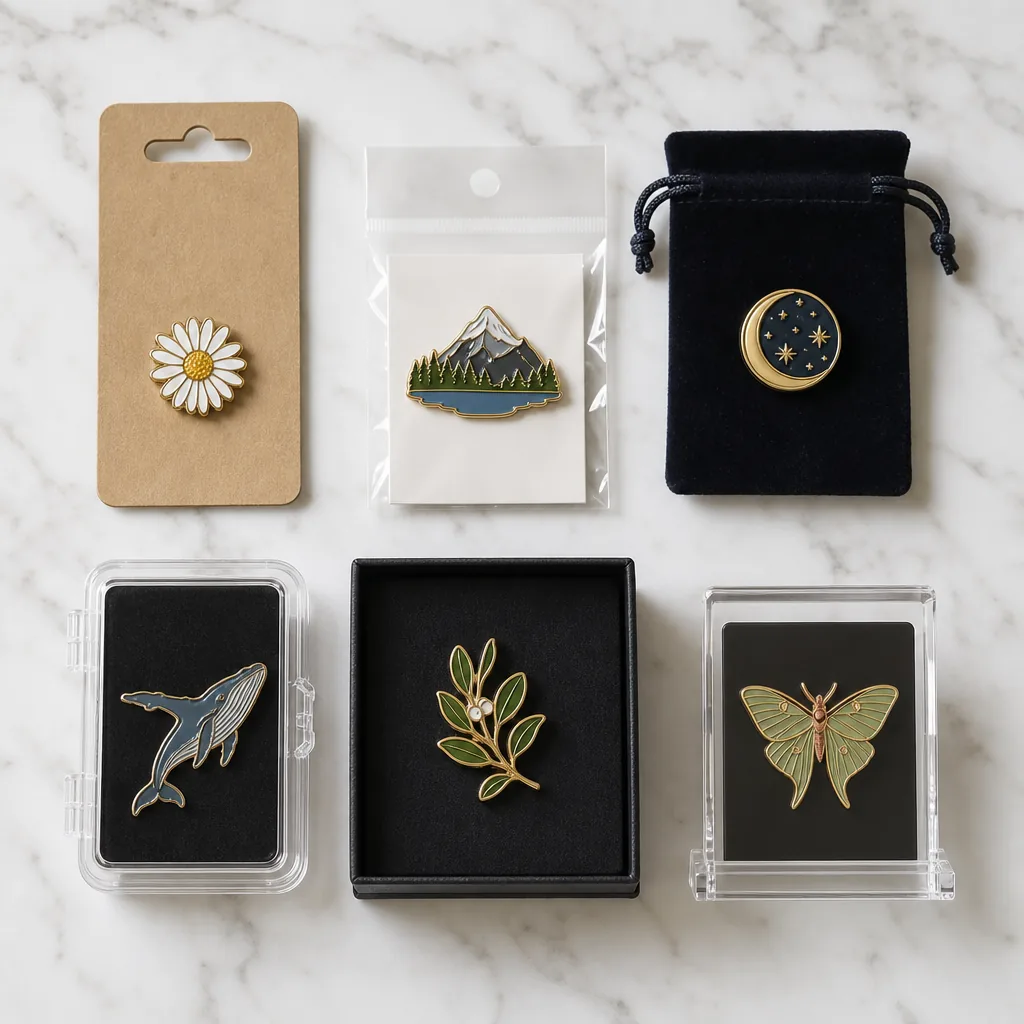
Packaging is where mixed orders quietly lose money. If each SKU is boxed differently, carton dimensions change, freight efficiency drops, and kitting errors multiply. A better approach is to define a common outer carton logic and then allow only the inner tray, insert, or header card to vary by SKU. For many export orders, an opp bag with a printed card is enough for low-cost giveaways, while a paper box or foam tray is better when the items are sold as a collection or premium gift.
If the set ships together, insist on a packing map that states the count per inner carton, the exact set composition, and the barcode or label position. Keep master cartons under about 5 kg when possible, especially for air freight, and use 5-layer corrugated cartons when the order includes hard enamel, die-cast, or magnetic components that can rub during transit. For factories like ZheCraft that make multiple metal gift lines, the operational advantage is not just production capacity; it is the ability to keep the same QC file, same packing logic, and same ship window across several product types without losing track of details.
What to do next
Before you request quotes, turn the campaign into one master spec sheet, one artwork folder, and one sample approval checklist. Then ask the supplier to quote each SKU separately but on the same finish standard, the same packaging logic, and the same delivery deadline so you can see where the real cost and risk sit.
- Pick one hero SKU and make it the visual reference for the whole set.
- Confirm Pantone values, plating code, substrate, thickness, and accessory type in writing.
- Request tooling, unit price, and packaging as separate quote lines.
- Approve a physical sample for every distinct construction method, not just one item.
- Use AQL 0.65, 1.5, and 4.0 as the inspection framework before mass production starts.
Have a project? Send your artwork and target quantity and we’ll reply with a detailed quotation within 12 working hours.
Ready to get this made?
Send your sketch, target quantity and ship-date. Detailed quotation in 12 hours.



