How to Spec Custom Metal Gift Sets Without Mismatch
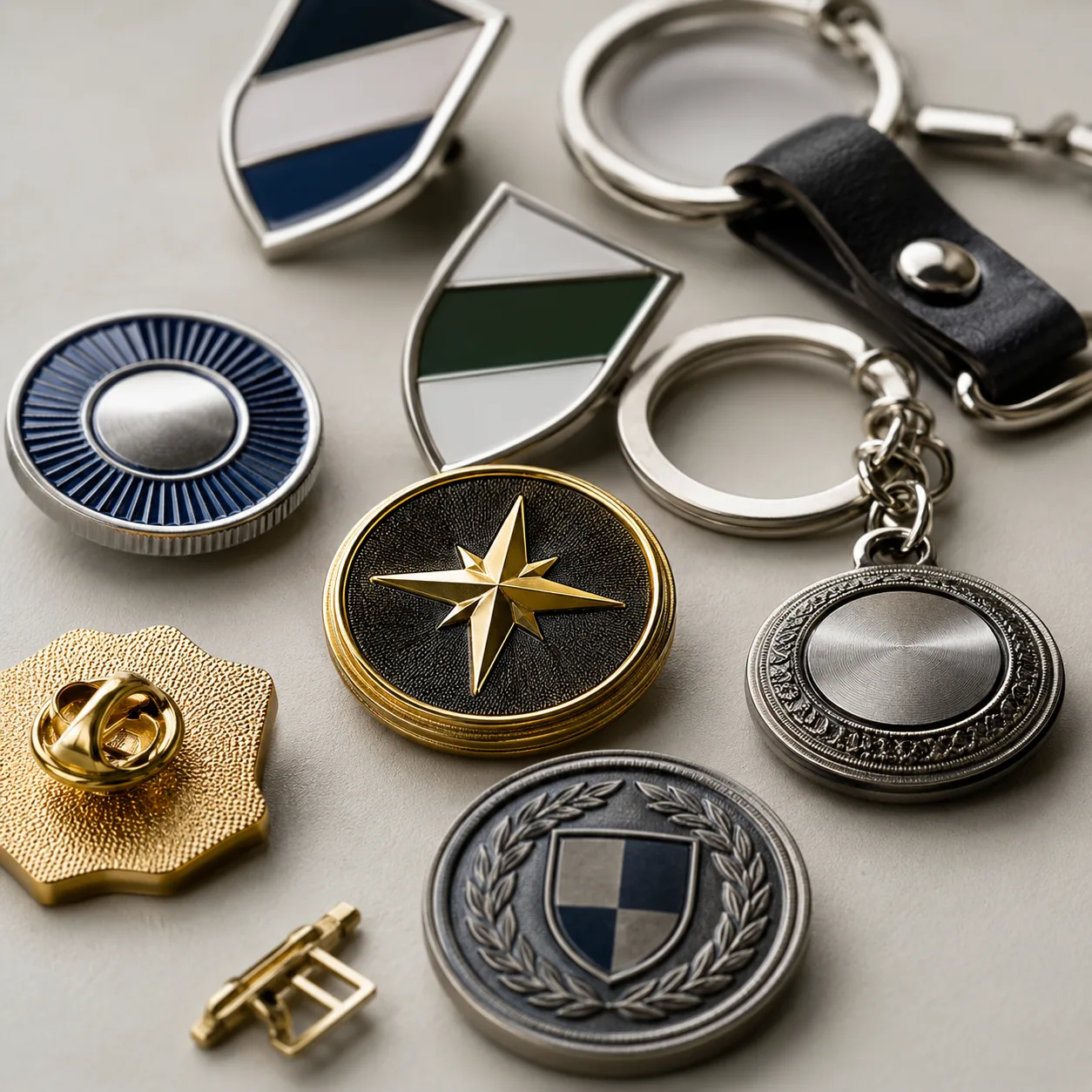
Why multi-item gift sets fail after separate approvals
Most custom promo sets do not fail because one component is defective. They fail because each component is approved in isolation. A 32 mm soft enamel pin, a 40 mm challenge coin, a 45 mm keychain, and a 20 mm printed lanyard can all meet their individual drawings and still look like four unrelated jobs when placed in the same tray. The mismatch usually appears in details buyers did not control early enough: logo scale, border weight, plating tone, enamel gloss, card orientation, and how the items sit under the same light.
The risk increases when pins, coins, keychains, patches, and lanyards are handled by different workshops or different production lines inside one supplier group. Stamped metal, die-cast zinc alloy, woven polyester, embroidery, screen print, and offset print all have different minimum line widths, color behavior, and finishing tolerances. If the buyer sends separate RFQs and lets each team resize the artwork independently, the factory may produce technically acceptable parts that do not function as one branded set.
The practical fix is to approve the set as a controlled assembly, not as a bundle of SKUs. Before tooling starts, lock the common appearance rules, then allow each item to adapt only within those rules. A set-level approval package should include the master vector artwork, Pantone or physical color reference, metal finish family, target dimensions, process-specific artwork reductions, packaging dieline, and the final pack-out order. That prevents rework at the expensive stage, after molds, plating racks, lanyard print screens, and packaging inserts are already made.
- Use one master vector file, with item-specific artboards named by SKU.
- Define one primary color reference, preferably Pantone Solid Coated plus a physical chip or approved master sample.
- Choose one metal finish family for all metal pieces unless the contrast is intentional and documented.
- Set the same visual hierarchy across items: hero logo, secondary text, border, and background.
- Approve the tray, card, pouch, or mailer layout before mass production, not after components are finished.
- Keep one complete golden sample set for reorder comparison, including packaging and insert position.
Build the set architecture before quoting SKUs
The first specification decision is not whether the pin should be soft enamel or hard enamel. It is how the finished set should be read by the recipient. A board-level corporate gift set may need restrained finishes, low-contrast enamel, and a rigid box. A trade show giveaway can carry brighter colors, lighter packaging, and a more visible lanyard. A commemorative set may need the coin to be the hero item, with the pin and keychain repeating only the main emblem.
A useful set architecture defines one hero item, one or two support items, and the packaging frame that unifies them. For example, a three-item internal recognition set could use a 45 mm antique brass coin as the hero, a 30 mm matching lapel pin as the wearable item, and a 40 mm keychain as the daily-use item. The logo diameter might be held at 22-24 mm across all metal items, while the outer text ring appears only on the coin because the pin cannot hold legible 1.0 mm lettering.
This approach also makes quoting cleaner. Instead of asking suppliers to interpret a loose concept, issue one set specification with size bands, finish system, logo scale, and packaging position. That lets the factory price the real job: number of molds, enamel fills, plating finish, lanyard print method, insert material, assembly labor, and carton packing. It also avoids a common cost surprise: a design that looks simple in a PDF but needs separate molds for each item because the buyer did not standardize shape, relief height, or attachment hardware.
Set-level specifications to lock before tooling
The best time to control mismatch is before the first mold or screen is made. After tooling, every change has a cost: new die charges, delayed sampling, additional plating trials, or repacking labor. The table below gives practical buyer targets for a mixed set of pins, coins, keychains, and lanyards. Exact limits vary by factory, but these ranges are realistic for mainstream promotional production rather than luxury jewelry-grade finishing.
| Control point | Recommended buyer target | Typical tolerance or production note |
|---|---|---|
| Master artwork | AI, EPS, or editable PDF with separate artboards for each SKU | No factory-side resizing over ±3% without written approval |
| Logo scale | Keep primary logo height within a 10-15% visual band across metal items | For small pins, simplify text rather than shrinking below legible size |
| Pantone color | Pantone Solid Coated plus chip or approved sample | Enamel color target often ΔE 2-4; printed polyester may drift ΔE 4-6 |
| Plating finish | One family: bright nickel, black nickel, antique brass, antique silver, or gold | Decorative plating commonly 0.03-0.10 micron flash; premium top layers may be 0.1-0.3 micron |
| Minimum line width | Design visible metal lines at 0.25-0.30 mm minimum | Raised borders below 0.20 mm may fill, polish unevenly, or lose enamel separation |
| Relief height | Use consistent raised/recessed contrast across pins, coins, and keychains | Typical relief step is 0.20-0.50 mm depending on stamping or die casting |
| Thickness | Set a visual weight band by item function | Pins 1.2-2.0 mm; keychains 2.0-3.0 mm; coins 3.0-4.0 mm |
| Dimensional tolerance | State tolerance on finished size, not only artwork size | Common tolerance is ±0.2 mm for small metal parts and ±0.5 mm for lanyard width |
| QC level | Use set-level inspection, not only component inspection | Typical final inspection: AQL 2.5 major, AQL 4.0 minor, with critical defects rejected |
Do not over-specify decorative products as if they were aerospace machined parts. A promotional coin does not need a ±0.02 mm machining tolerance. It does need controlled logo scale, acceptable plating tone, clean enamel fill, correct attachment hardware, and stable packaging position. The strongest specifications are measurable enough for inspection but realistic enough for production.
Control finish, plating, and color under real light
Finish mismatch is one of the fastest ways to make a gift set look cheap. Bright nickel, antique brass, black nickel, matte gold, and painted black can all be attractive, but they do not belong together by accident. Warm and cool metals are especially sensitive: a yellow-gold keychain beside a pale nickel pin may look like two brands unless the contrast is intentional.
For most B2B sets, choose one dominant finish system. Bright nickel is neutral, clean, and suitable for modern corporate programs. Antique brass or antique silver gives depth to coins and commemorative pieces because the recessed areas hold darkening. Black nickel gives a technical or premium look but can show fingerprints and minor surface marks more visibly than antique finishes. If photography matters, avoid pairing mirror-polished metal with very low-contrast card printing; the metal can reflect the packaging and make the logo appear weaker in product images.
Color must also be controlled by process. Soft enamel and hard enamel can usually hold closer Pantone appearance than woven lanyards because enamel sits as a solid fill and polyester yarn or ink absorbs light differently. A reasonable buyer target is ΔE 2-4 for enamel or printed metal inserts and ΔE 4-6 for textile print, confirmed under D65 daylight or a agreed light source. Do not judge color only from phone photos, because camera white balance can make nickel look warm or turn navy into black.
If the program has strict brand color requirements, pay for a pre-production sample or color strike-off before mass production. For enamel pins and coins, confirm plating plus enamel together, because the metal border changes perceived color. For lanyards, confirm both the printed webbing and the stitched or heat-cut edges. For backing cards, specify paper stock, coating, and print method; a 350 gsm matte card will not look like a 300 gsm glossy card even if both use the same CMYK values.
Make artwork rules process-specific but visually consistent
Artwork mismatch usually comes from proportion, not from bad artwork. The same logo can look balanced on a 40 mm coin and cramped on a 25 mm pin if text, border, and icon spacing are not adjusted. The solution is not to force identical artwork onto every item. The solution is to define which elements are fixed and which elements may be simplified.
A practical rule is to keep the main emblem shape, color order, and finish consistent, then simplify secondary details by process. On a 45 mm coin, 1.2 mm raised lettering may be legible around the rim. On a 28 mm pin, the same text may need to be removed, enlarged, or converted to a backing card detail. For soft enamel, keep metal dams at 0.25-0.30 mm where possible so the enamel cells remain clean. For hard enamel, very fine recessed details may disappear after polishing. For die-cast zinc alloy keychains, sharp internal corners should be radiused to avoid weak metal flow.
Lanyards and patches need separate artwork logic. A 20 mm sublimated lanyard can carry small gradients and fine text better than a screen-printed lanyard, but edge bleed and seam placement still matter. A woven patch may require line simplification to 0.8-1.0 mm because thread cannot reproduce the same edge sharpness as stamped metal. An embroidered patch may need even larger text and fewer tiny islands, especially if the merrowed border is part of the design.
Ask the supplier to mark every artwork change on the proof. If the factory removes small text, thickens outlines, changes corner radius, or converts gradients to flat color, those changes should be visible in the approval drawing. Never approve a proof that only says “adjusted for production” without showing what changed.
Match size, hardware, and packaging to the use case
A coherent set gives each item a clear job. Pins are for close-view identification, coins for weight and perceived value, keychains for daily handling, and lanyards for event visibility. Oversizing all pieces increases cost and shipping weight without improving usability. Undersizing all pieces makes the set feel thin and reduces perceived value, especially when placed in a rigid box.
Mainstream size ranges are predictable. Lapel pins usually work at 25-35 mm, with 30 mm being a safe corporate size. Challenge coins commonly sit at 38-45 mm diameter and 3.0-4.0 mm thickness; larger 50 mm coins feel premium but increase zinc alloy or brass cost and carton weight. Keychains often work at 35-50 mm, depending on whether the ring, chain, swivel hook, or bottle-opener function is included. Lanyards are commonly 15, 20, or 25 mm wide; 20 mm is the usual balance for logo visibility and wearing comfort.
Hardware should be specified as carefully as the decorative face. A butterfly clutch pin back is economical, but a rubber clutch may feel more comfortable and reduce scratching against a card. A split ring should be matched to keychain thickness; thin rings can deform during use, while oversized rings make small charms look cheap. For lanyards, specify the attachment: lobster hook, swivel hook, breakaway buckle, safety release, or phone loop. A corporate compliance program may require a breakaway neck safety feature, while a retail souvenir may prioritize appearance.
Packaging is where many otherwise good sets lose alignment. State the card or tray dimensions, item orientation, cavity tolerance, and display sequence. EVA foam, paper pulp trays, blister inserts, and folded backing cards all behave differently. For a gift box, keep 1.0-1.5 mm clearance around rigid metal parts so the tray is not too tight after plating thickness and packaging tolerance are added. For mailer kits, perform a shake test or drop simulation before approval; heavy coins can slide and scratch polished pins if cavities are shallow.
Cost, MOQ, lead time, and inspection checkpoints
Multi-item sets increase coordination cost because they combine tooling, finishing, assembly, and packing risk. Standardizing the finish family, attachment hardware, and packaging layout reduces cost faster than shaving 1 mm from a pin. The most expensive choices are usually separate custom molds for every item, special plating trials, hard enamel polishing, custom rigid boxes, and low-volume assembly with many manual pack-out steps.
For mainstream China FOB production, simple custom metal sets can start at low hundreds of pieces, but the economics improve sharply at 500 sets and again at 1,000 sets. Mold or die charges are often billed separately, commonly USD 40-120 per small pin or keychain mold and USD 80-200 for more detailed coin dies, depending on size and relief. These are practical planning ranges, not fixed quotes; alloy, plating, artwork complexity, packaging, and inspection requirements can move the price materially.
| Set configuration | Practical MOQ tier | Typical USD FOB range per set | Normal lead time after artwork approval |
|---|---|---|---|
| Pin + keychain on backing card | 100-300 sets | USD 1.80-4.20 | 12-18 days including sampling |
| Pin + coin + keychain in polybag or card pack | 300-500 sets | USD 3.20-7.20 | 15-24 days including sampling |
| Coin + pin + lanyard + printed card | 500-1,000 sets | USD 4.80-9.80 | 20-32 days including textile strike-off |
| Four-piece metal set in EVA tray and rigid box | 500-1,000 sets | USD 7.50-16.00 | 25-40 days including box proof |
| Premium hard enamel set with custom tray | 1,000+ sets | USD 9.00-22.00 | 30-45 days depending on polishing and packing |
Build the inspection plan into the purchase order. For incoming components, check size, plating, enamel fill, print position, attachment strength, and color against the approved sample. For final assembly, inspect pack-out order, tray fit, scratches caused during assembly, missing accessories, barcode or label accuracy, and master carton count. A common final inspection plan is AQL 2.5 for major defects and AQL 4.0 for minor defects, with critical defects such as wrong logo, unsafe sharp edges, missing items, or broken hardware requiring rejection regardless of AQL count.
Lead time should be counted from approved production artwork, not from the first email inquiry. A realistic schedule is 2-5 days for artwork proofing, 5-10 days for metal sampling, 3-7 days for lanyard or print strike-offs, 10-25 days for mass production depending on quantity, and 2-5 days for final assembly and inspection. Air shipping may shorten transit, but it cannot fix late artwork approval or a failed color sample.
RFQ checklist for a matched gift set
A strong RFQ gives the supplier enough information to quote the same product you intend to buy. It should reduce interpretation, not invite guesswork. Attach the artwork, define the set architecture, and ask the supplier to confirm process limits before price negotiation. If the supplier proposes changes, require those changes to be shown on a marked proof.
- List every item in the set with target size, thickness, material, finish, and attachment hardware.
- Attach one master artwork file and state which elements cannot be altered.
- Specify Pantone references, acceptable color tolerance, and whether physical chips or samples are required.
- Define plating finish, relief style, enamel type, and whether polishing or antiquing is required.
- State packaging type, tray or card dimensions, item position, insert material, barcode needs, and carton packing.
- Request mold fees, sample cost, sample lead time, mass-production lead time, MOQ breaks at 100, 300, 500, and 1,000 sets.
- Ask for inspection standard, AQL level, defect definitions, and whether the supplier will keep a complete golden sample set.
- Require one consolidated approval package covering artwork, samples, packaging, and final assembly before bulk production.
For a repeatable program, keep the approved set specification as a controlled document. Include final drawings, photos of the golden sample under neutral light, Pantone references, plating notes, packaging dielines, carton marks, and inspection criteria. On reorders, compare against the complete set, not only the individual components. That is how buyers avoid gradual drift in metal tone, card stock, logo scale, and lanyard print across multiple production runs.
The next step is simple: build one master set spec before requesting firm pricing. Lock the shared artwork scale, finish family, color reference, size range, packaging layout, MOQ target, and inspection standard. Then approve one coordinated sample set that shows every component together. ZheCraft can turn a loose promotional concept into a production-ready specification with size callouts, finish notes, MOQ options, and pack-out controls before the first mold is cut.
Have a project? Send your artwork and target quantity and we’ll reply with a detailed quotation within 12 working hours.
Ready to get this made?
Send your sketch, target quantity and ship-date. Detailed quotation in 12 hours.



