How to Source Rhinestone Brooches Without Stone Loss
1. Define the brooch by end use, not by appearance
The fastest way to overpay for rhinestone brooches is to quote them like ordinary enamel pins. A 32 mm logo brooch for uniforms, a 50 mm event brooch for evening wear, and a 75 mm scarf brooch for retail all need different stone counts, base thickness, clasp strength, and packing. If the RFQ only says “silver brooch with crystals,” suppliers will fill in the gaps with their cheapest interpretation, and that is where stone loss usually begins.
Start with the use case: fabric type, expected wear time, whether the brooch will be mailed individually, and whether it must survive repeated use. For thin blouses and uniform shirts, keep finished weight near 8-16 g and specify a 0.8-1.0 mm pin wire with a locking safety catch. For coats, scarves, and premium retail pieces, 18-45 g is acceptable, but the hinge base should be wider and the back should be balanced so the piece does not rotate on fabric.
Define size in millimeters, not adjectives. In practice, 25-35 mm fits logo accents, 40-55 mm fits formal and gift brooches, and 60-80 mm fits decorative fashion pieces. Write the tolerance into the RFQ: ±0.3 mm for stamped brass parts and ±0.5 mm for zinc alloy parts is realistic. Tighter tolerances on irregular rhinestone outlines add cost without improving appearance, while vague tolerances create disputes later.
If the brooch is for uniforms or corporate gifting, also define contact risk. For skin-adjacent wear, specify nickel-free contact surfaces, lead and cadmium limits as required by your market, and a clasp that will not snag fine knits. For retail, define the target perceived value because the stone type, plating tone, and packaging should match the shelf price.
2. Build the RFQ around a stone map
Rhinestone brooch cost is driven more by the stone map than by the outer silhouette. Two 50 mm brooches with the same outline can differ by 40-70% in price if one uses 24 large stones and the other uses 90 small stones. Before asking for bulk pricing, convert the art into a stone map that shows every stone position, stone size, color, and setting style.
For standard promotional and retail orders, glass rhinestones are the best balance of brilliance, durability, and price. Acrylic stones reduce cost and weight, but they scratch faster and look flatter under strong light. Premium crystal stones deliver stronger sparkle and better color consistency, but the unit price rises enough that they usually make sense only for higher-margin retail or formalwear programs.
Ask the supplier to quote stones by SS size and by metric diameter. Common references are SS6 at about 1.9-2.0 mm, SS8 at 2.3-2.4 mm, SS10 at 2.7-2.9 mm, SS12 at 3.0-3.2 mm, and SS16 at 3.8-4.0 mm. For letters, logos, and small curves, avoid stones below 1.8 mm unless you are ready for more manual labor and a higher reject rate. Tiny stones increase setting time and make missing-stone defects harder to catch.
If the design uses color, specify the exact stone family, not only a Pantone code. Rhinestone shades rarely match Pantone perfectly, so the RFQ should say whether you want clear crystal, light rose, jet black, Siam red, or a named supplier color series. That reduces substitution and rework later.
| RFQ item | Recommended specification | Why it matters |
|---|---|---|
| Stone type | Glass rhinestone for standard orders; acrylic only for low-cost lightweight use | Controls shine, scratch resistance, and unit price |
| Stone size | SS6-SS16 with diameter in mm | Prevents substitution with smaller stones |
| Stone color | Named stone color plus reference sample or Pantone guide | Reduces shade disputes |
| Stone setting | Prong-set, cup-set, or glue-set stated clearly | Affects loss rate, tooling, and appearance |
| Stone count | Factory-confirmed total count on proof | Major driver of labor cost |
| Finished weight | Target weight with ±10% tolerance | Prevents sagging and shipping surprises |
3. Match base metal and setting method to the design
The base metal and the stone-setting method should be decided together. Brass works best for flatter, crisper brooches because it stamps cleanly and supports fine prongs. Zinc alloy is better for heavier 3D forms and sculptural shapes, but thin prongs in zinc are easier to deform, so the setting structure must be designed more conservatively.
For a 30-50 mm rhinestone brooch, brass at 1.2-1.8 mm base thickness is usually the best balance when the design is flat or lightly domed. For 50-80 mm sculptural pieces, zinc alloy at 2.0-3.0 mm is more practical and helps keep tooling cost under control. Stainless steel is durable, but it is usually a poor fit for decorative rhinestone brooches because complex relief, shallow stone seats, and polished detailing are harder to form cleanly.
Prong-set stones look premium and resist loss better because the stone is mechanically retained. Cup-set stones are neat and stable for repeated patterns. Glue-set stones allow more flexible layouts, but they depend on adhesive chemistry, surface preparation, and curing time. If the factory proposes glue-set for a design with frequent handling, ask what adhesive is used, how long it cures, and what pull-force test they apply before packing.
For plated finishes, ask for the actual stack, not just “gold” or “silver.” A practical decorative stack is brass or zinc base, followed by nickel or nickel-free barrier layer where allowed, then decorative plating. For flash finishes, 0.03-0.05 microns is common; for more durable decorative gold or silver appearance, 0.10-0.20 microns is more realistic. If the market requires nickel-free contact surfaces, state it before sampling because the stack, cost, and lead time will change.
| Build option | Best use | Typical FOB range at 500 pcs | Main caution |
|---|---|---|---|
| Brass, prong-set glass stones | Retail brooches, corporate gifts, formal events | USD 1.80-4.80 | Higher labor cost; needs an accurate stone map |
| Brass, glue-set glass stones | Logos with mixed stone sizes or shallow profiles | USD 1.30-3.40 | Adhesive process must be tightly controlled |
| Zinc alloy, cup-set stones | Large 3D shapes, characters, souvenirs | USD 1.60-4.20 | Heavier; check fabric sagging |
| Zinc alloy, acrylic stones | Low-cost fashion promo or kids’ event items | USD 0.90-2.30 | Lower shine and scratch resistance |
| Brass with enamel plus stones | Brand badges needing color and sparkle | USD 1.90-5.20 | Color fill and stone setting add lead time |
4. Put MOQ, tooling, and lead time in hard numbers
A useful quote separates tooling, sample fee, unit price, packing, and freight terms. For custom rhinestone brooches, tooling is commonly USD 50-180 for simple stamped brass molds and USD 100-300 for more complex zinc alloy molds. If the design needs a dedicated stone-position jig or setting template, ask whether that is included or billed separately.
MOQ depends more on complexity than on size. A simple brass or zinc brooch can often be made at 300 pcs, but 500 pcs is a more stable MOQ for multi-color stones, custom plating, or retail packaging. For orders below 300 pcs, unit price rises quickly because mold setup, stone sorting, plating rack setup, and manual setting labor are spread across too few units.
Ask for quantity breaks at 300, 500, 1,000, 3,000, and 5,000 pcs so you can see where pricing drops. For a typical custom brooch, FOB pricing often falls around USD 2.20-4.80 at 300 pcs, USD 1.30-3.40 at 1,000 pcs, and USD 0.95-2.60 at 5,000 pcs, depending on metal, stone count, plating, and packaging. Ask for FOB by port, usually FOB Ningbo or FOB Shanghai for mainland China suppliers, so you are comparing like with like.
Lead time should be stated in calendar days. A normal schedule is 2-4 days for artwork proof, 7-10 days for mold and pre-production sample after proof approval, 15-25 days for bulk production after sample approval, and 3-7 days for final inspection and packing depending on packaging complexity. Rush orders are possible for simple designs, but compressing adhesive curing or plating drying usually increases stone loss, tarnish, or glue haze.
- Request separate pricing for individual polybag, backing card, velvet pouch, and retail box.
- Confirm whether stone color changes require a new sample or only a revised proof.
- Write down payment terms, usually 30% deposit and 70% before shipment on first orders.
- Ask whether the quoted plating thickness and AQL level are included, not optional upgrades.
- State shipping deadline in days, not vague weeks.
- Ask for a real production photo of a comparable finished brooch, not only a rendering.
5. Approve the sample with measurements and stress tests
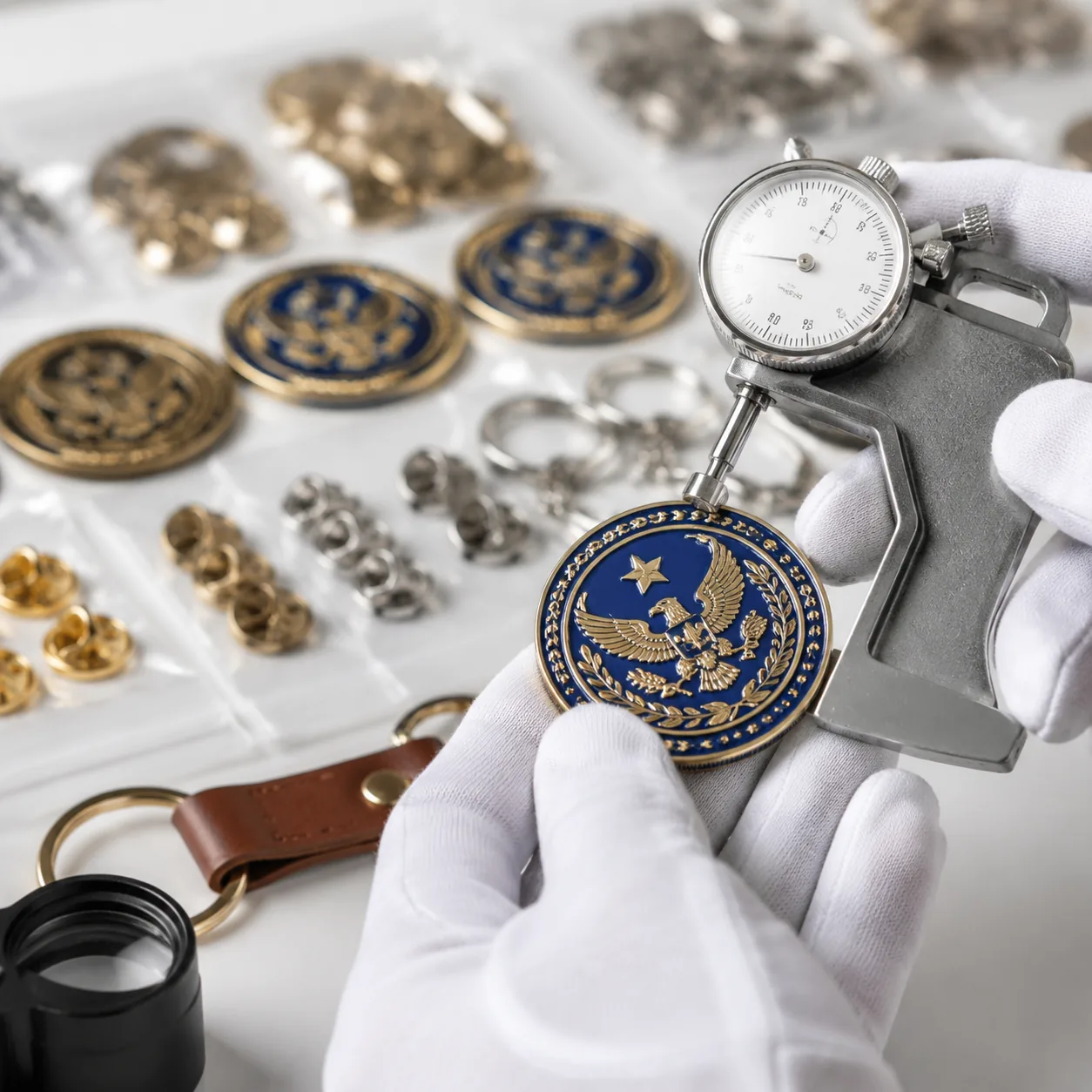
Photos are useful for checking shape and shine, but they do not prove stone security, clasp strength, or weight balance. When the sample arrives, measure the finished width, thickness, and weight, then compare those numbers against the approved proof. A 0.5 mm size drift is often acceptable, but a 5 g weight increase can make a brooch pull on thin fabric or rotate when worn.
Check plating under strong neutral light, especially around prongs, hinge solder points, and recessed stone cups. For decorative brooches, a practical plating thickness is often 0.05-0.10 microns for flash gold, 0.10-0.20 microns for a more durable imitation gold finish, and 3-5 microns for a nickel underlayer where nickel is permitted. If the target market requires nickel-free contact surfaces, state that before sampling because the plating stack, cost, and lead time will change.
Stone retention should be tested before approval. For glue-set stones, press several stones sideways with a wooden stick and confirm that none shift. A firm tape-pull test can expose weak bonding, but it should be treated as a screen, not a substitute for process control. For prong-set stones, inspect whether all prongs are fully seated and whether any stone rocks when touched from the side.
Clasp testing matters just as much as stone testing. Open and close the pin 20 times and confirm that the needle still aligns with the catch, the hinge does not loosen, and the point is not exposed in a way that can scratch skin or damage fabric. For items sold into apparel channels, also test the brooch on the intended fabric for at least 2 hours to check sagging, rotation, and puckering.
- Measure overall size at the widest point; use ±0.3 mm for brass or ±0.5 mm for zinc alloy.
- Weigh the sample and set a production tolerance of ±10% unless the brooch is for delicate fabrics.
- Open and close the clasp 20 times to check hinge looseness and needle alignment.
- Wear-test the sample on the intended fabric for 2 hours to check sagging, rotation, and fabric damage.
- Inspect at least 10 random stones with a loupe for gaps, glue overflow, chips, or tilt.
- Confirm stone colors against the physical sample, not only the digital rendering.
6. Freeze the production file and lock QC points
Once the sample is approved, freeze the production file. It should include the final artwork, stone map, base metal, metal thickness, plating finish, back hardware, logo backstamp if any, packaging, and signed sample photos. Do not leave “minor changes” open after approval, because even a small line shift can change the stone count, prong locations, and tooling geometry.
Keep a golden sample at both the factory and the buyer side. It should be signed and dated, with the approved front, back, and side views attached. That reference prevents disputes when production photos look slightly different because of lighting or camera angle. For rhinestone brooches, the golden sample matters more than with flat pins because stone alignment and plating tone are harder to judge from pictures alone.
Bulk production should include incoming material checks, in-process checks after stamping or casting, plating inspection, stone-setting inspection, and final packing inspection. For manual rhinestone setting, 100% visual inspection for missing stones is realistic and necessary. Dimensional and functional checks should be handled through a sampled AQL plan instead of subjective carton-by-carton judgment.
A practical inspection target is AQL 2.5 for major defects and AQL 4.0 for minor defects, with a tighter AQL 1.5 for clasp failures because the item is worn on fabric. Major defects should include missing stones, wrong stone color, peeled plating, exposed base metal, loose clasp, and misaligned safety catch. Minor defects usually include small glue marks, slight plating variation, or negligible surface marks that do not affect wear.
| Inspection point | Recommended control | Reject if |
|---|---|---|
| Stone placement | 100% visual check before packing | Missing, cracked, wrong color, or visibly tilted stone |
| Plating | AQL 2.5 major, 4.0 minor | Peeling, black spots, exposed base metal, obvious color mismatch |
| Clasp function | AQL 1.5 major | Needle does not lock, hinge is loose, or point is unsafe |
| Size and thickness | Sample 13 pcs per 500 pcs minimum | Outside approved tolerance or affects fit |
| Glue overflow | AQL 4.0 minor unless severe | Visible glue around stones on the front face |
| Packing | AQL 2.5 major | Wrong barcode, mixed design, or crushed retail packaging |
7. Pack for freight so stones and clasps survive transit
Rhinestone brooches are more fragile in transit than flat enamel pins because raised stones can scratch each other and clasp hardware can press into neighboring pieces. Individual OPP bags are acceptable for giveaways, but add a foam sheet or card insert if the brooch has tall stones or sharp pin hardware. For retail, a backing card inside a clear bag is usually the minimum presentation that also stabilizes the item.
Do not overpack master cartons. A practical gross carton weight is 12-15 kg for mixed brooches and 10-12 kg for retail-boxed brooches with fragile display packaging. For orders above 1,000 pcs, use inner cartons so one crushed outer carton does not damage the entire shipment. If the brooches are plated in mirror silver, polished gold, or dark finishes, specify anti-scratch separation between pieces.
The extra packing cost is usually small compared with the replacement cost of scratched goods. Anti-scratch packing may add only USD 0.03-0.12 per piece, depending on whether you use a polybag, tissue, foam pad, or a fitted card with the front face isolated from the clasp. For higher-value retail orders, that cost is usually justified.
Ask the supplier to confirm outer carton count, inner carton count, net weight, gross weight, and whether cartons are drop-tested before shipment. If the order will move by air, keep packaging compact; if it will move by sea, prioritize crush resistance and moisture control. A few silica gel packets are cheap insurance against dull plating and musty retail packaging.
8. Send a complete brief before you place the order
Before you issue the RFQ, prepare a one-page sourcing brief instead of a long email thread. Include artwork, target size, quantity breaks, stone preference, market use, required packing, delivery deadline, and any compliance requirement such as nickel-free contact surfaces. A complete brief lets the factory quote the correct construction rather than a cheaper but weaker version.
If you already have a reference sample, send front, back, and side photos with a ruler and weight. If you do not have one, ask for two construction options: a lower-cost glue-set version and a stronger prong-set or cup-set version. Comparing both at the RFQ stage is much cheaper than discovering after sampling that the selected build is too heavy, too dull, or too fragile.
For a first order, 500-1,000 pcs is usually the safest start unless the design is very simple or the deadline is extremely tight. Approve one physical sample, lock the stone map, then require in-line production photos before plating and after stone setting. That workflow reduces handoff risk and prevents the usual causes of missing stones, inconsistent finishes, and avoidable rework.
A strong brief should also name the decision owner for artwork approval, sample approval, and shipment release. Small delays often happen because sourcing, merchandising, and quality teams each assume someone else is signing off. A single owner shortens the loop, especially when the factory needs an answer on stone color, clasp style, or packaging within 24 hours.
- Use millimeter drawings, not screenshots alone.
- Attach the approved stone map and keep it unchanged after sampling.
- State the exact target market and fabric type.
- Ask for FOB price breaks at 300, 500, 1,000, 3,000, and 5,000 pcs.
- Require a golden sample and dated photo set.
- Specify packing and inspection standards in the RFQ, not after production starts.
Have a project? Send your artwork and target quantity and we’ll reply with a detailed quotation within 12 working hours.
Ready to get this made?
Send your sketch, target quantity and ship-date. Detailed quotation in 12 hours.



