How to Source Mixed Promo Sets Without Spec Drift
Q1: Why do mixed promo sets fail more often than single-item orders?
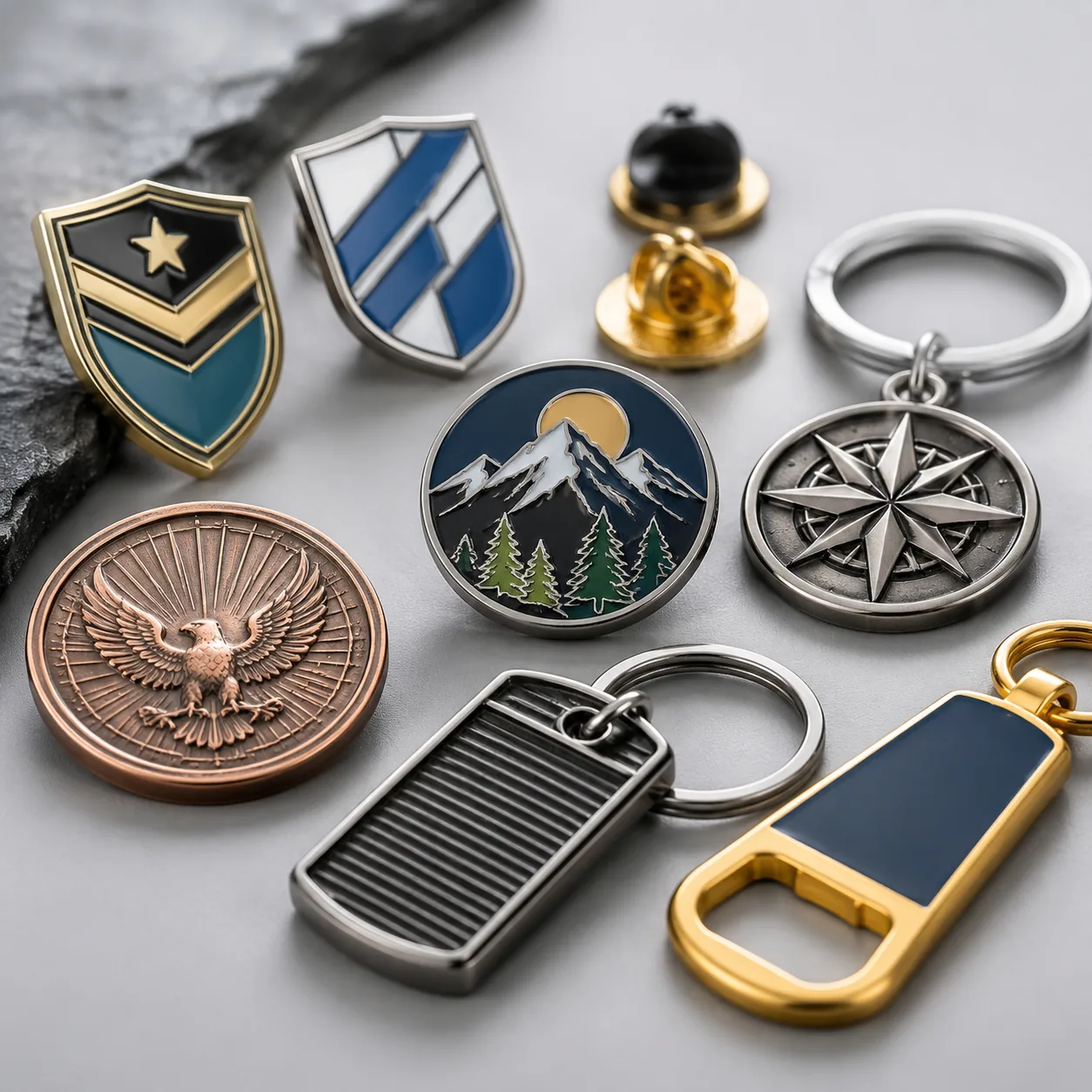
Mixed sets fail because the risk is rarely the pin, coin, or lanyard by itself. The failure is usually at the system level: a 32.0 mm pin approved in isolation may no longer fit a 40 mm presentation card after plating build-up, border bevel, or a tray cavity that was cut too tight. Once you combine pins, coins, keychains, patches, and lanyards, every component brings its own tooling, finish, print, and packing tolerance stack.
That is why mixed orders create more rework than a single SKU. A factory can hit the individual spec on each item and still miss the commercial target if the set does not present cleanly, pack efficiently, or ship in the right sequence. The purchase order should therefore treat the set as one commercial unit with one master spec sheet, one artwork control file, and one approval chain, even if multiple workshops are involved.
For China sourcing, timing also matters. Typical production windows are not aligned: stamped pins may need 10-14 days after sample approval, die-cast coins 14-18 days, woven patches 5-7 days, and printed lanyards 7-10 days. A single late revision can move the whole ship date because the slowest process becomes the critical path. The right question is not whether a factory can make each item, but whether it can freeze one combined spec and pack everything without last-minute resizing.
Q2: What should a buyer lock before requesting quotes?
Lock the commercial and physical anchors before asking for numbers: set composition, order quantity, target ship date, pack method, and whether the items must match one visual system. Without those five points, suppliers will quote different assumptions and price comparisons become meaningless. A clean RFQ should specify exact dimensions, thickness, material, decoration method, attachments, artwork files, and whether packing is one set per box or bulk packed by SKU.
The most common mistake is leaving final size open. That sounds flexible, but it often creates hidden cost shifts: if a pin moves from 30 mm to 28 mm, the backing card, foam insert, and carton loading count may all change. For mixed sets, define tolerance bands up front. A practical starting point is ±0.3 mm for pins and keychains under 35 mm, ±0.5 mm for coins up to 40 mm, ±1.0 mm for printed accessories like lanyards, and ±1.5 mm for packaging inserts unless the design requires tighter control.
A strong RFQ also names the commercial terms. Ask for FOB pricing in USD, separate tooling if applicable, lead time in calendar days or workdays, minimum order quantity by component, and whether packaging has its own MOQ tier. That makes it easier to compare suppliers that quote differently on plating, assembly, and pack-out.
At ZheCraft, the smoothest projects usually start with one master table listing item code, material, size, thickness, finish, decoration method, attachment, packaging, and approval status. That reduces ambiguity and helps the factory decide whether to consolidate finishing, inspection, or packing into one production lane instead of treating each item as a separate job.
Q3: Which specs cause the most quote confusion?
Three specs create most of the confusion: thickness, finish, and attachment or hardware. Thickness is not a visual preference; it affects weight, feel, die depth, and shipping cost. Finish changes both appearance and process because soft enamel, hard enamel, screen print, epoxy dome, and plated metal each use different cure times, rejection thresholds, and inspection methods. Hardware is often treated as an afterthought, yet it drives breakage claims, pack size, and replacement rate.
Buyers should not assume that standard means the same thing across product types. A 1.5 mm stamped lapel pin blank, a 2.5-3.0 mm coin, and a 1.2 mm keychain body may all be standard in their own categories, but they are not interchangeable in assembly or packaging. For plating, ask for the actual layer type and target thickness: decorative nickel flash is often around 0.10-0.15 micron, hard nickel around 0.20-0.25 micron, and antique finishes are usually expressed by appearance rather than a thicker deposit. If the factory cannot state the thickness or visual standard, the quote is underdefined.
Tolerances should be written in the RFQ, not inferred later. A useful starting spec for metal promo items is size ±0.3 mm for smaller pins, thickness ±0.2 mm for cast or stamped metal, enamel fill flushness within 0.1-0.2 mm below the raised line, and attachment pull strength that is appropriate to the item weight. For lanyards, specify width tolerance at ±1 mm and print registration within ±1.5 mm unless the artwork uses a full-bleed edge.
The table below shows where mixed sets usually drift and what to specify instead.
| Spec area | Common buyer wording | Better procurement wording |
|---|---|---|
| Size | Around 30 mm | 30.0 mm max, ±0.3 mm tolerance |
| Plating | Gold finish | Shiny gold plating, 0.10-0.15 micron decorative flash |
| Thickness | Feels solid | 2.0 mm body thickness, ±0.2 mm |
| Attachment | Standard backing | Butterfly clutch, rubber clutch, or magnetic back stated by SKU |
| Packaging | Nice box | One set per printed box, insert tolerance ±1.0 mm |
Q4: What sample stages should a mixed set go through?
A mixed set should normally pass through three checkpoints: artwork proof, pre-production sample, and golden sample lock. The artwork proof confirms that all items share the same logo rules, font weights, line widths, Pantone references, and copy placement. The pre-production sample confirms actual materials, dimensions, finish behavior, and packing fit. The golden sample becomes the fixed reference for mass production and future reorders.
Do not approve only one item if the set contains multiple processes. For example, approving a coin sample while skipping the lanyard print and patch weave is risky because the order may still fail on Pantone drift, edge sealing, or box height. A proper approval package should include measured dimensions, close-up photos, and a written statement of acceptable variation for each component.
For integrated factories that make enamel pins, coins, keychains, patches, and lanyards in the same supply chain, the advantage is control across more than one item family. But integration only helps if the buyer freezes the reference set. If one component keeps changing while the others are already approved, the whole batch can slip into rework and the final carton count may no longer match the approved packing plan.
Q5: What checklist prevents set-level rework?
Use a checklist that checks the system, not just each product. The goal is to make sure the set works as a single deliverable in hand, in carton, and on shelf. This is where procurement teams often miss hidden issues such as tray depth, card size, zipper pouch thickness, carton quantity per master case, and whether a mixed pack needs manual assembly time.
- Confirm one master artwork file per set and one revision number
- Lock each item’s size, thickness, plating, and attachment in writing
- State tolerance bands for metal, print, and packaging components
- Approve one complete set sample, not isolated item samples
- Verify carton loading count, outer carton dimensions, and gross weight
- Check whether any item uses a different factory process or subcontractor
- Record the exact packing method: bulk, polybag, backing card, tray, or box
- Set one final ship date with a buffer for mixed-process scheduling
If the order is for promotional distribution, also check whether the set will survive warehouse handling. Pins and coins can usually take tighter pack-outs, but patches and lanyards wrinkle if compressed too hard, especially in cartons over 20-25 kg gross weight. A sample that photographs well can still fail in transit if the inner pack lacks crush resistance or if the set shifts inside the box.
Q6: How do lead time and MOQ change when items are combined?
Mixed sets do not reduce MOQ linearly. Each component still has its own material and setup economics, so combining four items does not mean each MOQ falls to one quarter. More often, the factory will quote a separate MOQ tier for each line item and then add an assembly or packing MOQ if the set must ship together.
A realistic planning range for standard mixed promo sets is 12-20 days for production after sample approval, excluding ocean freight. Simpler printed items can be faster, while die-cast parts, epoxy-heavy finishes, or complex packaging can push the schedule to 20-25 days. For urgent orders, air freight helps transit time, but it does not fix a weak spec sheet. It only moves bad planning faster.
A useful rule is to treat any set with tooling, special plating, or custom boxes as a critical-path project. If all items are print-based and share common materials, timing is more compressible. Once packaging is customized, the pack-out becomes its own workflow and needs its own lead-time allowance, usually 3-5 extra days for hand assembly and final inspection.
Typical MOQ tiers for mixed promo components are often quoted as 100-300 pcs per design for woven patches, 100-500 pcs for printed lanyards, 100-300 pcs for basic pins, and 100-200 pcs for simple coins, but the real order floor is often set by the highest-cost component or the packaging run. If one item needs tooling, expect a separate one-time mold charge and a longer first-order lead time than the rest of the set.
Q7: What price ranges should buyers expect?
FOB pricing for mixed sets is usually quoted item by item, then assembled into a set price. As a buyer-side benchmark, simple printed lanyards often start around USD 0.35-0.80 per piece, woven patches around USD 0.25-0.90, basic soft-enamel pins around USD 0.40-1.80, and small challenge coins around USD 0.90-3.50 depending on diameter, thickness, and finish. A printed backing card or simple polybag can add USD 0.05-0.20 per set, while a rigid presentation box with insert usually adds USD 0.35-1.20 per set.
If the supplier gives one all-in number, ask for a breakdown. You need to see where the cost sits: tooling, plating, print, packaging, assembly, inspection, and cartonization. That breakdown tells you whether savings come from simplifying one item, changing the box, removing a special finish, or reducing manual pack-out time. It also makes it easier to compare offers from different factories that may quote the same final number using very different assumptions.
Be careful with quotes that look unusually low. In mixed sets, low prices often come from underestimated packing labor, optimistic shared setup assumptions, or excluding packaging inserts from the quote. If the supplier later discovers that each item needs separate machine time or separate hand packing, you will face change requests after approval. A low quote is only useful if it includes the same scope, tolerance, and pack method as the other bids.
Q8: What should you do next before issuing the PO?
Before issuing the purchase order, turn the approved sample into a controlled document set. The pack should include one master spec sheet, one artwork pack, one sample reference photo set, one packaging drawing, and one agreed inspection standard. For quality control, many buyers use AQL 2.5 for major defects and AQL 4.0 for minor defects on mixed promotional goods, then tighten the plan if the event date is fixed and replacements are impossible.
Then confirm the practical controls: who signs off revisions, what happens if one item is delayed, and whether partial shipments are allowed. If the answer is no partial shipment, state that clearly and accept the scheduling risk. If partial shipment is allowed, define which items can ship first and whether that changes carton labeling, warehouse receiving, or invoice timing.
A good pre-PO review also asks for photos of pre-production materials, a packing mock-up, and at least one final carton sample if the order uses custom packaging. For mixed sets, this is especially important because the physical fit can fail even when every individual component meets spec.
If you want the lowest-risk path, send one integrated RFQ, insist on a complete set sample, and ask the factory to quote packing as a separate line item. That keeps engineering, pricing, and logistics aligned. For buyers managing multiple promo items at once, it is usually the fastest way to avoid spec drift without overcomplicating the order.
Have a project? Send your artwork and target quantity and we’ll reply with a detailed quotation within 12 working hours.
Ready to get this made?
Send your sketch, target quantity and ship-date. Detailed quotation in 12 hours.



