How to Source Lower-Impact Custom Pins and Sets in 2026
Define the impact target before asking for an eco version
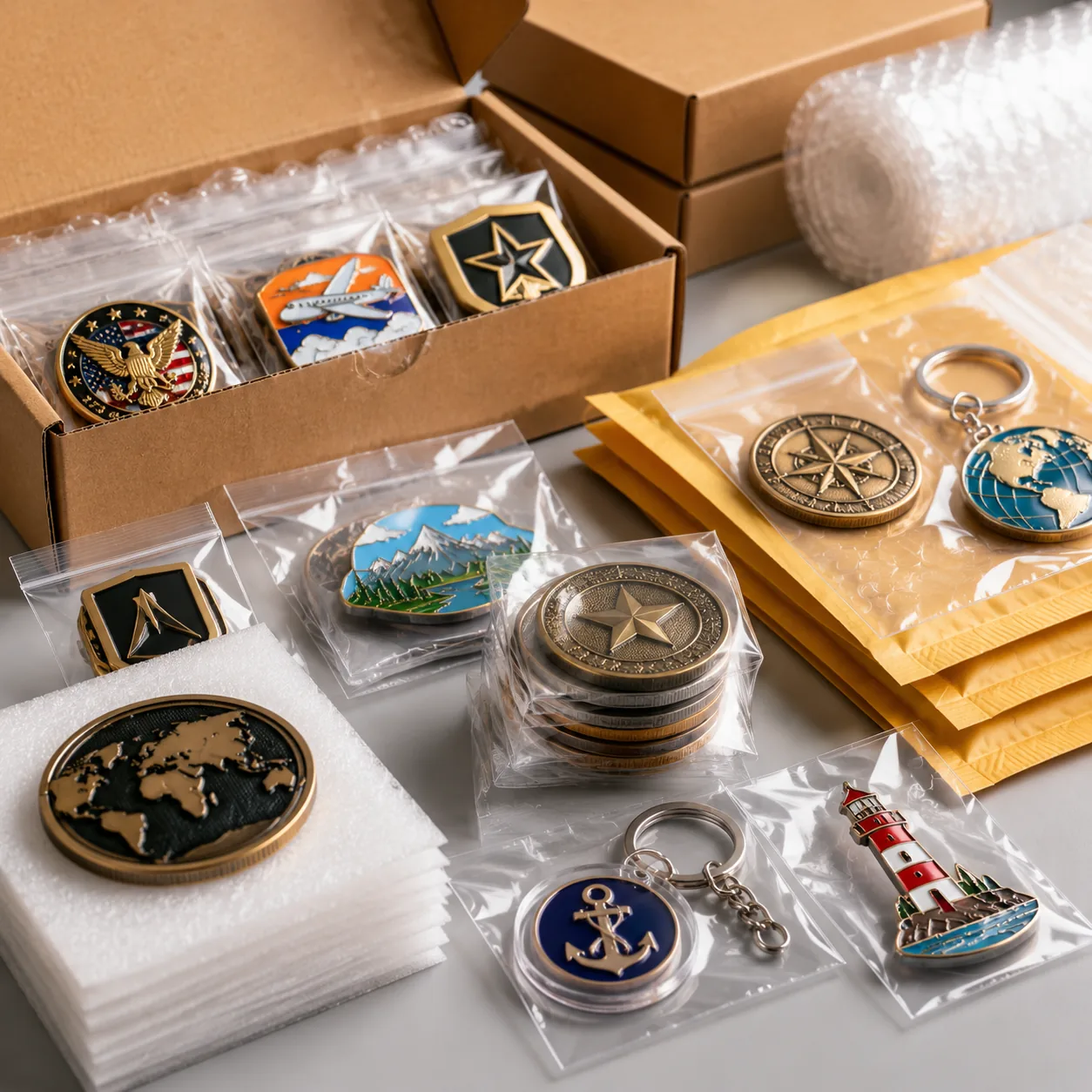
The sourcing challenge is rarely finding a factory willing to call a pin, patch, keychain, lanyard, or gift set "eco." The harder part is cutting impact without creating new failures in finish, color control, attachment strength, pack protection, MOQ, lead time, or landed cost. In this category, lower-impact substitutions usually fail for technical reasons, not marketing reasons. Recycled-content zinc alloy can show micro-pitting on broad polished faces. RPET webbing can produce slightly softer edge definition than virgin polyester on fine reverse text. Removing the individual OPP bag can create plating rub if posts, clutches, or jump rings are left exposed. Lightweight presentation cards can crush when board caliper is too low or export cartons are under-filled.
For most B2B buyers, the goal is not maximum recycled content at any price. The workable target is to reduce virgin plastic, cut oversized unit packaging, avoid preventable airfreight, and make one or two substitutions that do not change the approval standard. In practice, keep the durability-critical core item stable and change the surrounding components first: webbing, cards, sleeves, trays, mailers, and master-carton configuration.
A realistic 2026 example is a new-hire set containing a 30 mm soft enamel lapel pin, a 20 x 900 mm lanyard, and a printed backing card. The pin may remain iron or zinc alloy because edge sharpness, post strength, and service life matter more than headline recycled content. The lower-impact gains more often come from switching the lanyard to RPET, using FSC-certified 350-400 gsm SBS or kraft board for the card, removing the OPP bag where scratch risk is low, and tightening inner-pack and carton counts to improve cube utilization. Those changes are easier to validate and repeat than changing every substrate at once.
Write the RFQ so every supplier quotes the same build
A useful RFQ for a lower-impact program must lock the standard construction first, then define the allowed substitution range. If you ask only for green options, each supplier will optimize a different variable and the quotes will not be comparable. One may remove packaging only, another may propose recycled alloy, and a third may change only the card while leaving all plastic inserts untouched.
The RFQ should still read like a normal production specification: size in mm, thickness, process, plating, Pantone references, attachment hardware, packaging method, inner-pack quantity, export-carton weight cap, inspection standard, and compliance requirements. Then add tightly controlled sustainability fields: required or preferred recycled content, acceptable packaging reductions, banned materials such as virgin PVC or individual OPP bags, and the allowed premium. For most promo accessories, a 3-8% FOB tolerance above the standard build keeps responses realistic without inviting noncompetitive pricing.
- State whether recycled content is mandatory, preferred, or acceptable only if FOB stays within 3-8% of the conventional quote.
- Specify measurable appearance limits: Pantone match within buyer-approved tolerance, enamel fill level, plating tone, line legibility, and edge sharpness.
- Request component-level disclosure for metal body, clutch, jump ring, webbing, buckle, card, sleeve, tray, unit bag, and export carton.
- Ask for FOB breaks at 300, 500, 1000, 3000, and 5000 pcs to identify where the lower-impact build becomes cost-neutral.
- Separate sample lead time from production lead time; a practical target is 5-10 calendar days for samples and 15-28 days for bulk after approval.
- Require the factory to flag where it does not recommend the substitution, especially for mirror polish, deep emboss, tight woven text, or premium retail presentation.
A credible supplier should be willing to say no. If a recycled-alloy pin cannot meet a mirror-polish requirement, or if a recycled PVC blend causes unacceptable lot-to-lot color drift on a mascot keychain, that is useful sourcing data. A qualified no is more valuable than a vague yes.
Prioritize low-risk substitutions before changing the core item
The safest substitution is usually the one the end user barely notices. In custom accessories, packaging and fiber-based swaps usually carry less risk than changing the base metal, molding compound, or plating system. Removing an OPP bag, reducing a backing card from 500 gsm to 350 gsm, replacing a thermoformed blister with a die-cut paperboard nest, or changing a lanyard from virgin polyester to RPET affects function far less than redesigning the core pin, badge, or keychain body.
Durability still matters. A metal pin or recognition set that stays in use for years may have a better practical footprint than a lower-grade version that fails early and needs replacement. For long-retention uses such as service awards, membership pins, museum merchandise, and employee-recognition sets, keep the durable construction stable and strip waste from the packaging system first. For short-use event kits, conference giveaways, and campaign packs, broader substitutions such as RPET straps, FSC sleeves, kraft mailers, and simplified card-and-band presentation are easier to justify.
| Component | Standard option | Lower-impact option | Typical trade-off | MOQ / FOB effect |
|---|---|---|---|---|
| Lanyard strap | Polyester, 20 x 900 mm, 0.8-1.0 mm thick | RPET polyester, 20 x 900 mm | Softer hand feel; fine edge definition and reverse text can be slightly less crisp | Usually no MOQ change from 500 pcs; FOB often +USD 0.01-0.05/pc |
| Backing card | 350 gsm C2S art card | FSC SBS 350-400 gsm or FSC kraft 350-400 gsm | Kraft has lower white point and shows scuffing sooner; uncoated stock can pick up rub marks | Usually no MOQ change from 500 pcs; cost-neutral to +USD 0.02/pc |
| Individual unit bag | OPP polybag | No bag, glassine sleeve, or paper band | Higher scratch risk unless posts and edges are protected in the inner pack | No MOQ impact; may reduce FOB by USD 0.01-0.03/pc |
| Soft PVC keychain | Virgin PVC | Recycled PVC blend | More batch-to-batch color variation; fine raised detail may soften | Often requires 1000+ pcs; FOB commonly +3-8% |
| Metal pin body | Standard iron or zinc alloy | Recycled-content zinc alloy | Large flat polished areas need tighter polishing control to avoid visible pits | Usually no MOQ change; FOB often +USD 0.03-0.08/pc at 1000 pcs |
| Gift insert tray | Vacuum-formed plastic tray | Die-cut paperboard nest, 600-1000 gsm laminated board | Less rigid premium feel; retention tabs and drop performance must be tested | Usually no MOQ change from 1000 sets; can reduce carton cube about 5-12% |
Operational simplicity is an important filter. If the greener option adds hand insertion, orientation checks, tissue interleaving, or extra surface protection, it may increase defects and extend lead time enough to erase the material benefit. The strongest lower-impact programs are usually the ones that remain simple to run on the factory floor and simple to repeat on reorder.
Use real 2026 MOQ, FOB, and lead-time benchmarks
Commercial clarity matters as much as material choice. Ask suppliers to separate tooling, sample charges, unit FOB, packaging cost, proofing cost, export-carton cost, and any third-party testing fees. Without a line-item breakout, a small material swap can hide larger increases caused by lower yield, outsourced paper conversion, or added hand packing.
As a practical 2026 benchmark, a 30 mm soft enamel iron pin with butterfly clutch at 1000 pcs typically falls in the USD 0.32-0.58 FOB range, depending on plating, color count, and packaging. A 35 mm die-cast zinc alloy pin with two posts more commonly lands at USD 0.55-0.95 FOB at the same volume. Recycled-content zinc alloy usually adds about USD 0.03-0.08 per piece when the finish is satin, antique, or standard polished rather than mirror-grade. A 20 x 900 mm full-color RPET lanyard with lobster hook and safety break at 1000 pcs often sits around USD 0.38-0.72 FOB, usually within 3-7% of virgin polyester when the supplier already sources RPET webbing routinely.
Sets should be quoted both assembled and loose-packed if local final assembly is an option. A three-piece set with pin, lanyard, and FSC card can look inexpensive until a custom die-cut nest, manual insertion, sleeve application, and barcode label add USD 0.12-0.35 per set. Sample charges also vary by process. Metal pin pre-production samples often cost USD 35-75 including mold adjustment or setup, while custom paper sleeves, nests, or folding mailers can add USD 20-60 depending on print coverage, die-line complexity, and whether a new knife is needed.
Lead time is where lower-impact variants often drift. Standard soft enamel pins may sample in 5-8 days and run bulk in 12-20 days after approval. RPET lanyards often sample in 5-7 days and run bulk in 10-18 days. FSC sleeves, paperboard nests, and custom mailers can add 3-7 days if board grade, lamination, or die-cutting is non-stock. For event-critical orders, ask which materials are kept in stock, which are bought to order, and what the supplier's cutoff is before a rush order triggers substitute materials or air shipment.
Approve samples against finish, tolerance, and transit risk
Sample approval should test the substitution itself, not just the logo and artwork. Many teams approve enamel color and layout, then discover during bulk production that recycled board scuffs, kraft fibers shed, RPET edges fuzz slightly after handling, or no-bag packing causes plating marks. The sample must validate the changed material, the unit pack, and the outer-carton logic together.
For metal pins and badges, inspect under direct and angled light at normal viewing distance and again at 20-30 cm. Check for pits, polishing waves, die lines, burrs, enamel underfill, overfill, and plating haze. If recycled-content alloy is used, inspect large smooth fields, borders, and recessed backgrounds first because variability shows there fastest. Confirm post alignment, clutch fit, and backing-card hole registration. For lanyards, check fine-text edge clarity, color migration at folds, hook spring return, buckle engagement, and heat-cut consistency. For paper packs, open and reclose several times, then inspect corner burst, tab fatigue, rub resistance, and insert retention.
- Request 3-5 pre-production samples when the substitution affects appearance, durability, or packaging, not just one showroom sample.
- Use a written inspection target such as AQL 2.5 for major defects and AQL 4.0 for minor defects unless your internal standard is tighter.
- Confirm decorative plating thickness in writing; about 0.03-0.05 microns of nickel is common for decorative use, while higher-contact applications may need a heavier build.
- Set dimensional tolerances by component: metal stampings often hold +/-0.15 mm on critical features, die-cut paper about +/-1.0 mm, and sewn or heat-cut lanyard length about +/-5 mm.
- Run a packed drop test on the real configuration, such as 6 faces from 76 cm, plus a rub test to check plating, print, and board abrasion in transit.
- Approve both the product and the packing method; a good-looking loose sample does not validate bulk shipment.
A capable supplier should also explain what the sample does not prove. A hand-packed sample may not show whether 3000 units need extra dividers, post caps, tissue interleave, or a tighter carton fill ratio to survive sea transit. Those limits should be recorded in the approval file and PO, not left in chat screenshots.
Convert the approved swap into enforceable production controls
If the lower-impact choice is not written into the purchase order and packaging specification, it often disappears on the repeat run. That happens most often with paper and packing components because kraft board, SBS board, and standard coated card can look similar in approval photos, and because factories may revert to the standard material when a repeat order is rushed.
The control system does not need to be complex, but it does need to be precise. Name the approved material at component level: RPET polyester webbing, FSC SBS 400 gsm backing card, no individual OPP bag except on polished badge SKUs, die-cut paperboard nest instead of PVC tray. If the quoted basis included recycled content, require written notice before production if the resin blend, source mill, alloy source, or webbing supplier changes. For mixed sets, ask for a final pack-out photo or short video before shipment so you can confirm component count, presentation order, and the approved packing configuration.
Inspection should focus on the defects most likely to rise after the substitution. No-bag metal items need abrasion checks on plating, edges, and posts. Kraft or uncoated board needs checks for print density, board dust, die-cut burr, and edge crush. Recycled PVC or acrylic needs extra attention to color shift, odor, and clarity. RPET lanyards need checks on edge finish, hook attachment, stitch quality where applicable, and buckle consistency. For assembled sets, carton-level verification matters because packing errors increase when multiple new components are introduced together.
Know when not to switch, then scale from a controlled pilot
Not every SKU is a good candidate for lower-impact substitution. If the item is safety-sensitive, highly polished, color-critical, premium retail-facing, or intended for long-term display, the conventional construction may still be the better decision. A magnetic name badge that must hold through heavy garments may require a stable magnet grade with no compromise. A mirror-polished commemorative coin in black nickel is a poor place to test recycled-alloy variability. Children's items should be driven first by compliance, coating safety, odor, migration limits, and drop durability before any sustainability claim is considered.
The best rollout method is a controlled pilot. Start with one SKU or one repeatable mixed set at 500-1000 pcs annual demand, request a side-by-side quote for the standard versus lower-impact construction, and compare more than unit price. Review sample lead time, defect exposure, pack-out method, freight cube, reorder stability, and whether the substitution still works on the second order. If the pilot succeeds on both first run and repeat run, then extend the same logic to adjacent items instead of changing every category at once.
- Choose one repeat order or one mixed set with stable annual demand, ideally 500-1000 pcs or more.
- Request side-by-side quotations with every material, packaging, MOQ, FOB, tooling, and lead-time difference listed line by line.
- Approve only against a physical sample packed the same way the bulk order will ship.
- Lock exact material names, gsm, pack method, carton limits, and SKU-level exceptions into the PO and reorder specification.
- Track three outcomes after delivery: defect rate, buyer or end-user feedback, and total landed cost versus the standard build.
- Scale only the substitutions that remain commercially stable on the second and third order, not just the pilot run.
In 2026, lower-impact sourcing for custom pins and promo sets is not about broad claims. It is about disciplined substitution. Keep the durable core where performance matters, remove packaging waste first, quote tightly controlled alternatives, validate them under real handling and transit conditions, and write the approved build into the production record. Buyers who follow that process usually get the best commercial result: fewer claims, more credible material reductions, and a sourcing program that still works at production scale.
Have a project? Send your artwork and target quantity and we’ll reply with a detailed quotation within 12 working hours.
Ready to get this made?
Send your sketch, target quantity and ship-date. Detailed quotation in 12 hours.



