How to Source a Retail-Ready Enamel Pin Collection
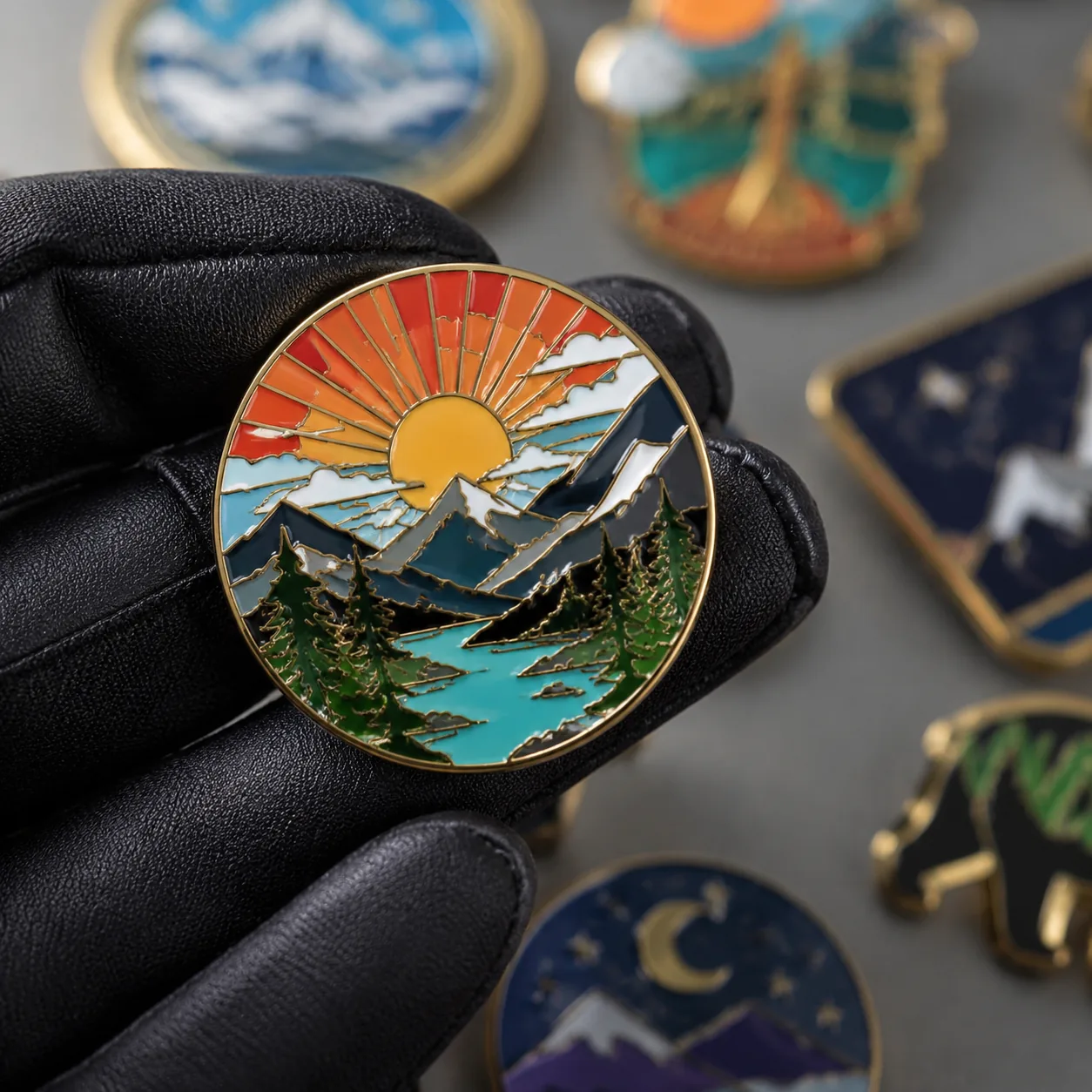
Step 1: Build the range as retail SKUs, not artwork files
The common retail failure is not one defective pin; it is a good-looking collection that cannot be received, merchandised, scanned, replenished, or inspected cleanly. A museum shop, artist capsule, festival line, or licensed brand range may include 6 to 20 designs, but each design is still a separate SKU with its own mold, enamel colors, plating batch, backing card, barcode, packing quantity, and inspection record. If the RFQ says only “12 custom enamel pins, 100 pcs each,” the factory will fill gaps with assumptions that may not fit your channel.
Define every SKU by design code, finished width and height, target retail price, metal thickness, base metal, enamel type, plating finish, attachment, backing card, barcode, inner packing, and order quantity. A 25 mm soft enamel pin on a 55 x 85 mm card is a different cost and QC job from a 45 mm double-post imitation hard enamel pin in a 60 micron resealable bag. The quote must show those differences before tooling starts.
For costing and display planning, group pins into size bands: small 20–25 mm, standard 26–35 mm, and feature 36–50 mm. Keeping a launch inside two bands reduces mold variation, card formats, carton sizes, and fixture imbalance. It also improves reorder control: if four designs sell through first, you can replenish those SKUs without reworking the entire collection.
Step 2: Issue an RFQ grid that fixes the specification
Use a spreadsheet with one row per SKU and locked technical fields. Otherwise one supplier may quote 1.5 mm iron soft enamel with economy butterfly clutches, while another quotes 2.0 mm zinc alloy imitation hard enamel with deluxe clutches and thicker plating. Both are “custom enamel pins,” but the landed cost, feel, lead time, and defect risk are not comparable.
A reliable retail baseline is 1.5–2.0 mm metal thickness for pins under 35 mm and 2.0–2.5 mm for pins over 35 mm. Use die-struck iron for simple silhouettes and crisp raised lines; use zinc alloy casting for irregular outlines, many internal cutouts, 3D relief, or very large shapes. Brass is less common for budget retail pins but can be specified for premium corrosion resistance and sharper die work.
Specify plating by finish and minimum thickness. Nickel, gold color, black nickel, antique brass, antique copper, and dyed black are common. A practical decorative plating spec is 3–5 microns on visible surfaces; economy production below about 2 microns can show faster edge wear, inconsistent tone, and base-metal exposure after handling. Ask suppliers to split tooling, pre-production samples, bulk unit price, packaging, and freight. Typical FOB China pricing for a 25–35 mm soft enamel pin is USD 0.75–1.60 at 100 pcs/design, USD 0.55–1.25 at 300 pcs/design, and USD 0.45–1.05 at 500 pcs/design, excluding tooling. Standard flat molds usually run USD 35–80/design; large, cutout-heavy, or 3D molds can reach USD 90–150/design. Imitation hard enamel normally adds USD 0.10–0.35/pc for extra filling, polishing, and surface control.
| RFQ field | Recommended buyer input | Commercial or QC impact |
|---|---|---|
| Design count | List each SKU with design code and revision number | Tooling, color filling, labels, and inspection are SKU-specific |
| Finished size | Width x height in mm; tolerance ±0.5 mm up to 40 mm, ±0.8 mm above 40 mm | Prevents resizing, card mismatch, and unexpected carton weight |
| Metal thickness | 1.5, 1.8, 2.0, or 2.5 mm; tolerance ±0.15 mm die-struck, ±0.20 mm cast | Controls perceived quality, die depth, post strength, and freight |
| Base metal | Die-struck iron, brass, or zinc alloy | Affects edge sharpness, cutout stability, corrosion resistance, and mold cost |
| Enamel type | Soft enamel or imitation hard enamel | Changes surface feel, polishing risk, unit cost, and lead time |
| Plating | Finish plus minimum 3–5 microns on visible surfaces | Improves consistency and reduces early edge wear |
| Attachment | Butterfly clutch, rubber clutch, deluxe clutch, magnet, safety pin, or brooch pin | Changes safety profile, card layout, cost, and retail perception |
| Packaging | Card size, 300–400 gsm stock, bag micron, barcode, warning text | Turns a loose component into a scannable retail SKU |
| QC standard | ANSI/ASQ Z1.4 or ISO 2859-1, General Level II, AQL 2.5 major / 4.0 minor | Defines pass/fail limits before shipment |
Step 3: Set artwork engineering rules before sampling
Collections often combine illustrator art, mascots, marks, and campaign graphics. If every file uses different line weights, enamel islands, outline thicknesses, and back formats, production slows and rejects rise. Create one manufacturability rule set before paying for molds.
For enamel pins, raised metal lines should be at least 0.25 mm for simple soft enamel and 0.30 mm for imitation hard enamel or polished retail pieces. Recessed enamel pockets should be at least 0.35 mm wide; narrower pockets may trap bubbles, underfill, or cure unevenly. Avoid isolated metal dots under 0.40 mm, sharp internal corners below a 0.30 mm radius, and open slots narrower than 1.0 mm in die-struck iron. Text is safest at 1.2 mm cap height or larger; very small lettering should be raised metal, not enamel-filled.
Standardize the edge and back. A flat cut edge is clean and economical for modern graphics. A raised rim of 0.5–0.8 mm protects enamel on larger pins, but it adds visual weight. For retail, a backstamp with brand name, copyright, batch code, or year is common. Keep backstamp relief around 0.20–0.30 mm so it stays legible without interfering with posts, magnets, or card mounting.
Limit color complexity. Most factories can fill 6–8 enamel colors per design consistently; beyond that, each color adds mixing, filling, curing, and inspection points. Metallic plating changes perceived color: white enamel beside black nickel looks brighter, while navy or burgundy beside antique brass can appear muted. Approve the finished metal-and-enamel sample, not only Pantone chips.
Step 4: Sample the highest-risk SKUs first
Sampling every SKU is safest, but the first gate can be targeted. For a 10–12 SKU collection with shared construction, sample the three to five highest-risk designs: the largest pin, the smallest detailed pin, the design with the most colors, the design with cutouts, and the design using dark or mirror-like plating. These reveal most mold, plating, polishing, and filling risks before releasing every tool.
Realistic pre-production sample timing after approved artwork and payment is 7–12 days for die-struck soft enamel, 10–15 days for imitation hard enamel, and 12–18 days for zinc alloy casting or complex cutouts. Add 2–4 days for backing card proofs and barcode placement checks. Digital artwork proofing can finish in 24–48 hours, but physical sampling cannot be compressed responsibly below the time needed for tooling, plating, enamel curing, polishing, and assembly.
Inspect samples with calipers, a thickness gauge, and a barcode scanner. Finished size tolerance should be ±0.5 mm for pins up to 40 mm and ±0.8 mm for larger or cast pieces. Post placement should stay within ±1.0 mm of the approved drawing, especially where the pin must sit straight on a card. Check clutch fit by pulling and rotating the backing; a loose post or weak clutch is a major defect, not a cosmetic issue. Confirm colors against Pantone Solid Coated references under neutral D65-style light, while allowing a small visual shift after enamel curing.
Step 5: Control packaging as part of the product
Retail packaging is not an afterthought. A pin can pass metal inspection and still fail commercially if it hangs crooked, hides artwork, rubs through the bag, scans poorly, or arrives mixed with another SKU. Approve the card, bag, warning label, and carton label as controlled components.
Common card sizes are 55 x 85 mm for one standard pin, 65 x 90 mm for a larger feature pin, and 80 x 100 mm for two-pin sets. Use 300–400 gsm C1S or C2S card for most retail backing cards; 250 gsm often bends when carrying a 35–45 mm metal pin. Specify CMYK or Pantone print, matte or gloss lamination, corner radius, hang hole type, 3 mm bleed, and exact post holes. Keep the pin at least 8–12 mm below the hang hole so the card does not tear or rotate on a peg.
For bagging, 30–40 micron OPP self-seal bags are clear and economical, usually adding USD 0.02–0.05/pc FOB. A 50–60 micron resealable OPP or CPP bag improves shelf handling and reduces scuffing, but adds cost and carton volume. If selling through children’s, museum, or mass retail channels, supply the exact warning text, age grade, country-of-origin statement, and market-specific marks. The supplier can print what you provide; the buyer remains responsible for legal wording in the destination market.
- Approve one card dieline per format with finished size, bleed, hang hole, corner radius, and post locations.
- Confirm whether the barcode is printed on the card, applied as a sticker, or printed on the outer bag.
- Scan barcode samples before bulk printing; target clean scans at normal retail distance, not only a visual match.
- Specify pin orientation, clutch placement, and whether spare clutches are included.
- Request one fully packed sample per packaging format, including card, bag, warning copy, and carton label.
- Define carton labels by PO number, SKU code, design name, quantity, net weight, gross weight, carton number, and country of origin.
Step 6: Order by MOQ tier with production gates
After sample and packaging approval, release bulk production with named gates: final artwork lock, mold start, first-off bulk piece, plating approval, enamel filling, polishing, assembly, carding, bagging, final inspection, and shipment booking. This is critical for collections because one late SKU can hold the entire shipment if the PO must ship complete.
Typical bulk lead time after sample approval is 15–25 days for 500–3,000 total soft enamel pieces, 22–35 days for imitation hard enamel or mixed plating, and 30–45 days for orders above 10,000 pieces, more than 20 designs, or multiple printed card formats. Add 3–7 days if retailer routing labels, barcode approvals, or warning labels require sign-off. For event merchandise using ocean freight, freeze artwork at least 45–60 days before the required in-hand date; for air freight, still allow a rework buffer.
MOQ is both factory policy and setup math. A practical MOQ is 100 pcs/design, with better pricing at 300 and 500 pcs/design because mold setup, plating racks, enamel mixing, packing labor, and QC are spread over more units. Some suppliers accept 50 pcs/design for test runs, but unit price often rises 30–70%, and rework options are limited. Shared cards and bags can reduce packaging cost, but molds and enamel filling remain SKU-specific.
| Order tier | Typical use | Indicative FOB unit range for 25–35 mm soft enamel | Notes |
|---|---|---|---|
| 50 pcs/design | Market test or artist proof | USD 1.10–2.20 | Often uneconomical after tooling; limited room for rejects or rework |
| 100 pcs/design | First retail launch | USD 0.75–1.60 | Common low MOQ for 6–12 SKU collections |
| 300 pcs/design | Museum shop, convention, or event line | USD 0.55–1.25 | Better labor efficiency and more stable color setup |
| 500 pcs/design | Standard retail replenishment | USD 0.45–1.05 | Stronger price point; require SKU-labeled inners and cartons |
| 1,000+ pcs/design | Chain retail or licensed program | USD 0.35–0.85 | Negotiate included packaging, spare clutches, tighter AQL, and plating thickness |
Step 7: Inspect by SKU before accepting shipment
Do not inspect a collection only by total carton count. Each SKU needs its own quantity check, appearance review, packaging check, barcode scan, and carton label verification. Agree on the sampling standard before production. For retail metal accessories, ANSI/ASQ Z1.4 or ISO 2859-1 General Inspection Level II with AQL 2.5 for major defects and 4.0 for minor defects is common. Premium retail or licensed programs may require AQL 1.5 major and 2.5 minor.
Major defects include wrong plating, wrong enamel color, missing or loose post, weak clutch fit, incorrect barcode, mixed SKU packing, sharp burrs, broken card, visible logo error, rust, and exposed base metal on the front face. Minor defects include tiny dust in enamel, slight plating shade variation, light hairline marks, small card scuffs, or shallow enamel low spots that do not affect saleability. For soft enamel, recess depth variation around ±0.15 mm is usually acceptable. For imitation hard enamel, the surface should feel smooth with no obvious pits, over-polished metal lines, or cloudy polishing marks.
Keep inspection records by design code. If one SKU has a barcode error while the other eleven are clean, the buyer can decide whether to ship partial, re-card only that SKU, or hold the full order. That decision is far cheaper before export than after mixed defects reach a US, UK, EU, Canadian, or Australian warehouse.
Step 8: Send a complete sourcing pack before final quotes
Before requesting final pricing, reduce the project to one controlled sourcing pack: vector artwork, SKU grid, target quantities, size bands, plating choice, enamel type, attachment, card dielines, barcode files, warning text, inspection level, delivery address, Incoterm, and required ship date. If comparing soft enamel and imitation hard enamel, ask for two quotation columns in the same RFQ rather than running separate conversations.
For a first collection, avoid too many variables at once. Six to twelve SKUs, one plating finish, one attachment type, one card size, and 100–500 pcs/design is a manageable launch. Add glitter, glow enamel, screen printing, mixed metals, magnets, chains, spinner parts, or multi-pin sets after the first order proves sell-through and reorder accuracy.
The most useful next step is to send the factory three items: the artwork folder, the completed SKU grid, and photos of the retail presentation you want to match. With those, ZheCraft can check manufacturability, flag high-risk details, recommend line or size adjustments, and quote sample and bulk stages separately. That gives you a controlled approval plan before committing to every mold.
Have a project? Send your artwork and target quantity and we’ll reply with a detailed quotation within 12 working hours.
Ready to get this made?
Send your sketch, target quantity and ship-date. Detailed quotation in 12 hours.



