How to Read a Custom Promo Product Spec Sheet
Why spec sheets fail buyers
Most rework on custom promo products starts before production, when a buyer approves a sheet that is technically complete but operationally vague. A line like “gold plating” or “mixed colors” may look clear in procurement, yet it leaves the factory room to choose a finish thickness, color method, or inspection rule that may not match the brand’s expectation. The result is usually not a dramatic defect; it is a series of small mismatches across material, finish, size, pack-out, and assembly.
The practical problem is that buyers compare quotes line by line, but factories manufacture line by line. If a spec sheet omits the wrong detail, the supplier will still make a product, just not necessarily the one you intended. On metal promo items, the costliest misses usually sit in three places: base material, decoration method, and dimensional tolerance. ZheCraft sees this most often on mixed programs where pins, coins, keychains, and lanyards must look consistent but were specified by different teams using different language.
A good spec sheet does not need to be long; it needs to be unambiguous. The best sheets tell the factory what to make, how tightly to control it, what can vary, and what must match exactly. That is the difference between a document that supports procurement and one that merely records an idea.
Header block: lock the identity and revision
The top of the sheet should identify the item in a way that prevents substitution. “Hard enamel lapel pin” is not enough if the order actually requires a 25 mm die-struck pin with soft enamel fill and epoxy dome. The product name, intended use, and brand owner should be stated together because factories often quote from the header before they read the rest.
This block should also lock version control. Use a drawing number, revision code, artwork file name, approved sample code, and approval date so the sample and mass-production records can be traced later. If one line changes after sampling, even by 0.2 mm or a different Pantone match, treat it as a new revision rather than a comment in an email chain. That is especially important when the same artwork is reused across product families with different tooling limits.
For custom promo products, a clean header usually includes the product family, target market, finish, and order stage. A simple example is: 25 mm soft-enamel pin, retail gift use, version R03, approved on 2025-03-14. That lets the factory quote tooling, plating, and packing against the same record instead of guessing which file is current.
- Product name must match the build method, not just the marketing name.
- Revision code should change whenever artwork, size, finish, or packing changes.
- Use one named approver and one approval date.
- State whether the order is for prototype, pilot, or mass production.
- Link the approved PDF, source AI file, and physical sample code.
Dimensions and tolerances: where hidden risk lives
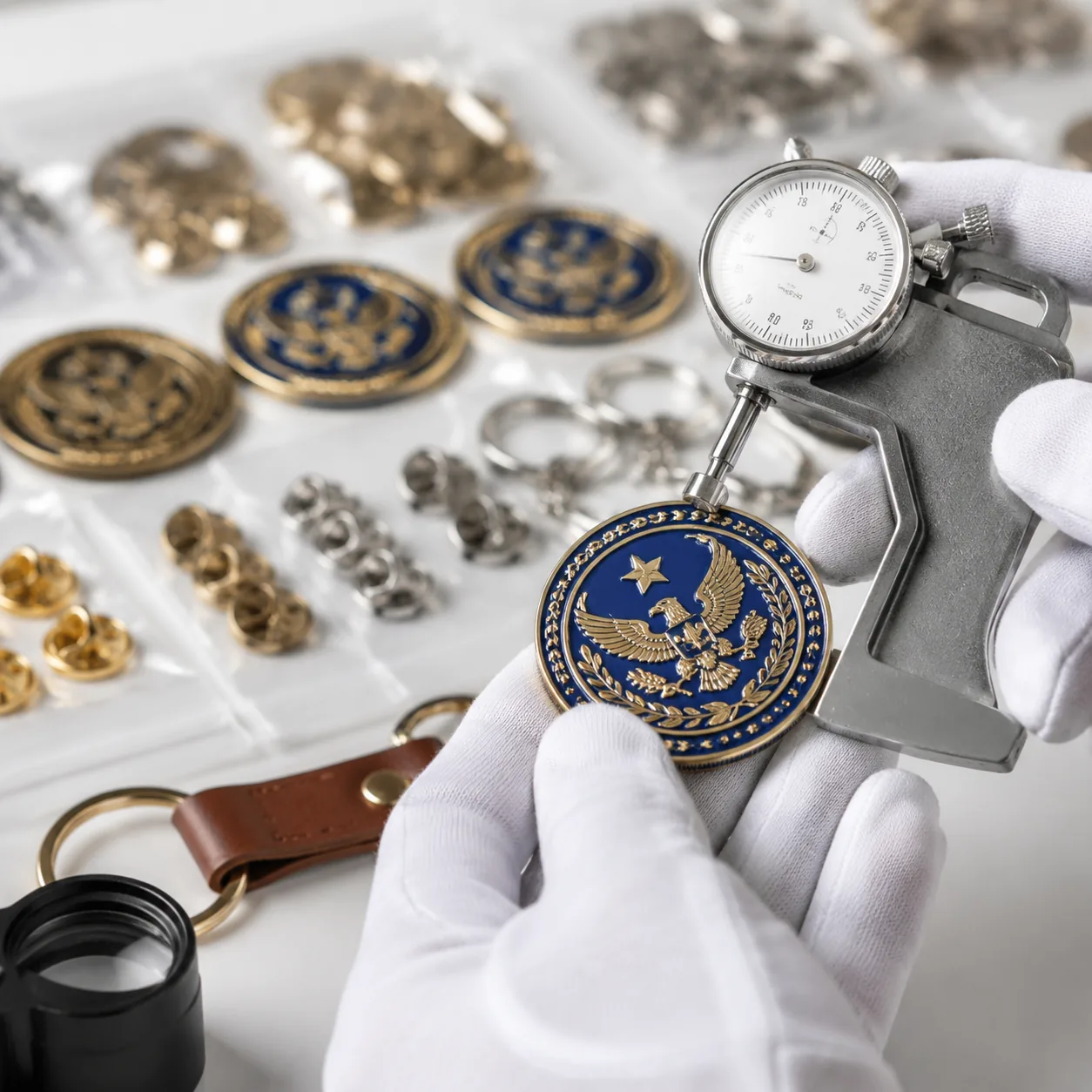
Dimensions are not just about appearance; they control tooling, plating coverage, packaging fit, and attachment performance. A 30 mm pin with a 1.5 mm border behaves differently from a 30 mm pin with a 0.8 mm border because edge wear, fill depth, and metal strength all change. On coins and badges, a tolerance of ±0.3 mm may be acceptable for the outer shape, but hole position, clasp position, or magnet center often needs tighter control, typically ±0.2 mm or better.
If the product has moving parts, cutouts, or double layers, specify both the finished size and the critical-feature tolerance separately. Factories can hold a broad outer tolerance while still missing a key alignment point unless you identify which dimension actually matters. For mixed promo sets, do not assume the same nominal size in different units is interchangeable; a 1 mm difference in pin diameter is visible when it sits beside a coin or keychain on the same backing card.
For tooling-intensive parts, also name what is measured after plating, not only before. Nickel, black nickel, antique brass, and soft enamel fill can each add or remove about 0.03 to 0.12 mm per side in practical production terms, which is enough to matter on tight-fit parts. A sheet that says “30 mm” without clarifying whether that is pre-plate or finished size invites avoidable disputes.
A practical rule is to specify one general tolerance and one critical-feature tolerance. Outer silhouette can often sit at ±0.3 mm to ±0.5 mm depending on material and process, while hinge points, magnet centers, clasp centers, and pin posts should be tighter. If the design has a tight card slot or blister cavity, call out the finished thickness with the same care.
| Spec line | What to write | Why it matters |
|---|---|---|
| Overall size | 30.0 x 24.0 mm, ±0.3 mm | Controls fit, plating area, and visual balance |
| Critical feature | Clasp center 12.0 mm from top edge, ±0.2 mm | Prevents rotation and sagging |
| Thickness | 1.8 mm finished, excluding attachment | Affects weight, durability, and packaging fit |
| Hole or cutout | 2.5 mm opening, ±0.15 mm | Protects tooling and avoids weak edges |
| Backing card slot | 55.0 x 89.0 mm, +0.0/-0.5 mm | Ensures retail pack compatibility |
Material and plating: the numbers buyers forget
Material choice should be written as a grade or construction, not a broad category. “Metal” tells the factory almost nothing; zinc alloy, brass, iron, stainless steel, and aluminum all behave differently in casting, stamping, polishing, and plating adhesion. For plated products, the finish should name the color, surface type, and any minimum thickness requirement, because a bright-gold visual spec is not the same as a 0.1 micron decorative flash gold or a 0.3 to 0.5 micron layer with better wear resistance.
If the product will be handled often, shipped internationally, or stored for months before use, durability matters more than initial shine. Nickel plating, for example, can work as a stable base under color plating, but it may not be the right face finish if the buyer wants a warm antique look. Matte, brushed, sandblasted, and polished surfaces also change how the same plating reads under light, so the sheet should describe both the base surface and the top finish.
For common promo-metal items, these are practical FOB ranges many buyers use for reference at 1,000 to 3,000 pcs per style: zinc alloy soft-enamel pins at about USD 0.55 to 1.40 FOB, hard-enamel pins at USD 0.75 to 1.85 FOB, die-struck coins at USD 0.90 to 2.60 FOB, and keychains at USD 0.70 to 2.20 FOB depending on size, plating, and backing. Low MOQs of 100 to 300 pcs usually raise unit pricing by 20 to 60 percent because setup cost is spread over fewer units. Typical sampling lead time is 7 to 12 days; production lead time is 18 to 35 days after sample approval, depending on plating complexity and packing.
ZheCraft often advises buyers to separate cosmetic finish from protection layer in the spec sheet. That keeps quotes comparable across suppliers and reduces arguments about whether a plating color matched visually but failed in wear. If the item has skin contact, spell out whether nickel-free construction is required and whether that means nickel-free plating, nickel-free substrate, or both. If the target market includes the EU, say so explicitly; many buyers need nickel release control, not just a visual finish claim.
If the supplier quotes plated thickness, ask whether the number is average thickness or minimum local thickness. A decorative flash layer may be quoted at 0.03 to 0.05 micron, while a more durable decorative layer may be 0.1 to 0.3 micron. For antique finishes, the visual result may depend more on polishing and oxidation control than on a thicker coat, so thickness alone is not enough without a finish reference sample.
A useful buyer-side benchmark is to tie finish to a reference condition: bright nickel mirror finish, matte black nickel with 60 to 80 gloss units, antique brass with recessed dark fill, or satin gold with brushed face. If the factory has room to choose between similar looks, you do not have a finish spec; you have a preference.
Decoration method: choose the process before the color
Many spec sheets list Pantone colors before they define the decoration method, which causes trouble later. Screen printing, enamel fill, UV print, offset print, laser engraving, embossing, and debossing all produce different edge quality and color density, so the same brand color may appear differently depending on the process. The buyer should specify the decoration method first, then the color standard, then the acceptable variation.
For enamel products, line width, recess depth, and fill level determine whether the artwork reads cleanly at production scale. A fill that looks perfect in a digital file can fail in metal if the recess is too shallow or the smallest line is below the toolmaker’s practical limit, usually about 0.20 to 0.30 mm for reliable mass production. If the design uses fine text, a 2.0 mm minimum text height is safer than a 1.0 mm guess, especially on small pins and coins.
For printed items such as lanyards, magnets, and packaging cards, the sheet should state whether color is intended to be matched by visual approximation, Pantone reference, or a physical master sample. If a supplier is printing on polyester webbing, a 5 mm logo repeat on a 20 mm lanyard can shift slightly in edge crispness versus a 15 mm repeat on a 25 mm tape, so the artwork scale should be locked too. For woven lanyards, a practical resolution limit is often around 0.3 to 0.5 mm per thread line, so gradients and tiny type should be rejected before quote stage.
The most common mistake is mixing process language with design language. “Full color” is not enough unless it is tied to one process. A 4-color offset print badge, a UV print keychain insert, and a soft-enamel pin all require different tolerances for edge softness, registration, and color drift, so the quote should reflect the real decoration method from the start.
| Method | Best for | Main limitation |
|---|---|---|
| Soft enamel | Raised metal lines and tactile detail | Fill depth variation if art is too fine |
| Hard enamel | Flat, polished surface | Less visible texture; tighter color control needed |
| UV or epoxy print | Small logos and gradients | Can scuff if handling is heavy |
| Laser engraving | Serials, text, and monochrome marks | No color, limited contrast on some metals |
Attachment, function, and use case
A spec sheet should treat attachment as a functional component, not a footnote. On pins and badges, butterfly clutch, rubber clutch, magnetic back, safety pin, brooch pin, and deluxe clasp all change the item’s weight limit, skin contact, and rotation behavior. A heavier brooch-style product may need a broader pin bar or two-point support to prevent sagging, while a lighter promo pin may be fine with a standard clutch and simple anti-rotation teeth.
For keychains, the attachment hardware is equally important: split ring size, chain length, jump-ring wire diameter, and swivel quality all affect returns. If the item is intended for retail sale rather than a giveaway, specify drop resistance or pull force expectations in practical terms, not vague words like “strong.” For example, a key fob may need to survive a 10 N pull test on the ring, while a bag charm could accept lower load but needs better surface protection against abrasion.
For magnets and fridge items, the back-side adhesive, magnet grade, and substrate flatness determine whether the product sits flush and stays aligned. A 30 x 30 mm fridge magnet using ferrite may hold fine for paper displays, but if the buyer wants a thicker base or a premium feel, neodymium or a larger contact area may be required. The spec should state whether the item is decorative only or expected to hold a card stack, and if so, define the target holding force, such as 150 to 250 g for a small memo magnet.
One useful habit is to state the product’s real-world stress case. For example: daily pocket carry, conference badge wear, fridge display only, or bag charm with repeated pull. That tells the factory whether to optimize for appearance, pull strength, abrasion resistance, or weight. At ZheCraft, this is often the difference between a quote that looks lower and a product that survives actual use.
- State the expected use case, not just the product name.
- Specify attachment type, size, and finish for every hardware part.
- Name any pull, drop, or holding-force target in numeric terms.
- Identify whether the product is decorative, wearable, or load-bearing.
- Call out any skin-contact or safety requirement up front.
Inspection limits: turn quality into numbers
A spec sheet should not say only “good quality” or “no defects.” It should identify the inspection standard and the defects that fail the order. For large promotional orders, an AQL framework is usually the most practical way to align factory and buyer expectations, with visual inspection often set around AQL 2.5 for major defects and AQL 4.0 for minor defects, depending on product type and risk. For premium retail packs, some buyers tighten major defects to AQL 1.0 or 1.5 and keep minor defects at AQL 2.5, but the exact level should be written before production starts.
The sheet should also define what is checked on every unit versus what is sampled. Color consistency, plating scratches, attachment function, and package count are not equally important. If a sample passes but the mass run drifts, the buyer needs a reference point: approved sample, approved color chip, approved hardware, or approved carton pack-out. Without that hierarchy, every defect becomes a debate instead of a measurement.
A practical inspection line for small promo hardware might read: no sharp burrs by touch, no visible plating pitting at 30 cm viewing distance, no color shift beyond Delta E 2.0 against approved master, no mixed SKUs, and functional attachment pass on 100 percent of units if the part is wearable or load-bearing. For dimension checks, a common factory target is Cpk 1.33 on critical features when the program is mature; for new tooling, buyers often require a first article report before mass production.
For claims and dispute prevention, define acceptance by defect type. Example: major defects include broken clasp, missing plating area over 2 mm, wrong Pantone family, or incorrect SKU; minor defects include small surface scratches under 0.5 mm, tiny polish haze, or slight card print shift. If you do not categorize defects, the factory cannot quote inspection cost accurately and the buyer cannot enforce consistency.
- State AQL level for major and minor defects.
- List pass/fail conditions for scratches, dents, plating voids, and color shift.
- Define what is 100 percent inspected versus sampled.
- Name the approved master sample and its revision.
- Specify who pays for rework if the spec was followed but the result is still unacceptable.
Packing and shipment: the last spec buyers ignore
Packing matters because many claims are not production defects; they are transit damage or unpacking surprises. A correct product in a weak bag, oversized carton, or loose blister pack can still arrive bent, scratched, or mixed. The spec sheet should state inner pack count, bag material thickness if relevant, carton quantity, carton compression limits, and any insert card or barcode requirements.
For small metal items, good packing language is often more important than fancy packaging language. If the buyer wants 100 pins per inner polybag, 20 inner bags per export carton, and no loose hardware inside the carton, that should be written exactly. For soft goods or lanyards, polybag thickness of 40 to 50 microns is common for basic export packing; premium retail packs may use heavier bags or a printed header card. The point is not to overspecify everything, but to stop improvisation at the packing table.
For international shipments, packing also affects counting accuracy and customs handling. If the buyer wants mixed SKUs in one master carton, the carton map should be written before production so the factory does not improvise at the packing stage. When products are small and similar, especially pins, coins, and keychains, a clear pack-out table reduces the chance of SKU mixing far more effectively than a verbal reminder. Standard export cartons are often targeted at 10 to 15 kg gross weight to reduce crush risk and handling damage.
If the product is designed for retail shelves, the packaging spec should say whether minor scuffs on the inner bag are acceptable, whether the card stock must match a particular finish, and whether the set needs a hang hole or euro slot. That level of detail sounds tedious, but it prevents the common situation where the product itself is fine and the commercial presentation is not.
Also clarify shipment timing. A supplier may be able to make the product in 20 days, but not print cartons, wait for approval, and pack mixed sets in the same week. If the order has a fixed launch date, lock the production calendar as clearly as the artwork.
What to do next
Take your current spec sheet and highlight every line that uses a subjective word: nice, strong, premium, standard, matching, durable, or high quality. Replace each one with a measurable requirement or a named reference sample. If the line cannot be measured, it cannot be inspected, and if it cannot be inspected, it will not be controlled consistently.
For your next RFQ, keep the sheet to one product family and one revision only. Include size, material grade, finish thickness where relevant, decoration method, tolerance, attachment, inspection standard, MOQ, lead time, and packing format in the same document. If you want, ZheCraft can help turn that into a production-ready spec sheet for pins, coins, keychains, badges, patches, or lanyards before you request quotes.
Have a project? Send your artwork and target quantity and we’ll reply with a detailed quotation within 12 working hours.
Ready to get this made?
Send your sketch, target quantity and ship-date. Detailed quotation in 12 hours.



