How to Read a Custom Metal Product Spec Sheet
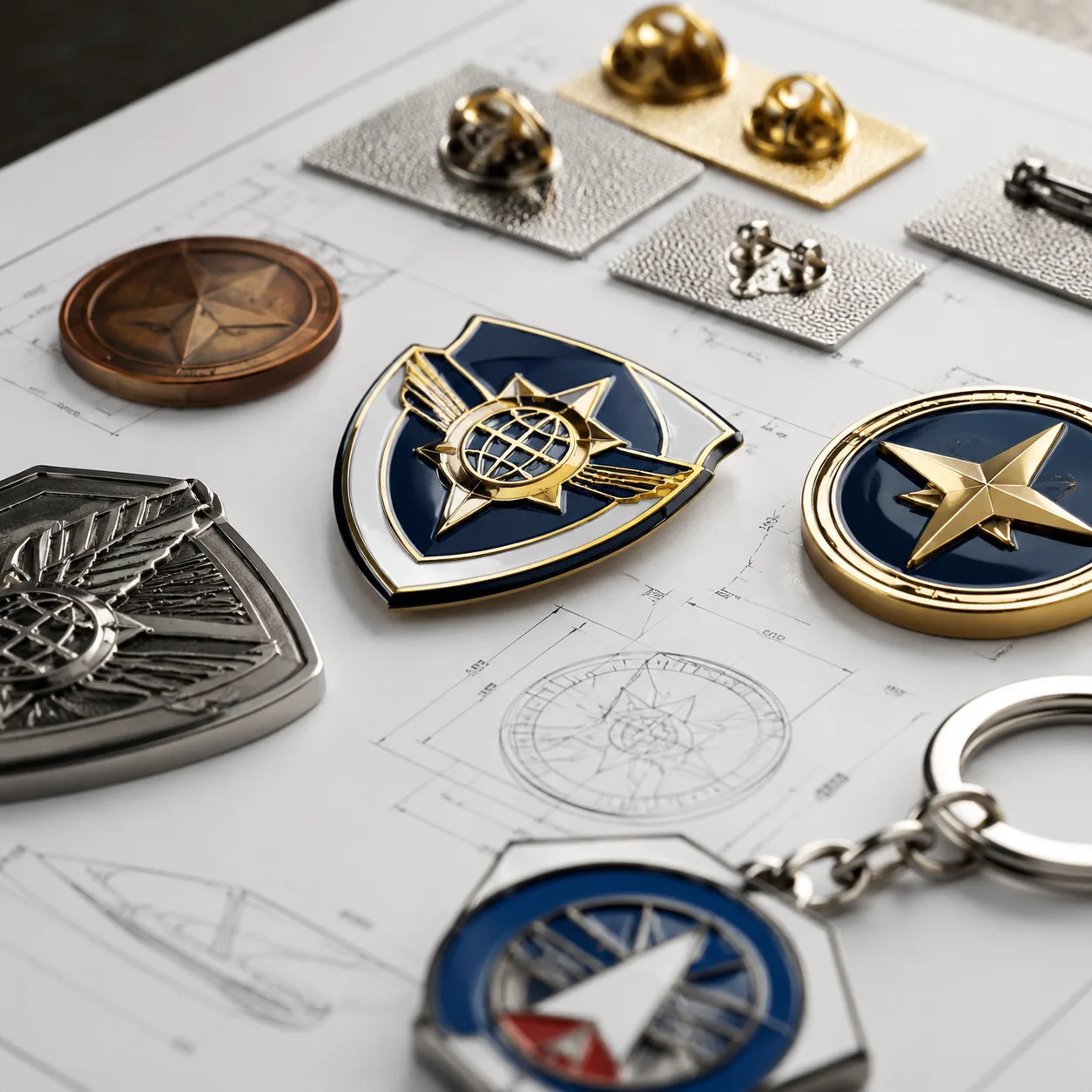
Why spec sheets fail at quote stage
Most rework starts before tooling, when a buyer approves a quote that looks complete but leaves key variables undefined. A custom metal product spec sheet should function as a production contract, not a marketing summary. If a line item can change fit, finish, cost, inspection method, or lead time, it belongs on the sheet. The fastest way to reduce disputes is to read each line as a factory would: what must be exact, what can vary, and what needs written approval before mass production.
This matters across custom pins, badges, coins, keychains, magnets, patches with metal components, belt buckles, and lanyard hardware. The same artwork can still produce very different outputs depending on process and build: a 35 mm badge may be stamped brass at 1.2 mm, die-cast zinc alloy at 2.0 mm, or a printed insert with epoxy. Those parts are not interchangeable even if the front image is identical. Buyers often compare unit price without checking whether the item is 2D or 3D, soft enamel or hard enamel, polished or antique, or whether the attachment is included. That is where hidden cost lives.
A good rule: if the supplier cannot reproduce the quote from the spec sheet alone, the spec is incomplete. A complete sheet should let a second buyer, a sampler, and an inspector all reach the same conclusion about the product without calling back for clarification.
Base construction: the line that changes everything
The base construction line tells you how the item is built, and that affects tooling, surface detail, unit cost, and rejection risk. Stamped brass is usually preferred for crisp edges, thin profiles, and small cutouts. Die-cast zinc alloy is usually preferred for heavier 3D forms and deeper relief. If the quote says only “metal badge” or “custom pin,” the process is underdefined. Ask for the base metal, forming method, and whether the design is 2D or 3D before approving tooling.
A useful production spec states material, process, thickness, and finished size together. Example: brass, stamped, 1.2 mm thick, 35 mm wide, 2D front, polished edges. For zinc alloy pieces, a common production thickness range is 1.5 to 3.0 mm, with 0.3 to 0.5 mm relief depth on simpler designs and up to about 1.2 mm on heavier cast pieces. If the design has fine cutouts, bridges under 0.4 mm, or small text below 1.5 mm high, brass generally gives less shrinkage risk than die casting. As a practical cost reference, FOB pricing often starts around USD 0.20 to 0.45 per piece for simple stamped items at 1,000 pcs, rises to USD 0.60 to 1.50 for plated enamel pins, and can exceed USD 2.00 for heavier cast, polished, or multi-step pieces depending on packaging and finish.
MOQ also follows construction. Simple stamped items with stock hardware may start at 100 to 300 pcs. Custom cast pieces with enamel usually sit at 300 to 1,000 pcs. If a supplier offers a very low MOQ, confirm whether that price assumes existing tooling, shared molds, or a simplified finish. Cheap quotes often depend on assumptions the buyer has not noticed yet.
| Spec line | What it controls | Common buyer mistake |
|---|---|---|
| Base metal | Strength, weight, edge sharpness | Approving a quote without naming brass or zinc alloy |
| Process | Detail depth and tooling cost | Assuming stamped and die-cast are interchangeable |
| Thickness | Feel, rigidity, plating behavior | Leaving thickness “factory standard” |
| 2D/3D definition | Visual style and mold complexity | Not stating whether raised areas are required |
Size, thickness, and weight: the numbers that drive cost
Size and thickness are not cosmetic notes; they directly affect mold size, polishing time, plating coverage, and shipping weight. A 25 mm pin and a 50 mm pin may share the same artwork, but the larger one often needs thicker base metal, stronger attachments, and more polishing labor. If the spec sheet lists only overall width, ask whether that includes cutout tabs, raised borders, or a backing plate. For circular items, diameter should be measured across the finished outer edge, not the artwork boundary.
Thickness tolerance matters because thin parts can warp during polishing or plating, while thick parts add cost and may require different backing hardware. A practical tolerance for many custom metal promo items is ±0.2 mm on thickness and ±0.5 mm on linear dimensions. For items that must align with inserts, packaging, or companion parts, tighten the tolerance to ±0.1 mm on critical features and define which surfaces are cosmetic versus functional. If the design includes holes or mounting points, call out positional tolerance too; ±0.3 mm is a realistic target for many small metal parts, while tight-fit assemblies may need ±0.1 to ±0.2 mm on critical hole locations.
Typical production lead time for simple metal promo items is 12 to 18 days after sample approval. Plated or enamel items with multiple color steps usually need 18 to 25 days. Rush orders can sometimes be compressed to 7 to 10 days, but only if tooling is ready and the spec is locked. For packaging changes, add 3 to 7 days if inserts, printed cards, or barcode labels must be sourced separately.
The sample should be representative of the mass order, not better than it. If the sample is thicker, glossier, or more polished than the production run, it creates a false approval and a predictable dispute later. Good factories lock dimensions before sampling so the approved sample reflects the final build, not an idealized one-off.
Plating spec: finish, thickness, and what buyers forget
Plating is where many buyers read the color but miss the process. The spec should name the finish, the layer stack, and any special requirements such as nickel-free or anti-tarnish topcoat. Common decorative plating thicknesses are roughly 0.3 to 1.0 microns for the visible layer. For higher-wear items, some factories apply 1.0 to 2.5 microns on the top layer or add a clear protective lacquer to reduce tarnish. If a quote is unusually cheap, confirm whether the finish is true electroplating, PVD, spray color, or a shortcut coating.
When comparing quote lines, ask whether the finish is polished, matte, antique, brushed, or sandblasted, because each changes labor and final appearance. Antique brass can hide small surface marks and recessed texture, while mirror nickel exposes scratches and requires stronger pre-polishing control. For wearable items, ask whether the plating is nickel-free if the destination market requires it, and whether an anti-tarnish seal is included for humid climates or retail storage of 6 months or longer. Without that note, tarnish risk becomes a post-shipment complaint rather than a manufacturing discussion.
A practical FOB range for common finishes is useful during quoting. For 1,000 pcs, basic shiny nickel or antique brass may land around USD 0.20 to 0.45 depending on size and hardware. Adding hard polish, extra plating color, or protective lacquer can push the same item into the USD 0.45 to 0.90 range. Premium finishes such as matte black with selective polish, rainbow plating, or PVD-style effects often need tighter process control and higher scrap allowance, so the final price may move above USD 1.00 per piece even before packaging is added.
| Finish type | Best for | Trade-off |
|---|---|---|
| Shiny nickel | Clean corporate look | Shows scratches and polishing marks |
| Antique brass | Vintage or high-contrast relief | Less bright, more muted appearance |
| Matte black | Modern promo items | Can show edge wear on high-contact parts |
| Rainbow / special finish | Attention-grabbing campaigns | Higher variation and narrower control |
Color and fill: what the spec must say
For enamel items, the color line should specify Pantone references, fill type, and whether metal walls will be raised above the color. “Red” is not enough; Pantone 186 C and Pantone 200 C are both red families, but they read differently under daylight and indoor LED lighting. If the item uses soft enamel, note whether recessed fills are flush, slightly domed, or intentionally low. If it uses hard enamel, surface leveling and post-fill polishing become part of the spec, not an afterthought.
A complete color line also addresses acceptable variation. For batch manufacturing, a practical control target is a visual match within an agreed Delta E threshold, often around Delta E 2 to 3 for branded programs, with a physical master sample used as the reference. If exact matching is critical, send a printed swatch or approved production sample, not only a PDF. Buyers sourcing from factories like ZheCraft often send a primary sample plus a Pantone callout, which reduces the chance of arguing over monitor color later.
For designs with multiple fills, the spec should also state minimum wall width. A common usable minimum is 0.25 to 0.30 mm for simple soft enamel, but 0.35 to 0.40 mm is safer for small text and thin borders. If the wall is too narrow, color bleed and uneven fill are more likely. For hard enamel, ask for final surface flatness within about 0.10 to 0.15 mm relative to the metal wall on visible faces.
If the design includes gradients, translucent fills, or printed color areas, specify the print method separately. Do not let a supplier substitute paint, silk screen, or epoxy doming without written approval. Those substitutions can change gloss, abrasion resistance, and the way the logo reads at retail distance.
Hardware, attachment, and function checks
Hardware is one of the easiest places to under-spec and the hardest place to fix after production. Backing type, pin post count, magnet strength, split ring size, chain length, clasp style, and any safety feature all need to be written into the sheet. If the product is used on clothing, backpacks, or soft goods, the hardware must match the load and fabric thickness. A decorative item that fails in use is usually a spec problem, not a factory problem.
For metal badges and pins, specify whether the backing is butterfly clutch, rubber clutch, deluxe clutch, safety pin, or magnetic back, and state whether the post is centered, offset, or anti-rotation. For standard pins, one post is common for small items under 30 mm; larger pieces often need two posts to prevent spinning. For keychains, define the ring diameter, chain length, connector type, and whether the chain is single or double loop. For lanyards, define the hook style, breakaway requirement, and any anti-twist feature. If the hardware will touch skin or fine fabric, state whether edges need rounding to at least R0.2 mm or if a protective cover is required.
If you need hold strength, define it in practical terms. For example, a magnetic badge may require a pull force of 1.5 to 2.5 kgf for lightweight apparel and higher for thicker garments. A keychain ring may need a 25 mm outer diameter with 1.8 mm wire thickness, while a split ring for higher wear may need 2.0 mm wire. These values make sourcing less ambiguous and help the factory choose standard hardware instead of guessing.
- State the exact attachment type and finish.
- Specify the number and placement of posts or attachment points.
- Confirm load expectation for wearable items.
- Call out anti-rotation, locking, or breakaway features if needed.
- Ask for hardware photos on the pre-production sample.
Tolerances, surface quality, and acceptance limits
A spec sheet becomes powerful when it defines what counts as acceptable and what counts as a defect. Surface quality should mention allowable scratches, pinholes, pits, bubbles, color bleed, plating dullness, burrs, and exposed base metal. Tolerances should also cover cutouts, internal gaps, and line width, especially for logos with small text or fine borders. If the art depends on clean separation between colors, the factory needs a minimum line width and a clear note on how much metal wall is required.
For most promotional metal products, a buyer can start with practical acceptance limits such as AQL 2.5 for major defects, AQL 4.0 for minor defects, and AQL 0 for critical defects. That means no broken posts, no missing parts, and no unsafe sharp edges on shipment. For premium orders, some buyers tighten the plan to AQL 1.5 for major defects and AQL 2.5 for minor defects. If you skip acceptance criteria, the sample may pass on appearance while the mass order drifts beyond what the brand can use. A clear spec should also state whether minor cosmetic marks inside a hidden area are acceptable or not.
Tolerance language should be measurable. Example: overall size ±0.5 mm, hole position ±0.3 mm, thickness ±0.2 mm, enamel fill flush within 0.15 mm of the metal wall, and plating coverage 95 percent minimum on exposed faces. For plated parts, define whether “coverage” applies to visible faces only or all exposed surfaces including edges. These numbers give the inspector a target and give the supplier a way to correct problems before shipment, instead of after a customer opens the box.
If the item has cosmetic grading, define it. For example, front-facing scratches longer than 2 mm may be rejected on premium retail goods, while a hidden back surface may allow light tooling marks if they do not affect function. That distinction matters because factories need to know where to spend labor and where a small mark is commercially acceptable.
Compare complete vs incomplete specs before approving production
The clearest way to read a quote is to compare a complete spec line with an incomplete one. The difference is not paperwork style; it is production risk. A complete line reduces judgment calls at the factory and makes it easier to trace a defect back to the original instruction. An incomplete line often looks cheaper only because the supplier has not priced the unknowns yet.
| Spec area | Complete line | Incomplete line |
|---|---|---|
| Base metal | Brass, stamped, 1.2 mm thick | Metal badge |
| Plating | Shiny nickel, 0.5 microns, lacquered | Silver finish |
| Color | Pantone 186 C soft enamel, recessed fill | Red enamel |
| Hardware | Two butterfly clutches, centered posts | Back attachment included |
| Tolerance | ±0.5 mm overall, ±0.2 mm thickness | As per factory standard |
This same logic applies to MOQ tiers and pricing. A supplier may quote USD 0.38 FOB at 1,000 pcs, USD 0.29 at 3,000 pcs, and USD 0.22 at 5,000 pcs for the same item, but only if the spec stays unchanged. If you add a second plating color, custom back stamp, or retail packing insert, the price and lead time should move accordingly. As a guide, many factories treat 100 to 300 pcs as a low MOQ for simple stock-hardware combinations, 500 to 1,000 pcs as a common MOQ for custom enamel or cast pieces, and 3,000 pcs or more for fully custom packaging or specialty finishes.
Lead time should also be tiered. A repeat order with no design changes may ship in 7 to 12 days after sample approval. A new custom design often needs 12 to 18 days. Multi-color enamel, special plating, or retail packaging can extend that to 18 to 25 days. If a supplier promises much less, ask whether tooling, plating, or QC is being skipped from the timeline.
What to do next before you approve production
Before approving a sample or mass production, convert your buyer brief into a line-by-line spec sheet and verify every field against the quote. Ask the supplier to confirm material, thickness, process, finish, color method, hardware, tolerance, MOQ, lead time, and acceptance level in writing. If any line is missing, treat it as a risk item rather than a harmless omission. For mixed product programs, lock the same language across pins, badges, coins, keychains, magnets, and lanyard hardware so the supplier does not interpret the same brand differently across items.
A practical approval workflow looks like this: confirm the drawing, approve the physical or digital proof, check that dimensions and plating notes match the quote, and release tooling only after the sample matches the written spec. If you are working with ZheCraft, send the artwork plus your preferred dimensions, finish, attachment, target use case, and shipment deadline, then ask for a spec confirmation before sampling. That is the fastest way to catch mismatches early, when a revision still costs days instead of weeks.
Before release, ask one final question: if this order ships exactly as written, will the buyer still be satisfied? If the answer depends on an assumption that is not on the sheet, add it now. In practice, the best orders are not the most creative ones; they are the ones where every important variable is written down before a mold is cut.
Have a project? Send your artwork and target quantity and we’ll reply with a detailed quotation within 12 working hours.
Ready to get this made?
Send your sketch, target quantity and ship-date. Detailed quotation in 12 hours.



