How to Order Mixed Promo Products Without Color Drift
Why mixed promo orders drift
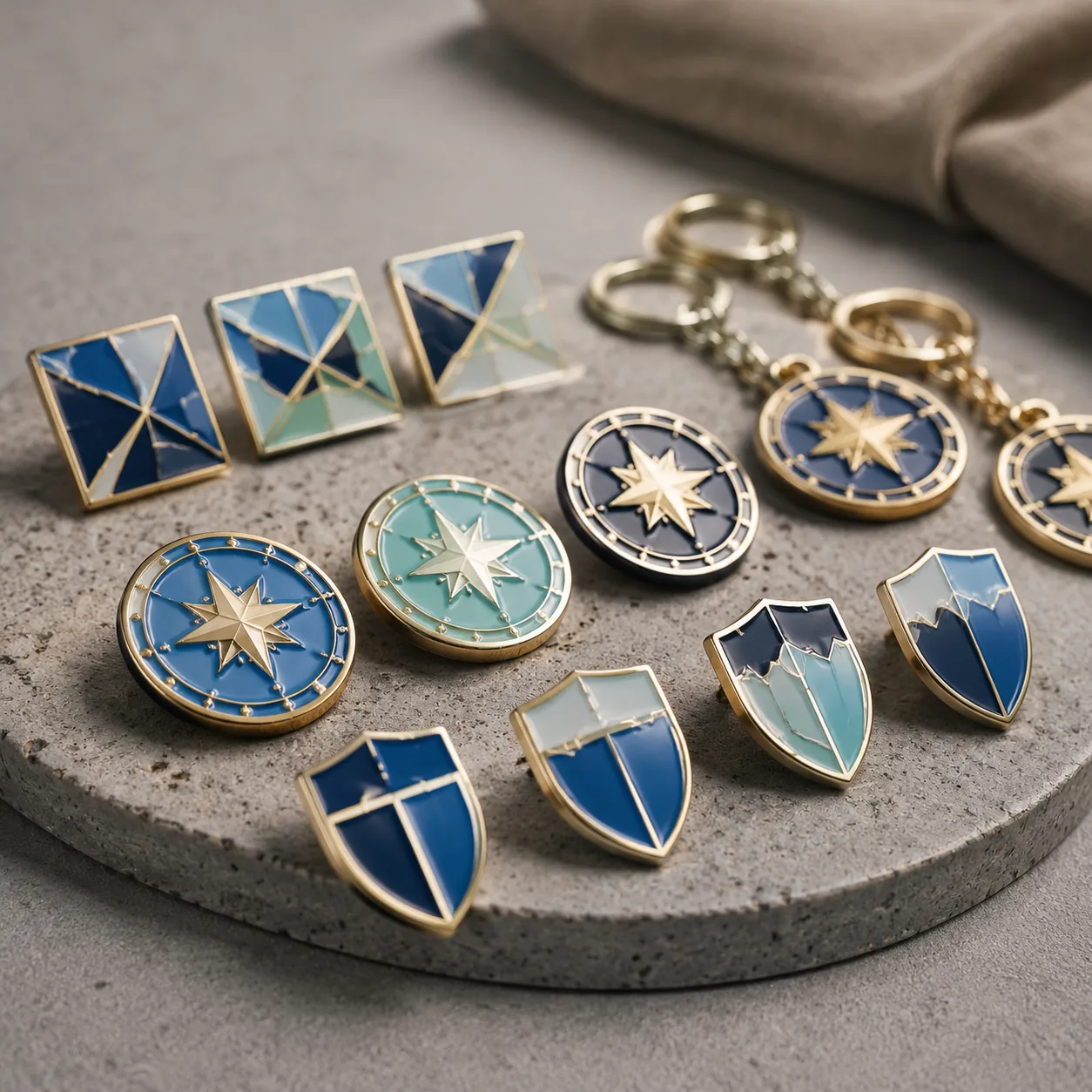
Mixed promotional orders fail when buyers treat pins, coins, lanyards, patches, PVC charms, and keychains as if one Pantone callout will behave the same on every material. It will not. A Pantone 186 C red in hard enamel over nickel, a woven polyester patch, and a sublimated lanyard can all be produced correctly and still look inconsistent when packed in the same campaign kit.
The reason is physical, not cosmetic. Metal reflects light from plated edges. Fabric absorbs light and changes shade with yarn direction. PVC color is compounded into a soft polymer and can shift during curing. Screen-printed or heat-transferred ink sits on a base material whose whiteness, texture, and finish affect saturation. Even clear epoxy can warm or darken a color by a small but visible amount.
For procurement, color must be controlled like a critical dimension. A usable order file defines the target, the measuring method, the acceptable tolerance, the approval sample, and the person authorized to release production. Without those controls, the factory is forced to interpret “match brand blue” using its own lighting, substrate, ink supplier, and production experience. That is how rework, delayed launches, and receiving disputes begin.
The strongest mixed-product orders use one visual standard but different process limits. The buyer keeps the brand family consistent while allowing realistic variation by material. ZheCraft typically sees fewer disputes when buyers confirm these controls before tooling, mold making, dye lots, or embroidery thread purchasing begins.
Set one master standard
Start with a master reference, not a file name. The best reference is a retained golden sample from a previous approved run. The next best option is a current physical Pantone guide, such as Pantone Solid Coated for enamel and print or Pantone TCX/TPG where textile matching is required. A PDF, JPG, or phone photo should never be the final authority because screen brightness and white balance can move the perceived color farther than the production process itself.
Write the hierarchy into the purchase order. For example: “Color approval priority: 1) retained 2024 golden sample, 2) Pantone 286 C coated swatch viewed under D65 daylight, 3) approved digital artwork for layout only.” This prevents arguments when a screen proof looks slightly different from a physical sample. Artwork confirms placement and shape; it does not replace a physical color standard.
For metal goods, define the color and the finish together. A navy enamel fill bordered by polished nickel will read cooler than the same fill bordered by gold plating. Antique brass will mute bright fills, while black nickel can make adjacent colors appear deeper. For soft goods, identify the thread, fabric, or ink target separately because polyester yarn, woven backing, and heat-transfer ink do not reflect light like enamel.
If the campaign has retail or brand-compliance risk, request one master retained sample for the full program and one approved pre-production sample per product type. The master sample anchors the brand color; the category samples prove the color is achievable on each substrate. This adds several days at the front of the order but is cheaper than rejecting finished inventory.
Define tolerances by process
A practical specification gives the factory a measurable pass/fail range. For hard enamel, printed metal, and flat coated surfaces, many buyers use a spectrophotometer target of ΔE 2.0 to 3.0 under D65/10° viewing. For textiles, PVC, and embroidery, a broader visual range is often necessary because texture, pile, thread twist, and surface gloss affect the reading. If a supplier promises “100% same color” across metal, textile, and molded PVC, treat that as a sales statement, not a control plan.
Use numbers that match the method. Typical hard enamel fills are polished nearly flush with raised metal lines and can hold tighter color consistency than soft enamel, where recessed pools and gloss make fills look darker. Embroidery thread can vary by dye lot, and stitch direction can change shade even within one patch. PVC color may shift during mixing and curing, especially on bright white, neon, translucent, or very dark colors.
| Product or method | Practical color tolerance | Related production spec | Main control risk |
|---|---|---|---|
| Hard enamel pins | ΔE 2.0-3.0 or close visual match to approved plated sample | Metal line tolerance ±0.10 mm; enamel overfill/underfill checked visually | Polishing and plating change perceived shade |
| Soft enamel pins | ΔE 3.0-4.0 visual range | Recess depth often 0.20-0.40 mm; optional epoxy adds gloss | Recess shadow makes colors appear darker |
| Challenge coins | ΔE 3.0-4.0 on color fills | Die-struck relief tolerance ±0.15 mm; antique finish must be approved | Antique wash mutes nearby colors |
| Screen-printed lanyards | ΔE 3.0-5.0 depending on webbing color | Common widths 15, 20, 25 mm; print registration ±1.0 mm | Ink absorption and polyester dye lot variation |
| Sublimated lanyards | ΔE 4.0-5.0 visual range | Best on white polyester; edge-to-edge print can vary ±1.5 mm | Heat, pressure, and base fabric whiteness |
| Woven patches | Visual tolerance against approved yarn card | Border tolerance ±1.0 mm; small text usually needs 2.5-3.0 mm height | Yarn sheen and stitch density alter shade |
| Molded PVC items | ΔE 3.0-5.0 depending on pigment | Relief tolerance ±0.20 mm; minimum raised line often 0.50 mm | Pigment mixing, curing, and material shrink |
Also define inspection level. For general cosmetic inspection, many importers use ANSI/ASQ Z1.4 or ISO 2859-1 with General Inspection Level II. Common AQL settings are 0.65 for critical defects, 2.5 for major defects, and 4.0 for minor defects. Color outside the approved tolerance should normally be major if it affects brand presentation, not minor.
Map color to substrate
A mixed-order color map translates one brand color into realistic production targets. It should list the master color, the intended appearance, and the target for each substrate. For example, a buyer may define brand blue as Pantone 286 C, then approve enamel against Pantone 286 C, woven patch thread against the closest available polyester yarn, and sublimation against a printed strike-off on white 20 mm polyester webbing.
Do not expect every process to hit the same instrument reading. A spectrophotometer can help on smooth, opaque surfaces, but it is less reliable on textured embroidery, metallic finishes, glitter enamel, reflective thread, transparent PVC, and curved epoxy domes. In those cases, use a physical sample under controlled viewing conditions: D65 daylight, neutral gray background, and a viewing angle that avoids glare.
Substrate color matters. Printing white ink on black fabric, yellow ink on navy webbing, or red on natural cotton will not match the same ink on a white base. For lanyards, ask whether the factory is printing on pre-dyed webbing or sublimating on white polyester. Sublimation on white polyester usually gives brighter color and faster setup, while screen printing on dyed webbing can be more opaque but may require ink drawdowns and longer drying time.
For patches, confirm whether the item is woven, embroidered, chenille, printed, or PVC. A woven patch can reproduce smaller detail and flatter color blocks than embroidery, but thread availability still limits exact color matching. Embroidery often looks premium but cannot hold tiny brand marks, gradients, or small text without distortion. If text is under 3 mm high, woven or printed construction is usually safer than embroidery.
Control finish, coating, and sheen
Finish is part of color control. Plating thickness for promo metal goods is commonly around 3-8 microns, depending on the finish and price point. Thinner plating may pass basic appearance checks but can look uneven on edges, recesses, or large flat areas. If the item will be handled heavily, specify the plating finish and corrosion expectation, such as 24-hour neutral salt spray for standard decorative plating or 48 hours for higher-risk retail programs.
Clear coatings change appearance. Epoxy domes add depth and gloss but can make colors look warmer or slightly darker after curing. Matte varnish can reduce saturation. UV coating over printed charms can increase contrast and make small dust defects more visible. If the final product includes epoxy, varnish, glitter, translucent enamel, glow pigment, or metallic ink, the approval sample must include that layer; a flat color swatch is not enough.
Metal finish pairings also need approval. A black enamel fill on antique nickel may disappear in low light, while the same fill on polished silver remains legible. White enamel next to gold plating can look creamier than expected. Raised metal lines below 0.25 mm may polish down unevenly and create inconsistent borders around color fills. For most die-struck lapel pins and coins, keeping raised metal lines at 0.30 mm or wider improves color separation and reduces visual bleeding.
Soft goods need sheen control too. Glossy screen print, matte silicone print, woven polyester, and embroidery thread can all use the same nominal color but look different under retail lighting. If the campaign will be photographed, displayed at a trade show, or packed in one gift box, approve the finish-and-color pairing under the same lighting used for final evaluation.
Price, MOQ, and lead-time realities
Color control affects cost and schedule. A supplier quoting mixed promo items without sample time, mold time, dye-lot approval, or separate pre-production approvals is probably assuming a low-control order. That may be acceptable for giveaways, but it is risky for brand-critical launches.
| Item | Common MOQ tier | Typical FOB China price range | Sample lead time | Bulk lead time after approval |
|---|---|---|---|---|
| Hard enamel pins, 25-35 mm | 100, 300, 500, 1,000 pcs | USD 0.65-1.80/pc depending on size, plating, clutch, card | 7-10 days | 12-18 days |
| Soft enamel pins, 25-40 mm | 100, 300, 500, 1,000 pcs | USD 0.45-1.35/pc; epoxy usually adds USD 0.05-0.15 | 6-9 days | 10-16 days |
| Challenge coins, 40-50 mm | 100, 300, 500 pcs | USD 1.60-4.20/pc depending on thickness and enamel areas | 10-14 days | 18-25 days |
| Printed lanyards, 20 mm | 300, 500, 1,000, 3,000 pcs | USD 0.28-0.85/pc with hook and safety breakaway | 5-8 days | 10-15 days |
| Woven or embroidered patches | 100, 300, 500, 1,000 pcs | USD 0.35-1.60/pc depending on size, backing, border | 6-10 days | 12-18 days |
| Molded PVC keychains | 300, 500, 1,000 pcs | USD 0.70-2.30/pc depending on mold size and color count | 9-14 days | 15-22 days |
These ranges are planning figures, not fixed quotes. Tooling, color count, packaging, freight terms, exchange rates, inspection requirements, and seasonal load can move them. However, they show why buyers should not approve mixed campaigns at the last minute. A realistic schedule for controlled color across several product families is usually 25-45 days from approved artwork to ready-to-ship goods, depending on sampling rounds.
Small MOQs also increase variation risk. A 100-piece pin run and a 300-piece patch run may be made on different production lines, using different material batches, and packed by different teams. If the order will be reordered later, ask the supplier to retain color formulas, thread codes, plating notes, and one approved sample for at least 12-24 months.
Build a usable approval workflow
The workflow should be simple enough for the supplier to follow and strict enough to protect the buyer. Separate artwork approval from color approval. Artwork approval confirms size, shape, logo position, die lines, text, packaging layout, and attachment hardware. Color approval confirms the actual material, finish, pigment, ink, thread, coating, and viewing condition.
A good sequence is: RFQ with color-control sheet, digital artwork proof, material or thread confirmation, pre-production sample, written sample approval, bulk production, in-line check, final inspection, shipment release. Do not allow mass production to start from a digital proof unless the order is low risk and the buyer accepts the variation.
- Name one buyer-side decision owner for final color release.
- List the master reference and approval hierarchy on the PO.
- Define each product’s substrate, finish, coating, and decoration method.
- State tolerances such as ΔE range, visual approval rule, and AQL level.
- Require one pre-production sample per product family or decoration method.
- Approve samples under D65 daylight or another named lighting condition.
- Keep one golden sample at the factory and one with the buyer for reorders.
- Record thread codes, ink formulas, plating finish, and epoxy or varnish use.
Approval evidence should be explicit. “Looks good” in a chat thread is weak. Use a dated approval message tied to the sample number, product code, color target, and any accepted deviation. If a sample is approved with a known difference, write it down: for example, “Patch navy accepted visually darker than enamel pin due to woven yarn texture.” This protects both buyer and supplier during final inspection.
Inspect before shipment
Final inspection should compare production goods against the approved sample, not against memory or a phone image. Pull samples from the beginning, middle, and end of production where possible. For AQL inspection, define whether color drift is critical, major, or minor before the inspector arrives. Brand color mismatch, wrong plating, missing epoxy, or visibly inconsistent dye lots should normally be major defects.
For mixed kits, inspect both individual items and the assembled set. A lanyard may pass alone, and a pin may pass alone, but the campaign can still fail if the two brand blues clash strongly in the same pouch or gift box. Place the items side by side under neutral daylight and retail-like indoor light if the final use environment matters.
Packaging can also change perception. A white backing card makes colors look cleaner and brighter; kraft paper can warm them; black foam can deepen nearby shades. If the kit will be presented on a printed card, blister tray, velvet box, or polybag with insert, include packaging in the final approval sample. For retail programs, inspect barcode placement, warning labels, country-of-origin marking, and carton labels at the same time so shipment release is not delayed after color has already passed.
The practical rule is simple: approve what you will receive, in the condition you will receive it. That means final finish, final coating, final substrate, final packaging, and final inspection criteria. A one-page color-control sheet and disciplined sample workflow usually cost less than one emergency remake, especially when the campaign includes several factories or production methods.
Have a project? Send your artwork and target quantity and we’ll reply with a detailed quotation within 12 working hours.
Ready to get this made?
Send your sketch, target quantity and ship-date. Detailed quotation in 12 hours.



