How to Order Mixed Promo Items Without Color Drift
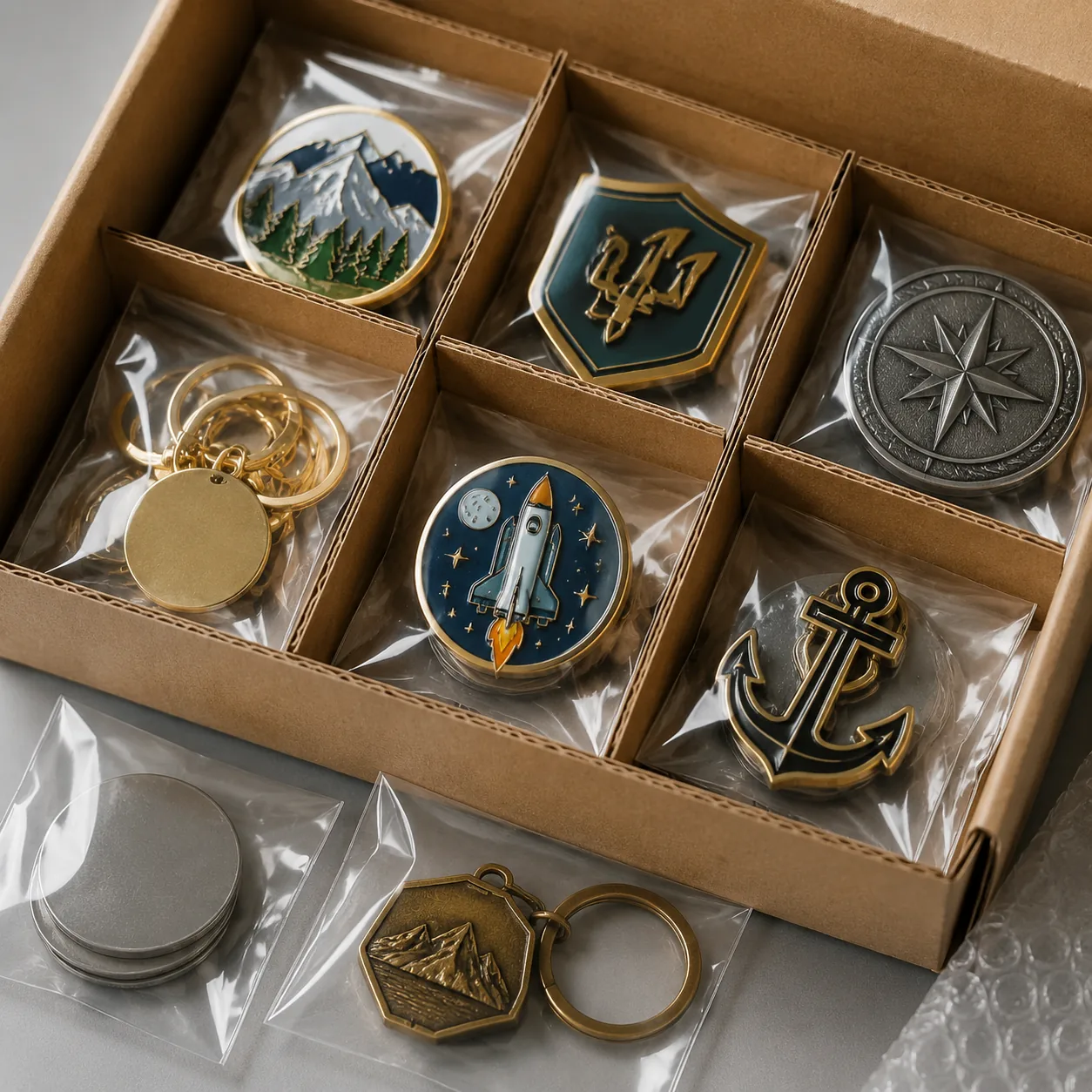
Why mixed promo sets drift off-brand
Color drift usually appears after samples arrive: the pin blue reads colder than the coin blue, the lanyard red prints deeper than the patch, and the backing card finish makes the whole set look uneven. The root cause is not one bad factory step. Each product family uses a different substrate, coating, and decoration method, so one Pantone number does not produce one identical visual result across metal, textile, enamel, and print.
A polished nickel pin reflects light differently from anodized aluminum, woven polyester, or embroidered thread. Even when the artwork is the same, plating thickness, enamel fill depth, ink laydown, curing temperature, and fabric absorption change how the color is perceived. The goal is not perfect visual identity across every item. It is controlled consistency within a defined tolerance band that the buyer and factory both approve before mass production.
The risk is amplified by batch variation. One supplier may keep plating within a tight finish window, while another runs textile dye lots with a slightly warmer cast. If you do not name the master reference, light source, finish target, and acceptable tolerance in writing, the factory will interpret “match” differently for each component.
What to lock in the RFQ
Start by naming one master reference item for the whole set. In most programs, that is the most visible or brand-critical piece: a pin face, coin face, or lanyard ribbon. The other items should follow that reference as closely as their process allows. Do not ask every item to “match the logo” in a vague sense. Ask them to match the approved master sample under a stated light source.
Your RFQ should separate hard requirements from preferred targets. A hard requirement might be Pantone 186 C matched to a physical control sample within ΔE 2.0 under D65 light. A preference might be a satin finish on the coin and a slightly softer hand feel on the lanyard. That distinction lets the factory quote the correct process instead of promising impossible visual uniformity.
Include production assumptions up front: artwork format, plating color, thread or ink method, and whether the first sample or golden sample becomes the reorder standard. For mixed sets, ask each product family to be approved separately, even if they ship together. One approved pin does not automatically approve the patch or lanyard.
- Name one master reference item for the full set
- State Pantone and provide a physical swatch or signed sample
- Specify inspection under D65 or D50, not ambient office light
- Require separate approval for metal, textile, and print components
- Define whether reorder lots must follow the retained sample or the artwork file
Which materials are hardest to match
Metal and textile are the hardest pair to align. Metal reflects light, so plating thickness, polish, and base alloy can make the same color look brighter or darker from one angle to the next. Textile absorbs color, so lanyards and patches usually read deeper and less glossy than a plated pin or coin, even when the ink formula is technically correct.
Soft enamel, hard enamel, woven patches, printed lanyards, and embossed coins each create a different visual effect. Soft enamel sits below the metal rim and often looks slightly darker. Hard enamel is polished flush and usually appears cleaner and brighter. Woven patches reduce saturation because the weave breaks up the image, while printed lanyards can gain density as the ink sinks into the fabric yarns.
The result is predictable if you know what to expect. A navy specified as Pantone 296 C may look almost identical on a woven patch and a screen-printed lanyard, but appear cooler and glossier on a hard enamel pin. That is not automatically a defect. It is the normal behavior of different production systems.
| Item type | Typical color behavior | Useful buyer control |
|---|---|---|
| Soft enamel pin | Color reads slightly deeper in recessed fills | Approve against a retained sample under D65 light |
| Hard enamel pin | Flatter, glossier, and visually brighter | Specify gloss target and plated finish code |
| Metal coin | Reflection changes perceived shade by viewing angle | Match to a plated master sample, not a screen image |
| Woven patch | Fine detail but muted saturation | Use a thread chart and set minimum line width |
| Printed lanyard | Ink density changes with weave and cure temperature | Require a strike-off and confirm fabric lot |
How close is close enough
For most promo programs, “close enough” means the set looks consistent to an end buyer at arm’s length in normal indoor light. In practice, many buyers use a visual acceptance target of no obvious mismatch between primary items and a color difference of roughly ΔE 2.0 to 3.0 for adjacent materials, depending on finish. If the set is intended for retail resale or licensed branding, tighten the tolerance and keep the approval sample on file.
Do not over-specify identical appearance unless the budget supports extra sorting, reject handling, and repeat sampling. Tight control across four product categories often adds 5 to 15 calendar days to the schedule because the factory may need separate color corrections for plating, ink, thread, and packaging. If the campaign has a firm launch date, ask for pre-production proofs on every decoration method and build time for one correction round.
The best control point is the signed golden sample, not the artwork file. Artwork shows intent; the sample shows how that intent actually behaves on metal, fabric, and enamel. For repeat orders, the retained sample should remain the primary standard unless both sides formally agree to update it.
Which specs actually reduce drift
Useful specs are measurable before mass production. For mixed promo sets, the strongest controls are a named master color, an approved sample hierarchy, a stated light source, and finish targets that the supplier can reproduce. If a requirement cannot be checked at sampling, it will not be controlled at shipment.
A good buyer spec also identifies the process limits for each item family. That means you do not ask the lanyard to behave like a coin or the patch to match a mirror-polished pin. Instead, you define a narrow, realistic band for each process and document it in the PO and sample approval sheet.
| Spec area | Recommended instruction | Why it matters |
|---|---|---|
| Color reference | One master Pantone plus signed physical sample | Prevents each category from interpreting the color differently |
| Light source | Inspect under D65 or agreed equivalent | Ambient light can hide or exaggerate mismatch |
| Finish | State gloss, matte, or satin by item | Finish changes perceived color even when pigment is identical |
| Tolerance | Set visual approval plus ΔE target if available | Creates a measurable acceptance boundary |
| Packaging | Use inner bags, tissue, or sleeves for polished items | Scuffing changes the final appearance after approval |
For hard goods, practical manufacturing tolerances are usually tightest on engraving and plating geometry, then looser on perceived color. Common buyer-side controls include decorative plating around 0.08 to 0.12 microns for flash nickel or gold on promo items, with heavier decorative wear-resistant plating often moving to 0.15 to 0.25 microns when budget allows. Dimensional tolerances are often held to ±0.2 mm for small pins and coins and ±0.5 mm for larger accessories. For textiles, specify thread chart references, print strike-offs, and acceptable shade variation by approved lot rather than forcing a metal-style tolerance onto fabric.
What pricing, MOQ, and lead times to expect
Mixed sets cost more to coordinate than single-item orders because each category needs its own sampling, QC, and packing step. As a rough FOB China benchmark for standard promo quality, soft enamel pins often land around USD 0.35 to 1.20 each at 500 to 1,000 pcs, hard enamel pins around USD 0.60 to 1.80, 1.5 to 2 inch coins around USD 1.20 to 3.50, woven patches around USD 0.25 to 0.90, and polyester lanyards around USD 0.28 to 0.85 depending on width, attachment, and print coverage. Rush orders, epoxy domes, cut-to-shape backing cards, or premium plating can push those figures higher.
Typical MOQ tiers are also different by product family. Pins commonly start at 100 to 300 pcs per design for simple factory runs, while better pricing usually appears at 500 pcs and above. Coins often start at 100 to 200 pcs, patches at 100 to 300 pcs, and lanyards at 100 to 500 pcs depending on printing method and hardware. If you bundle all four into one campaign, ask whether the factory can hold one common color standard across separate MOQs or whether each item will need its own minimum lot.
Lead times usually range from 7 to 10 days for sampling and 15 to 25 days for mass production once artwork is approved. Mixed sets with multiple decoration methods often need 20 to 35 days end to end, especially if you require one correction round. Add shipping time separately: air freight may take 5 to 10 days door to door, while sea freight can take 25 to 40 days depending on origin and destination.
How to approve samples without ambiguity
The approval stage should tell the factory exactly what is acceptable. Use one retained sample per item family, sign it, photograph it under the same light, and store it with the PO file. Ask the supplier to label each sample with material, plating code, ink formula, thread chart, and production date so the reorder standard is traceable.
When checking the samples, inspect them in the same environment. D65 light is the safest default for color evaluation; if that is not available, at least avoid mixed office lighting and daylight from a window at the same time. Look at the set together first, then separately. A color that passes alone may still look wrong next to the other items in the kit.
If one component is allowed to differ more than the rest, write that down. For example, a woven patch may be permitted to appear one shade less saturated than the pin, while the lanyard must remain within a tighter band because it is the most visible element when worn. That kind of instruction is far more useful than a generic note that the set must “look premium.”
- Check every sample under the same light source
- Verify plating, thread, and ink references against the PO
- Compare all items as a set, not one by one only
- Confirm packaging prevents rubbing and scuffing
- Keep one signed retained sample for each product family
- Record any approved exceptions in writing
When to split the order instead of forcing one set
Split the order when the products serve different brand roles or when one process is too far from the others to justify a single visual target. A collector pin and a giveaway lanyard do not need the same gloss behavior or the same saturation. If you push both toward one exact appearance, you may spend more on rework than the consistency is worth.
Splitting also reduces schedule risk. A single bundled PO can stall if one department misses color approval or if one material lot is unavailable. A better structure is often one master brand spec, separate POs by product family, and one shared approval file. That keeps color governance unified while allowing each process to run on its own realistic timetable.
If the launch is fixed and the set includes both metal and textile, consider a small pilot run before full production. A 50 to 100 pc pilot for each key item can reveal plating drift, print density issues, or thread substitution before the factory commits the whole batch. That is usually cheaper than discovering the mismatch after packing.
What experienced buyers do next
Experienced buyers lock the visual standard in writing, not in memory. They approve one retained sample per item family, define the master reference item, and specify exactly which differences are acceptable between metal, textile, and print. They also ask the supplier whether the same plating bath, ink formula, thread chart, and fabric lot will be used for repeats, because reorders often drift when a factory treats the first batch as a one-off visual target.
The most reliable setup is a single coordination owner at the factory who tracks plating, printing, weaving, and packaging against one approval file. That owner should be responsible for color references, sample retention, and reorder consistency across all components. If you are sourcing from a vertically integrated supplier, request separate approved samples for each product family before mass production and keep the approved set as the contract standard.
For mixed promo programs, the rule is simple: control the reference, control the light, control the finish, and control the sample record. Do that well, and pins, coins, patches, and lanyards can ship as one coherent brand set instead of four loosely related products.
Have a project? Send your artwork and target quantity and we’ll reply with a detailed quotation within 12 working hours.
Ready to get this made?
Send your sketch, target quantity and ship-date. Detailed quotation in 12 hours.



