How to Lock Reorder Specs for Custom Metal Promo Products
Why reorder drift happens
Most repeat-order problems do not come from the original sample. They show up on the second or third run, when a buyer assumes 'same as last time' is enough and the factory fills in the gaps with whatever is fastest or cheapest that week. In metal promo goods, small changes in alloy mix, plating bath age, polishing time, and enamel fill depth can all move the final look by enough to trigger a complaint, even when the parts are technically usable.
The problem is structural. A sample is a snapshot; a reorder is a production decision. If the original approval did not lock the mold ID, plating reference, color chip, packaging spec, and inspection standard, the next order is really a new interpretation of the old job. At ZheCraft, we treat reorders for enamel pins, keychains, fridge magnets, coins, and badges as controlled repeats only when the buyer has a retained master sample and a written spec sheet.
Write a master spec once
The fastest way to reduce reorder risk is to build one master spec that survives handoffs between sales, engineering, and production. It should be boring and explicit: product name, exact dimensions, thickness, weight target, material, plating, enamel type, attachment, packaging, art file version, and approved sample date. If the buyer only sends artwork, the factory will make assumptions about things the artwork cannot define, such as polished or matte finish, undercut depth, and how much relief should remain visible after plating.
A good spec also records what is allowed to vary and what is not. For example, a 35 mm soft enamel pin might allow a weight swing of plus or minus 10 percent, but the Pantone colors, outline thickness, and back stamp must stay fixed. That distinction matters because it gives the factory room to manufacture efficiently without reopening every decision on every reorder.
- Lock the approved sample number and keep one retained sample on both sides.
- Record the exact Pantone references, not just 'red' or 'blue'.
- State the plating name and the acceptable shade, such as shiny nickel or black nickel.
- Specify whether the product is soft enamel, hard enamel, die-struck, or printed.
- Name the attachment, packaging, and any insert card so those items do not drift later.
Freeze color, plating, and surface finish
Color drift is one of the most common reorder complaints because buyers usually notice it first. For enamel-filled products, use Pantone Solid Coated references and, if the shade is important, attach a physical color chip as well. For CMYK printing on magnets or cards, ask for a printed proof under D50 or D65 light, because office lighting can make a bad match look acceptable until the goods reach the customer.
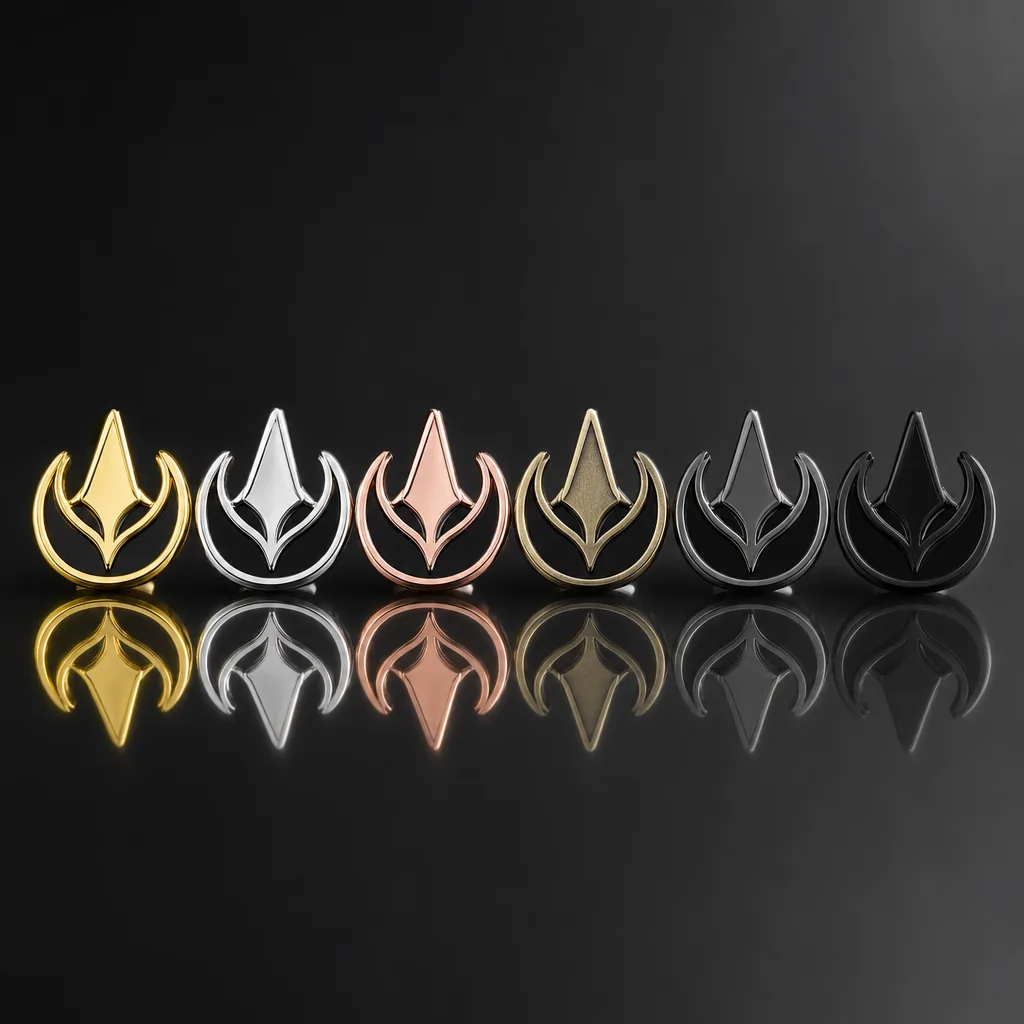
Plating needs the same discipline. Decorative nickel, brass, black nickel, copper, and gold all age differently in a bath, and the visible tone can shift if the line changes polishing pressure or run order. For polished decorative items, a practical target is nickel underplate around 5 to 8 microns, with gold flash often in the 0.05 to 0.10 micron range when a bright gold look is needed. If you do not care about exact thickness, say so; if you do care, write the number down and keep the reference sample in a sealed bag.
| Spec item | Typical target | How to control it |
|---|---|---|
| Enamel color | Pantone Solid Coated reference | Approve a physical chip and keep one retained sample |
| Nickel plating | 5-8 microns underplate for decorative wear | Specify finish name and reject tone drift against the master |
| Gold flash | 0.05-0.10 micron decorative layer | Confirm shade under the same light source every reorder |
| Soft enamel depth | 0.2-0.3 mm below metal lines | Keep the cavity depth and fill level fixed |
| Matte or glossy top | One finish only per SKU | Do not mix polish levels inside the same reorder |
Set dimensional tolerances the factory can actually hold
A lot of reorder friction comes from dimensions that were never defined in the first place. For small metal promo products, a practical tolerance is plus or minus 0.3 mm on overall size for items under 50 mm, plus or minus 0.2 mm on thickness, and plus or minus 0.25 mm on hole position or key ring interface. For multi-layer badges or cutout designs, the bridge between openings should usually stay at 0.8 mm or above if you want decent yield.
Do not over-spec the wrong feature. Buyers sometimes ask for total thickness to the nearest tenth while leaving line width, recessed area depth, and back attachment loose. That is backwards. The features that affect function and appearance should be locked first: pin post location, magnet placement, chain length, coin rim height, and any engraved text that must remain legible after plating. If the design depends on tiny letters below 1.5 mm high, expect sharper rejections and a lower first-pass yield.
Build QA gates into the order, not after it
Inspection is cheaper when it happens before packing. For repeat orders, the most useful gate is the first-article check against the retained master sample, followed by in-line inspection on the first 20 to 50 pieces, then a final lot check before boxing. For general cosmetic metal goods, a common standard is critical defects at 0, major defects at AQL 2.5, and minor defects at AQL 4.0, with sampling per ANSI/ASQ Z1.4 level II. If the product will be handed to customers directly, that is usually a sensible floor, not a luxury.
The inspection checklist should cover the things people actually complain about: color deviation, plating blotchiness, burrs, enamel overflow, dust in the cavity, loose attachments, broken rings, crooked print, and packaging damage. If the supplier changes polish team, plating line, or assembly line, ask them to flag it before production starts. That is the moment to recheck the sample, not after 5,000 pieces are already packed.
What repeat orders should cost and how fast they should move
Repeat orders should not price like first orders if the mold is already paid for and the spec is stable. The factory still has labor, plating, polishing, assembly, and QA costs, but you should not be paying setup pain a second time. For many custom metal products, a repeat order with no artwork change and no tooling change can run in 10 to 15 days after sample approval, while a new mold or new attachment can push the lead time to 18 to 25 days. Shipping is separate.
FOB pricing depends on size, finish, color count, and packaging, but the ranges below are realistic for small to medium promotional runs when the spec is already fixed.
| Item | Repeat MOQ | Typical FOB price | Repeat lead time |
|---|---|---|---|
| Soft enamel pin, 30-40 mm | 100-300 pcs | USD 0.45-1.10/pc | 10-15 days |
| Hard enamel pin, 30-40 mm | 100-300 pcs | USD 0.55-1.40/pc | 12-18 days |
| Die-struck badge or brooch | 100-300 pcs | USD 0.60-1.80/pc | 10-16 days |
| Zinc alloy keychain | 100-300 pcs | USD 0.70-2.20/pc | 12-18 days |
| Challenge coin, 1.75 in | 100-200 pcs | USD 1.20-3.80/pc | 15-22 days |
| Metal fridge magnet | 200-500 pcs | USD 0.35-1.20/pc | 8-14 days |
When to revise the spec and when to leave it alone
Not every variation is a defect. Some drift is a normal result of hand-finishing, and trying to eliminate every last cosmetic difference can push the order into unnecessary cost or delay. If the last run had minor polish variation but no functional issue, the right move may be to keep the spec stable and tighten only the inspection note. If the color was off by a full shade, the back stamp was wrong, or the attachment failed in use, then the spec itself needs a revision, not just a complaint email.
Use judgment on finishes too. Chrome reads cleaner and more corporate, but it shows scratches more easily. Black nickel hides wear and gives stronger contrast, but it can mute fine detail on small logos. Matte plating reduces fingerprints, which helps on badges and lanyard slides, but it can also soften the perceived depth of a logo. If the buyer cares most about consistency across reorders, the safest choice is usually the finish the factory can reproduce with the least manual polishing.
What to do next
If you are planning a reorder, do not send only the old artwork. Send the approved sample reference, the exact product spec, the packaging spec, and the inspection rules in one file so the factory can quote and produce against the same target. That is the difference between a repeat order and a new interpretation of a past job.
- Pull one retained sample and label it with the last approved PO number.
- Confirm the Pantone, plating finish, dimensions, attachment, and packaging in writing.
- Set the defect standard before production: critical 0, major AQL 2.5, minor AQL 4.0.
- Ask for a first-article photo set or physical pre-production sample before the full run.
- If the product is going to a retail or event audience, keep the spec conservative rather than chasing novelty on the reorder.
Have a project? Send your artwork and target quantity and we’ll reply with a detailed quotation within 12 working hours.
Ready to get this made?
Send your sketch, target quantity and ship-date. Detailed quotation in 12 hours.



