How to Decide Between Pins, Coins, Keychains, Patches, Magnets, and Lanyards
Start With The Job, Not The Product
The most common sourcing mistake is asking for a product before defining the job it has to do. A trade-show giveaway, retail merch SKU, internal award, and mailer insert fail for different reasons. If the format is wrong, the item may still look good in a render but miss on cost, wear resistance, branding space, or shipping weight.
For B2B buyers, the best framework is simple: define the primary job, the acceptable trade-off, and the one spec that must not fail. A lapel pin can be ideal for collector appeal and visible branding, but it is weak if you need large artwork or daily key use. A keychain can survive daily handling, but it usually has less premium presentation than a challenge coin or hard enamel pin. A lanyard gives you sponsor visibility and utility, but it is not the right format if the item needs to feel like a keepsake.
ZheCraft usually advises buyers to rank four constraints in order: intended use, brand visibility, target landed cost, and reorder risk. That order matters because a product that is cheap to make but expensive to rework is not actually cheap. The right choice is the format that fits the use case with the fewest compromises.
| Primary job | Usually best fit | Typical FOB range (USD/pc) | Typical MOQ | Typical lead time (days) | Why it wins | Main trade-off |
|---|---|---|---|---|---|---|
| Brand visibility on clothing | Enamel pin or brooch | 0.35-2.20 | 100-300 | 10-18 | High perceived value and clean logo placement | Small artwork area |
| Hand-carried daily utility | Keychain | 0.28-1.80 | 200-500 | 10-18 | Frequent use and strong retention | More wear on joints and plating |
| Recognition or award item | Challenge coin | 0.90-4.80 | 100-300 | 15-25 | Premium feel and strong presentation | Heavier and less casual |
| Large artwork or messaging | Patch or lanyard | 0.18-1.60 | 100-500 | 12-20 | More printable area | Less rigid premium appearance |
| Fridge or desktop display | Fridge magnet | 0.22-1.40 | 100-300 | 7-15 | Easy placement and low cost | Lower wear resistance |
Choose The Product By Audience Behavior
For event campaigns, match the product to retention time. A conference attendee may keep a lanyard for one week and discard it, while a retail customer may keep a pin for years if it has collector appeal. A factory can make either look good, but only one will deliver the right retention behavior. If the audience is likely to display the item at a desk, magnet and coin formats often outperform wearable products because they stay visible without being used roughly.
A useful rule: if the audience will touch the item more than once a day, choose a format with reinforced hardware and low breakage risk. For mailers, keep finished weight below about 35 g when possible; for handouts, under 60 g is usually easier to keep freight efficient. For executive gifts, presentation can justify higher unit cost, but only if the object feels substantial in hand. As a practical benchmark, a plated metal coin or hard enamel pin should feel dense enough that it does not read as a giveaway accessory.
- Choose pins when the audience wants visible self-expression or collector value.
- Choose keychains when the item must travel with the user every day.
- Choose coins when the audience expects presentation, recognition, or ceremony.
- Choose patches when large artwork or garment application matters.
- Choose magnets when the item should live on a desk, fridge, or office board.
- Choose lanyards when the real job is ID holding plus sponsor visibility.
Compare By Surface Area, Detail, And Branding Mode
Artwork complexity should not be judged only by whether the design is technically possible. The better question is how much of the original design survives after scaling, plating, material limits, and production tolerance. A product with more surface area is not automatically better if the decoration method is weak for fine lines.
Hard enamel and soft enamel pins can carry detailed artwork, but both are bounded by small dimensions and minimum line width. Patches and lanyards give more room for text, sponsor logos, and long messages. Coins can support crisp relief and edge detail, but they are less efficient for full-color branding than printed or woven fabric formats. If your art has a long slogan, multiple URLs, or several sponsor marks, move to patch or lanyard first instead of trying to force it onto a 25 mm metal part.
For metal items, safe artwork rules matter. Minimum line width is usually 0.20-0.30 mm for plated metal with enamel fill, while recessed text should stay above 1.0 mm height if you want it readable after polishing. For woven patches and jacquard lanyards, small text below 3 pt equivalent often becomes soft or distorted, especially at high stitch density. In general, do not approve a design that only works at screen scale if it will be produced at 25-40 mm finished size. A cleaner rule is to design for the actual manufacturing size, not the original vector file.
| Product | Typical usable size | Best decoration mode | Tolerance / spec guide | When to avoid |
|---|---|---|---|---|
| Pin | 20-35 mm | Die struck, soft enamel, hard enamel | Post position tolerance ±0.3 mm; enamel recess depth about 0.8-1.2 mm; plating thickness typically 0.1-0.3 μm for color retention benchmarking | When the logo needs long copy or multiple sponsors |
| Keychain | 30-50 mm | Die struck, soft enamel, acrylic insert, epoxy dome | Hole-to-edge margin ≥1.5 mm; ring wire Ø2.2-2.8 mm; split-ring closure gap under 0.5 mm is a good target | When you need ultra-light mailers |
| Coin | 38-50 mm | Die struck, 2D/3D relief, selective color fill | Relief height typically 0.3-1.5 mm; edge text should be ≥1.2 mm high; face flatness within ±0.2 mm is a practical target | When you need wearable branding |
| Patch | 60-90 mm | Woven, embroidered, PVC | Merrow border width about 2.5-3.5 mm; sew margin ≥3 mm; cut tolerance ±1 mm on standard shapes | When you need a rigid premium object |
| Lanyard | 15-20 mm width | Sublimation, woven, jacquard, screen | Text height ideally ≥1.2 mm; seam tolerance ±2-3 mm; breakaway clip pull testing should be defined by use case | When the item must look like a gift rather than event gear |
| Magnet | 40-70 mm | Soft enamel, printed insert, molded PVC | Magnet pull usually 150-350 g for small fridge use; backing flatness within 0.3 mm helps adhesion | When the item needs daily mechanical use |
Decide By Durability And Failure Mode
Durability is not one thing. A pin can lose its finish, a keychain can fail at the split ring, a magnet can slip off a glossy surface, and a patch can fray at the edge. Buyers should decide which failure is acceptable before comparing quotes. If the wrong part fails, the campaign feels cheap even if the unit cost was good.
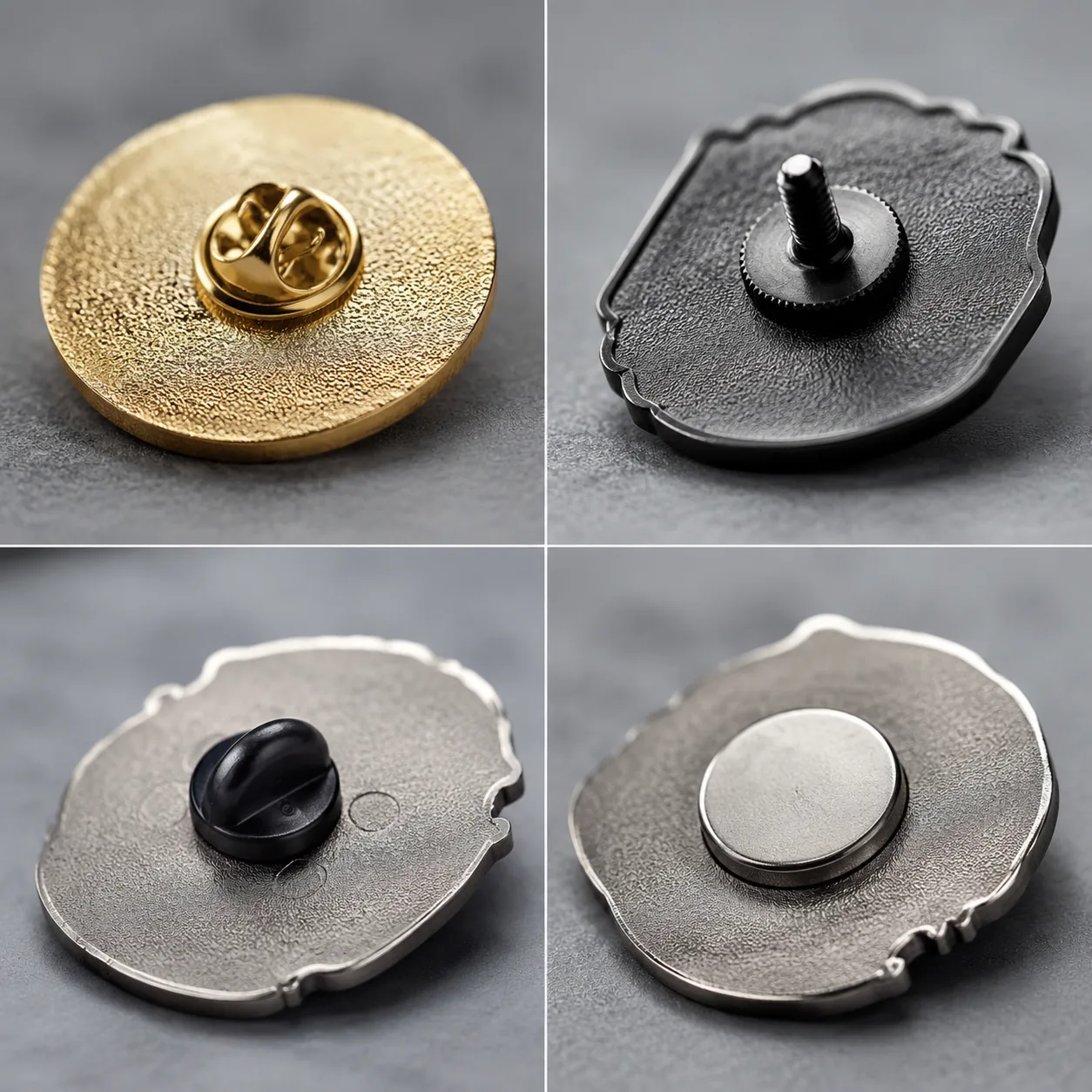
For metal products, the weak points are usually plating wear, attachment hardware, and edge finishing. ZheCraft typically treats attachment and finish as separate decisions because they age differently in use. A 0.8 mm pin with good plating can still disappoint if the clutch is weak or the pin post bends during transit. For plated pieces, nickel-free or black nickel finishes often hold visual contrast better than thin gold plating when the product will be handled repeatedly.
If the item will be used outdoors or handled frequently, use more conservative specs and lower decorative complexity. A simple 2D stamped build often survives abuse better than an overcomplicated multi-layer design. The more moving parts, the more important it is to accept a higher inspection burden and slightly longer lead time. For example, a moving-spinner pin or multi-piece keychain may need an extra 2-4 days of factory time compared with a plain stamped item.
For fabrics, durability depends on thread density and backing, not just appearance. An embroidered patch with 9,000-12,000 stitches on a 75 mm badge will hold shape better than a loose fill with thin borders. On lanyards, polyester webbing around 900D equivalent is common for event use; a thicker weave or satin finish looks better, but may show edge curling if the print is heavy. For magnets, use backing strength matched to the substrate: a small fridge magnet needs modest hold, while a vehicle or locker application needs a stronger embedded magnet or thicker steel insert. If the magnet is going onto a curved or powder-coated surface, insist on a flatter base and a larger contact area.
Use Cost Bands To Eliminate Weak Options Fast
Buyers often ask for a quote comparison too early, before they know which product class is suitable. A better approach is to use cost bands as a filter. Very roughly, simple promotional magnets or lanyards often sit in the lowest unit-cost band, pins and patches sit in the middle, and coins or premium multi-process items sit higher because of tooling, finishing, and packaging. That rough ordering is more useful than chasing the lowest quote from the wrong format.
FOB pricing shifts with size, plating, decoration method, and quantity, but the decision pattern stays consistent. For example, a 25 mm soft enamel pin at 500-1,000 pcs may land around USD 0.55-1.20 FOB, while the same design at 5,000 pcs can fall to roughly USD 0.28-0.65 FOB. A 50 mm challenge coin with 3D relief and polished plating often prices around USD 1.20-2.90 at 500 pcs and USD 0.85-1.90 at 3,000 pcs. A basic printed polyester lanyard can come in at USD 0.18-0.45 FOB at 1,000-5,000 pcs, while a woven jacquard version is commonly USD 0.30-0.85 FOB depending on width and attachment. Printed magnets and simple PVC keychains usually price well below premium metal items, but packaging can add a meaningful 0.10-0.35 USD per piece if you need backing cards or boxes.
The right question is not which product is cheapest; it is which product gives the lowest total campaign cost. That includes sample cycles, rework risk, shipping volume, and how much of the design survives production. A slightly higher FOB price can be the better buy if it cuts approval loops from three rounds to one. In practice, a clean single-process design often beats a cheaper multi-process item once sampling, freight, and spoilage are included.
MOQ and lead time matter just as much as unit cost. Typical factory MOQs are about 100-300 pcs for pins and magnets, 200-500 pcs for keychains, 100-300 pcs for patches, 300-500 pcs for lanyards, and 100-200 pcs for coins if the design is standard. Sample lead time is often 5-8 days for metal items and 7-12 days for woven or embroidered items; bulk production is commonly 10-15 days for simple pins or keychains, 12-18 days for patches and lanyards, and 15-25 days for coins with custom packaging. If the order needs special plating, enamel matching, or assembled extras, add roughly 3-7 days.
| Constraint | Low-cost direction | Mid-cost direction | Higher-cost direction |
|---|---|---|---|
| Small giveaway budget | Lanyard, simple magnet | Small pin, simple keychain | Coin or boxed set |
| Premium presentation | Coin in presentation box | Hard enamel pin with backing card | Multi-piece set |
| High artwork clarity | Printed patch, sublimation lanyard | Acrylic keychain with insert | Mixed-method metal item |
| Frequent handling | Keychain, PVC patch | Brooch with secure backing | Delicate plated pin with moving parts |
Match The Product To Production Risk
Production risk is where many sourcing decisions quietly fail. A product with expensive tooling, multiple colors, tight tolerances, or special surface effects can look attractive in a mockup but become difficult to stabilize in mass production. The safest choice is often the one with the fewest interacting variables.
Use this rule of thumb: every added process step increases the chance of mismatch between artwork, sample, and bulk result. For metal products, that may mean plating plus soft enamel plus epoxy plus backstamp plus special hardware. For textile products, it may mean mixed yarn counts, backing changes, and extra packaging layers. If you are launching a new brand or a first-time campaign, keep the structure simple and let the artwork do the work.
If your team cannot tolerate schedule slips, choose the format that minimizes approvals and tooling dependencies. Standard pin, coin, and keychain structures are easier to repeat than highly customized hybrids. ZheCraft often recommends a simpler construction for first-time buyers, then a more elaborate version after the reorder spec is locked. That approach also helps keep future reorders within the same color and plating tolerance window.
Quality control should be matched to the product. For pins and coins, a practical inspection target is AQL 2.5 for major defects and 4.0 for minor defects on a production lot, with dimensional checks on diameter, plating color, and post alignment. For patches, inspect border coverage, stitch density, and cut accuracy; a ±1 mm cut tolerance is usually acceptable on common sizes, while premium logo patches may need tighter control. For lanyards, inspect print registration, seam strength, and clip installation; for magnets, check surface flatness and pull strength rather than only print appearance. If the product will be shipped internationally, add carton drop checks and count verification so missing pieces do not become a customer service issue.
- Prefer simpler formats when the deadline is fixed and the launch date cannot move.
- Prefer standard hardware when the item will be reordered across regions or seasons.
- Prefer one decoration method per item when brand consistency matters more than novelty.
- Prefer thicker, more forgiving builds when the item will be handled in transit or mailers.
- Prefer fewer color zones when you need fast sample approval and stable bulk output.
A Simple Decision Matrix For Real Buyers
When multiple products could work, use a decision matrix instead of debating preferences. Score each option against the same five criteria: fit for use, brand impact, durability, cost, and production risk. The highest-scoring product is usually not the most exciting one, but it is often the one with the cleanest procurement result.
This is especially useful for cross-functional teams where marketing wants something premium and procurement wants predictable supply. A coin may win on presentation, while a patch may win on visibility and a lanyard may win on unit economics. The decision matrix forces the team to be explicit about what is being traded away. It also makes vendor discussions faster because everyone is judging the same spec, not a different interpretation of the same render.
For example, a 35 mm hard enamel pin might score 4/5 on brand impact and 3/5 on durability, but only 2/5 on message space. A 20 mm woven lanyard clip can score 5/5 on utility but only 2/5 on premium feel. A 45 mm coin often leads on recognition and perceived value, but it may lose if the campaign needs fast distribution or low postage cost. A practical rule is to weight the criteria before discussing suppliers, not after quotes arrive.
| Criterion | Weight example | What to score | Good sign |
|---|---|---|---|
| Fit for use | 30% | Does the item match how it will actually be used? | No obvious mismatch between function and format |
| Brand impact | 25% | Does it look and feel on-brand? | Logo and colors survive production clearly |
| Durability | 20% | Will it last through handling and shipping? | Weak points are limited and obvious |
| Cost | 15% | Does total landed cost fit budget? | No hidden packaging or rework inflation |
| Production risk | 10% | How likely is a sample or bulk issue? | Few special processes and clear specs |
What To Do Next
If you are choosing between these formats for a current campaign, start by writing one sentence that defines the item’s job. Then list the one failure you cannot accept, such as loose hardware, unreadable text, weak brand presence, or poor retention. That alone will remove most bad options.
Next, ask suppliers for quotes on only two or three formats that survive that first filter. Compare them on the same basis: size, material, plating or decoration method, packaging, sample timing, MOQ, and expected lead time. If one option needs extra approvals or special processes, count that as part of the cost. If the quote omits packaging or freight assumptions, ask for them explicitly so the landed cost is real, not theoretical.
For ZheCraft, the fastest path is usually to share artwork, intended use, target quantity, target FOB ceiling, and the deadline in one brief. From there, we can recommend the most stable build, flag risky specs early, and suggest where a simpler structure will save time without hurting the campaign. That is usually better than asking for every product type to be quoted blindly.
Have a project? Send your artwork and target quantity and we’ll reply with a detailed quotation within 12 working hours.
Ready to get this made?
Send your sketch, target quantity and ship-date. Detailed quotation in 12 hours.



