How to Decide Between Die-Struck, Cast, and Etched Metal
Start With the Failure Mode, Not the Artwork
Most expensive rework in custom metal promo products comes from choosing the wrong build method before the specification is clear. Buyers often start with appearance, but the better first question is what can fail in production or use: soft detail, sharp edges, poor wear, excessive weight, slow tooling, or a unit price that collapses on reorder. Die-struck, cast, and etched metal each solve a different manufacturing problem, and each carries different risks for detail, finish, and lead time.
A die-struck part is usually the best choice when the design is bold, shallow, and meant to feel crisp in the hand. Cast parts are better when the shape needs real volume, deep relief, or undercuts that stamping cannot form cleanly. Etched parts suit thin, flat designs with fine linework and lower tooling cost when the item is mostly graphic rather than sculptural.
The goal is not to select the process that looks best in a render. It is to choose the process that keeps the design readable after polishing, plating, and daily handling.
- Use die-struck when the artwork is clean, repeatable, and shallow-relief.
- Use cast when you need 3D form, undercuts, or natural contours.
- Use etched when line accuracy and low thickness matter more than depth.
Match the Process to the Artwork Geometry
The same logo can succeed or fail depending on the build. A corporate mark with large fields, clear separations, and a simple silhouette usually performs well as die-struck or etched. A mascot, commemorative emblem, or decorative medallion with layered surfaces usually needs casting to preserve the intent. If you force sculptural geometry into stamping, the factory often has to simplify the design until the original form is diluted.
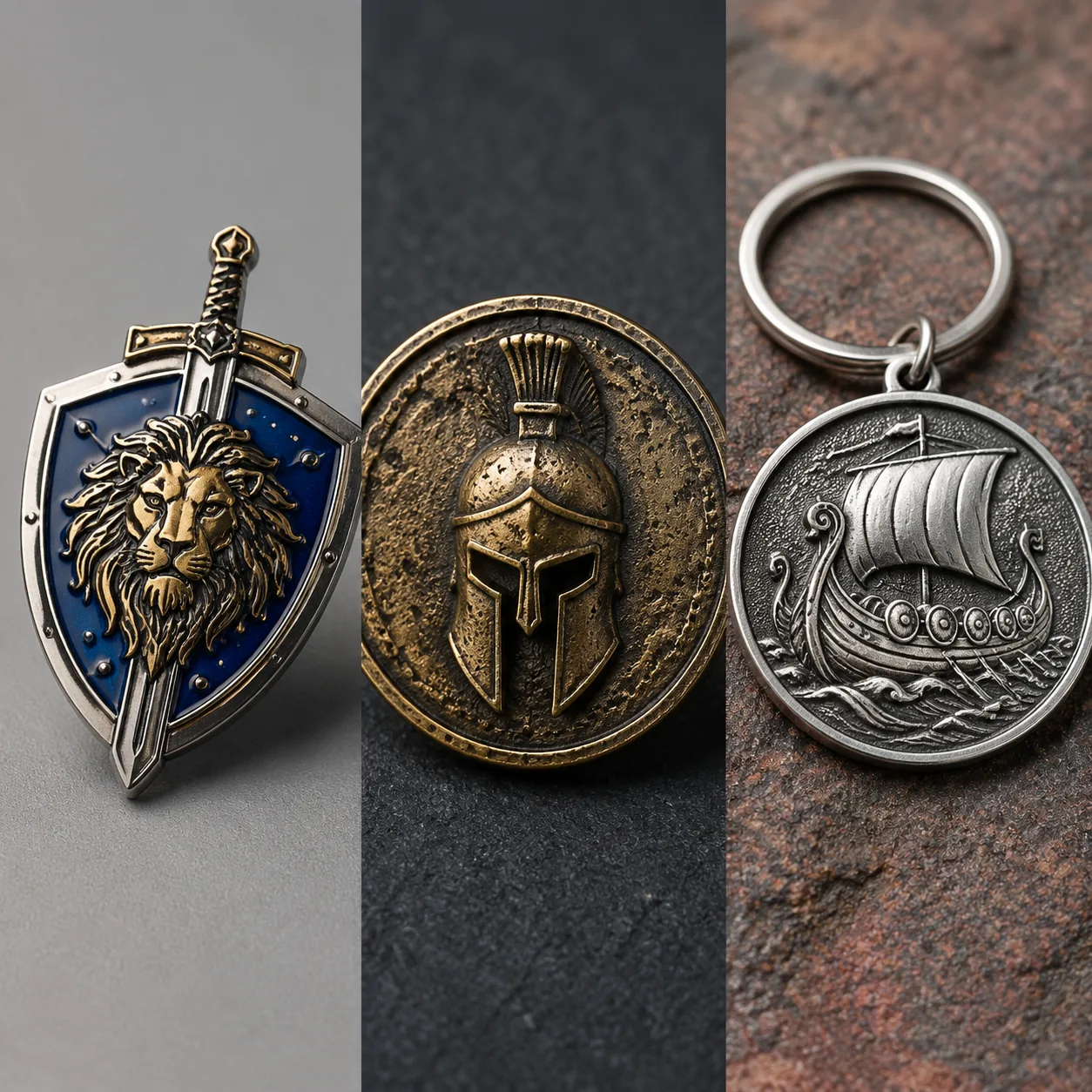
For enamel pins and badges, die-struck with color fill is usually the safest middle ground because raised borders protect the enamel and keep edges crisp. For challenge coins, cast works when you want deeper relief, coin-edge texture, and an art-object feel. For keychains and thin tags, etched or flat die-struck builds help control thickness and reduce swing weight, especially when the item must hang straight.
A practical rule: if the design depends on shadow and depth, lean cast. If it depends on outline and brand clarity, lean die-struck or etched.
| Build method | Best artwork type | Typical geometry limit | Common use case |
|---|---|---|---|
| Die-struck | Bold logos, icons, text | Fine detail below about 0.20 mm can soften | Corporate pins, badges, medals |
| Cast | 3D relief, mascots, irregular contours | Very thin walls below about 0.35 mm can warp or fill poorly | Challenge coins, sculpted keychains |
| Etched | Flat graphics, light bodies, fine linework | Deep relief and heavy texture are limited | Thin badges, bookmarks, metal tags |
Compare Cost Drivers Before You Quote
The lowest unit price is not always the lowest total cost. Tooling, polishing, plating, color fill, scrap rate, and rework matter more than many first-time buyers expect. A cast item may look economical in a quote, but if the geometry needs heavy hand finishing or multiple mold splits, the savings can disappear. An etched part may be cheap to tool but expensive if you need thicker stock, tighter tolerances, or a premium plated finish to make it feel substantial.
For medium-volume orders, FOB ranges are more useful than a single target price. Typical pricing for simple promotional metal goods is often about USD 0.45 to 1.80 per piece for die-struck items, USD 0.60 to 2.40 for cast parts, and USD 0.30 to 1.20 for etched parts. Tooling commonly runs about USD 40 to 120 for simple die-struck work, USD 60 to 180 for cast tools, and USD 30 to 100 for etched tooling. Complex 3D relief, multiple cavities, or heavy hand polishing can push those numbers higher.
MOQ also varies by complexity. A simple pin or badge is often available at 100 to 300 pieces, while cast items with more finishing can move to 300 to 500 pieces, and highly customized or multi-finish orders may require 500 pieces or more. Ask for the same artwork in the same size, thickness, and plating across all three methods so the real trade-off is visible instead of hidden by quote structure.
- Confirm whether the quote includes polishing, plating, color fill, and packing.
- Check whether tooling is one-time or partially refundable on reorder.
- Verify that size, thickness, and attachment hardware are identical across quotes.
Use Specifications to Narrow the Choice
A process decision becomes much easier when you compare the variables side by side. Buyers often focus on appearance, but minimum line width, thickness, and plating behavior can determine whether the item ships cleanly and survives use. In a production review, the factory should compare all three methods against the same art before confirming the mold direction. That prevents a lot of back-and-forth after the first sample.
| Spec | Die-struck | Cast | Etched |
|---|---|---|---|
| Minimum readable line width | About 0.20 to 0.25 mm | About 0.25 to 0.35 mm | About 0.15 to 0.20 mm |
| Recommended thickness | 1.2 to 2.0 mm | 1.5 to 3.5 mm | 0.8 to 1.5 mm |
| Typical thickness tolerance | ±0.15 to ±0.20 mm | ±0.20 to ±0.30 mm | ±0.10 to ±0.15 mm |
| Typical edge detail | Crisp, defined, slightly formal | Rounded, sculptural, tactile | Flat, precise, lightweight |
| First sample lead time | 7 to 12 days | 10 to 15 days | 6 to 10 days |
| Mass production lead time | 12 to 20 days | 15 to 25 days | 10 to 18 days |
These are practical ranges, not guarantees. A large coin with heavy relief may need more polishing and a longer lead time even if the process is cast. Likewise, an etched badge with very tight text can become fragile if the base metal is too thin. The right method is the one that leaves the fewest compromised requirements.
Treat Finish and Plating as Part of the Build Decision
Plating is not just decoration; it changes how each build method reads. Die-struck items take plating well because the raised and recessed zones are already clear. Cast parts can look excellent in antique finishes because the depth helps the dark wash settle naturally into the recesses. Etched parts often benefit from bright plating or selective color because flat surfaces can look visually empty without contrast.
Common decorative plating on promotional metal goods is usually specified around 0.03 to 0.10 microns for flash or cosmetic layers, while more durable decorative systems may use heavier nickel, copper, or topcoat stacks depending on the supplier and corrosion target. Buyers should also lock down whether the finish must be lead-free, nickel-free, or compliant with a specific market standard before sampling, because the base alloy and plating stack affect both appearance and durability. For items that will be handled often, a harder clear coat or an antique finish can reduce visible wear at edges and high points.
Concrete examples help. A 35 mm die-struck lapel pin with soft enamel usually reads sharper in black nickel than in polished silver if the artwork depends on contrast. A cast commemorative coin with deep relief often reads better in antique brass than in bright gold because the recesses stay legible after darkening.
- Choose antique plating when relief depth should read clearly.
- Choose bright plating when the item is mostly line-based or brand-led.
- Avoid multi-plating if quantity is small and lead time is tight.
Know the Limits That Make a Process Expensive
Some combinations look fine in CAD but become difficult in production. Very deep undercuts, tiny floating islands, and extreme 3D slopes raise scrap risk for stamped work. Cast parts can trap bubbles or need more hand finishing if the design has closed cavities. Etched parts may look elegant in proofs but feel too light for executive gifts or commemorative pieces where buyers expect a substantial object.
There are also use-case limits. If the item will be worn daily on thick fabric, a die-struck build with a secure clutch or rubber backing usually performs better than a lightweight etched piece. If the item will be handled as a collectible or desk display, a cast build may justify the extra finishing work. If the buyer only needs a clean branding piece for bulk distribution, the lightest workable process is often the most practical choice.
A concrete example: a 28 mm logo badge with two lines of 0.18 mm text is usually better suited to etched or die-struck construction than cast, because the fine text can get lost in rounded relief. By contrast, a 40 mm commemorative coin with a raised portrait, textured background, and edge lettering is usually a cast or heavily struck design, not an etched one.
Use a Buyer Checklist Before You Approve Samples
Before approving any sample, force the decision through the same checklist every time. That keeps procurement, design, and the factory aligned and reduces subjective debate over what looks premium. It also gives you a clean basis for comparing two suppliers who may propose different build methods for the same design.
- Confirm the main objective: visual fidelity, weight, cost, or premium feel.
- Lock the build method before discussing plating or packaging.
- Verify minimum line width, smallest text size, and relief depth.
- Specify thickness tolerance, ideally within ±0.2 mm for small items.
- Ask for a pre-production sample if the design has cutouts, texture, or moving parts.
- Check that the attachment method matches the item weight and intended use.
- Request FOB pricing for at least two quantities, such as 300 and 1,000 pieces.
- Ask for AQL inspection terms, typically AQL 2.5 for major defects and AQL 4.0 for minor defects on promo metal goods.
If the supplier cannot state a realistic tolerance, line-width limit, or sample lead time in days, the quote is not ready for approval. Good buyers treat those numbers as part of the spec, not as afterthoughts.
Make the Final Choice by Product Type
For lapel pins and badges, die-struck is the default when the artwork is clean and the quantity is recurring, because it balances durability, crisp borders, and predictable cost. For challenge coins, cast is the stronger choice when you want portrait depth, layered texture, or a premium collectible feel. For bookmarks, metal tags, and other thin branded items, etched usually gives the best mix of low thickness, sharp linework, and manageable tooling cost.
The decision gets easier when you translate the product into a requirement. If the job is to survive repeated wear, choose the method that preserves edge definition. If the job is to impress as a collectible, choose the method that creates visual depth. If the job is to deliver a lot of clean brand marks at a controlled budget, choose the method that keeps the profile thin and the tooling simple.
At ZheCraft, the first review usually checks line width, depth, attachment load, and finish target, then recommends the process that fits the actual use case instead of the prettiest rendering. That approach saves time on samples and avoids the common mistake of asking one process to behave like another.
Have a project? Send your artwork and target quantity and we’ll reply with a detailed quotation within 12 working hours.
Ready to get this made?
Send your sketch, target quantity and ship-date. Detailed quotation in 12 hours.



