How to Decide Between 2D and 3D Metal Giveaways
Start With the Product Job, Not the Artwork
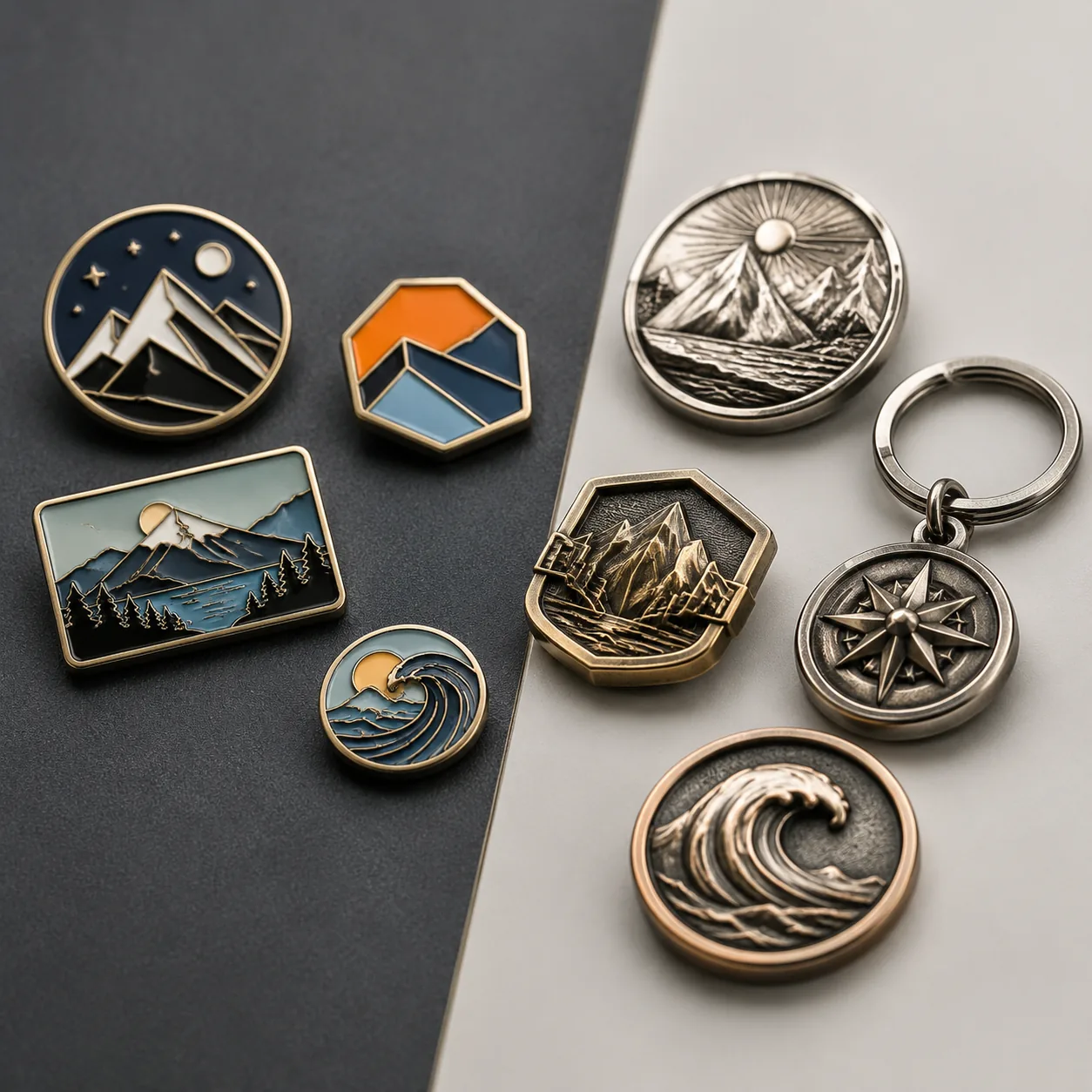
The right question is not whether a design can be made in 2D or 3D. It is what the item must do at arm’s length, in hand, and on reorder. If the priority is logo clarity, text legibility, and color separation, 2D is usually the safer build. If the priority is sculpted presence, shadow, and tactile value, 3D earns its cost. That choice affects tooling complexity, plating flow, reject risk, and repeatability, so it should be settled before the mold is cut.
This matters across custom pins, challenge coins, badges, keychains, medals, and corporate giveaways. A flat build can be more efficient for a 30 mm lapel pin with a simple logo, while a medallion or mascot pin may need depth to look premium. The cheapest quote is not always the cheapest program once you include revisions, sample cycles, and the risk of remaking tooling after art approval. A good supplier should be able to tell you where the break point is before production starts.
- Choose 2D when the message is logo, text, icon, or flat illustration.
- Choose 3D when the silhouette, contour, or sculpted face is the selling point.
- Choose hybrid when you need readable copy plus a raised emblem, border, or mascot.
- Avoid 3D when the art includes very small text, thin separators, or many tight color breaks.
What 2D Builds Deliver
A 2D build gives you crisp edges, simpler plating control, and lower tooling risk. It is the standard choice for soft enamel pins, flat badges, stamped coins, and many keychains because line work stays readable and recessed areas are easier to control. For sourcing teams, the biggest advantage is predictability: the approved sample usually tracks the artwork closely, and repeat orders are less likely to drift because the surface geometry is simpler to reproduce.
2D also works well when the design depends on contrast rather than sculpture. On a 28 mm pin, a reliable minimum visible line width is usually 0.20-0.25 mm, with recessed color wells around 0.15-0.30 mm deep. Typical height contrast on a small piece is about 0.2-0.6 mm, which is enough to define zones without making the part hard to polish or prone to color bleed. For hard enamel, the fill is leveled after curing, so the final face can be nearly flush while still preserving the relief beneath it.
The limitation is visual impact. A 2D item can still look premium with hard enamel, antique plating, sandblast textures, or thicker stock, but it will not create the same highlight-and-shadow effect as a sculpted form. If the buyer expects a commemorative object, a sports-medal feel, or a collectible coin with strong tactile depth, flat geometry may look too graphic unless the finish and thickness are upgraded.
| 2D spec area | Typical working range / expectation |
|---|---|
| Minimum visible line width | 0.20-0.25 mm for reliable separation |
| Recess depth for color areas | 0.15-0.30 mm common on small items |
| Raised/recessed levels | Usually 0-1 step, about 0.2-0.6 mm contrast |
| Typical thickness | 1.2-2.0 mm for pins; 1.8-3.0 mm for coins |
| Best use case | Logos, badges, promo giveaways, flat coin faces |
When 3D Is Worth the Added Cost
A 3D build is worth paying for when the shape itself carries meaning. That includes mascot heads, portrait-style coins, vehicle parts, product replicas, and any design where the outline and surface contour communicate more than the printed artwork can. In those cases, the buyer is not purchasing decoration alone; they are buying relief, tactility, and a more collectible feel. A small object with well-controlled depth can read substantially more premium than its size suggests.
3D performs best when there is one dominant focal form. A 32-40 mm medallion, for example, can often use 0.8-1.8 mm of relief on the main subject and 0.3-0.8 mm on the background field. Larger coins or plaques may push relief to 2.0-3.0 mm, but once the geometry becomes too deep, the risk of softened edges, trapped polish lines, and plating distortion increases. Deep relief only helps if the mold maker can preserve crisp transitions after hand polishing and plating.
The downside is cost and control. 3D requires more sculpting time, more judgment in polishing, and more careful sample approval because every small surface change affects how light lands on the part. On reorder, the factory must preserve the same model file, polishing reference, and surface standard, or the piece can drift subtly even when dimensions still look correct on paper. That is why 3D is as much a production decision as a design decision.
- Use 3D for one dominant subject rather than many competing sculpted details.
- Expect longer sample cycles if the surface includes faces, folds, fur, machinery, or organic contours.
- Ask for a polished reference sample if reflection quality is important to presentation.
- Do not use 3D to rescue a weak composition; volume will not fix poor proportions.
Why Hybrid Often Wins
Many products do not need to be fully 2D or fully 3D. A hybrid build uses a flat main field for readability and selected raised zones for emphasis, such as a shield border, mascot outline, center emblem, or textured backdrop. For many programs, this is the most efficient compromise between brand clarity and premium feel. It also helps control plating lines where the message matters most.
Hybrids are especially useful when multiple stakeholders are involved. Marketing usually wants the logo readable at arm’s length, while product or sales teams want tactile value and collectibility. A hybrid can satisfy both if the art is planned around relief zones instead of forcing depth everywhere. On smaller items, restraint matters: a 0.5-1.2 mm border lift often adds enough substance without crowding the center copy or reducing legibility.
The most reliable hybrid structures have a clear hierarchy. Use flat text on a raised badge face, a sculpted mascot over a simple base, or a textured background behind a crisp icon. These structures reduce the risk of color overflow and make sample approval easier because everyone can see what must stay sharp and what is allowed to carry volume.
| Hybrid choice | Why it works | Main risk |
|---|---|---|
| Flat center, raised border | Preserves logo clarity while adding premium framing | Border can overpower small artwork |
| Raised mascot, flat text plate | Creates a focal point and keeps copy readable | Text can feel visually detached |
| 3D emblem on 2D base | Good for coins and medallion-style items | Tooling and polishing time increase |
| Textured background with flat icon | Adds richness without losing legibility | Texture can hide plating defects if overdone |
Cost, MOQ, and Lead-Time Reality
The right buying decision is not just unit price; it is total program cost. A 2D item usually has lower mold or setup cost and a faster first-sample turnaround, while 3D adds sculpting labor and usually a longer approval loop. For small runs, that tooling difference can outweigh unit savings, especially if the first sample needs revision. If the design is likely to change, the low initial quote can become the expensive option.
Typical FOB pricing varies by size, finish, quantity, and packaging, but the pattern is consistent. For a simple 2D soft enamel pin, a realistic FOB range is about USD 0.45-0.95 at 500-1,000 pcs and USD 0.28-0.65 at 3,000-5,000 pcs. A comparable 3D sculpted version often sits around USD 0.70-1.60 at 500-1,000 pcs and USD 0.45-1.20 at 3,000-5,000 pcs. Hard enamel, antique plating, magnetic backs, and multi-part keychains can push those numbers higher by 15-40% depending on finish and assembly.
Lead times follow the same pattern. A simple 2D sample may take 5-8 days, while a 3D sculpted sample often needs 7-14 days because the master model and polishing reference take longer to finalize. Mass production commonly runs 15-25 days after sample approval for straightforward 2D orders and 20-30 days for more complex 3D work. Reorders using the same tooling can shorten by several days if the spec is unchanged and the previous master sample is on file.
MOQ depends on the factory and the product type, but a practical planning range is 100-300 pcs for simple pins or keychains, 300-500 pcs for more detailed 3D items, and 200-500 pcs for coins and badges with multiple plating steps. Lower MOQs usually carry a higher unit price because setup cost is spread over fewer pieces. If a quote looks unusually cheap for a highly sculpted part, confirm whether tooling, plating upgrades, packaging, and revision allowance are included.
| Order factor | 2D typical range | 3D typical range |
|---|---|---|
| Sample lead time | 5-8 days | 7-14 days |
| Mass production lead time | 15-25 days after approval | 20-30 days after approval |
| MOQ planning range | 100-300 pcs | 300-500 pcs |
| FOB unit price at 500-1,000 pcs | USD 0.45-0.95 | USD 0.70-1.60 |
| FOB unit price at 3,000-5,000 pcs | USD 0.28-0.65 | USD 0.45-1.20 |
What to Put in the RFQ
If you want quotes that are actually comparable, do not ask only for size and quantity. State the build type, the intended visual priority, the required relief height, the acceptable line width, and whether the product must match an existing sample. For 2D work, specify enamel type, color count, edge finish, and whether the piece must stay flat enough for readable text. For 3D work, specify the level of relief, target smoothness, and which areas must remain visually flat for branding or copy.
A useful RFQ separates non-negotiables from preferences. A factory can often adjust polish, matte texture, or minor relief. Changing a design from full 3D to hybrid after sampling usually means retooling. If the team has a hard ceiling on cost, say so early; otherwise, the supplier may quote a stronger visual option that fails budget review later. State the target finish upfront as well, because shiny nickel, black nickel, antique brass, and matte gold all change how depth reads.
| Spec to state | 2D requirement | 3D requirement |
|---|---|---|
| Primary visual goal | Logo clarity, line accuracy, color separation | Depth, contour, collectible presence |
| Relief height | 0-0.6 mm, if any | Typically 0.6-2.5 mm, depending on size |
| Line width / detail floor | 0.20-0.25 mm minimum recommended | Avoid tiny text below 0.30 mm on sculpted areas |
| Surface fill | Tight enamel control, smooth fill, clean borders | May omit enamel in sculpted zones |
| Acceptable tolerance | ±0.10-0.20 mm on critical features | ±0.15-0.30 mm depending on geometry |
Quality Checks Before You Approve
The most common failure is not that the item looks bad; it is that it is the wrong build for the message. A 3D pin with weak facial detail can look muddy, while a 2D coin with too much empty flat space can look cheap. Check the approved sample under the same conditions the end buyer will use: daylight, indoor light, and, if possible, product-photo lighting. A design that looks fine under a bench lamp may read very differently in a catalog or ecommerce thumbnail.
For QC, ask the factory to check relief consistency, plating coverage at the high points, and visibility of fine lines after polishing. For 2D items, inspect color bleed, recessed pit marks, metal burrs, and edge cleanliness. For 3D items, inspect whether the high and low points still read clearly after plating, because overly aggressive polishing can soften sculpted features. If the design includes text, verify that it remains legible at the final size rather than at the original artwork size.
- Confirm the approved sample is labeled as the production master.
- Check that plating tone, surface gloss, and relief depth match the intended build.
- Inspect the product from 30-50 cm, not only at close range.
- Verify text legibility at final size, especially below 1.5 mm character height.
- Ask for AQL language in the PO; a common inspection target is AQL 2.5 for major defects and 4.0 for minor defects.
For dimensional control, ask the supplier to state the target tolerance on diameter, thickness, and key raised features. A practical expectation for small metal giveaways is ±0.10-0.20 mm on critical dimensions for simpler 2D parts and ±0.15-0.30 mm on sculpted 3D areas, depending on size and finish. If the piece includes epoxy or soft enamel, also confirm fill height so the surface does not sit below the metal rim by more than the intended spec.
Make the Decision and Lock It In
For a current project, start by choosing the one feature that matters most: readability, tactile impact, or cost stability. Then request two quotes from the same factory on the same artwork: one in 2D and one in hybrid or 3D, with the same size, plating, and quantity. That gives you a real decision base instead of a vague opinion about what looks better.
If you want the lowest-risk path, lock the build type before sampling, approve the relief with a physical or 3D-rendered sample, and freeze the specs before mass production. That is the fastest way to avoid reorder drift and unclear approvals. The goal is not the most complex build; it is the one that fits the item’s job in the market and can be repeated without surprises.
Have a project? Send your artwork and target quantity and we’ll reply with a detailed quotation within 12 working hours.
Ready to get this made?
Send your sketch, target quantity and ship-date. Detailed quotation in 12 hours.



