How to Compare Factory Quotes for Custom Metal Products
Why the Lowest Quote Is Often Not the Cheapest
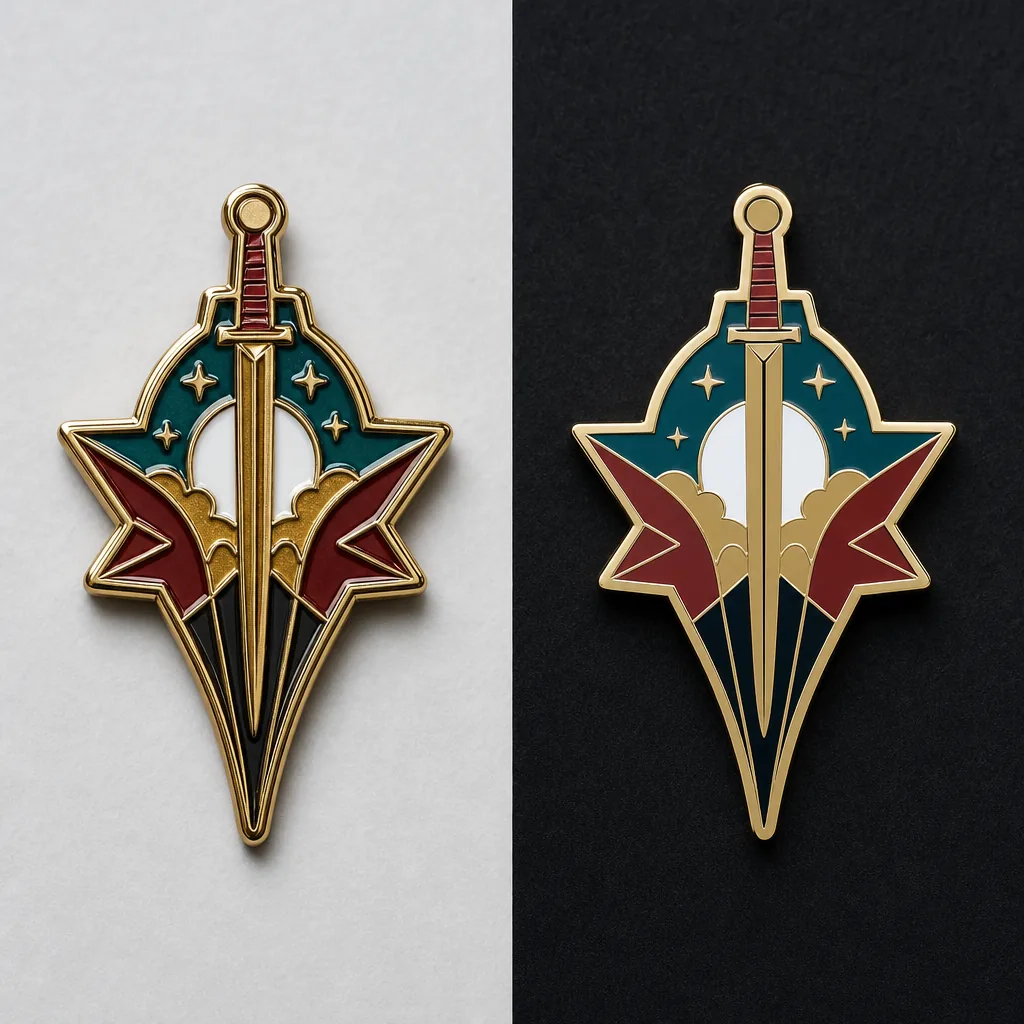
For custom metal products, two quotes can look similar on paper and still land at very different real costs. A 1.25 inch soft enamel pin with 5 colors, black nickel plating, butterfly clutch, and an OPP bag might be quoted at FOB $0.28 to $0.65 at 500 pcs, depending on alloy, finish, and packing. The same visual piece in hard enamel can move up another $0.05 to $0.20 because polishing and surface flatness take more labor.
The price gap usually comes from assumptions, not just margin. One factory may include tooling, one sample, and standard packing; another may leave those out and quote only the bare unit price. For buyers of pins, brooches, challenge coins, keychains, magnets, patches, and lanyards, the right comparison is total cost against the same spec sheet, not the lowest number in the first line of the quote.
What a Comparable Quote Must List
A usable quote needs more than a unit price and a lead time. It should state exact product size, material, thickness, plating, color count, attachment, packaging, sample status, and Incoterm, plus whether artwork cleanup and mold fees are included. Without those fields, you cannot compare two factories on equal terms, because even a small change in thickness or packing can move the cost by 10 percent or more at low volume.
| Quote field | What to specify | Why it matters |
|---|---|---|
| Size and tolerance | Example: 30 x 22 mm, outline tolerance +/-0.2 to 0.3 mm, thickness +/-0.2 mm | Controls fit, weight, and whether the die needs rework |
| Metal and thickness | Zinc alloy 1.2 to 1.5 mm or brass 1.0 to 1.2 mm | Affects crispness, feel, and bend resistance |
| Plating | Black nickel, gold, silver, antique brass, with decorative plating around 0.05 to 0.2 microns | Special finishes and extra underplate steps change cost |
| Colors and process | Soft enamel, hard enamel, printed, epoxy, or none; list Pantone references | More colors and polished fills add labor |
| Attachment and packing | Butterfly clutch, rubber clutch, magnet, split ring, OPP bag, backing card | Accessories and packing are often excluded from the headline price |
| Sampling and lead time | One pre-production sample, mass production 12 to 25 days | Shows whether the quote is for a real schedule or just an estimate |
At ZheCraft, we quote against a fixed spec sheet for that reason. The buyer sees the same variables the factory sees, which makes it easier to compare pins, coins, badges, and keychains without hidden assumptions.
Reading Unit Price, Tooling, and Extras
The most common mistake is treating unit price as the whole quote. Tooling for a simple flat pin or coin die is often about $45 to $120, while more complex multi-level or 3D work can run $80 to $200 or more. If a supplier says tooling is free, ask whether it is recovered in the unit price, because a free mold on 500 pcs may simply be a higher per-piece price spread across the first order.
Packaging can also distort comparison. A blank bulk pack may be included, but an individual backing card, barcode sticker, insert, or custom box usually adds cost, often $0.03 to $0.25 per unit depending on complexity and print run. For small orders, those extras can be 10 to 25 percent of the total order value, so they need to be in the same column in every quote.
Specs Worth Paying For
Not every upgrade is worth the money, but some are. Pay for better surface polish on visible faces, thicker substrate on items that must not bend, and stronger attachments on heavier products such as large badges, brooches, and challenge coins. For metal products under 50 mm, practical tolerances are outline +/-0.2 to 0.3 mm, hole position +/-0.15 to 0.2 mm, and thickness +/-0.2 mm; looser than that, and fit issues start showing up in assembly or packaging.
Inspection terms matter just as much as geometry. A common commercial standard is AQL 2.5 for major defects, AQL 4.0 for minor defects, and 0 for critical failures, but the buyer should define what counts as major, minor, and critical. For example, a loose magnet on a fridge magnet or a weak brooch pin on a lapel badge is a functional defect, not a cosmetic one, and should be treated accordingly.
Where Hidden Charges Show Up
Hidden costs usually appear after the first sample round, when the buyer discovers the quote was based on a looser interpretation of the drawing. The most frequent items are artwork redraws, extra color changes, plating changes after approval, additional sample rounds, rush production, export packing, and label work for retail or Amazon fulfillment. If you need finished goods packed into cartons by SKU, ask for that line item up front; otherwise, it can appear only after the order is already committed.
A Simple Normalization Formula
The easiest way to compare suppliers is to build a normalized landed price for the same quantity. Start with unit price, add tooling amortized over the first order, then add packaging, sample fees, domestic freight to port or forwarder, and any extra inspection or label costs. If you are comparing 500 pcs, a $60 mold fee adds $0.12 per piece; at 3,000 pcs, it adds only $0.02, so a quote with a lower unit price but a higher mold charge may actually be worse on the first buy.
This is where a side-by-side spreadsheet helps. A quote at FOB $0.42 with full packing and a $65 mold may beat a quote at FOB $0.36 that excludes bags, labels, and sample shipping. For buyers who order recurring runs, it is worth asking the factory to quote both a first-order price and a repeat-order price, because the repeat run removes tooling amortization and often changes the real economics by 10 to 30 percent.
| Supplier example | Quoted FOB | Included items | Risk |
|---|---|---|---|
| Supplier A | $0.42 at 1,000 pcs | Tooling, standard OPP bag, butterfly clutch | Looks higher, but fewer add-ons later |
| Supplier B | $0.36 at 1,000 pcs | Unit only, no bag, no sample shipping | Can become more expensive after extras |
| Supplier C | $0.55 at 1,000 pcs | Backing card, label, one pre-production sample | Better for retail-ready programs |
What To Do Next
Send every factory the same one-page spec sheet and ask for a quote in the same format. If the product is a pin, coin, badge, keychain, magnet, patch, or lanyard, lock the drawing, size, thickness, plating, color count, attachment, packaging, quantity, and Incoterm before you ask for pricing. If one supplier refuses to quote those details, that is a signal that the comparison is not ready yet.
- Fix the drawing and dimensions before asking for price
- Request tooling, unit price, sample cost, and packing as separate lines
- Ask for a first-order price and a repeat-order price
- Confirm tolerance, plating, and AQL in writing
- Compare FOB on the same port and the same packing spec
- Reject any quote that does not state what is excluded
Have a project? Send your artwork and target quantity and we’ll reply with a detailed quotation within 12 working hours.
Ready to get this made?
Send your sketch, target quantity and ship-date. Detailed quotation in 12 hours.



