How to Choose the Right Promo Product Build for Reorders
Start With Reorder Risk, Not the Product
Most buyers do not need a “better” pin, coin, or keychain. They need a build that can be reordered six months later without artwork cleanup, plating drift, or a surprise cost jump. That is the real sourcing problem: how much specification discipline to buy now so the second order matches the first one without re-approval.
Treat one-off giveaways and repeat programs differently. A single-event item can tolerate broader cosmetic variation, lighter packaging control, and simpler attachment hardware. A reorder-driven item needs locked vector artwork, fixed Pantone references, documented thickness, plating callouts, and a retained sample record so the factory can reproduce the same build without guessing.
For repeat orders, write the spec as if someone else will place the next PO. If the first file does not state size tolerance, finish, packaging, and acceptable defect rate, the supplier will fill in the gaps. That is where reorder drift starts, especially when the first production run is approved from a photo instead of a measured golden sample.
The rule is simple: the more often the item will be reordered, the less you should rely on verbal instructions. A decent factory can make a beautiful sample from a vague brief. Repeating that sample consistently at 1,000 or 5,000 pieces is a different job.
Lock the Four Build Decisions First
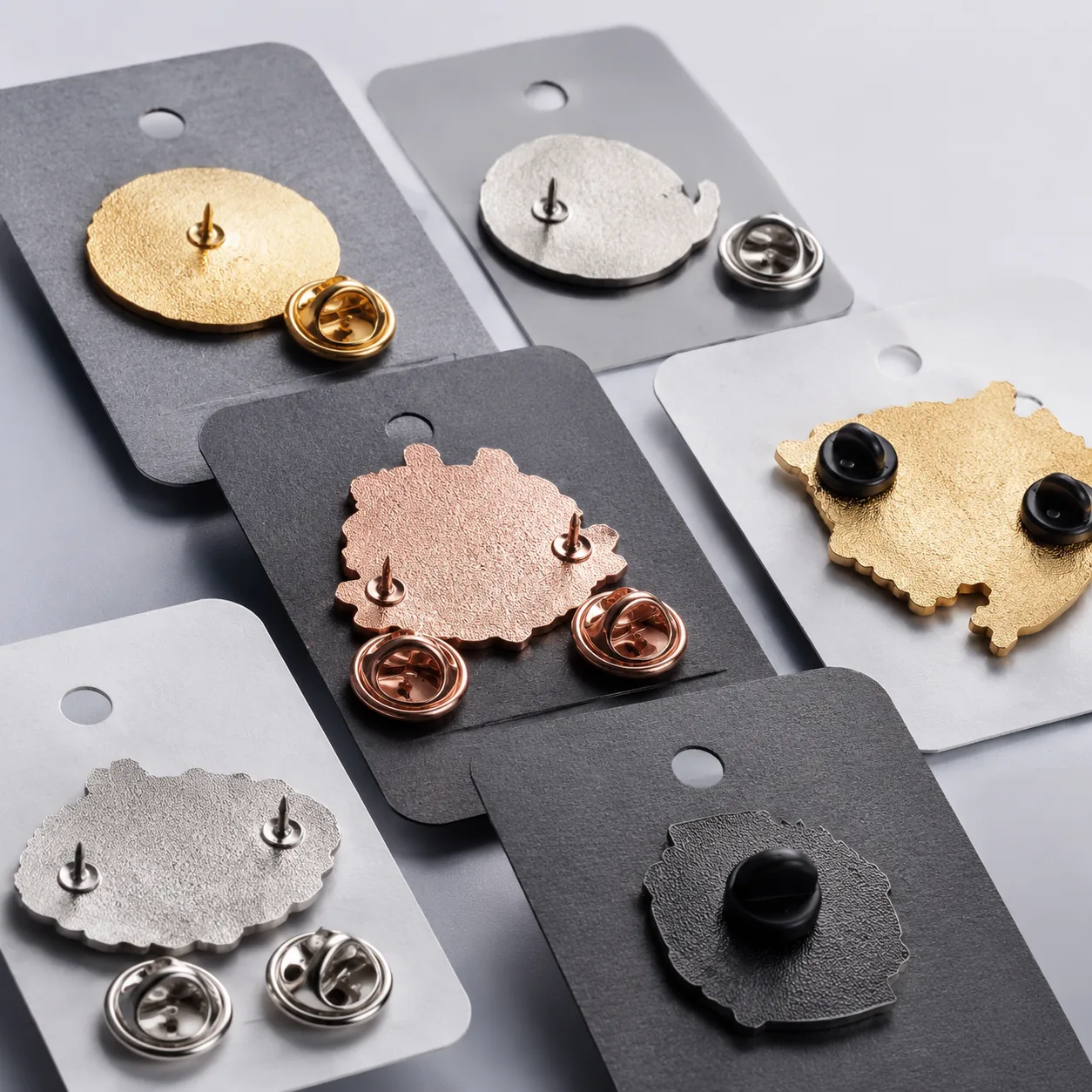
Before comparing quotes, define four variables: body material, decoration method, hardware, and surface protection. These choices determine the tooling route, inspection standard, packing method, and much of the FOB price. If you skip them, different suppliers will quote different assumptions and the numbers will not be comparable.
| Decision | Typical options | Practical spec range | What it changes |
|---|---|---|---|
| Body material | Zinc alloy, brass, iron, stainless steel, acrylic, PVC | Metal thickness commonly 1.2–3.5 mm for pins and 1.8–4.0 mm for keychains; acrylic parts often 2.0–5.0 mm | Weight, mold detail, corrosion resistance, tooling cost |
| Decoration method | Soft enamel, hard enamel, offset printing, screen printing, laser, woven, embroidery | Minimum line width often 0.20–0.30 mm for metal; printed text below 1.0 mm usually needs vector control; woven patch text usually 5–6 pt or larger | Color accuracy, wear resistance, lead time |
| Hardware | Butterfly clutch, rubber clutch, magnet, safety pin, split ring, lobster clasp, carabiner | Backing or fit tolerance typically ±0.3–0.5 mm on fit-critical parts; pull-force targets often 3–8 kgf for key rings and lanyard clips | Retention strength, fabric damage, safety |
| Surface protection | Polish only, epoxy dome, clear coat, anti-tarnish, UV ink, laminate | Epoxy dome often 0.3–0.8 mm; clear coat 10–25 μm; plating thickness commonly 0.05–0.10 μm for decorative nickel, higher on wear-prone finishes when specified | Scratch resistance, gloss, outdoor life, color stability |
A buyer asking for a lightweight retail keychain and a buyer asking for a bulk-mail giveaway may want the same artwork, but they do not need the same engineering. Once these four choices are fixed, quote comparison becomes meaningful because suppliers are pricing the same build instead of four different interpretations.
If you want cleaner RFQs, split the build into a core spec and optional upgrades. Example: core = zinc alloy, soft enamel, nickel plate, standard butterfly clutch; upgrade = epoxy, black nickel, custom backing card, individual polybag. That makes it easy to compare the true cost of each feature instead of hiding extras in a single quote.
Match the Build to the Use Case
Category matters less than how the item will be used. A conference pin worn once for photos has a different failure mode than a membership badge worn weekly for a year. A magnet shipped in a carton has different packaging risk than a magnet living on a metal office door. If you choose by category alone, you will overpay in some areas and under-spec the parts that actually fail.
Use the use case to set priorities. Daily wear needs stronger retention and better surface protection. Mailers need lower breakage risk and tighter carton control. Retail items need cosmetic consistency, color control, and fewer finish defects. Outdoor or humid use needs anti-tarnish plating, UV-stable print, and corrosion-resistant alloys. Zinc alloy is a strong default for molded shapes; brass is better when you need sharper edge definition and a more premium surface on fine detail. Acrylic can be light and inexpensive, but it is a poor choice when edge chipping or hole cracking would create returns.
Concrete examples help. A staff pin for a three-day event can use soft enamel, a butterfly clutch, and standard nickel plating. A membership coin that will sit on desks for years should move to brass, higher polish, and anti-tarnish packaging. A keychain sold at retail often needs die-cast zinc, tighter weight consistency, and individual polybags to protect the finish during transit.
The right build also depends on touch and handling. If a customer will open and close the item repeatedly, choose a hardware spec with verified cycle life. If the item is purely decorative, spend on finish quality and consistency instead of overbuilding the attachment.
Use Price Bands to Sanity-Check the Spec
Buyers often ask for the cheapest version first and then try to upgrade quality later. That usually fails because each step changes tooling, polishing, curing, and inspection cost. The key is to know which build fits the target budget before asking for quotes. A stamped iron pin with soft enamel and standard backing is not the same job as a brass hard enamel pin with epoxy and a custom backing card.
| Build choice | Typical FOB range USD | Typical MOQ | Lead time days | Best for |
|---|---|---|---|---|
| Stamped iron soft enamel pin | 0.35–1.20 | 100–300 pcs | 12–18 days | High-volume promos and simple artwork |
| Brass hard enamel pin | 0.80–2.80 | 100–300 pcs | 14–22 days | Premium brand use and finer detail |
| Zinc alloy keychain | 0.70–3.50 | 100–500 pcs | 15–25 days | Heavier retail-style giveaways |
| Die-struck coin | 0.90–4.50 | 100–300 pcs | 14–24 days | Recognition awards and collector programs |
| Woven patch | 0.25–1.40 | 100–500 pcs | 10–18 days | Small text and low-profile branding |
| Printed lanyard | 0.18–1.10 | 100–500 pcs | 7–15 days | Events, ID use, and fast campaigns |
These are realistic FOB buying bands, not promises. Size, plating thickness, attachment complexity, and packaging move the number quickly. A custom backing card, matched Pantone printing, or individual polybag can add labor that matters more than the raw material delta. If two suppliers are quoting different thicknesses, different plating, or different packing, the lower quote is not a real comparison.
For reorder planning, ask for tiered pricing before you approve the sample. Many factories will price a pin at roughly $1.05 at 300 pcs, $0.78 at 1,000 pcs, and $0.62 at 3,000 pcs, with a 5–12% packaging surcharge if each unit needs a card and polybag. That spread is normal; what matters is whether the spec still matches your program at each tier and whether the supplier can hold the same mold, finish, and hardware across repeats.
Also ask whether the quote assumes one or two molds, one or two plating baths, and one or two packing steps. A quote that bundles everything into one line item hides the real drivers and makes future reorders harder to control.
Know When a Simple Build Wins
A simple build is the right answer when the artwork is clean, the quantity is modest, and the buyer does not need a premium tactile feel. Flat shapes, two to three colors, standard plating, and stock hardware reduce risk and shorten lead time. Fewer process steps also mean fewer failure points in inspection, which matters when you are buying multiple SKUs and cannot manage separate correction loops for each one.
This is also the safest route when reorder likelihood is uncertain. If you are testing a campaign concept, keep the spec narrow: one metal, one plating finish, one attachment, one packing method. That lets you learn demand before locking in more expensive tooling or accessory options. For first-time buyers, this usually gives the best balance of appearance, price, and schedule control.
A simple build should still be controlled. Even a low-cost lanyard can drift if the fabric width, clip style, ink coverage, and carton count are left open. “Simple” should mean fewer variables, not vague requirements.
Examples of simple but disciplined builds include a 20 mm woven patch with merrowed edge, a 15 mm printed lanyard with swivel hook, or a 25 mm soft-enamel pin with standard nickel plate. Each is inexpensive, but each still needs a fixed art file, size tolerance, and packing rule.
When to Pay for a Controlled Build
Choose a more controlled build when the item will be handled often, photographed closely, or compared side by side across reorders. In those cases, tighter dimensional control, stable plating, and documented color targets matter more than shaving a few cents. A hard enamel pin, die-cast keychain, or embroidered patch with a locked stitch count costs more up front, but it reduces visual drift that customers notice immediately.
A controlled build is also the right choice when the product supports brand equity. If the item will sit beside retail packaging, be sold through a distributor, or appear in a recurring loyalty program, the cost of inconsistency is often higher than the unit delta. You are not just buying the item; you are buying repeatability.
A useful rule: if a buyer will inspect the item in hand, use a tighter build; if the item will be seen from arm’s length or used once, control the spec just enough to avoid defects. For retail or membership programs, ask for plated samples, Pantone callouts, and a retained golden sample. For event-only runs, a preproduction sample and standard inspection may be enough.
If you need a concrete threshold, use tighter control when artwork contains thin strokes below 0.25 mm, when a finish must stay uniform across multiple drops, or when the item is expected to last longer than one season. At that point, the spec should define acceptable color delta, plating class, and the exact sample the factory must match.
Run the Spec Check Before You RFQ
A factory can only quote cleanly when the drawing and purchasing instructions are complete. Before you send an RFQ, confirm the fields that affect both price and reorder stability. This is the minimum checklist I would want on repeat programs, especially when the second order matters as much as the first.
- Confirm exact size in mm and acceptable tolerance, such as ±0.3 mm for small metal parts or ±1.0 mm for lanyard width.
- Lock body material, plating or print finish, and any anti-tarnish or UV requirement.
- State attachment type, hardware color, pull strength, and retention requirement.
- Specify thickness, weight target, minimum line width, and edge radius if sharp corners matter.
- Define artwork format, Pantone references, and whether line art is vector-only.
- Request sample approval rules, retained sample retention, and acceptable AQL level.
- State packaging format, carton count, label requirements, and any polybag or backing card needs.
AQL should match product risk and buyer tolerance. For many promotional metal items, buyers use AQL 2.5 for major defects and 4.0 for minor defects, with critical defects set to 0 or near-zero acceptance. For retail-facing items, tighten that standard and require clear visual defect criteria. For bulk event runs, the focus may be more on count accuracy, fit, and functionality than on cosmetic perfection.
If the part is fit-critical, name the tolerance directly. Magnet alignment, clasp closure, clasp tension, and pin post placement all affect the final user experience. Typical working tolerances are ±0.2–0.3 mm for fit-critical metal features, while printed placement often needs ±0.5 mm or tighter if the design has borders. If the item is packed in sets, define whether component count is inspected per set or per carton. That saves time when the order is repeated six months later by a different buyer on the same team.
Lead time should also be explicit. A quote without a day count is not enough for reorder planning. For standard promo builds, ask for sample lead time, production lead time, and shipping cut-off separately, because a factory may need 5–7 days for sample approval and 10–20 days for production even when the same product can be re-run faster later.
Choose the Next Order Before the First One Ships
The best procurement decision is not which item looks nicest on the sample table. It is which build can be reordered with the least surprise. Start with use case, lock the four build choices, compare quotes only on matching specs, and then decide whether the lower-cost or tighter-controlled version fits your program.
A practical next step is to write a one-page decision sheet with four sections: material, decoration method, hardware, and protection. Add your target MOQ tier, target FOB range, acceptable tolerance, AQL target, and delivery window in days. If you are sourcing from China, ask for three quotes: a low-cost version, a balanced production version, and a premium repeat-order version. That gives you a clean comparison across pins, coins, keychains, patches, magnets, and lanyards without redesign work on the second order.
If you want fewer reorder surprises, also keep one “golden sample” in sealed storage with the PO number, date, and approved finish noted on the bag. That small discipline is often the difference between a smooth second order and a week of back-and-forth over what the first run actually looked like.
Have a project? Send your artwork and target quantity and we’ll reply with a detailed quotation within 12 working hours.
Ready to get this made?
Send your sketch, target quantity and ship-date. Detailed quotation in 12 hours.



