How to Choose the Right Decoration Method for One Promo Item
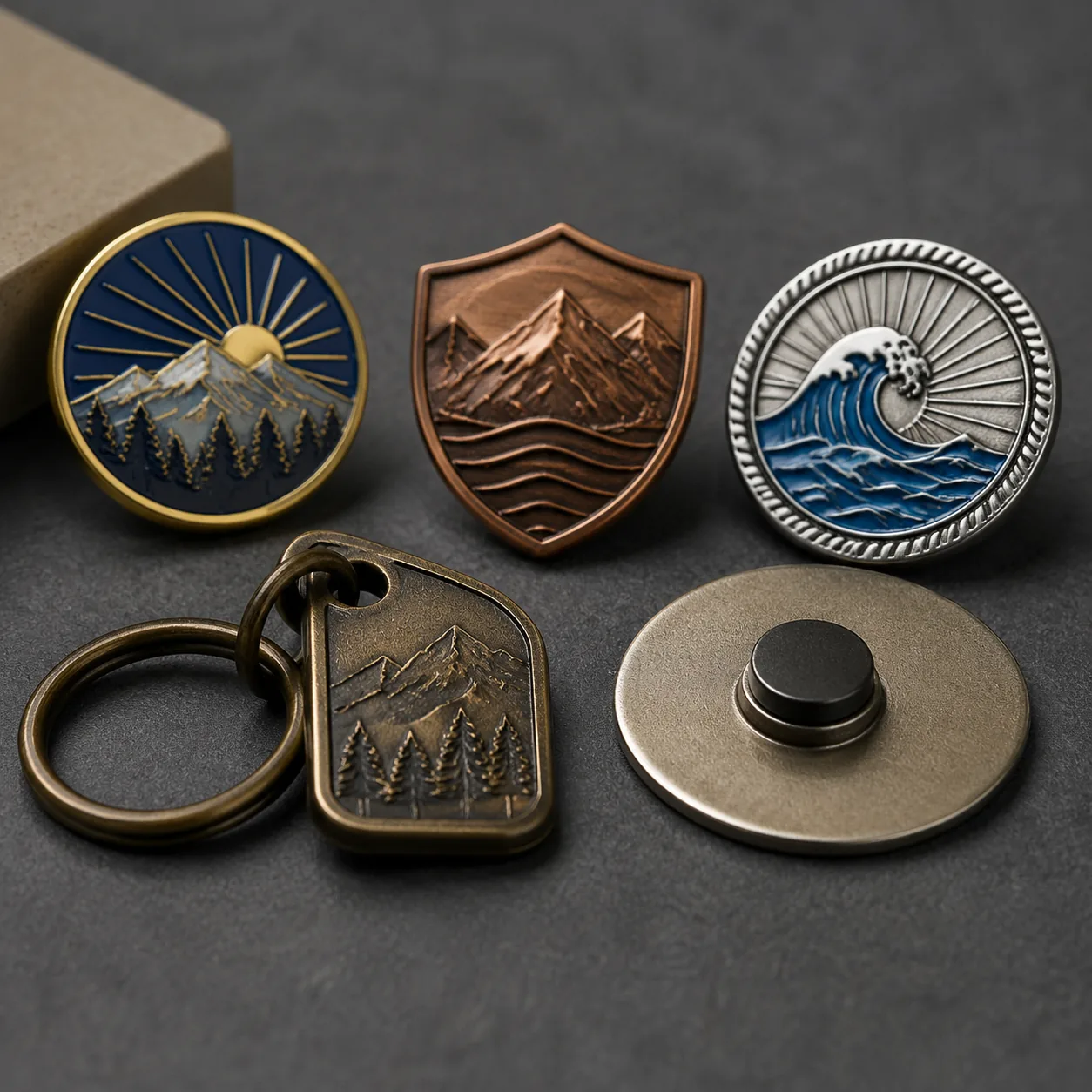
Start with the product, not the decoration name
Most promo-item mistakes happen because buyers choose a decoration method before they define what the item must do. A logo patch, lapel pin, keychain, bag tag, or uniform emblem can all be decorated in multiple ways, but each method has different limits on line width, color separation, thickness, wear resistance, and cost. If you start with the catalog term first, you usually end up paying for a process that is either too weak for the use case or too expensive for the order volume.
The right choice depends on four variables: artwork complexity, service life, quantity, and budget ceiling. A giveaway that lives in a box can tolerate a thinner topcoat or softer detail than a retail item worn weekly. A simple two-color logo can be built as enamel or woven, while a gradient-heavy illustration usually needs print. The goal is not the most premium-looking finish in isolation; it is the process that survives production, shipping, and end use without rework.
- Define the smallest readable text and line width before requesting quotes.
- State whether the item is low-wear, medium-wear, or high-wear.
- Fix the quantity band up front: 100-300, 300-1,000, or 1,000+ pieces.
- Name non-negotiables such as metallic border, matte face, soft-touch feel, or exact Pantone match.
Know the six methods buyers compare most often
For one promo item, buyers usually compare six decoration paths: soft enamel, hard enamel, print, engraving, woven, and PVC. Each one solves a different problem. Enamel gives a raised metal border and a premium tactile look. Print is best for fine detail and gradients. Engraving is strongest for restrained branding, serials, or naming. Woven constructions preserve detail on flexible textile pieces. PVC gives bold color, soft-touch durability, and strong shape definition.
The mistake is to judge them by appearance only. Soft enamel and hard enamel may look similar in a render, but the production route is different: hard enamel requires repeated polishing and fill leveling, while soft enamel keeps the recessed color visible below the metal lines. Printing can reproduce a logo that enamel cannot, but print wear, ink adhesion, and topcoat selection become critical. PVC can hold strong color blocks, but it is not the best fit for tiny negative spaces or ultra-thin interior cutouts.
| Method | Best for | Typical MOQ | FOB price range USD | Lead time days | Common limits |
|---|---|---|---|---|---|
| Soft enamel | Raised borders, clear color blocks, lapel pins, badges | 300-500 pcs | 0.35-1.20 | 12-20 | Tiny text under 4 pt and lines under 0.25 mm are risky |
| Hard enamel | Premium retail look, smooth face, long wear | 300-500 pcs | 0.50-1.80 | 15-25 | More polishing steps; fine detail is harder to keep sharp |
| Gradients, photos, small logos, multicolor art | 100-300 pcs | 0.20-0.90 | 7-15 | Lower tactile feel; scratch resistance depends on topcoat | |
| Engraving | Names, serials, minimalist logos, metal goods | 100-200 pcs | 0.25-1.00 | 7-14 | No color image; contrast depends on substrate and fill |
| Woven | Textile patches, badges, logos with small lettering | 300-1,000 pcs | 0.30-1.10 | 10-18 | Usually needs 0.8-1.0 mm minimum text height |
| PVC | Bold shapes, soft-touch badges, flexible promo items | 300-1,000 pcs | 0.45-2.20 | 15-30 | Small interior gaps and sharp corners need widening |
Match artwork limits to the process
The artwork should be evaluated at real size, not at presentation scale. Zoom the logo to the actual finished dimension and check the narrowest strokes, smallest text, and nearest color boundaries. As a practical rule, metal-based enamel work is safest when the minimum line width is at least 0.25-0.30 mm, while very small copy below 4 pt often becomes unstable after polishing and plating. For woven patches, text usually needs to stay above about 5 pt equivalent, and thin serif fonts should be avoided because thread spread blurs detail.
Print handles the most visual complexity. If the design has gradients, tiny typography, shadows, or photographic elements, print is usually the cleanest route. It also works well when the buyer wants low tooling cost and the quantity is modest. But print is more dependent on surface prep and coating; on smooth metal or coated plastic, adhesion and topcoat hardness matter more than the ink image itself. If the item will be rubbed often, ask specifically for abrasion testing or at least a scratch-resistant topcoat specification.
For engraved items, simplicity is an advantage. Engraving works best when the design is one-color, text-led, or intended to look understated. It is a good fit for nameplates, metal tags, premium corporate gifts, and serialized items. If a buyer wants a logo with a strong visual impact, engraving can be paired with black fill, paint fill, or an oxidized contrast finish, but the design should still be simplified so the cut depth stays uniform.
Woven and PVC are usually chosen for flexible products. Woven is better when the buyer needs cleaner text and tighter detail on fabric-based pieces, while PVC is stronger when the brand wants bold shape definition and a soft, dimensional feel. PVC is also useful when the piece may see moisture, frequent handling, or outdoor use. However, both methods need careful artwork cleanup: too many tiny islands, thin bridges, or sharp internal angles can distort during molding or weaving.
Compare durability, finish, and production risk
Decoration methods differ less by looks than by how they age. Soft enamel has a nice tactile border but the recessed color can show wear if the item is heavily handled. Hard enamel is smoother and more resistant to casual abrasion, but the process is more labor-intensive and usually less forgiving on tiny details. Print is the most flexible for image complexity, yet its durability depends heavily on the substrate, ink chemistry, and protective coating. Engraving is mechanically durable because the mark is cut into the surface, not laid on top of it.
For durability, ask suppliers how the finish behaves under real use, not just in photos. On metal items, a plated surface should keep a consistent tone after polishing and should not show pits, color haze, or edge burrs. On print, the most common failure modes are ink bleed, registration drift, and topcoat cracking. On woven and PVC products, shape retention matters as much as color retention, especially after heat, flexing, or transit compression. A beautiful sample that cannot hold its edges in bulk is not a good production answer.
Lead time is also process-dependent. A simple printed item can often ship in 7-15 days after artwork approval, while enamel and molded PVC typically need 12-30 days once tooling, color matching, and curing are included. If a mold is required, add another 3-7 days for first-tool confirmation, and longer if the buyer requests a second sample round. For time-sensitive launches, it is safer to choose the process that can be built once and approved quickly than to chase a premium process that needs multiple corrections.
| Decision factor | Choose a premium build when | Choose an efficient build when |
|---|---|---|
| Brand position | The item is retail-facing, award-level, or for executives | The item is for events, onboarding, or mass giveaway use |
| Artwork | Simple, iconic, and built to benefit from raised detail | Gradient-heavy, text-heavy, or photo-like |
| Wear | Frequent handling and visible long-term use | Short-life promo use or seasonal distribution |
| Budget | Unit price can be higher if the look is stronger | Lowest practical landed cost matters most |
| Schedule | You can absorb sample iterations | The deadline is fixed and buffer is limited |
Use quantity to decide where the economics flip
Quantity changes the economics more than most buyers expect. In the 100-300 piece range, buyers often win by choosing the process with the lowest setup friction, not the fanciest finish. In the 300-1,000 range, decoration methods with modest tooling costs start to compete better because fixed charges spread out. Beyond 1,000 pieces, the per-unit difference between a labor-heavy finish and a simpler build can become meaningful enough to change the landed cost by 20-40%.
Typical MOQ tiers also vary by process. Printed items may start at 100-300 pieces because the setup is light. Soft enamel and hard enamel usually sit around 300-500 pieces because mold and plating work need volume to make sense. Woven and PVC often begin around 300-1,000 pieces depending on size, complexity, and number of colors. If a supplier quotes a very low MOQ on a custom process, check whether the unit price includes hidden mold, plate, or proofing costs.
FOB price is only useful when the build is held constant. A quote of USD 0.35 versus USD 0.55 is not a real comparison if one supplier is using thinner plating, fewer colors, or a lower-cost backing. Ask for the same finished size, same attachment, same packaging, and same approval standard. Then compare like-for-like. The cheapest line item is often not the cheapest production result once sampling, corrections, and rejects are included.
Set sample and QC rules before mass production
A sample should prove manufacturability, not just appearance. Inspect the sample at actual size under daylight and indoor light. For enamel and metal items, check border crispness, plating tone consistency, fill level, and any softening of lettering after polishing. For print, check registration, opacity, edge bleed, and topcoat clarity. For woven and PVC items, verify that the shape matches drawing tolerances and that small elements remain readable at arm’s length.
QC should be specified before the order starts. A common starting point for promo items is AQL 2.5 for major defects and AQL 4.0 for minor defects, but the right threshold depends on how the item will be used. For retail or executive gifting, many buyers tighten inspection and reduce allowable cosmetic variance. For mass event giveaways, buyers may accept a slightly broader range, but still need strict controls on function, color mismatch, bent pins, broken backing, burrs, and misregistration.
Useful tolerance targets also help. For metal badges and pins, a dimensional tolerance of ±0.2 mm is often realistic on small features, while outer dimensions may be held around ±0.3 mm depending on size and tooling. For woven patches, ask for edge trim tolerance around ±1.0 mm and color approval against a physical standard, not only a screen file. For PVC, thickness often needs a tolerance band of about ±0.3 mm because fill pressure can change the final profile. If the supplier cannot state tolerances, the process is not yet under control.
- Approve one physical sample, not only a digital render.
- Check line width, smallest text, and color boundaries at finished size.
- Record plating tone, backing type, and attachment style in writing.
- Set defect limits for scratches, burrs, glue marks, color drift, and misalignment.
- Lock the approved build so reorders match the first production run.
Choose the right method for the final use case
If the item is a premium pin, award, or client gift, hard enamel or a refined engraved metal build is usually the best fit. If the item needs strong visual impact at controlled cost, soft enamel often gives the best balance of appearance and efficiency. If the artwork relies on gradients, small type, or photo realism, print is usually the safest production route. If the item is textile-based, woven is better for detail and embroidery is better when texture and durability matter more than tiny copy. If the brand wants a soft, bold, molded look, PVC is often the strongest choice.
A practical example: a two-color company crest for a trade show badge can be soft enamel at 300 pieces, FOB around USD 0.45-0.85, with a 12-18 day lead time. The same crest, if specified as hard enamel with premium plating and polished edges, may rise to USD 0.70-1.50 and 15-25 days. A complex event illustration with gradients could move to print at USD 0.20-0.60 and 7-12 days. The correct answer is not always the most impressive sample; it is the process that matches the artwork, the budget, and the deadline without compromise.
If you are still deciding, ask suppliers to quote two versions on the same spec: one premium and one efficient. Keep the artwork, size, backing, and packaging identical, and require clear notes on MOQ, FOB, lead time, and QC standard. That comparison forces the real trade-off into view and prevents a later redesign. If you want a faster path, build a one-page spec sheet first, then send it to suppliers for matched quotes before you commit to tooling.
Have a project? Send your artwork and target quantity and we’ll reply with a detailed quotation within 12 working hours.
Ready to get this made?
Send your sketch, target quantity and ship-date. Detailed quotation in 12 hours.



