How to Choose Between Flat, 2D and 3D Metal Builds
Start with the message the part must carry
Buyers often name the product first and the function second. That leads to poor RFQs, because a pin, coin, or badge can be built in very different ways while still looking similar on a spec sheet. The better question is not “What item is this?” but “What must the item communicate at arm’s length, at hand distance, and on reorder?” A flat logo badge, a textured emblem, and a sculpted mascot may all be 25 mm across, yet they behave like different products in tooling, plating, and inspection.
If the artwork is mostly linework, lettering, and separated color areas, flat or low-relief construction usually gives the cleanest result and the lowest reject rate. If the design depends on shadow, volume, or a premium gift feel, 2D or 3D relief can justify the added tooling and sampling time. For repeatable promotional metal goods, the safest choice is usually the simplest build that still protects the design intent, because every step up in complexity adds mold depth control, polishing labor, and more surface-risk points.
This framework is for production goods, not one-off art pieces. The goal is to reduce RFQ risk, improve reorder stability, and keep the quote comparable across suppliers. A dramatic render can still fail in production if the relief is too deep, the text is too fine, or the finish cannot bridge sharp transitions.
What changes from flat to 3D in production
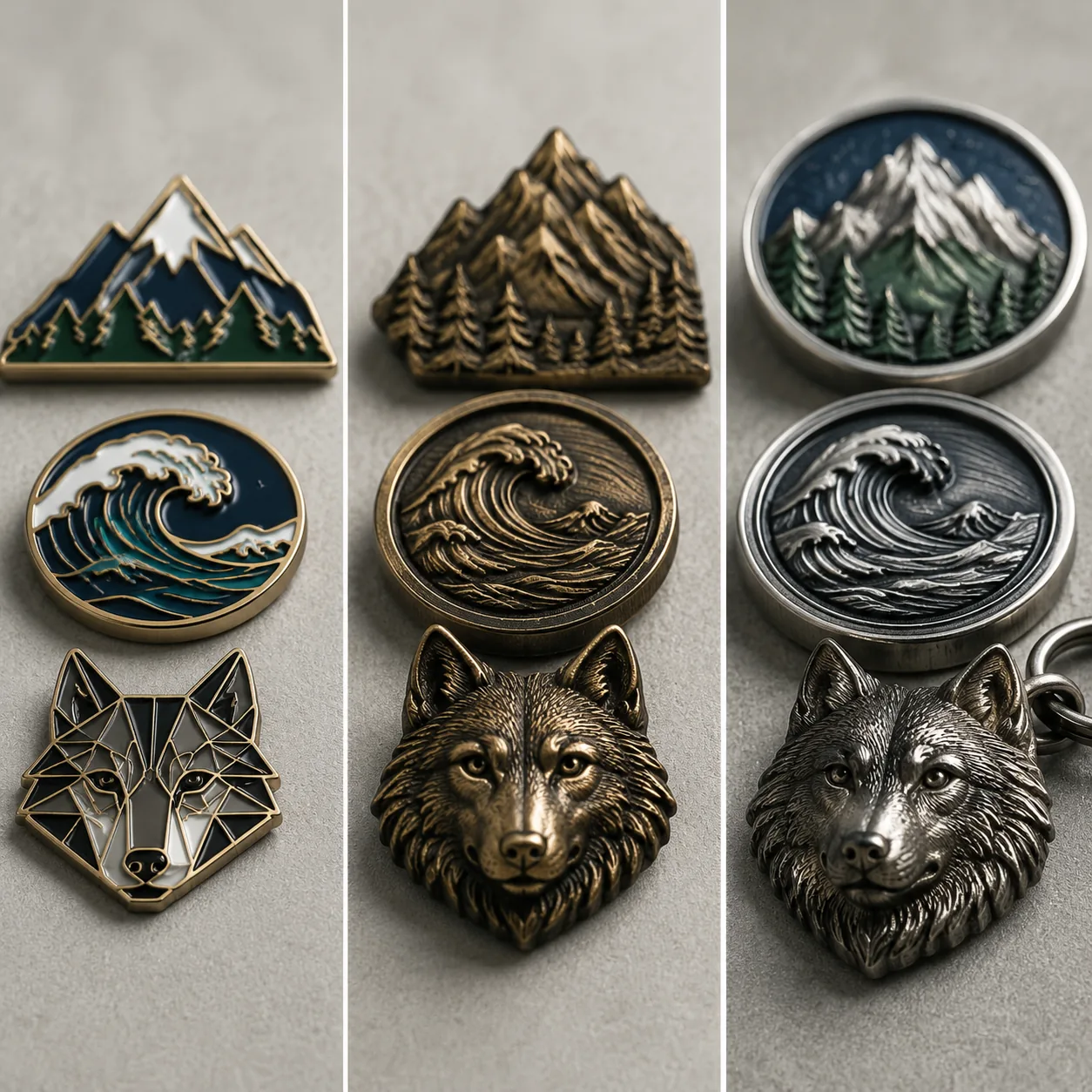
Flat builds rely on a mostly planar face with engraved, stamped, or filled detail. They are the most forgiving for small logos, text-heavy layouts, and mixed runs with multiple colorways. 2D relief adds stepped raised and recessed planes, which improves separation without requiring full sculpture. 3D relief turns the item into a modeled object, where the form itself carries the design and the artwork becomes secondary to the shape.
That difference affects more than appearance. Flat builds are easiest to control for thickness, polishing consistency, and color-fill boundaries. They also tolerate shorter turnaround when artwork is already approved. 2D relief gives more perceived value, but the buyer must lock height steps carefully or risk uneven plating and color pooling. 3D relief is the most sensitive to mold interpretation, undercut limitations, and hand-polish variation, so it is better reserved for hero products, collector pieces, and premium gifting programs.
| Build style | Best use case | Typical technical profile | Main trade-off |
|---|---|---|---|
| Flat | Logos, text, simple badges | Relief height often 0.2–0.6 mm; linework usually stays readable at 0.15–0.20 mm stroke; low die complexity | Less depth and premium feel |
| 2D relief | Mascots, emblems, structured artwork | Step heights often 0.5–1.2 mm; recessed zones and raised planes can be separated cleanly; moderate mold control | More tooling detail to control |
| 3D relief | Characters, sculptures, collectible gifts | Multiple planes and curved surfaces; undercuts must be controlled or split into tooling sections; highest polish sensitivity | Higher tooling risk and slower approval |
Detail, durability and finish risk are different variables
A common buyer mistake is treating more depth as automatically better. Depth can improve perceived value, but it does not automatically improve durability. In fact, deep relief can create sharp transitions that wear unevenly, trap residue during finishing, and exaggerate minor polish marks. For daily-handled items, a simpler profile with controlled edges often lasts longer than a dramatic sculpt that only looks perfect in the render. Thin protrusions, deep recesses, and tiny facial features are the first areas to degrade once the part is plated and polished.
Durability also depends on base metal and finish thickness. For zinc alloy die-cast pieces, a practical body thickness is typically 2.0–2.5 mm for pins and badges and 2.5–3.5 mm for heavier coins or medallions. Brass is usually preferred for sharper stamped lines and tighter logo edges when the artwork is relatively flat. Iron can work well for thinner stamped badges where cost matters more than deep relief. Decorative flash plating may be only 0.03–0.08 μm, while more wear-resistant nickel layers on promotional items commonly land around 3–8 μm. Gold-colored finishes are often cosmetic over nickel rather than solid precious-metal layers, so the base relief still drives most of the visual result.
The most common mistake is overspecifying depth when the real need is clarity. If the design must keep exact logo proportions, if the buyer needs aggressive cost control, or if text must remain readable below 15 mm overall size, full 3D is usually the wrong choice. If the product is a premium gift, a collector item, or a shape-led concept that would look generic without volume, flat is usually too conservative. For many programs, 2D relief is the safest middle ground because it adds perceived value without sacrificing branding control.
Cost and lead time move in predictable tiers
The biggest quoting mistake is comparing only unit price and ignoring tooling, sampling, and revision cost. Flat builds usually have the lowest mold and polishing burden, so MOQ can start around 100–300 pcs for simple promo orders. Sample approval commonly takes 7–10 days, and production lead time is often 10–15 days after sample approval. 2D relief usually needs more careful mold making and first-article review, so MOQ often starts around 300–500 pcs, with sample lead times around 8–12 days and production at 12–18 days. 3D relief commonly needs 500 pcs or more to make the tooling economics sensible, and lead time can stretch to 15–25 days depending on sculpt complexity and revision count.
FOB pricing varies by size, plating, backing, and packaging, but early budget ranges are useful. A simple flat metal item often sits around USD 0.35–1.20 per piece at 500–1,000 pcs. 2D relief commonly lands around USD 0.60–1.80, while 3D relief is often USD 1.20–3.50 or more for highly sculpted shapes. Tooling is where the gap becomes obvious: a simple flat or shallow 2D mold may be in the low hundreds of dollars, while a complex multi-plane 3D tool can be several times higher because it requires more hand-finishing and more sample iterations.
A practical way to read these numbers is by total program cost, not only piece price. If a slightly higher tooling fee removes one sample round, the calendar savings can be worth more than a few cents per unit. On a 1,000-piece reorder, avoiding one round of photo markup, sample shipping, and correction can matter more than the small spread between a flat and 2D unit quote. That is why experienced buyers compare build style as a program decision, not a line-item decision.
Use a technical screen before you choose the build
A short spec screen often makes the right choice obvious. If three or more of the items below are true, flat or 2D is usually safer than full 3D. If most are false, 3D may be worth the added cost and risk.
- Artwork relies on readable text below 1.5 mm stroke width
- The item must match a brand shape exactly across reorders
- The buyer needs first-sample approval on a short timeline
- The order includes multiple colorways sharing one base mold
- The product will be handled daily or shipped in volume
- The budget target sits below premium gift pricing
- The design has fine internal cut lines or tight facial features
For mixed programs, do not force every SKU into the same build style. A logo pin may be best as flat or shallow 2D, while a commemorative coin can carry more relief without looking crowded. In many cases, one sculpted hero item plus several simpler companions gives the best budget-to-impact ratio and reduces the risk that a complex SKU delays the entire order.
Use these practical thresholds when reviewing artwork: if the smallest negative space is below 0.25 mm, if raised text is below 0.3 mm high, or if the art contains more than two nested contour levels in a 20–25 mm part, move away from full 3D unless the factory has strong die-sinking capability. For highly polished surfaces, assume relief will appear more pronounced after plating, so what looks modest in CAD can read much deeper in metal.
Decision table: where each build wins
Use this table for procurement and brand teams making a fast call before RFQ. It assumes standard decorative metal promo products, not jewelry-grade finishing or industrial parts. The goal is to choose the least complex build that still preserves the brand story.
| Decision factor | Flat | 2D relief | 3D relief |
|---|---|---|---|
| Logo clarity | Best | Very good | Poor to fair |
| Premium feel | Fair | Good | Best |
| Tooling risk | Low | Medium | High |
| Sample revision risk | Low | Medium | High |
| Lead-time pressure | Best | Good | Weak |
| Reorder stability | Best | Very good | Depends on mold quality |
| Fine sculpted detail | Weak | Good | Best |
| Price control | Best | Good | Weak |
| Color-fill control | Best | Very good | Fair |
| Best MOQ fit | 100–300 pcs | 300–500 pcs | 500+ pcs |
The table does not say one style is universally better. It shows that each build optimizes a different buying priority. Flat wins when clarity and control matter most. 2D wins when you want a moderate lift in perceived value without heavy risk. 3D wins when the object itself is the message. The smartest buyer chooses the least complex option that still protects the brand story.
Lock tolerances, AQL and approval rules before sampling
Once the build style is chosen, vague specification becomes the next risk. The factory needs explicit direction on overall thickness, raised height, recessed depth, finish type, and minimum readable line width. For flat and 2D builds, state whether the surface should be mirror-polished, matte, sandblasted, or textured, because polishing changes how deep the relief appears after plating. For 3D builds, request front, side, and back profile views so the sample does not look correct from one angle and fail in hand.
A practical approval pack should define acceptable tolerance bands rather than asking for “close to artwork.” For many metal promo products, overall size tolerance of ±0.3–0.5 mm is common, while thickness tolerance often sits around ±0.2 mm depending on base material and process. For cutouts, post holes, and attachment points, ±0.1–0.2 mm is often worth specifying because fit failures show up there first. If the order is high-value or collector-grade, tighten only the dimensions that affect fit and brand shape, not every cosmetic edge; over-tightening increases reject risk and slows the run.
Surface quality also needs a measurable target. Decorative promo work commonly accepts AQL 2.5 for major defects and AQL 4.0 for minor cosmetic issues, while premium programs may tighten that to AQL 1.5 for critical fit or logo errors. If the item includes color fill, specify acceptable voids, pinholes, overflow, and mismatch at color boundaries. The more detailed the relief, the more important it is to define where texture is allowed and where it is not.
For metal samples, ask for a golden sample that is approved for shape and plating reference, then attach the spec sheet to that sample for reorder control. A reliable ordering sequence is: confirm build style first, lock relief height and edge treatment second, then approve plating color and backing or attachment last. That order avoids approving an attractive sample that cannot be repeated at scale. It also gives procurement one reference for future reorders instead of trying to interpret photos or email threads.
As a rule of thumb, if the supplier cannot state the expected AQL, tolerance bands, and sample lead time in the first quote, the quote is not ready for comparison. Good factories can usually tell you whether the part will be sampled in 7–12 days, whether production will be 10–25 days after approval, and which features are most likely to drift. That level of specificity is more useful than a low price with no process detail.
What to do next
If you are quoting a new design, start by classifying the artwork into one of three buckets: flat logo, structured emblem, or sculpted object. Then send the factory the smallest build that still preserves the design intent, plus the exact size, thickness, plating, tolerance, and AQL targets. If the first quote comes back wide, ask for a second quote with one level less relief so you can compare savings against the visual trade-off. For multi-item programs, mix build styles instead of forcing every SKU into the same premium level.
If you want the safest path, choose flat for clarity-led items, 2D for most branded merchandise, and full 3D only when the object itself is the selling point. That simple rule reduces rework, keeps lead time under control, and gives procurement a cleaner basis for comparing supplier quotes. For complex programs, ZheCraft can help translate artwork into a build spec that matches the budget, timeline, and reorder target before tooling starts.
Have a project? Send your artwork and target quantity and we’ll reply with a detailed quotation within 12 working hours.
Ready to get this made?
Send your sketch, target quantity and ship-date. Detailed quotation in 12 hours.



