How to Benchmark Custom Pin Quotes in 2026
Build a Comparable RFQ Before You Ask for Prices
Most bad quote comparisons start with a weak brief: one logo image, one rough size note, and a request for each factory's "best price." That does not produce benchmarkable numbers. One supplier may quote a 30 mm iron pin at 1.2 mm thickness with one post and bulk packing; another may price 1.5 mm brass with two posts, a deluxe clutch, and retail carding. The apparent price gap looks commercial, but the real difference is metal weight, labor time, plating route, packing content, and reject risk.
A usable RFQ forces every supplier to quote the same finished part and the same service scope. Lock the longest side in millimeters, overall width for irregular shapes, finished thickness, base metal, process, plating finish, attachment type and quantity, packaging, inspection level, quantity tiers, trade term, and sample route. State whether substitutions are allowed. If alternatives are permitted, require the factory to list each deviation line by line: metal change, thickness change, post count, clutch type, plating substitution, card stock substitution, and any outsourced process.
For most corporate, event, and promotional pins in 2026, a practical baseline spec is 30 mm longest side, 1.5 mm finished thickness, soft enamel on iron or brass, one butterfly clutch for compact shapes and two posts for wider or tall designs, decorative nickel or imitation gold plating, and either bulk pack or backing card plus polybag. Below 25 mm, one post is usually sufficient unless the shape is tall and narrow. Above 32-35 mm, two posts are standard because single-post pins rotate easily on garments, lanyards, and backpacks.
- Size: specify longest side and overall width; for irregular outlines, add critical cutout or bridge dimensions. Example: 30 x 24 mm finished size, with a 4.0 mm internal cutout and minimum bridge width of 1.2 mm.
- Thickness: 1.2 mm suits low-cost giveaway programs, 1.5 mm is the standard commercial grade, and 1.8 mm gives a heavier premium feel but adds metal weight and polishing time.
- Metal: iron is the common low-cost base; brass is preferred for finer die-struck detail, cleaner edge polish, and better performance on small text or narrow metal lines.
- Process: specify soft enamel, imitation hard enamel, die-struck no-fill, or printed-with-epoxy. Avoid vague terms such as "hard enamel look" unless the actual process is named.
- Plating: lock nickel, black nickel, imitation gold, imitation silver, antique nickel, or antique brass. Decorative flash on custom pins is typically thin, often around 0.03-0.05 micron where declared; it is a cosmetic finish, not heavy functional plating.
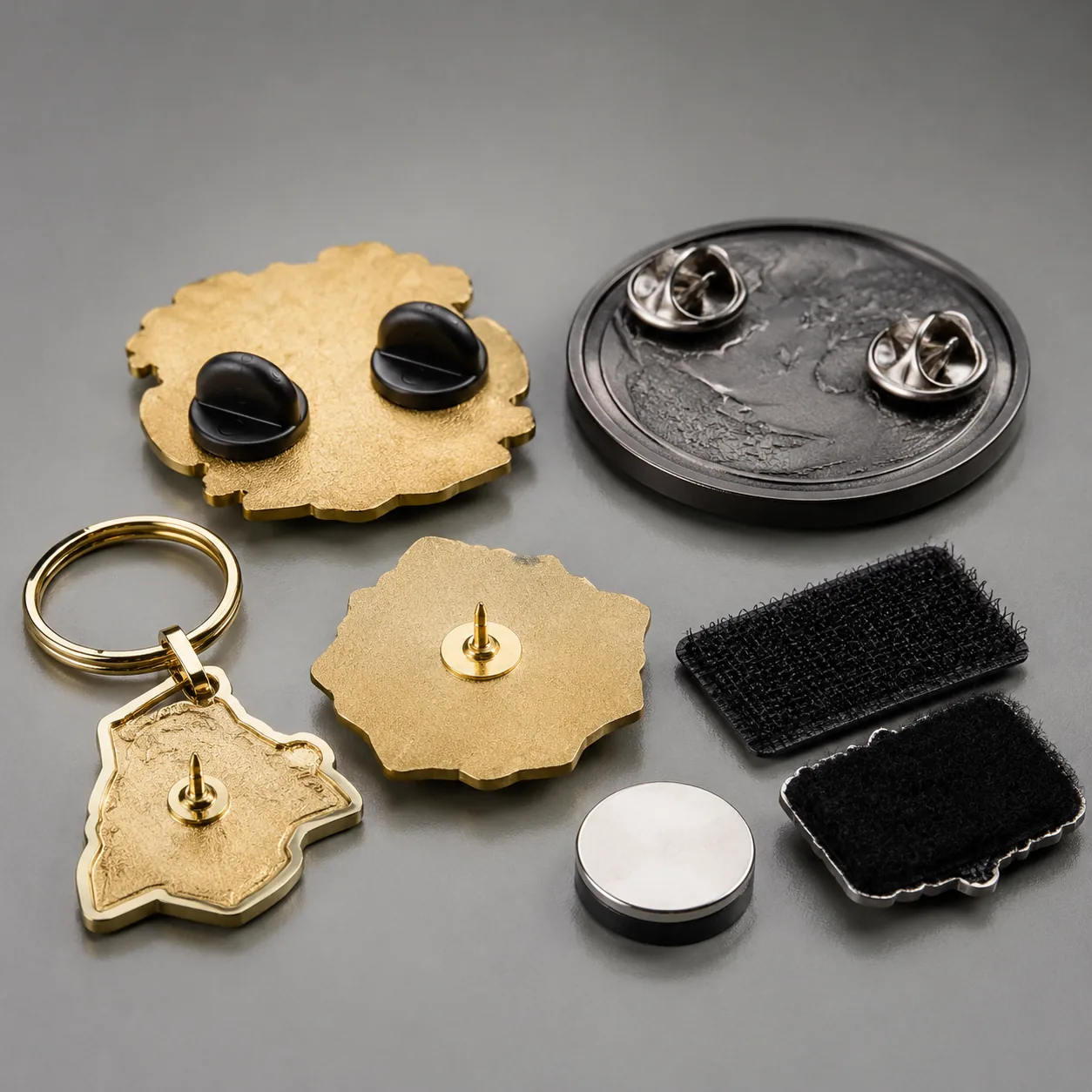
- Attachment: state butterfly clutch, rubber clutch, deluxe locking clutch, magnet, or safety pin, plus one-post or two-post construction and preferred post locations.
- Packaging: define bulk pack, individual polybag, backing card plus polybag, or gift box. For cards, state card size, paper weight, print sides, hole position, barcode requirement, and whether cards must be inserted before or after final QC.
- Inspection: define AQL and defect examples. AQL 2.5 major / 4.0 minor is common for standard promo orders; premium or licensed programs often move to AQL 1.5 major / 2.5 minor.
Normalize Every Quote Line Before Comparing Unit Price
The first unit price on a quote sheet is rarely the number you should benchmark. A quote at USD 0.46 FOB Ningbo is not comparable to USD 0.54 EXW Zhongshan if one includes the mold, polybagging, and a physical pre-production sample while the other does not. The same problem appears when one supplier absorbs tooling into the first order and another lists it separately, or when one assumes one post and another silently prices two.
Require every factory to use the same quote structure: tooling charge, sample fee, unit price by quantity tier, packaging cost, export carton dimensions, gross and net weight estimate, sample lead time, bulk lead time, overrun or underrun tolerance, payment terms, HS code description, and whether plating, enamel fill, and packing are in-house or outsourced. In-house plating and enamel filling generally produce more stable lead times than a multi-vendor route, especially when you need shipment inside a fixed event window.
Benchmark the approved-spec total cost, not the headline unit rate. A supplier that is USD 0.04 cheaper per piece can still cost more if it adds card insertion later, ships EXW instead of FOB, or misses line clarity on the first sample and forces a second approval loop. In pin sourcing, re-sampling often costs more in calendar days than in sample fees.
| Quote Variable | Supplier A | Supplier B | What Buyer Should Standardize |
|---|---|---|---|
| Pin spec | 30 mm soft enamel iron, 1.2 mm, 1 post | 30 mm soft enamel brass, 1.5 mm, 2 posts | Match size, thickness, metal, and attachment count before comparing price |
| Plating | Imitation gold, no flash range stated | Nickel flash, 0.03-0.05 micron declared | Lock finish and ask each factory to state decorative flash range if available |
| Tooling | USD 55 absorbed into first order | USD 80 separate mold charge | Break out tooling on every quote and compare it separately from unit cost |
| Sample route | Digital proof only | 1 physical pre-production sample at USD 35 | Require the same sample path from all suppliers |
| Packaging | Bulk pack, 100 pcs per bag | Backing card plus polybag | Quote one identical packing method |
| Trade term | FOB Ningbo | EXW Yiwu | Normalize to one term, usually FOB named port |
| Lead time | 10-12 days | 15-18 days | Count from the same trigger: artwork approval plus deposit, or sample approval plus deposit |
| Shipment tolerance | +/-10% | Not stated | Require a declared tolerance; +/-5% is common for custom pins |
Benchmark by MOQ Tiers, Lead-Time Windows, and Real FOB Ranges
A usable comparison needs quantity tiers because the cost curve changes sharply at low MOQ and then flattens once tooling, setup, and artwork separation are absorbed. For custom pins, the practical breakpoints are usually 100, 300, 500, 1,000, 3,000, and 5,000 pieces. Some factories advertise MOQ 50, but that tier usually carries the highest unit cost, the weakest scheduling priority, and the greatest chance of hidden simplifications such as thinner metal, one-post construction, or basic bulk packing only.
For a standard 30 mm soft enamel iron pin at 1.5 mm thickness with one butterfly clutch and bulk packing, realistic 2026 FOB China pricing is commonly USD 0.50-0.78 at 100 pieces, USD 0.36-0.58 at 300 pieces, USD 0.31-0.49 at 500 pieces, USD 0.27-0.42 at 1,000 pieces, and USD 0.23-0.35 at 3,000-5,000 pieces. Brass at the same size usually adds about USD 0.05-0.12 per piece. Deluxe locking clutches commonly add USD 0.06-0.12 each versus butterfly clutches. Printed backing cards plus polybags typically add USD 0.08-0.18 per set depending on card size, print coverage, barcodes, and insertion labor.
Tooling for a standard outline is usually USD 45-90. Complex openwork, multiple internal cutouts, asymmetrical shapes that need careful post placement, or larger 38-45 mm formats can push tooling to USD 90-150. If the order includes several size variants, separate language versions, or multiple attachment options, confirm whether the supplier is quoting one shared die with secondary fixtures or separate tooling per SKU. That detail materially affects reorder cost.
| Spec Scenario | Typical MOQ | Typical 2026 FOB Unit Price | Typical Bulk Lead Time |
|---|---|---|---|
| 25 mm soft enamel iron, 1.2 mm, 1 post, bulk pack | 100 pcs | USD 0.28-0.45 | 10-14 days |
| 30 mm soft enamel iron, 1.5 mm, butterfly clutch | 300 pcs | USD 0.36-0.58 | 10-18 days |
| 30 mm brass imitation hard enamel, deluxe clutch | 300 pcs | USD 0.58-0.95 | 12-20 days |
| 38 mm pin with epoxy dome, backing card, polybag | 300 pcs | USD 0.68-1.10 | 14-22 days |
| 30 mm pin with 2 posts and magnetic backing | 300 pcs | USD 0.78-1.30 | 12-20 days |
Read the Process Behind the Lead Time
Quoted lead time is only useful if you know how the days are allocated. Many factories batch die making, plating, color fill, and final packing to protect margin, so a quoted 9-day run can become 14 days if your order misses a plating slot or if retail packing is sent to an outside workshop. A supplier with a slightly longer headline lead time but a clearer day-by-day process plan is usually the safer benchmark.
For a standard 30 mm soft enamel pin, a realistic physical sample route is 1-2 days for artwork separation and mold file confirmation, 2-3 days for die making and first strike, 1-2 days for polishing and plating, 1-2 days for color fill and bake, and 1 day for QC and dispatch. That puts a physical pre-production sample at roughly 6-8 calendar days after artwork approval for a simple design. Add 2-3 days for epoxy domes, glitter, glow pigment, transparent fill, screen print, or multi-part retail packing.
Bulk production after sample approval is commonly 10-18 calendar days for 500-5,000 pieces with standard plating and bulk or simple individual packing. Backing card insertion, barcode labeling, split-SKU sorting, magnet attachment, gift boxes, or mixed-carton assortments usually add another 2-5 days. Antique finishes and black nickel often add queue time because they are commonly grouped into smaller specialty runs rather than daily standard plating cycles.
Ask the factory three direct questions: Are weekends counted, is plating in-house, and what event starts the lead-time clock? Some suppliers count from deposit receipt, others from artwork approval, and others only after physical sample approval. Those are materially different schedules. A lead time without a clear start trigger is not a control number.
Use Sample Approval to Set Measurable Production Standards
A sample is not just a visual check. It is where you convert appearance into measurable production rules. Approving from a phone photo is rarely enough if the program needs stable metal lines, clean enamel boundaries, repeatable clutch fit, and consistent card presentation across 1,000 or 5,000 pieces.
Write tolerances into the approval. For most commercial enamel pins, practical tolerances are +/-0.15 mm on overall size, +/-0.10 mm on thickness, and +/-0.20 mm on post location unless the part must fit a fixture, display slot, or pre-punched card with tight alignment. For soft enamel linework, many factories struggle below about 0.20 mm raised metal in volume production; 0.25-0.30 mm is a safer target for clean color separation and lower bleed risk. If the art includes small text, treat anything below about 0.8 mm capital height or below 0.18 mm stroke width as high risk unless the factory has shown equivalent production samples.
Plating language also needs precision. Decorative nickel, black nickel, imitation gold, and imitation silver on pins are usually thin cosmetic flash layers, often declared around 0.03-0.05 micron where the supplier provides a number. That is appropriate for appearance, but it is not a durability guarantee. On antique or dyed finishes, visual consistency matters more than the nominal flash figure, so retain a sealed golden sample or signed photo standard for reorders. For enamel, require Pantone references where possible, while recognizing that dark blue, orange, and red often need a visually approved match rather than a theoretical ink-book match because of resin behavior and bake variation.
- Inspect front-side metal lines under direct light for burrs, pits, breaks, color bleed, and incomplete fill at boundaries.
- Measure thickness at three points with calipers, not only at the edge where polishing can distort the reading.
- Check enamel fill height for sink, overflow, contamination, pinholes, and uneven bake gloss.
- Test post weld strength, post straightness, clutch fit, and rotation resistance on actual fabric or card stock.
- Verify Pantone references or approved visual equivalents for each color area, especially reds, oranges, and dark blues.
- Confirm backing card hole position, insertion force, and card bow after bagging.
- Freeze inner pack count, master carton count, shipping marks, carton dimensions, and barcode label format before bulk release.
Judge Price Against Failure Risk and QC Terms
The cheapest quote is often not the lowest-cost order. Saving USD 0.05 per piece disappears quickly if you see plating peel, weak post welds, off-center card punching, exposed base metal on the face, or a second sample loop. Benchmark price against failure risk, rework risk, and the clarity of the supplier's QC terms.
Some options add cost with limited technical risk. Moving from bulk pack to individual polybag usually adds straightforward labor and material. Other options increase both defect rate and schedule variance. Epoxy domes can trap dust or show edge lift; transparent colors reveal polishing inconsistency underneath; antique plating can reduce readability in low-relief artwork; printed elements can shift relative to die-struck boundaries; and magnetic backings can fail if the magnet grade, adhesive system, or metal plate alignment is weak.
QC terms should match program value. AQL 2.5 major / 4.0 minor is common for standard promotional orders. Collector, executive gift, or licensed merchandise programs often tighten to AQL 1.5 major / 2.5 minor and define defects in writing. On pins, major defects usually include wrong color area, missing or loose attachment, exposed base metal on the front face, plating peel, sharp burrs, and visible shape distortion. Minor defects usually include light back-side scratches, slight color variation within the approved standard, or small back-side plating marks outside the visible face.
During quote review, the better supplier is often the one that flags these risks before you ask. That behavior is a stronger predictor of stable bulk output than a low opening price.
Lock Reorder Variables Before Deposit
Most repeat-order disputes are created before production starts. Buyers assume the second order will match the first; factories may treat plating line choice, color interpretation, tooling storage, or outsourced packing as flexible unless those variables are frozen. Before deposit, convert the approved sample into a production control sheet that can be reused without rewriting the program.
That control sheet should list the approved artwork revision, final dimensions, thickness, material, plating, attachment, packaging, carton specification, AQL level, defect definitions, shipment tolerance, and approved reference images. Also lock the variables that commonly drift on reorders: tooling ownership, tooling storage period, sample retention period, color reference method, plating substitution policy, and whether any step may be outsourced without written approval. If the factory will store tooling for 12 months only, that matters to the true reorder economics.
A practical overrun agreement for custom pins is +/-5%. If exact count matters for event kits, subscription boxes, or serialized programs, state it at RFQ stage. Exact-count orders usually cost more because the factory must build internal overage to cover rejects while still guaranteeing the shipped final quantity. That hidden scrap buffer is real labor and material cost.
During production, request milestone evidence rather than generic status updates. Useful checkpoints include die photo, first struck metal piece, plating rack photo, first color-fill article, and final packed carton photo with count label. At shipment, ask for passed quantity, reject quantity, extra quantity packed if any, carton dimensions, gross and net weight, and a short final inspection summary. For higher-risk retail or licensed programs, add a third-party pre-shipment inspection against the same defect definitions used at sample approval.
Use a Repeatable Quote Scorecard
The cleanest way to benchmark custom pin quotes is to score them against the same variables every time. Send one normalized RFQ to three to five suppliers, require one quote template, and remove any factory that will not declare assumptions on metal, thickness, finish, attachment, packaging, sample route, and trade term. A nontransparent quote is not a benchmarkable quote.
A practical 2026 scorecard is 30% quote clarity and completeness, 25% sample quality against tolerances, 20% lead-time credibility, 15% QC terms and defect definitions, and 10% commercial terms such as tooling, payment, and overrun policy. That weighting keeps the decision tied to repeatability and delivered quality instead of headline unit cost. If two suppliers land within USD 0.02-0.03 per piece of each other, the one with stronger controls usually has the better landed outcome.
If your program includes pins alongside coins, keychains, patches, or medals, keep one shared control sheet for finish names, Pantone references, attachment options, packaging counts, carton labels, and inspection rules. That reduces approval loops, speeds reorders, and makes cross-item quote comparisons more reliable. In practice, the best supplier is usually the one that defines variables early, prices them transparently, and holds them through sample, bulk production, and reorder.
Have a project? Send your artwork and target quantity and we’ll reply with a detailed quotation within 12 working hours.
Ready to get this made?
Send your sketch, target quantity and ship-date. Detailed quotation in 12 hours.



