How to Approve a Golden Sample Without Costly Rework
Q: What should a golden sample actually prove?
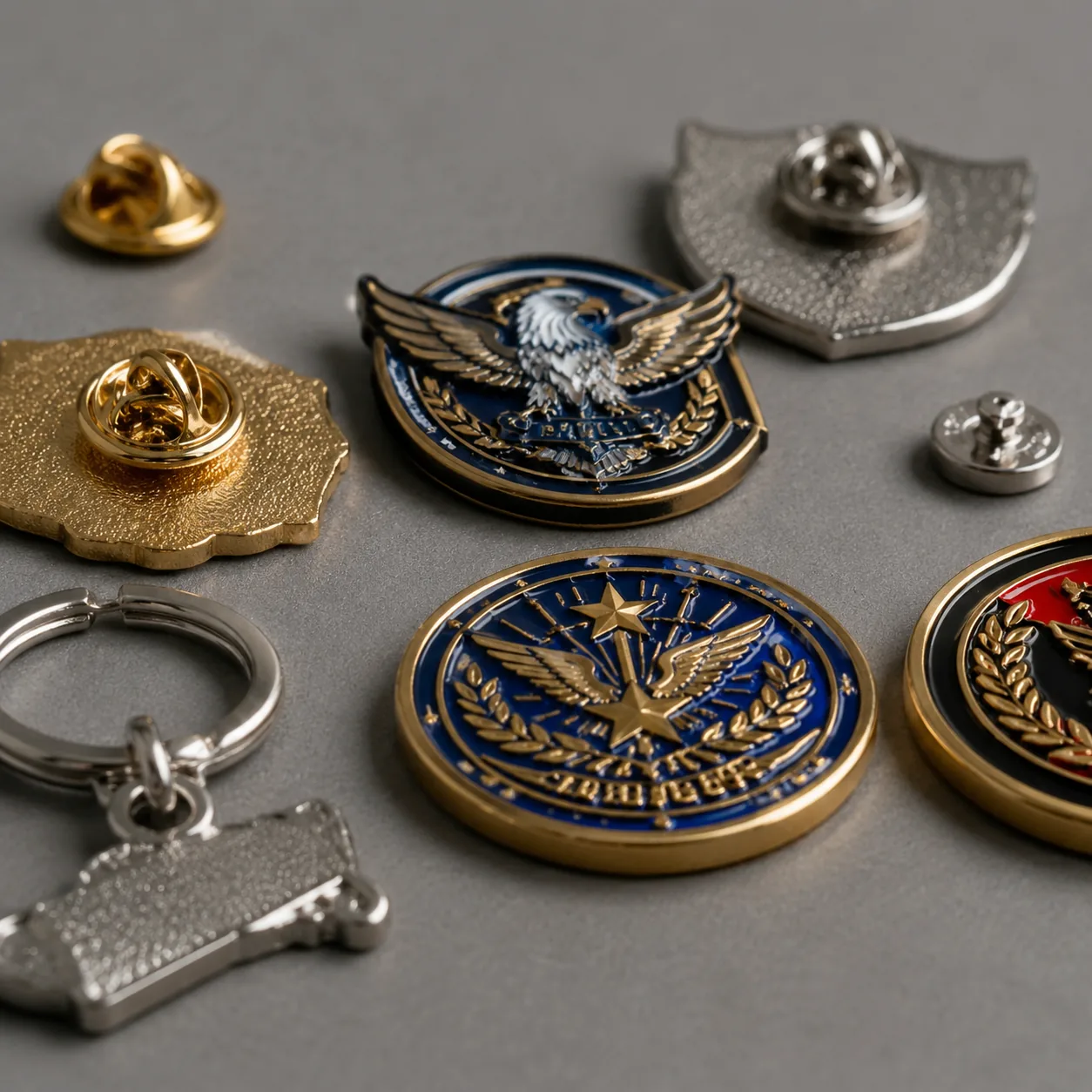
A golden sample is the frozen production reference, not a display piece. It should prove the exact build the factory can repeat at scale: dimensions, material stack, finish, color placement, attachment behavior, packaging, and the defect level you will accept. If any of those points are left vague, the sample becomes a visual reference only, which is how rework starts.
For custom enamel pins, challenge coins, badges, keychains, magnets, patches, and lanyards, the sample should also lock the process route: die-struck brass, zinc alloy die-cast, laser engraving, soft enamel, hard enamel, printed epoxy, woven, embroidered, or heat-transfer print. The same artwork can produce very different results depending on process. A 30 mm soft-enamel pin and a 30 mm printed pin may share the same graphic, but not the same tolerance risk, surface texture, or color behavior.
A proper golden-sample package should tie one physical sample to one approved record: drawing revision, Pantone references, plating name, carton spec, measured values, and date. Many buyers keep the sample card, artwork file, and test notes in one approval folder so reorder decisions do not depend on memory or chat history.
Q: Which dimensions and tolerances must be written on the sample card?
Write the dimensions that affect fit, appearance, and repeatability. For metal promo products, that usually means overall width and height, thickness, hole diameter, post location, edge clearance, and any recessed or raised detail height. For lanyards and soft goods, it means width, finished length, seam allowance, fold length, and clip position. For magnets and assembled items, include backer size and the exact placement of adhesive or hardware.
Do not approve a sample with a single nominal size only. The factory needs a target and an allowed band. A realistic spec sheet for most custom promo products uses ±0.2 mm to ±0.3 mm on critical metal thickness, ±0.3 mm to ±0.5 mm on outline size for small die-struck parts, and ±1.0 mm to ±2.0 mm on soft goods depending on material stretch and sewing method. For plated or cast parts, shrinkage and polish loss can shift the final size, so the acceptable band should be tied to the manufacturing route, not copied from a generic QC template.
| Item | Practical approval spec | Typical MOQ / lead time / FOB range |
|---|---|---|
| Soft enamel pin, 25–30 mm | Outline ±0.3–0.5 mm; thickness ±0.2 mm; plating visible on all raised lines; color fill matched to sealed Pantone chip under D65 light | MOQ 100 pcs; 12–18 days; USD 0.55–1.40 FOB/pc |
| Hard enamel pin, 25–30 mm | Outline ±0.2–0.4 mm; surface flush within 0.1–0.2 mm; no pits or sink marks; polish consistent across face | MOQ 100 pcs; 14–20 days; USD 0.65–1.80 FOB/pc |
| Die-struck challenge coin, 38–45 mm | Diameter ±0.3 mm; thickness ±0.2 mm; edge burrs removed; antique fill even in recesses; relief height within drawing tolerance | MOQ 100 pcs; 15–22 days; USD 1.20–3.80 FOB/pc |
| Woven patch, 80 mm | Size ±1.0 mm; stitch density 7,000–10,000 stitches per patch; border width 2.0–3.5 mm; edge fray free | MOQ 100 pcs; 10–16 days; USD 0.18–0.65 FOB/pc |
| Polyester lanyard, 20 mm x 900 mm | Width ±1.0 mm; length ±10 mm; print registration within 1.0 mm; hook centered within 2.0 mm | MOQ 100 pcs; 8–14 days; USD 0.22–0.85 FOB/pc |
| Zinc alloy keychain, 35–50 mm | Thickness ±0.2–0.4 mm; ring fit tested; plating coverage 100% on exposed faces; clasp closes without binding | MOQ 100 pcs; 12–20 days; USD 0.75–2.60 FOB/pc |
Use tighter limits when fit matters. A 0.5 mm oversize badge may still look fine alone but can fail in a presentation box cut to a 39.5 mm cavity. A 1 mm error on a 20 mm lanyard can shift a centered logo enough to look off-brand. The sample card should say what the number is, what the tolerance is, and what function that dimension protects.
Q: What finish and color checks should be approved in hand?
Photos are not enough for finish approval. Plating tone, gloss level, and surface texture all shift with lighting, camera white balance, and screen calibration. Inspect the sample in neutral white light, ideally D65, and compare it against a physical reference, not a screenshot. For metal products, confirm the finish name exactly: shiny gold, matte gold, nickel, black nickel, antique brass, antique silver, rose gold, or brushed nickel. If the finish has a directional grain, note the direction and acceptable variation.
Color approval should use a sealed Pantone chip or an agreed physical swatch. For enamel, print, and patch yarn, write the reference and tolerance language clearly. A strong approval note is: “Match Pantone 186 C within visual tolerance under D65 light; no exposed base metal on color edges; no color contamination into adjacent cells; gloss level consistent across the front face.” That is much more useful than “red is okay.”
For multi-color artwork, define whether slight run-to-run variation is acceptable. Soft enamel often tolerates small color-depth variation, while printed products show higher sensitivity to ink density and registration. If the sample uses an epoxy dome, specify whether the dome should be fully level, slightly recessed, or edge-filleted, because overfill and underfill change both appearance and wear resistance.
- {'li': 'Check plating tone against the written finish name, not a phone image.'}
- {'li': 'Inspect under white light and daylight if possible.'}
- {'li': 'Confirm gloss, matte, antique, or brushed texture is consistent across the part.'}
- {'li': 'Reject cloudy epoxy, pinholes, plating skips, or paint bleed at borders.'}
- {'li': 'Record any intentional variation, such as antique darkening in recessed areas.'}
Q: What functional tests belong in a sample approval?
A sample that looks correct but fails in use is not ready for mass production. The test set should reflect how the item will actually be handled. For lapel pins and badges, check clasp retention, pin rotation, and whether the piece sits flat on fabric after repeated opening. For keychains and coins, check ring opening force, connector movement, and whether moving parts rattle or bind. For lanyards, check hook security, seam integrity, and whether the print distorts after folding and pulling.
Keep the tests simple but repeatable. A buyer does not need a lab to catch most problems. A practical approval routine is a hand pull, twist, shake, rub, and visual inspection. For small metal attachments, a pull test in the range of 2–5 kgf will catch weak backs, split rings, or poor riveting in many promo applications. For lanyard clips and sewn attachments, a 3–8 kgf pull check often exposes weak stitching before bulk starts. If the item is meant for retail packaging, do a close check for scuffing, loose inserts, and carton crush risk.
If the product will be mailed, worn outdoors, or used by children, test the sample under those conditions before approval. UV exposure, abrasion, and accidental drops are common failure modes for promotional products. The goal is not to prove perfection; it is to prove the factory can repeat the acceptable version without hidden defects.
| Product | Must-pass sample test | Common failure to catch |
|---|---|---|
| Pins / badges | Clasp holds after repeated opening; post remains centered | Loose backing, rotation, sagging |
| Keychains | Connector resists pull and twist; ring closes fully | Split ring opens too easily |
| Coins | Edge is smooth; plating is even; no visible burrs | Pits, rough edges, uneven tone |
| Magnets | Holds on intended surface for the required load | Weak magnet grade, poor bond |
| Lanyards | Stitch and attachment survive pull check | Fraying, crooked hook, print drift |
Q: What defects are acceptable, and what should be rejected?
Approval becomes subjective the moment there is no defect line. The safest method is to define three buckets: acceptable, monitor, and reject. Acceptable means no action is required. Monitor means the issue is documented and stable, but only if the factory can prove it will not drift in bulk. Reject means the sample cannot be used as the master standard for production.
Use the actual risk, not the visual annoyance, to decide. Minor variation in an antique recess may be acceptable if the front face, logo edges, and function are intact. By contrast, sharp burrs, loose hardware, wrong size, wrong finish, incorrect Pantone, open plating, cracked epoxy, or unstable stitching should be rejected immediately. If a defect would cause a customer complaint, assembly problem, or packaging mismatch, it is not an approval item.
A good rule is to reject anything that is not repeatable with the current process route. If the sample was fixed by manual touch-up, hand polishing, or undocumented rework, the factory must either prove that step can be repeated or remake the sample with the final method. A lucky sample is dangerous because it creates a false sense of process capability.
- {'li': 'Accept: stable cosmetic variation that does not affect use or brand visibility.'}
- {'li': 'Monitor: small variation that is measurable and consistent across the set.'}
- {'li': 'Reject: sharp edges, weak attachments, wrong size, wrong color, or unstable finish.'}
- {'li': 'Reject: any sample that differs from the drawing in a critical dimension.'}
- {'li': 'Reject: any sample that cannot be repeated with the current process route.'}
Q: How do you lock the golden sample so production cannot drift?
Control the sample physically and digitally. The factory should keep one sealed reference sample, and the buyer should keep one if possible. Both should match the same approval record with the artwork revision, quotation number, sample date, packaging spec, and any agreed exceptions. Without version control, the golden sample becomes a memory, and memories are exactly what drift exploits.
The sign-off sheet should name the product, SKU, finish, color reference, measured values, and who approved it. If you are buying a range of products for one campaign, keep separate approval records for each SKU even when the artwork is shared. A pin, coin, patch, and lanyard may all use the same logo, but they do not share the same process risk, test method, or pack-out requirements.
For reorders, require the factory to match the sealed sample and the approval file before production starts. If the plant changes a mold cavity, plating line, thread source, or carton supplier, that change should trigger re-approval if it affects appearance or fit. The point is to stop quiet substitutions before they reach bulk quantities.
Q: When should you ask for a revised sample instead of approving?
Ask for a revised sample whenever the defect is structural, not cosmetic. If the logo is off-center, the mold line is wrong, the pin is too heavy for the backing, the magnet is too weak, or the print registration is drifting, a note in the margin is not enough. A revised sample is also the right move when the first sample is close but repeatability has not been proven across several pieces or across two process runs.
Do not approve temporary fixes unless the factory states the final production method in writing and the sample reflects that method. A sample made with hand painting, local touch-up, or extra polishing may look acceptable but still fail at scale. In most cases, one extra sample round costs less than bulk rework, air freight recovery, or a customer rejection after delivery.
If time is tight, ask the factory to confirm the root cause, the corrective action, and the measurable target for the next sample. A good revision request is specific: “Increase clasp retention to pass 3 kgf pull without opening,” or “Bring Pantone 186 C closer under D65 and remove visible bleed on cell 3.” That turns a vague complaint into a controlled resample.
Q: What should your approval checklist include before you release mass production?
Before you sign off, make sure the product is defined, measured, and testable. If the approval sheet only says “looks good,” it is not a production standard. It is an opinion. The checklist should capture identity, specs, finish, tests, packaging, and who owns the approval record.
- {'li': 'Confirm the sample number matches the PO or quotation.'}
- {'li': 'Confirm artwork revision, Pantone references, and plating finish.'}
- {'li': 'Measure the critical dimensions and record the actual values.'}
- {'li': 'Verify clasp, ring, hook, magnet, or backing performance.'}
- {'li': 'Check packaging, inserts, and carton counts if shipping-ready approval is required.'}
- {'li': 'Sign and date the master record, then store a photo set with the approved sample.'}
Keep the format consistent across product categories. That makes it easier to compare a pin order, a coin order, a patch run, and a lanyard program without rebuilding the review logic each time. Consistency also speeds up reorder approval because the factory knows exactly which fields are mandatory and which are optional.
A practical final gate is to confirm that the approved sample matches the same route you want in mass production. If tooling, material grade, packing method, or decoration method changes after approval, treat it as a new decision point rather than a silent update.
What to do next
Send one controlled golden sample request per SKU, not one mixed approval note for multiple unrelated products. Ask the factory to label each sample with the quotation number, process route, and revision date, then record the measured dimensions, finish notes, and test results on a single approval sheet. If you want fewer surprises, require a revised sample whenever the process route changes, even if the appearance looks similar.
If you are comparing suppliers, apply the same checklist to each sample so you are comparing repeatability, not presentation style. The safest next step is to freeze the approval record before tooling or bulk starts, because that is the point where the sample stops being a prototype and becomes your production standard.
Have a project? Send your artwork and target quantity and we’ll reply with a detailed quotation within 12 working hours.
Ready to get this made?
Send your sketch, target quantity and ship-date. Detailed quotation in 12 hours.



