How 100, 500, and 5,000-Piece Orders Change Cost
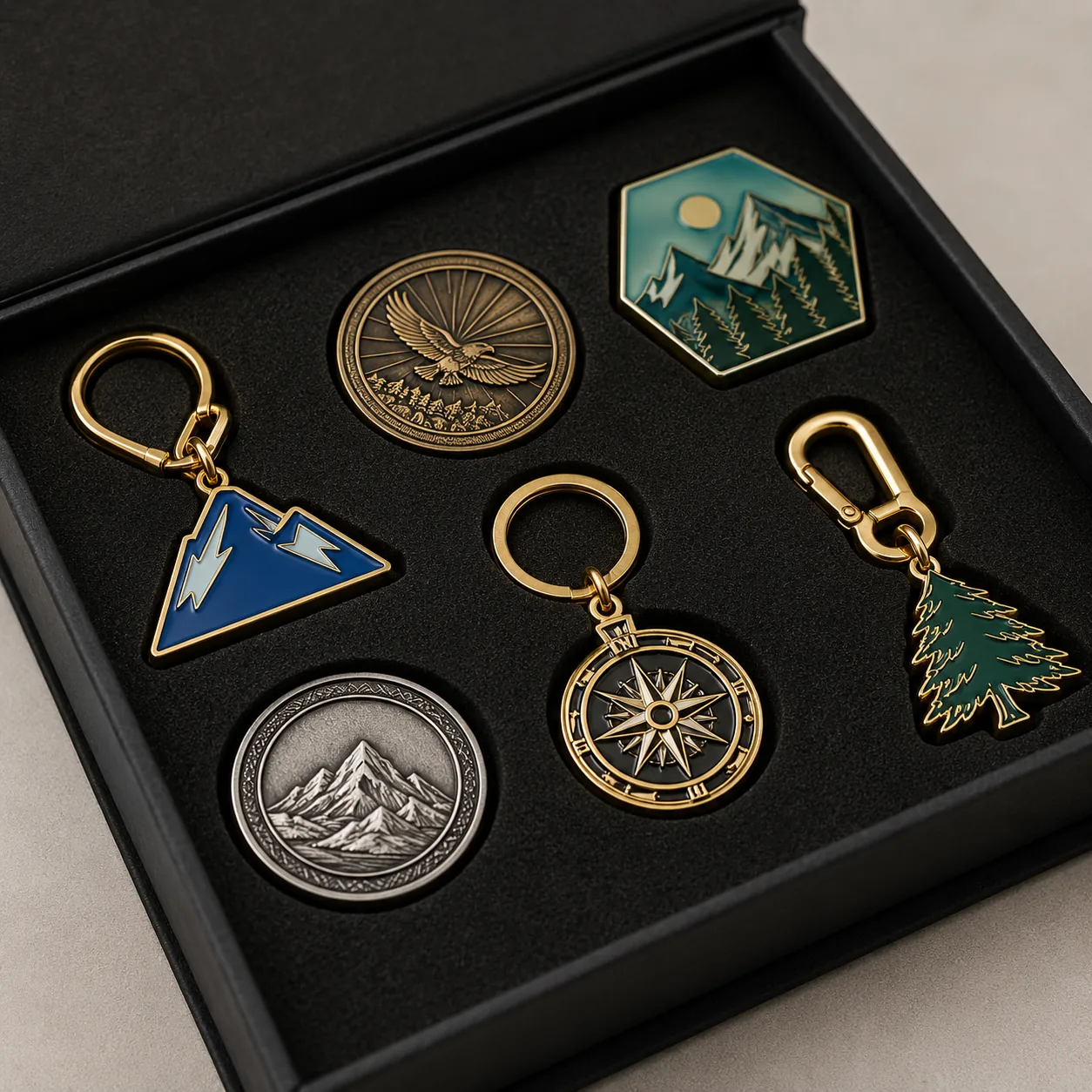
Tooling sets the cost floor
For custom metal giveaways, the biggest pricing error is comparing unit prices before separating fixed and variable costs. Tooling is fixed cost. Once the die, mold, or casting tool exists, every additional piece spreads that cost thinner. At 100 pieces, tooling can add more than USD 1.00 per unit. At 5,000 pieces, the same tool may add only a few cents. A simple 2D stamped lapel pin die commonly runs USD 60-140 per design. A larger 40-50 mm keychain or badge die is often USD 90-220. A deeper 3D coin mold with relief on both sides usually falls around USD 150-350, depending on diameter, relief depth, edge detail, and whether the rim is rope, reeded, or text engraved.
The cost stack is usually tooling, base metal, stamping or casting, trimming, polishing, plating, enamel or printing, curing, assembly, packaging, inspection, and cartonization. Thickness matters because metal weight rises quickly. Most soft enamel pins are 0.8-1.2 mm thick. Premium pins and badges often use 1.2-1.6 mm. Coins are commonly 2.0-3.5 mm. Keychains range from 1.8-4.0 mm depending on load and whether the design includes a swivel clasp, bottle opener, or moving part. Moving from 1.2 mm to 1.5 mm can increase metal weight by roughly 25% before scrap and also lengthen polishing time.
Material choice matters too, but not in a generic way. Iron is economical for many pins and flat badges because it stamps cleanly and keeps cost down. Zinc alloy is common for thicker cast keychains, openwork shapes, and 3D relief. Brass or copper is used when the buyer wants sharper detail, a better plating surface, or a more premium feel. The quote should name the base metal, because a low FOB price that quietly switches from brass to iron is not a real saving.
MOQ tiers: what changes at 100, 500, 1,000, and 5,000 pieces
MOQ is not just a sales policy. It reflects setup labor, die changeover, plating rack utilization, color-fill batching, reject allowance, and packing efficiency. A factory can often make 100 pieces, but the order still uses almost the same proofing, die setup, plating bath preparation, and QC paperwork as a 500-piece order. That is why 100 pieces is useful for VIP gifts or demand testing, but rarely efficient for broad distribution.
For one design, one plating finish, standard backing, and individual polybag packaging, the practical tiers usually look like this:
| Order size | Cost behavior | Typical lead time after artwork approval | Best use |
|---|---|---|---|
| 100-199 pcs | Highest unit cost; tooling and setup dominate; weak room for negotiation | 12-18 days | Executive gifts, samples, small events |
| 300-499 pcs | Unit price often drops 15%-30% versus 100 pcs if the spec stays unchanged | 14-20 days | Pilot campaigns, distributor tests |
| 500-999 pcs | Best balance for many buyers; tooling is diluted but cash exposure stays controlled | 15-23 days | Corporate events, merch launches |
| 1,000-2,999 pcs | Lower labor and plating allocation per piece; better packaging efficiency | 18-27 days | Regional rollouts, retail promo packs |
| 3,000-5,000+ pcs | Lowest stable FOB if artwork, finish, and packing are fixed | 22-32 days | National campaigns, annual giveaway programs |
Mixed designs change the math. A 500-piece order split into five 100-piece designs is not the same as one 500-piece design. Each design may need its own tool, first-article check, enamel setup, plating inspection, and packing verification. If budget matters, consolidate size, plating, attachment, and packaging first. Five 30 mm pins in gold plating with butterfly clutches and the same backing card will always quote better than five different sizes using gold, black nickel, antique brass, rubber clutches, magnets, and mixed bagging rules.
FOB price examples at 100, 500, and 5,000 pieces
The FOB ranges below assume export-ready cartons from a China factory, one design, one plating finish, normal artwork complexity, and no freight. Tooling is shown separately because hiding it inside the unit price makes small orders look artificially expensive and large orders look cheaper than they are. Real quotes move with metal price, exchange rate, finish, color count, epoxy, packaging, and inspection requirements.
| Product and baseline spec | Tooling range | 100 pcs FOB unit | 500 pcs FOB unit | 5,000 pcs FOB unit |
|---|---|---|---|---|
| 25 mm soft enamel iron pin, 1.2 mm, 4 colors, nickel or gold plating, butterfly clutch, polybag | USD 60-140 | USD 1.05-2.10 | USD 0.55-1.10 | USD 0.26-0.52 |
| 30 mm hard enamel pin, 1.4 mm, 5 colors, polished flat surface, rubber clutch | USD 80-180 | USD 1.60-3.20 | USD 0.88-1.75 | USD 0.42-0.86 |
| 40 mm zinc alloy coin, 3.0 mm, antique plating, 2D/3D one side, polybag | USD 120-280 | USD 2.10-4.40 | USD 1.15-2.25 | USD 0.58-1.18 |
| 35 mm metal keychain, 2.0 mm, enamel front, split ring and short chain | USD 100-240 | USD 1.95-4.20 | USD 1.10-2.15 | USD 0.55-1.25 |
| 50 mm metal badge, 1.5 mm, safety pin back or magnet, printed backing card | USD 100-260 | USD 2.40-5.00 | USD 1.45-2.95 | USD 0.80-1.70 |
These ranges show why the right order size depends on the job. A buyer testing demand may accept a USD 2.00 pin at 100 pieces because total spend is low. A national campaign cannot tolerate that unit cost and should engineer the item for 3,000-5,000 pieces: standard plating, fewer colors, repeatable packing, and a defect standard agreed before mass production. The product does not have to be simpler in appearance, but it should be simpler in manufacturing.
Lead time is a sequence, not one factory number
Credible lead time starts after final artwork approval, not after the first email. Clean vector artwork can usually be turned into a production proof within 24-48 hours. If the logo has open paths, gradients, tiny text, or unclear metal borders, proofing can take 2-4 days before the factory can cut a tool. For fixed event dates, approval delay is often the hidden schedule risk, not the factory floor.
A standard soft enamel pin schedule is usually: artwork proof 1-2 days, die cutting 2-4 days, stamping and trimming 1-3 days, polishing 1-2 days, plating 2-4 days, enamel filling and curing 2-4 days, final polish or epoxy if required 1-3 days, QC and packing 1-2 days. Simple 100-piece orders are not always faster because they still need the same tooling and plating steps. Larger orders add time mainly in color fill, curing capacity, assembly, and inspection sampling.
Coins and thick keychains usually take longer than pins. A double-sided 3D coin may need 4-8 days for tooling and 3-5 days for casting, tumbling, and antique finishing. A keychain with a swivel clasp, chain, leather strap, bottle opener, or rotating part can add 1-4 assembly days plus extra pull and function checks. Epoxy dome, glitter enamel, glow pigment, translucent enamel, offset printing, laser engraving, sequential numbering, and individual barcode labels each add process time and increase rework risk.
Transit must be planned separately. Express courier normally takes 3-7 days after dispatch. Standard air freight is often 5-10 days airport to airport or door to door depending on customs clearance. Ocean freight may run 18-35 days port to port, then add inland trucking and clearance. For a fixed launch or trade show, add at least 20%-30% buffer to the factory lead time and do not count weekends, holidays, or customs delays as production days.
Specifications that move FOB cost the most
Size, thickness, finish, color count, and packaging move FOB price more than most branding details. A 25 mm pin with four soft enamel colors and standard gold plating is a different product from a 45 mm cutout pin with eight colors, dual plating, epoxy dome, two posts, and a printed backing card. The second item can use twice the metal area, more manual fill time, more plating control, and more packing labor.
Decorative plating should be specified, not assumed. For promo pins, factories often target a visual-quality flash layer around 0.03-0.08 μm on exposed surfaces. For better-wear keychains and retail goods, ask for a thicker decorative layer, commonly around 0.10-0.25 μm, and confirm whether nickel-free, lead-safe, cadmium-safe, or EN71/CPSIA-related requirements apply. If compliance is required, the factory may need XRF screening or third-party lab testing, which adds cost and time.
Artwork engineering affects both cost and rejects. Enamel separation walls should normally be at least 0.25-0.30 mm wide. Recessed enamel cavities under about 0.35 mm can fill inconsistently. Raised metal text below 0.8-1.0 mm character height, or printed text below 4 pt, may not read cleanly. Cutouts smaller than 1.0 mm can trap polishing compound or distort during stamping. If legibility is critical, use screen printing, laser engraving, or a larger product size instead of forcing micro-detail into enamel.
- Limit enamel colors to 4-6 for cost-efficient promo runs; 7-10 colors usually adds fill time and defect risk.
- Use one plating finish across SKUs whenever possible; dual plating and masking can add 10%-25%.
- Choose 1.0-1.2 mm thickness for most lapel pins and 2.5-3.0 mm for most coins unless the design needs extra weight.
- Avoid epoxy dome unless it improves the product; it can add 1-3 days and create bubble or edge-lift failures.
- Standardize backs, rings, chains, cards, and polybags so packing runs in batches instead of by special instruction.
- Confirm carton limits early: export cartons are often kept near 10-15 kg gross weight for handling and freight efficiency.
Packaging and SKU structure can erase expected savings
Packaging is often treated as an afterthought, but it changes both unit cost and lead time. A plain individual polybag may add only USD 0.02-0.06. A custom backing card, OPP bag with adhesive flap, retail barcode sticker, velvet pouch, insert sheet, or gift box can add USD 0.05-0.90 per piece depending on material, print quantity, and manual packing time. Gift boxes also increase carton volume, which can raise air freight cost even when FOB looks acceptable.
SKU structure matters because factories do not pack by marketing intent; they pack by countable instruction. A simple instruction such as 500 pieces, one design, each in polybag, 100 pieces per inner bag, 1,000 pieces per carton is fast to execute and inspect. A more complex instruction such as five designs, two backing cards, three languages, mixed assortments of 12 per retail carton, barcode labels, and master-carton sequencing requires more labor and increases packing-error risk.
For 5,000-piece programs, ask for a packing matrix before production finishes. It should show SKU code, design name, quantity, inner pack count, carton quantity, carton mark, gross weight, net weight, and carton dimensions. This prevents the common problem of finished goods sitting in the warehouse because the team must relabel, recount, or repack them before shipment.
QC, tolerances, and AQL should be defined before production
Quality control is cheapest when it is written into the RFQ. For most custom metal promo items under 50 mm, a practical dimensional tolerance is +/-0.3 mm on length and width and +/-0.2 mm on thickness when the design is not highly irregular. Larger badges, openwork designs, and cast zinc alloy items may need +/-0.5 mm. Pin post placement should often be held within +/-1.0 mm of the approved location, with posts perpendicular enough that the clutch seats fully. Magnet alignment, clasp closure, and ring opening should be treated as functional requirements, not cosmetic notes.
Use AQL language instead of vague phrases such as high quality. For decorative promo goods, a common inspection plan is AQL 2.5 for major defects and AQL 4.0 for minor defects under ANSI/ASQ Z1.4 or ISO 2859-1 normal inspection. Critical defects should be zero tolerance. Major defects include wrong plating, wrong color, missing attachment, exposed base metal, broken post, unreadable required logo, or incorrect packaging. Minor defects may include tiny scratches, slight enamel unevenness, or small tone variation if they are not visible at normal viewing distance.
If the product will be resold, the inspection plan should also define finish acceptance and function checks. A plated surface may show small color variation, but it should not peel, blister, or rub through in handling. A clasp should open and close cleanly. A magnet should hold through the intended backing card. If the buyer wants a stricter standard, write it into the order as a photo-approved golden sample plus a defect catalog, not just a sentence that says premium finish.
How to request a quote that can be trusted
A reliable quote needs a complete specification, not a rough logo and a quantity. Send vector artwork, finished size in millimeters, thickness target, base metal preference, plating finish, enamel type, number of colors, attachment, packaging, quantity by design, delivery deadline, and destination country. If you are comparing 100, 500, and 5,000 pieces, ask the supplier to quote the same specification at all three quantities and to list tooling separately.
- Request prices at 100, 500, 1,000, 3,000, and 5,000 pieces using the same spec.
- Ask whether tooling is separate or embedded in unit price.
- State plating finish, base metal, thickness, and enamel type in the RFQ.
- Confirm packaging: polybag, backing card, pouch, or gift box.
- Require lead time in days after proof approval, not after inquiry.
- Ask for AQL, tolerance, and defect definitions in writing.
- Request carton dimensions, gross weight, and shipping method options.
The quote should show tooling, sample cost if separate, unit FOB price, production lead time in days after sample or proof approval, packaging included, carton estimate, and freight estimate if requested. Ask whether the price assumes soft enamel or hard enamel, iron or zinc alloy, one-sided or double-sided detail, and standard or compliant plating. Many quote disputes come from one side assuming a premium spec while the other priced a basic one.
The practical buying sequence is simple: lock one core design, simplify the finish, request tiered pricing, and choose the order size that matches the campaign risk. At 100 pieces, treat the order as validation. At 500 pieces, optimize for flexibility and deadline control. At 5,000 pieces, engineer for repeatability, QC clarity, and packing discipline. That is how a custom metal giveaway becomes a controlled procurement item rather than a guessing exercise.
Have a project? Send your artwork and target quantity and we’ll reply with a detailed quotation within 12 working hours.
Ready to get this made?
Send your sketch, target quantity and ship-date. Detailed quotation in 12 hours.



